

French “Bibase” Tilting Teakettle Siphon Inkwell with Original Labels
| Categories | Ink Bottle, Mechanical - Pump / Siphon |
| Type | Tea Kettle |
| Material | Glass |
| Markings | See Narrative |
| Manufacturer | Undetermined |
| Origin | France |
| Date or Era | circa 1900 |
Description & Mechanical Function
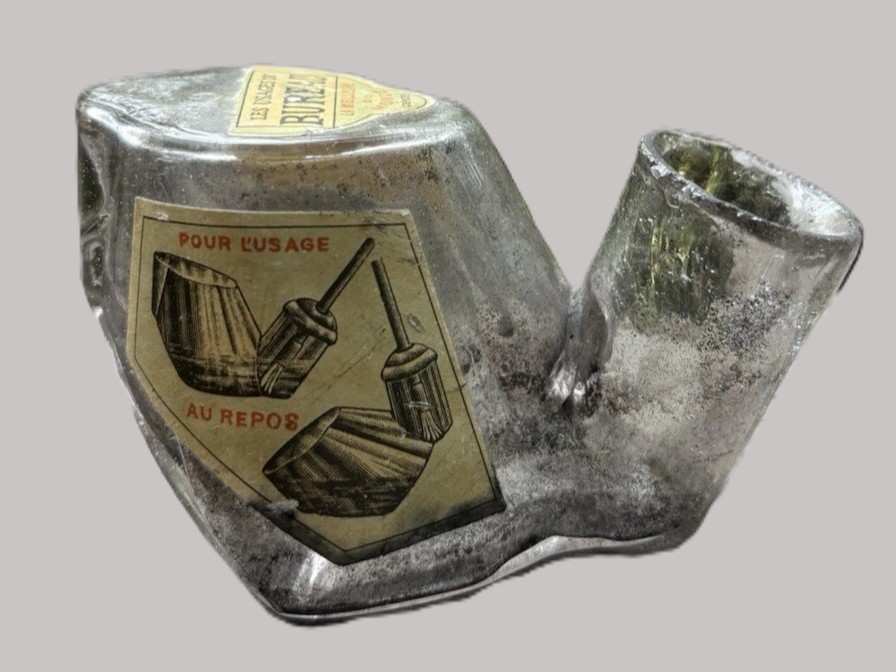
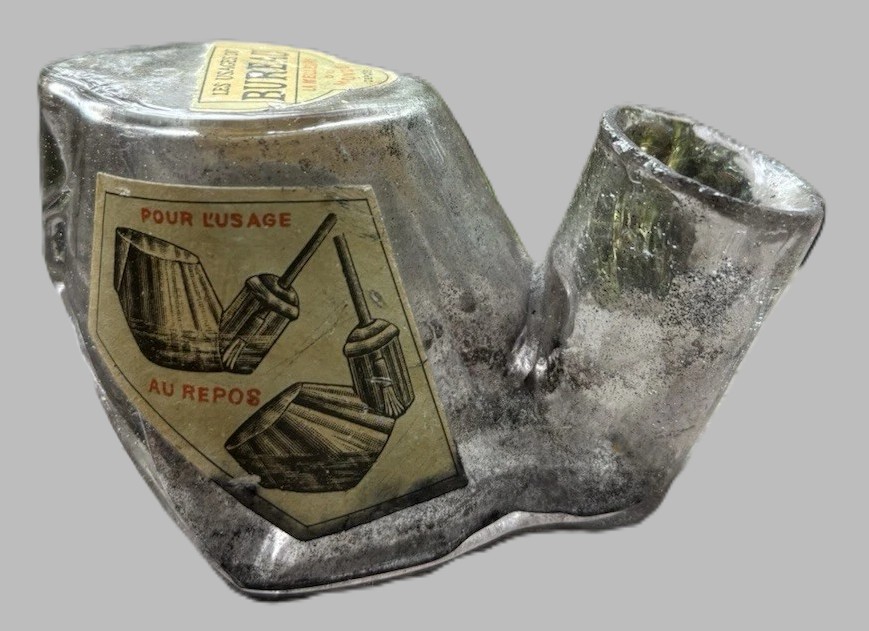
This teakettle-style (or fountain/siphon) glass inkwell is molded out of heavy blown/pressed clear-to-gray glass. It features a main reservoir body and an angled, open writing well (or font) extending forward from the base.
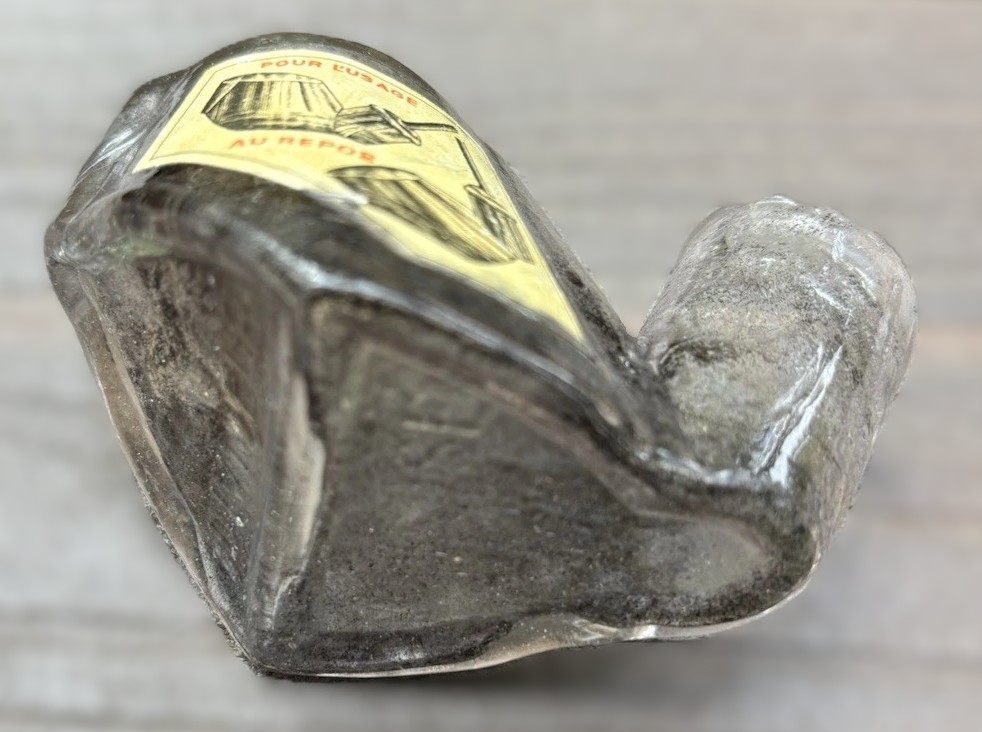
What makes this specific piece distinct is its dual-flat base geometry (hence “Bibase”), which creates a two-position tilting mechanism:
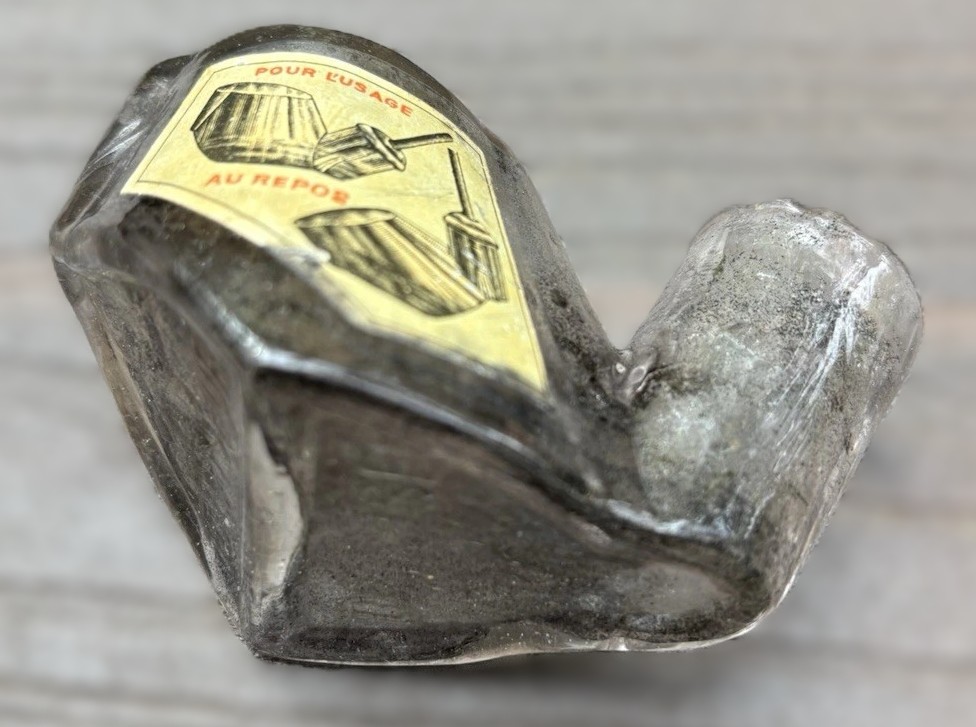
- “Au Repos” (Resting/Storage Position): The inkwell rests tipped backward onto its main flat base. In this tilted position, gravity forces the ink back into the main reservoir, keeping the level in the front spout lower. This reduces atmospheric evaporation, keeps the ink fresh, prevents dust contamination, and minimizes the risk of accidental spills if brushed by a hand or sleeve.
- “Pour L’Usage” (In Use Position): The inkwell is tipped forward so it sits flat on its secondary base. This shifts the internal ink volume toward the front opening, raising the fluid level in the spout so a dip pen can easily reach the ink without striking the bottom of the vessel.
Label Translations
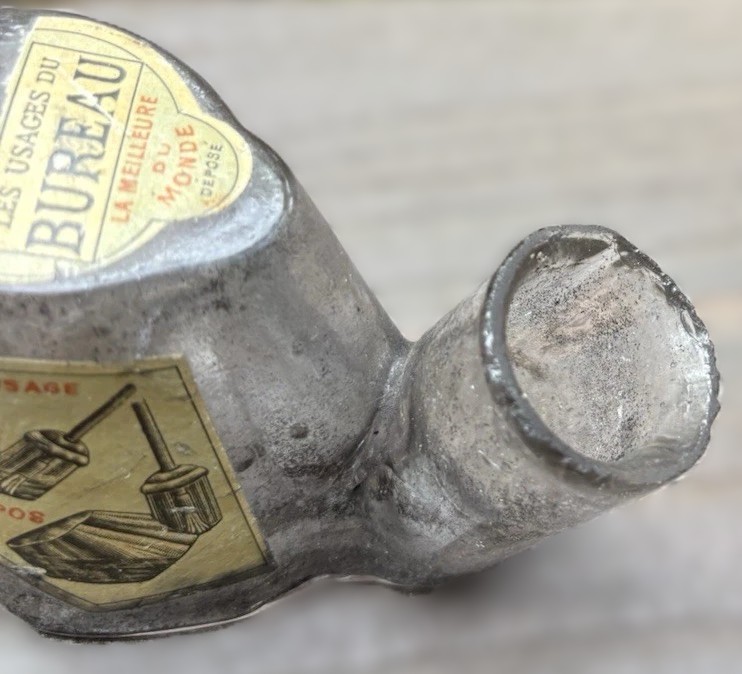
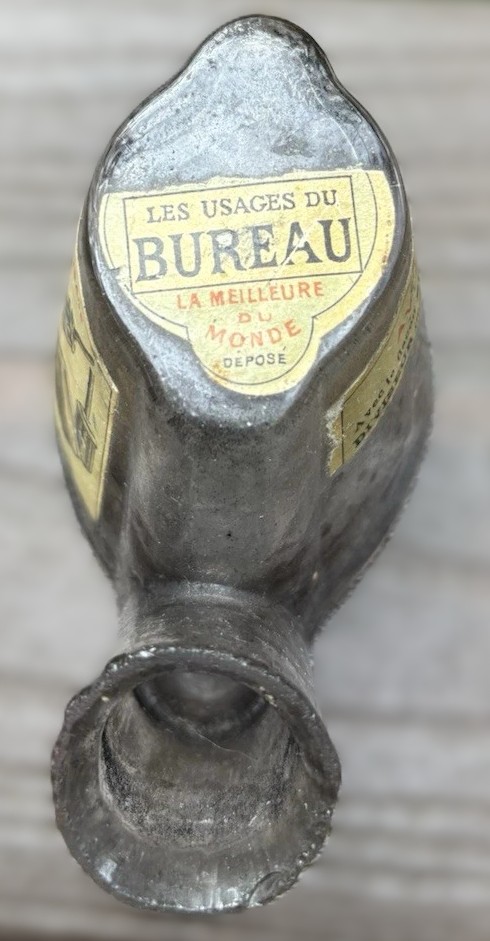
- Top Label:
- “LES USAGES DU BUREAU” → Office Uses / Desk Supplies
- “LA MEILLEURE DU MONDE” → The Best in the World
- “DÉPOSÉ” → Registered / Patented
- Front Side Label (Diagram):
- “POUR L’USAGE” → For Use (shows the inkwell tilted forward on its flat base with pen ready to dip)
- “AU REPOS” → At Rest / In Storage (shows the inkwell tilted backward with the pen sitting idle)
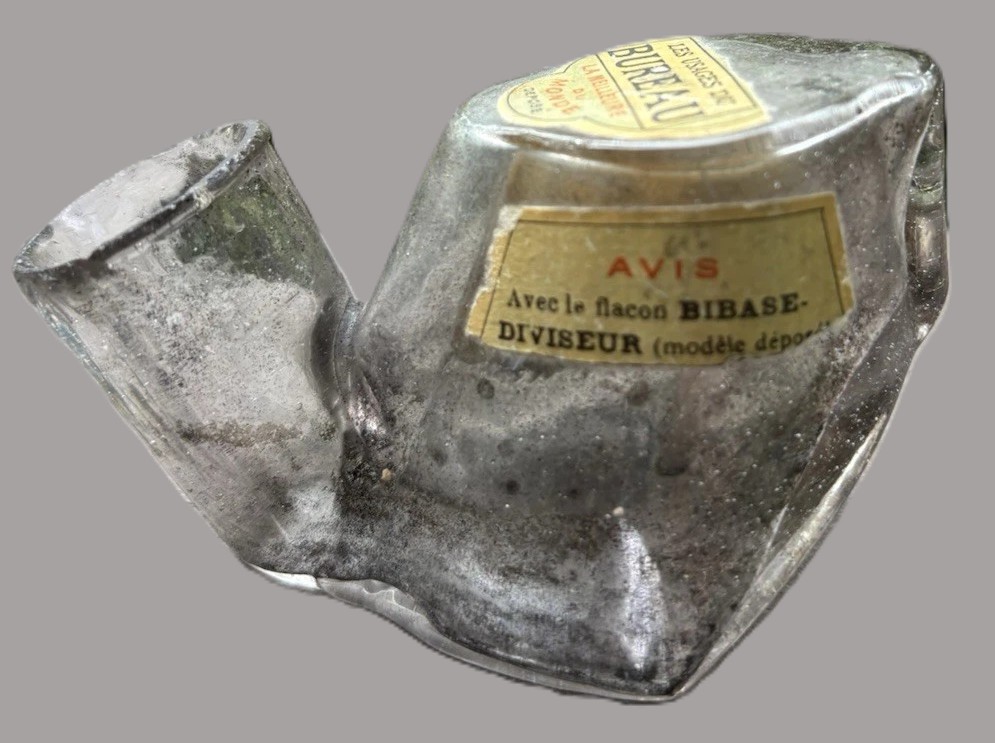
- Back Side Label:
- “AVIS” → Notice / Warning
- “Avec le flacon BIBASE-DIVISEUR (modèle déposé)” → With the BIBASE-DIVISEUR bottle (registered design)
How It Was Used
- Filling: Ink was poured directly into the front spout opening. The siphon effect trapped air in the main sealed chamber, maintaining a stable fluid level between the chamber and the spout.
- Daily Operation: When sitting down to write, the user pushed/tilted the inkwell forward onto its secondary base. A dip pen (fountain pen or steel nib holder) was lowered into the front well to load ink.
- Storage: Upon completing writing tasks, the user tilted the bottle back onto its primary base to draw the ink line away from the open mouth, sealing off the reservoir’s bulk and preserving the ink.
Manufacturer & Date
- Manufacturer: The top label features a distinct shield/cartouche logo stating “LES USAGES DU BUREAU / LA MEILLEURE DU MONDE”. This was a trademarked line of French office stationery and desk supplies distributed in France (primarily manufactured by Parisian ink and desk supply makers like L. & C. Hardtmuth, Antoine et Cie, or J. Gardot). The base is also embossed in raised glass lettering with the model name/patent details (“BIBASE-DIVISEUR / MODÈLE DÉPOSÉ”).
- Date: Circa 1890s – 1920s. Teakettle siphon inkwells of this molded glass design with paper labels and “modèle déposé” (French registered design) marks were widely produced during the late 19th and early 20th centuries during the height of the steel dip-pen era.
Sold for $86 in July 2026
Content disclaimer. The information posted is the owner’s best knowledge and may not have been vetted by the SOIC. We welcome comments, corrections, and additions, working to make our website information comprehensive and accurate.
Join the Society of Inkwell Collectors (SOIC) – it’s free!
Founded in 1981 as a non-profit organization,
we are documenting inkwells (and accessories).
We’re here to help and inform!