



English Sterling Silver Inkstand
| Categories | Silver |
| Markings | See Nnarrative |
| Manufacturer | Barker Brothers |
| Origin | England |
| Date or Era | circa 1909 |
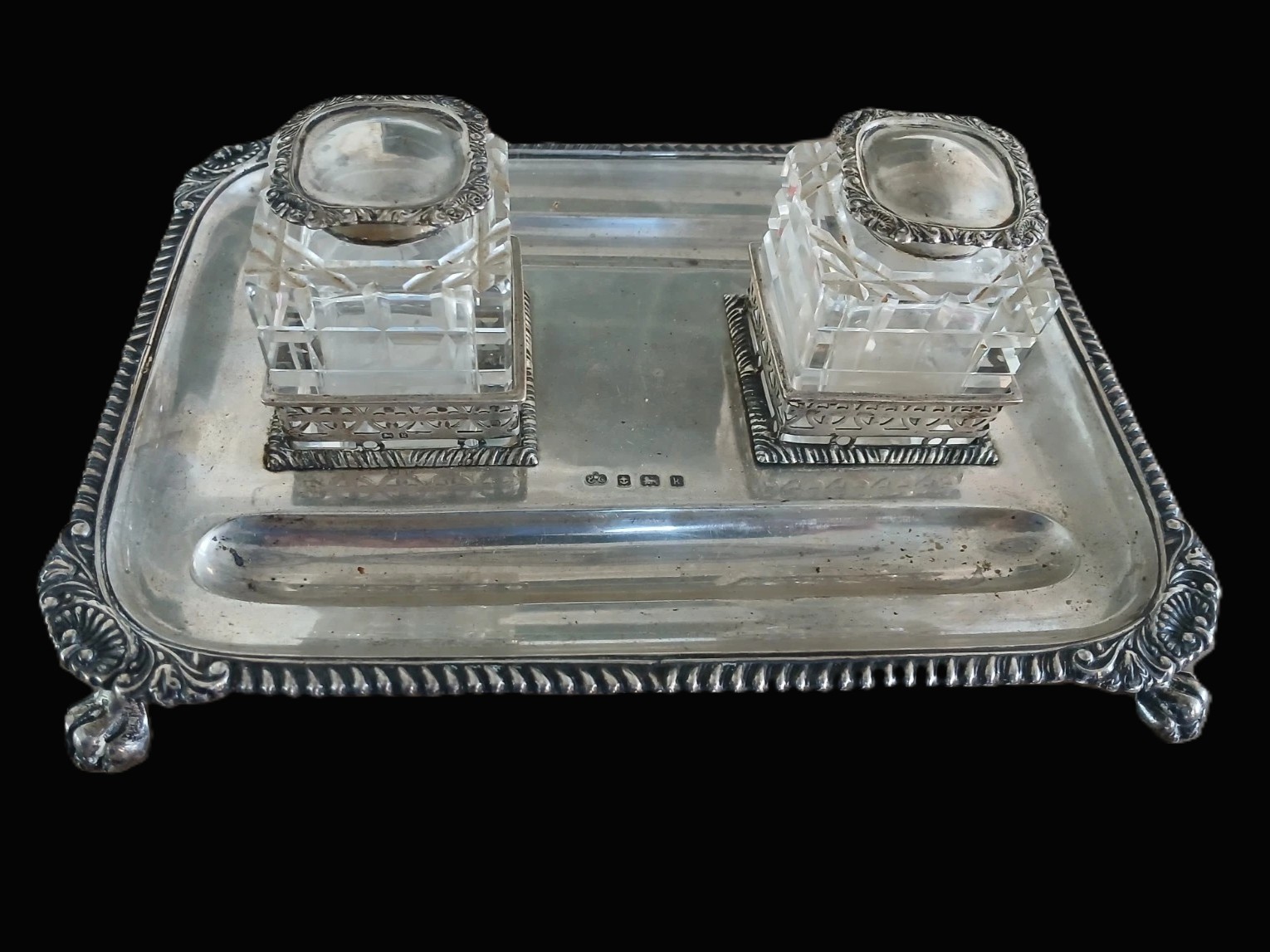
This English sterling silver inkstand from the early 20th century features a clean, rectangular design with two integrated crystal inkwells.
Description
- The Tray: The stand is a heavy sterling silver rectangular tray with a deep gadrooned (rope-like) border and a recessed pen channel at the front. It is supported by four claw-and-ball feet.
- Inkwells: The set includes two heavy, square-cut crystal inkwells. These sit within two fixed silver pierced galleries (frames) that are secured to the tray with threaded nuts on the underside.
- Inkwell Lids: Each crystal well is topped with a circular silver lid featuring a matching gadrooned edge that echoes the tray’s border.
Explanation of Hallmarks
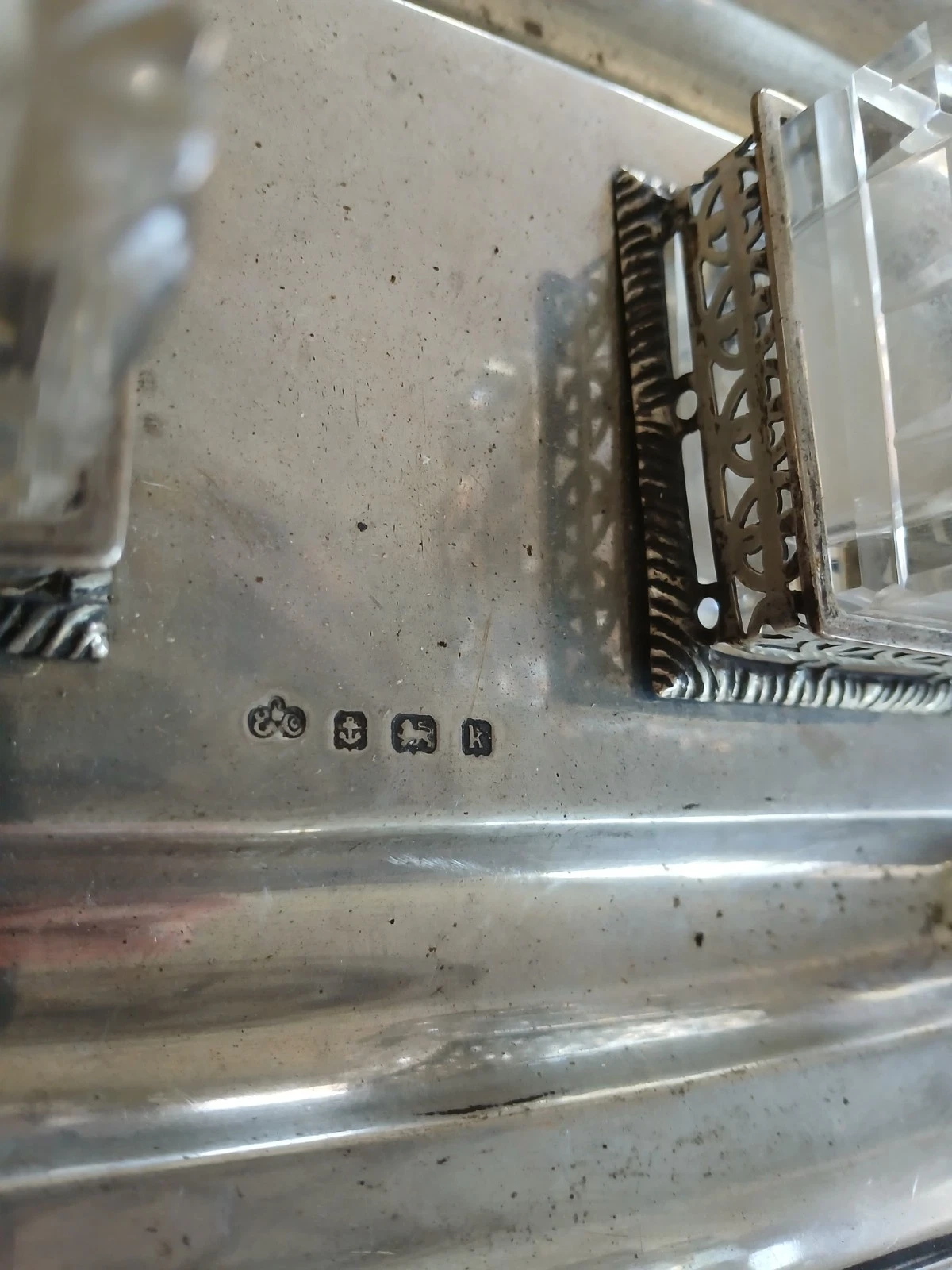
The piece bears a clear set of British hallmarks stamped on the top surface of the tray and inside the lids. Reading from left to right:
- Maker’s Mark (“&C”): This represents the silversmith firm Barker Brothers (of Birmingham), who often used variations of this mark during this period.
- The Anchor: This is the city mark for Birmingham, England, indicating the piece was assayed (tested for purity) at the Birmingham Assay Office.
- The Lion Passant: The most recognizable British mark, this “walking lion” certify that the piece is Sterling Silver (92.5% pure silver).
- Date Letter (“k”): This specific lowercase “k” in a shielded frame corresponds to the year 1909.
Summary of Origin
- Material: .925 Sterling Silver
- City: Birmingham, England
- Date: 1909
- Maker: Barker Brothers
Barker Brothers, founded in Birmingham in 1801 by Mary Barker, was one of the city’s longest-running and most significant silversmithing firms. The company’s reputation for quality was established early on when it acquired original manufacturing dies from the renowned firm Boulton & Watt.
Historical Timeline
The firm underwent several leadership and name changes over nearly two centuries:
- Early 19th Century: Operated as Mary Barker (1801) and later as Barker & Creed.
- Late 19th Century: Traded as William & Matthias Barker until 1885, when it became known simply as Barker Brothers, operating from Paradise Street.
- 1907: The business was incorporated as Barker Brothers Silversmiths Ltd.
- 1921: The firm expanded by acquiring Levi & Salaman and its subsidiary, the Potosi Silver Co..
- 1960s: A merger with Ellis & Co. (Birmingham) Ltd. led to the final name, Barker Ellis Silver Co. Ltd.
- 1992: After a brief period under private ownership following a subsidiary era with Pentos plc, the firm entered administration.
Production and Styles
While the firm produced a vast range of utilitarian silver and electroplated goods, it was highly regarded for its ability to adapt to the prevailing fashions of the day:
- Edwardian Era (1901–1910): Specializing in high-end domestic items, the firm produced ornate trays, tea and coffee services, and intricate desk accessories like inkstands and pen rests.
- Art Deco (1920s–1930s): Barker Brothers embraced the “Roaring Twenties” by creating stylish barware, including silver cocktail shakers, table lighters, and geometric trays.
- Global Reach: Their high-quality silverplate, often marked with a registered candelabra symbol after 1912, was exported extensively across the British Empire and North America.
Key Locations
The company was central to Birmingham’s famous Jewelry Quarter:
- Unity Works: In 1903, the firm moved to its long-term factory premises on Constitution Hill, where it remained active until the 1980s.
- London Showrooms: To cater to elite clientele and international merchants, they maintained a prestigious showroom in London during the early 20th century.
Identifying Marks
For sterling silver items, the firm’s hallmarks typically include the “BB” or “BBS Ltd” maker’s mark alongside the Birmingham assay marks (Anchor and Lion Passant). Their silverplate often features their trade names such as “Unity Plate” or “Britanoid”.
Sold for $400 in January 2026
Content disclaimer. The information posted is the owner’s best knowledge and may not have been vetted by the SOIC. We welcome comments, corrections, and additions, working to make our website information comprehensive and accurate.
Join the Society of Inkwell Collectors (SOIC) – it’s free!
Founded in 1981 as a non-profit organization,
we are documenting inkwells (and accessories).
We’re here to help and inform!