

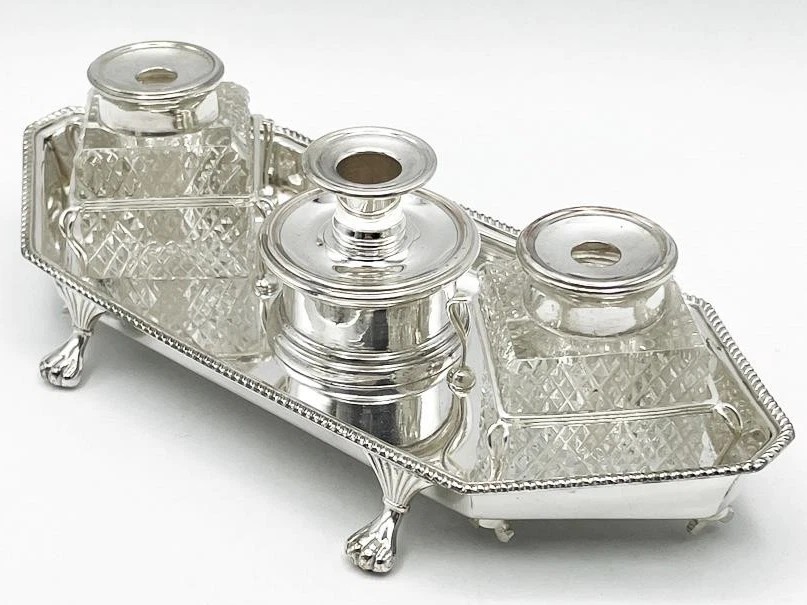



English Silverplated Standish
| Categories | Silver |
| Type | Standish |
| Material | Silverplate |
| Markings | Unmarked |
| Manufacturer | Undetermined |
| Origin | England |
| Date or Era | circa 1890 |
| Measuring | 9” long |
This is a classic example of a late Victorian English silverplated inkstand, sometimes referred to as a “standish.”
Description
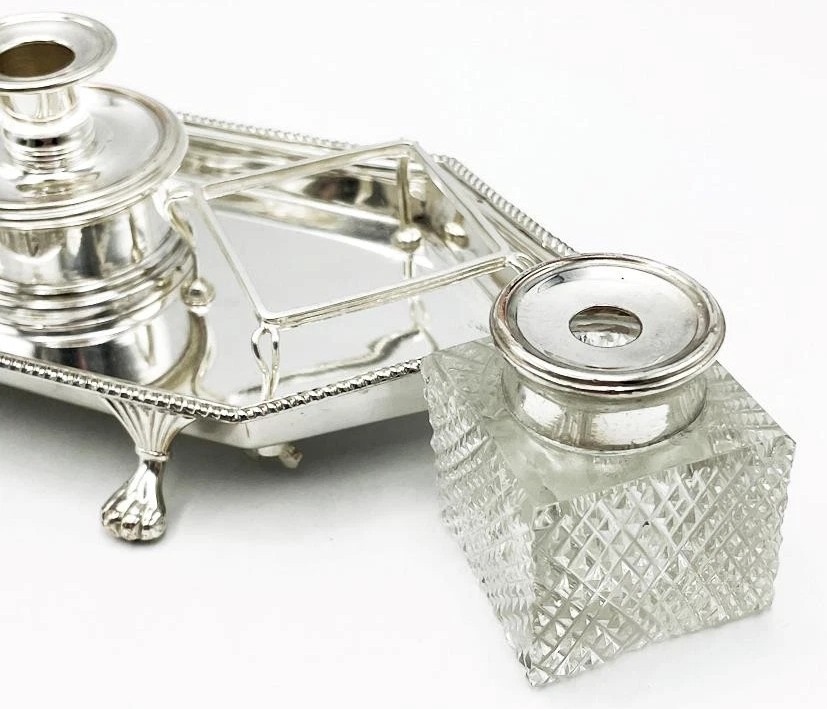
- The Tray: The base is an elongated octagonal tray with clipped corners. It features a decorative beaded rim, a hallmark of Neoclassical and Georgian revival styles popular in England.
- The Feet: It is supported by four lion paw feet, which were a staple of English silver design from the late 18th century through the Victorian era.
- The Inkwells: It holds two square, diamond-cut (or hobnail) glass inkwells. The silverplated lids have a central hole, which allowed for a pen to be dipped or rested without removing the lid, while also reducing ink evaporation.
- The Central Unit: The middle piece is a taper stick (a small candle holder) mounted on top of a cylindrical sealing wax box (sometimes called a wafer box).
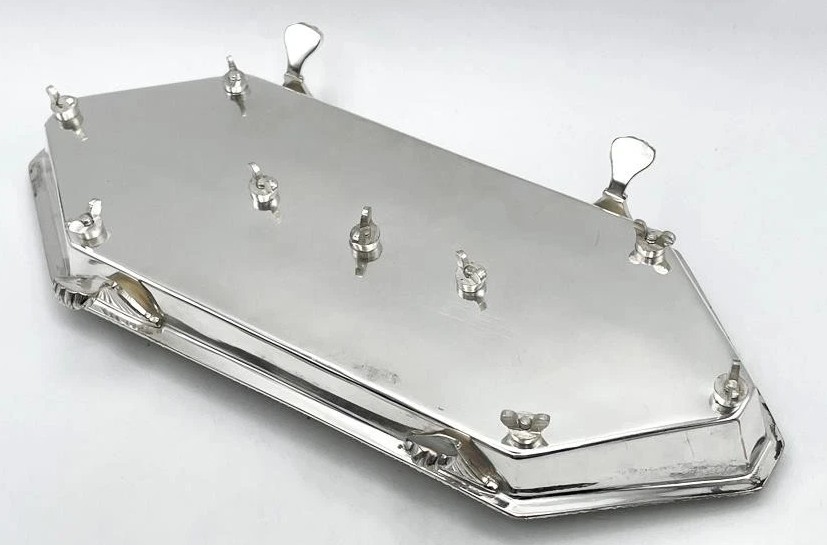
- Assembly: The underside shows a modular construction held together by seven wing nuts. This is a functional design feature that allowed the owner to disassemble the frames, wax box, and taper stick for thorough cleaning and polishing.
Age Estimate
While the design draws heavily from the Georgian period (late 18th century), the specific manufacturing techniques—particularly the use of wing nuts for assembly—point to the Late Victorian era, approximately 1880–1900.
- Why Victorian? Earlier Georgian pieces typically used more permanent solder or simple threaded screws. The wing-nut system was a Victorian innovation for mass-produced, high-quality “EPNS” (Electro-Plated Nickel Silver) sets, making them more practical for household staff to maintain.
- Functionality: The inclusion of a taper stick and wax box suggests a date before the widespread use of self-sealing envelopes (which gained dominance in the late 19th century), though these desk sets remained popular status symbols well into the Edwardian period (1901–1910).
Origin
This is almost certainly English. This specific combination of the beaded edge, lion paw feet, and the octagonal tray is a quintessential British desk accessory design, likely manufactured in one of the major silver-plating hubs like Sheffield or Birmingham.
Sold for $150 in April 2026
Content disclaimer. The information posted is the owner’s best knowledge and may not have been vetted by the SOIC. We welcome comments, corrections, and additions, working to make our website information comprehensive and accurate.
Join the Society of Inkwell Collectors (SOIC) – it’s free!
Founded in 1981 as a non-profit organization,
we are documenting inkwells (and accessories).
We’re here to help and inform!