

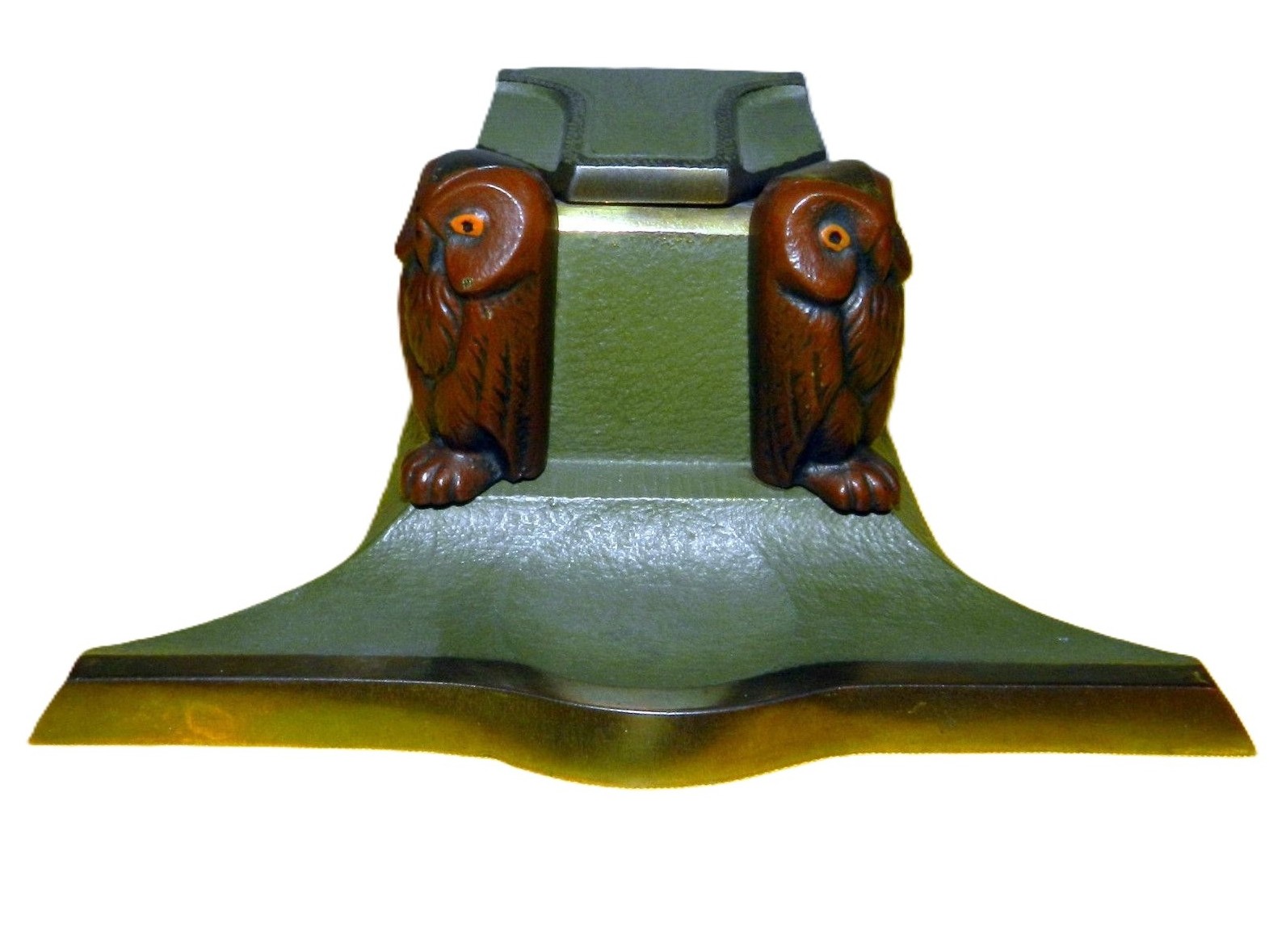
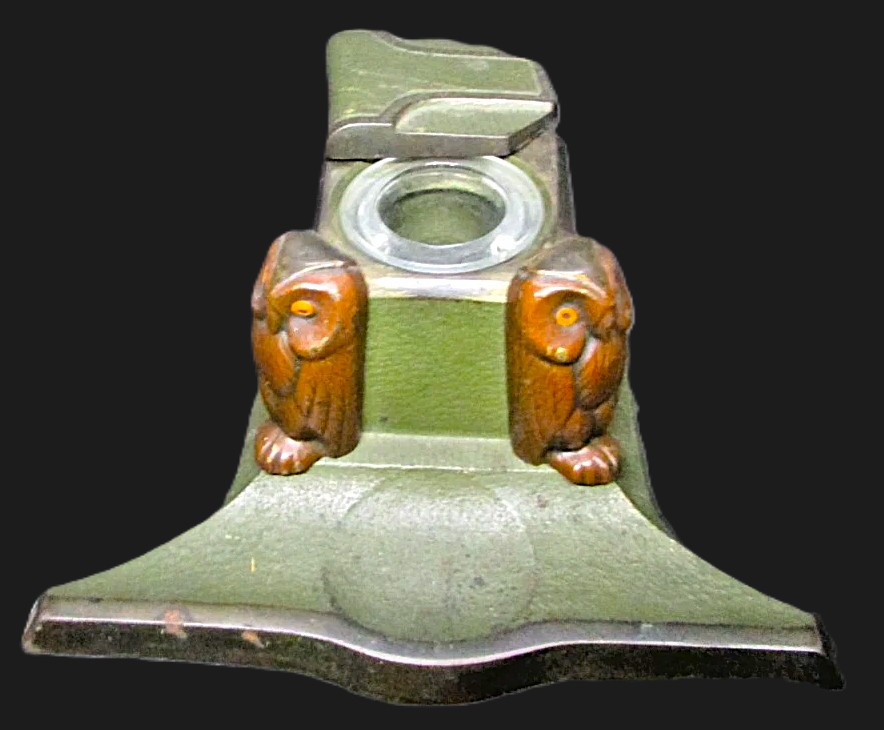

Cast Iron Inkstand with Owl Motif
| Categories | Figural - Animals & Living Creatures |
| Type | Owl |
| Material | Cast iron |
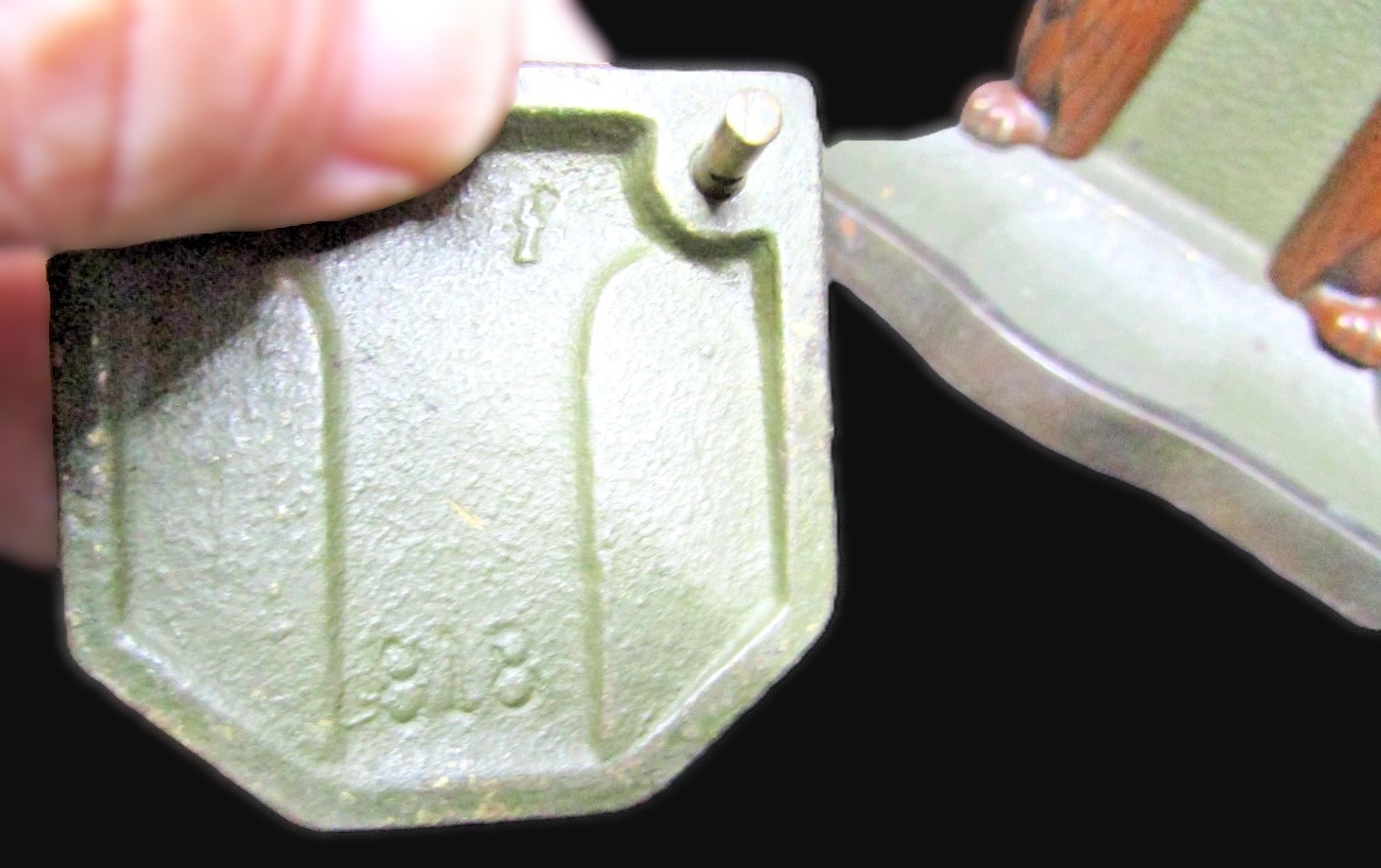
| Markings | "818" |
| Manufacturer | Bradley & Hubbard |
| Origin | United States |
| Date or Era | circa 1900 |
| Measuring | 5 ½” x 4” x 2 ½” high |
The owl motif was popular during the late 19th and early 20th centuries, often symbolizing wisdom and scholarly pursuits—perfect for an inkstand.
Description
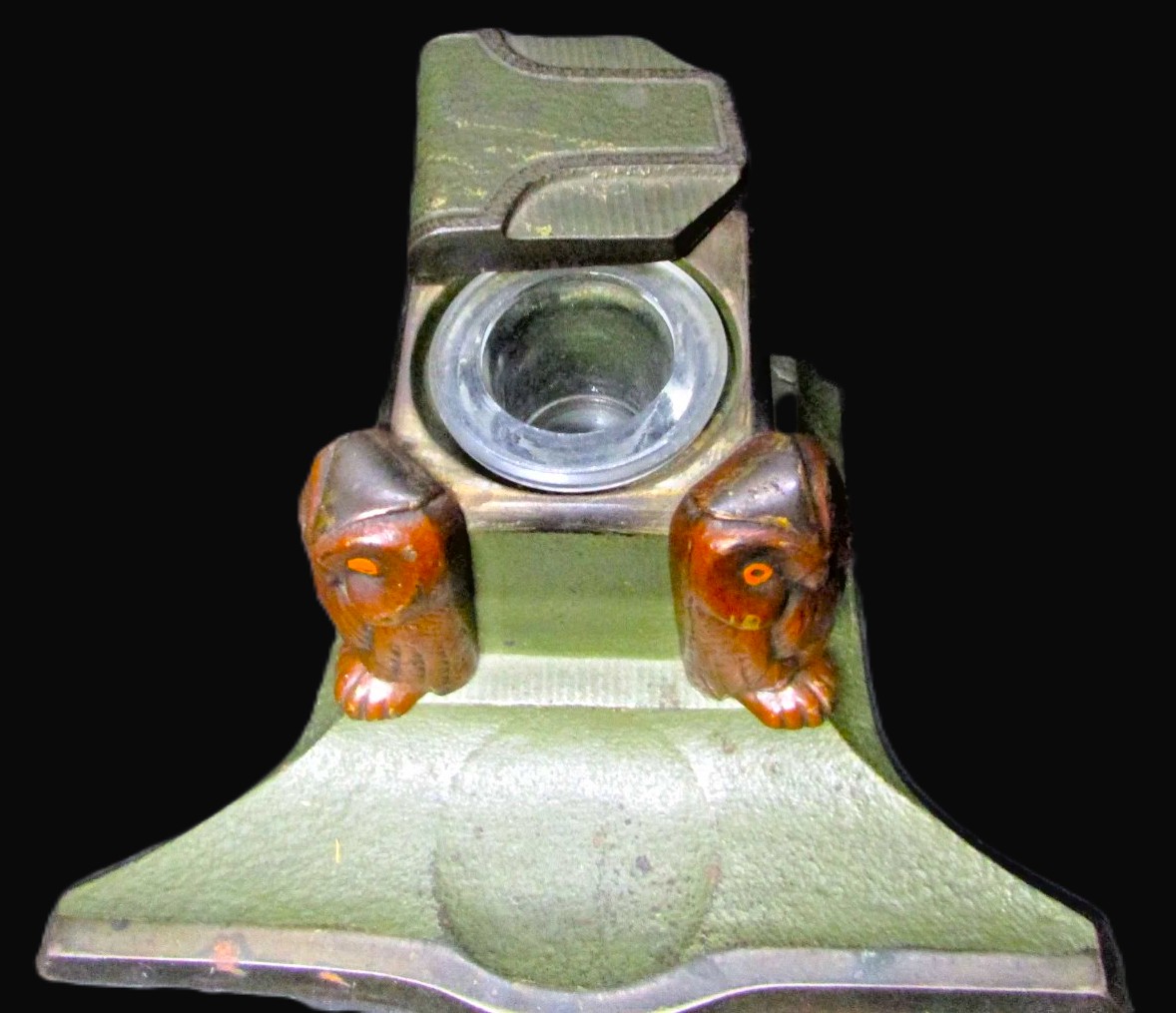
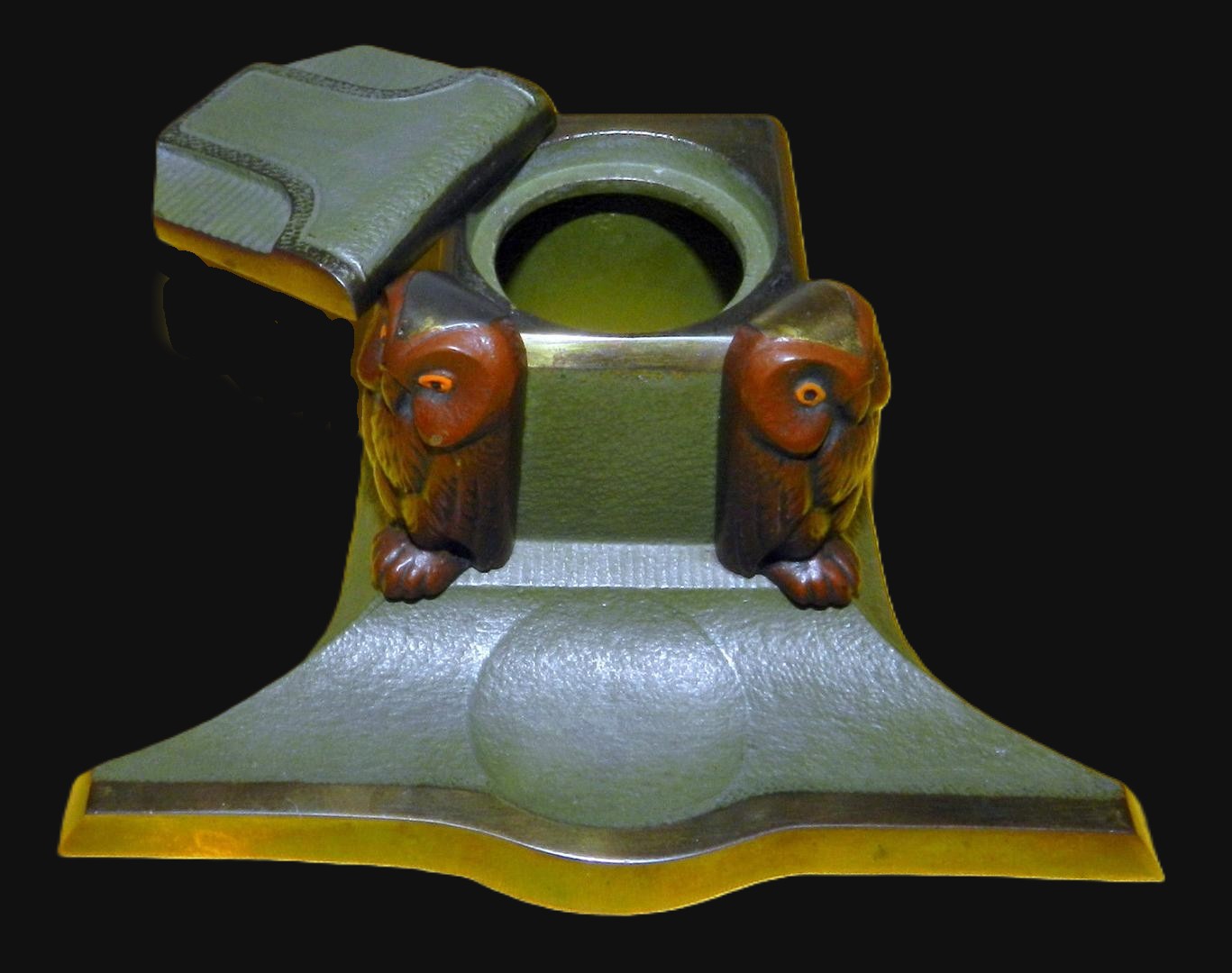
This cast iron inkstand features a robust, architectural design finished in a textured, matte moss green paint (sometimes referred to as a “Japanned” or “Bronzed” finish common for the era).
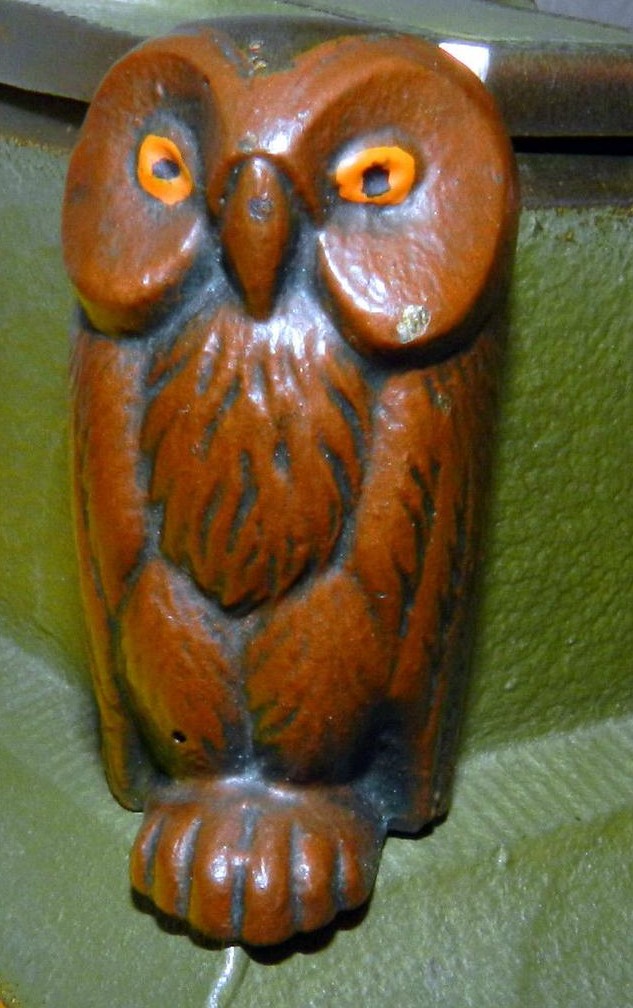
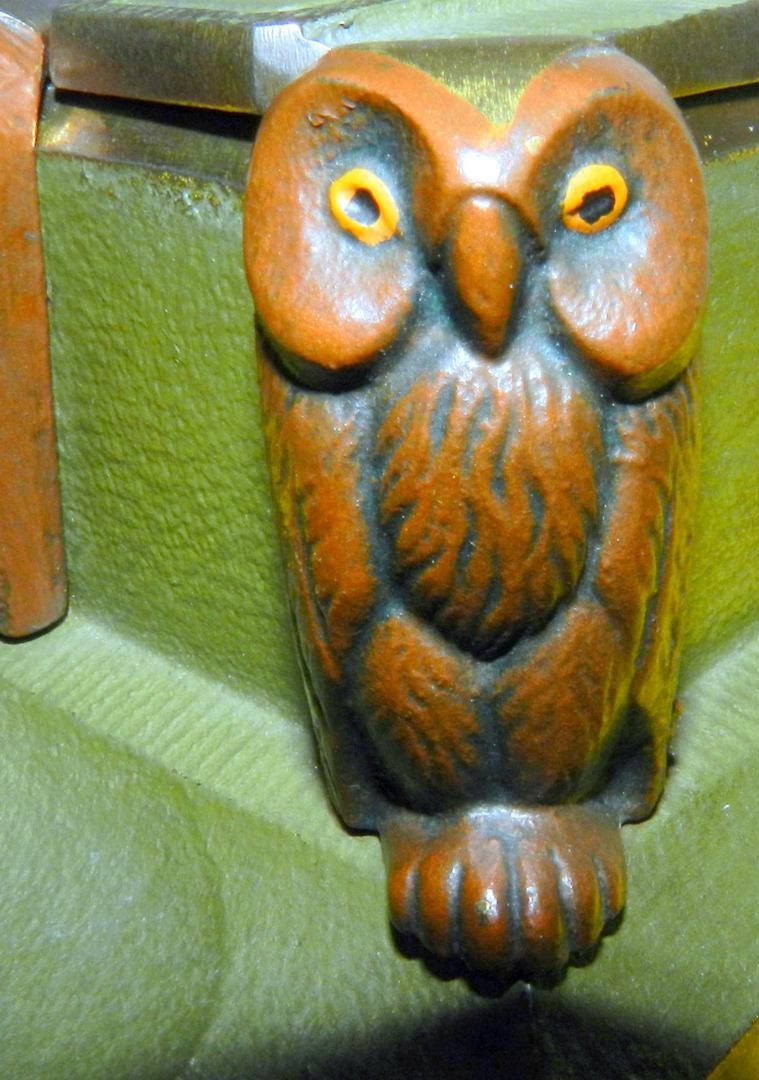
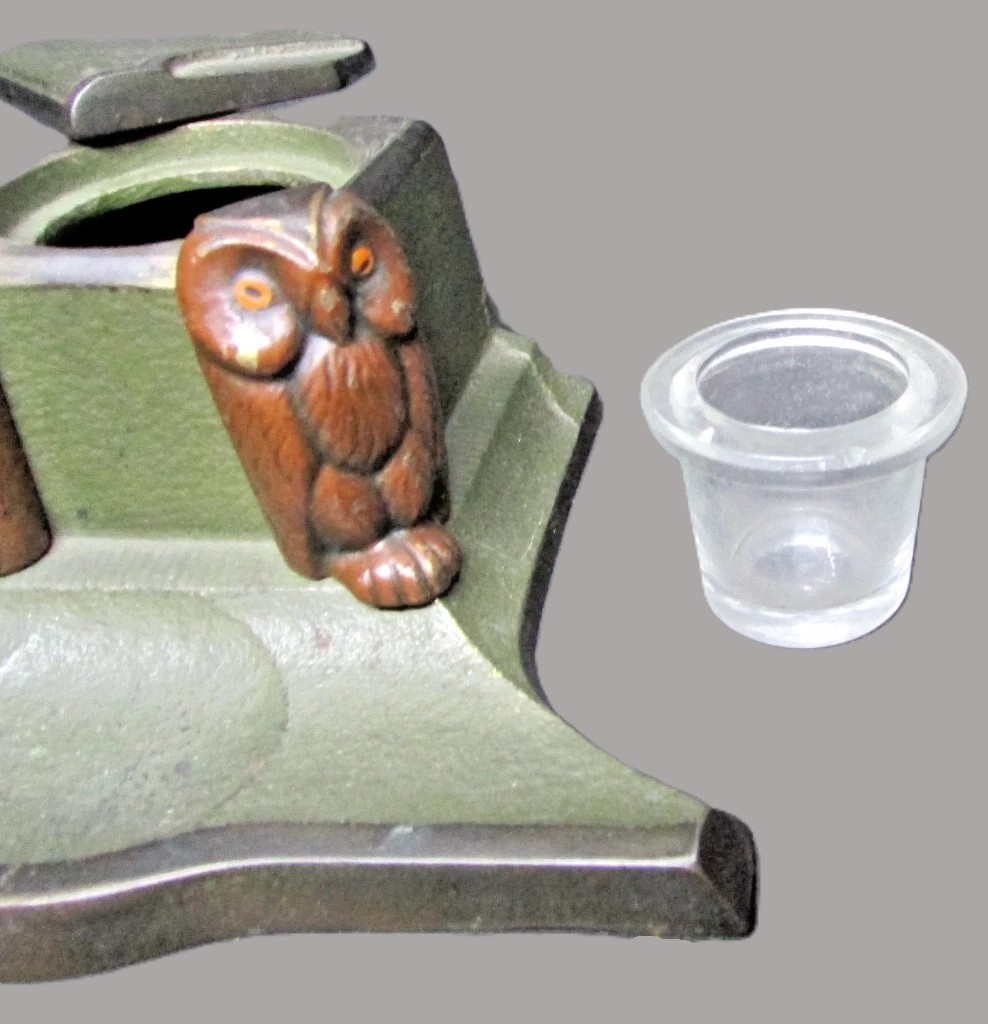
- Figural Elements: The standout feature is the pair of stylized owls flanking the central inkwell housing. They are rendered in a warm, brownish-red tone that provides a nice contrast to the green base. Notably, their eyes are accented with bright orange paint, giving them a striking, “watchful” appearance.
- Structure: The base is wide and flared, typical of cast iron stands designed to be heavy and stable so they wouldn’t slide during use. The front includes a curved pen tray for resting a dip pen.
- Mechanism: The lid is a flat, rectangular lid that swivels horizontally on a pivot pin rather than being hinged. This reveals a circular opening designed to hold the clear glass insert.
- Markings: The underside of the lid and the bottom of the base both feature the impressed number “818”.
Maker & Identification
The number “818” is a pattern or model number, which was standard practice for major American cast iron foundries of the period.
Based on the style, the specific swivel mechanism, and the font of the model number, this inkstand was likely manufactured by Bradley & Hubbard Manufacturing Company of Meriden, Connecticut.
Bradley & Hubbard was famous for their high-quality desk sets, clocks, and lamps. They frequently used this specific “textured green” finish and model numbers in this range for their “Art Metal” line. While many of their pieces are marked with a “B&H” in a circle, some smaller or simpler castings only carried the model number.
Age
Given the aesthetic (a transition between Victorian naturalism and the cleaner lines of Arts & Crafts), this piece likely dates to the late 1890s to approximately 1915.
The use of cast iron with this specific type of painted finish was most prevalent during the early 1900s as a more affordable, yet still decorative, alternative to solid bronze.
Sold for $87 in January 2026
Content disclaimer. The information posted is the owner’s best knowledge and may not have been vetted by the SOIC. We welcome comments, corrections, and additions, working to make our website information comprehensive and accurate.
Join the Society of Inkwell Collectors (SOIC) – it’s free!
Founded in 1981 as a non-profit organization,
we are documenting inkwells (and accessories).
We’re here to help and inform!