





Bull’s Head Inkwell
| Categories | Figural - Animals & Living Creatures |
| Type | Bull, Barnyard |
| Material | Spelter |
| Markings | Unmarked |
| Manufacturer | Undetermined |
| Origin | Undetermined |
| Date or Era | circa 1890 |
| Measuring | 4 ¾” long; 3” high |
Subject: Bull vs. Longhorn Steer
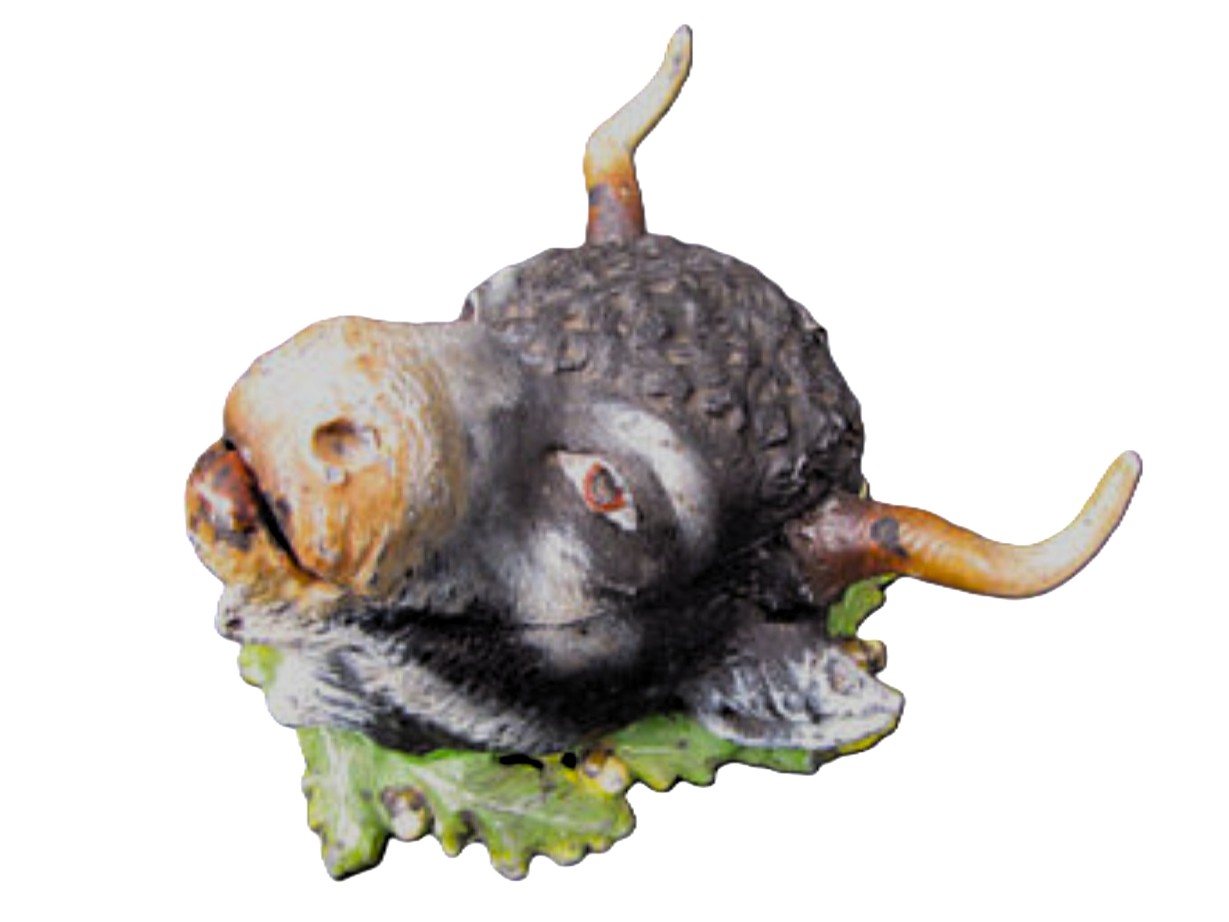
While the wide, sweeping orientation of the horns hints at a longhorn profile, the physical anatomy sculpted here points firmly to a bull’s head—specifically a stylized representation of an Angus, Highland, or similar European robust bull breed.
The telling features are the thick, tightly curled “topknot” of coarse hair between the horns and the heavy, muscled, and deeply wrinkled neck detailing. American longhorn steer depictions in late 19th-century metalwork typically emphasize a much leaner, smoother face and flatter forehead structure.
Material & Construction
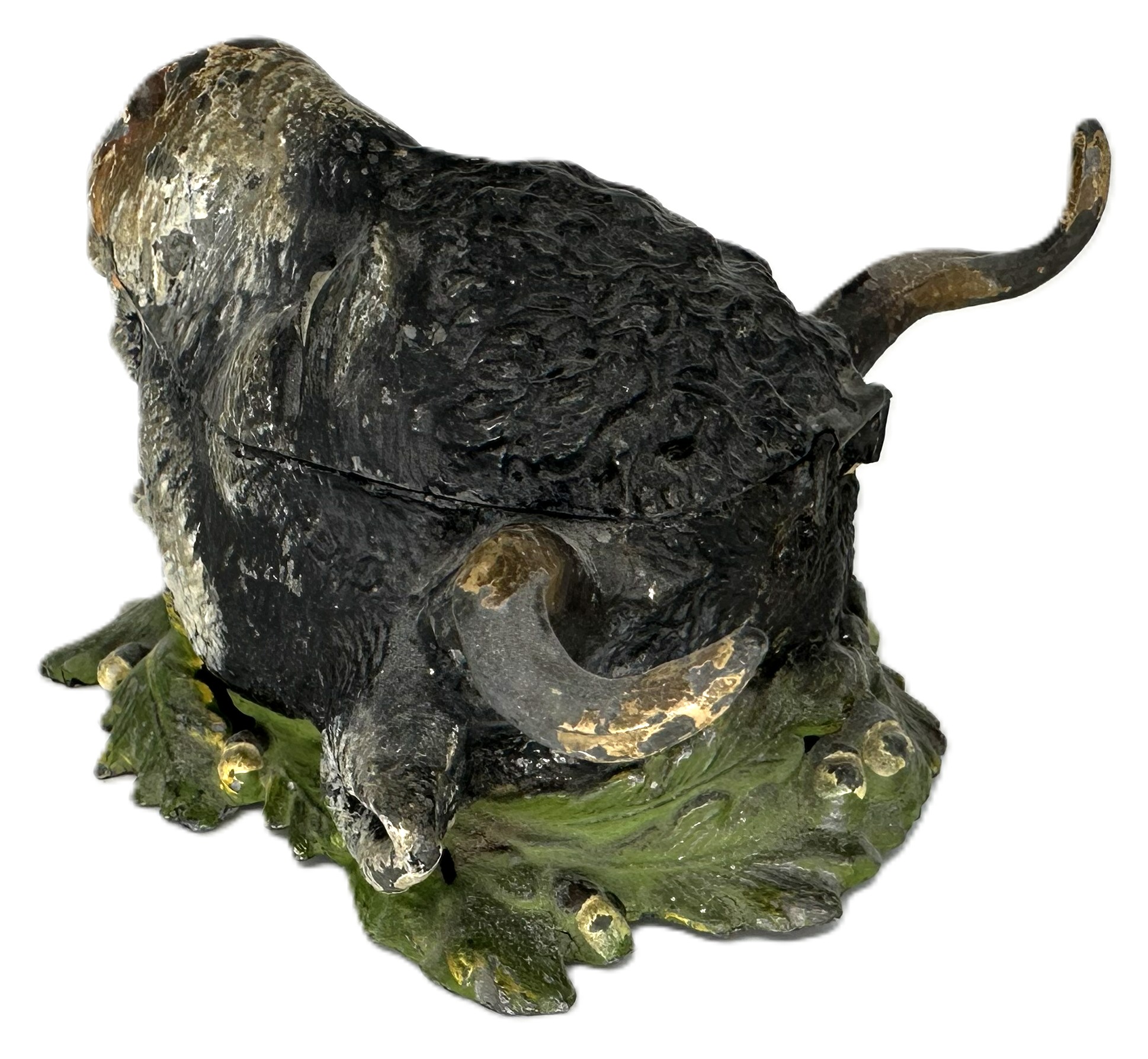
- The Metal: This is cast spelter (a zinc-based alloy frequently used in the late 19th and early 20th centuries as an affordable, highly fluid alternative to bronze). Spelter took intricate mold details beautifully, which is evident in the crisp rendering of the fur texture, the naturalistic folds around the eyes, and the leaf-molded base.
- The Finish: The piece is finished in its original cold-painted polychrome decoration. The head shows a dark patinated charcoal-black base with lighter gray/white highlight rubbing to accentuate the texture of the hair. The base is painted a vibrant foliage green, meant to simulate the animal bursting forth from a bed of oak leaves or field grass.
- The Hinge and Insert: The glass insert fits perfectly. The simple external bar hinge at the back of the neck allows the top half of the head to tilt back smoothly, parting right at the jaw and muzzle line to reveal the ink reservoir. The horns serve as a pen holder.
Manufacturer, Origin, and Date
Because it is unmarked, identifying a definitive foundry requires matching the specific mold pattern. However, we can narrow down the origin and date with some confidence based on the style and casting characteristics:
- Where it was made: This style of heavy, rustic, realistic animal-form desk novelty was an immense specialty of German and Austrian foundries during the historicist and naturalistic movements of the late Victorian era. German manufacturers (such as those in Nuremberg or Geislingen) and Austrian cold-painted white metal/bronze firms frequently exported these exact types of whimsical, leaf-based figural inkwells to the American and British markets.
- When it was made: It dates to the late 1880s to the mid-1890s (circa 1890). During this decade, hunt-themed decor, “Black Forest” naturalism styles, and robust animalier desk accessories reached peak popularity.
Condition & Character
The significant paint loss on the prominent surfaces—like the bridge of the nose, the muzzle, and the horn tips—is classic “honest wear.” Because spelter does not form a self-protecting patina like bronze, its painted finishes flake over time when handled. On a figural piece like this, the wear marks the exact spots where generations of writers gripped the muzzle to flip open the lid to dip their pens, giving it a storied character.
Estimated value: $175
Sold for $172 in August 2026
Content disclaimer. The information posted is the owner’s best knowledge and may not have been vetted by the SOIC. We welcome comments, corrections, and additions, working to make our website information comprehensive and accurate.
Join the Society of Inkwell Collectors (SOIC) – it’s free!
Founded in 1981 as a non-profit organization,
we are documenting inkwells (and accessories).
We’re here to help and inform!