





Boquet Pump Style Inkwell
| Categories | Mechanical - Pump / Siphon |
| Type | Pump |
| Material | Bronze, Porcelain |
| Markings | See Narrative |
| Manufacturer | Boquet |
| Origin | France |
| Date or Era | circa 1850 |
| Measuring | 4” diameter; 6” high |
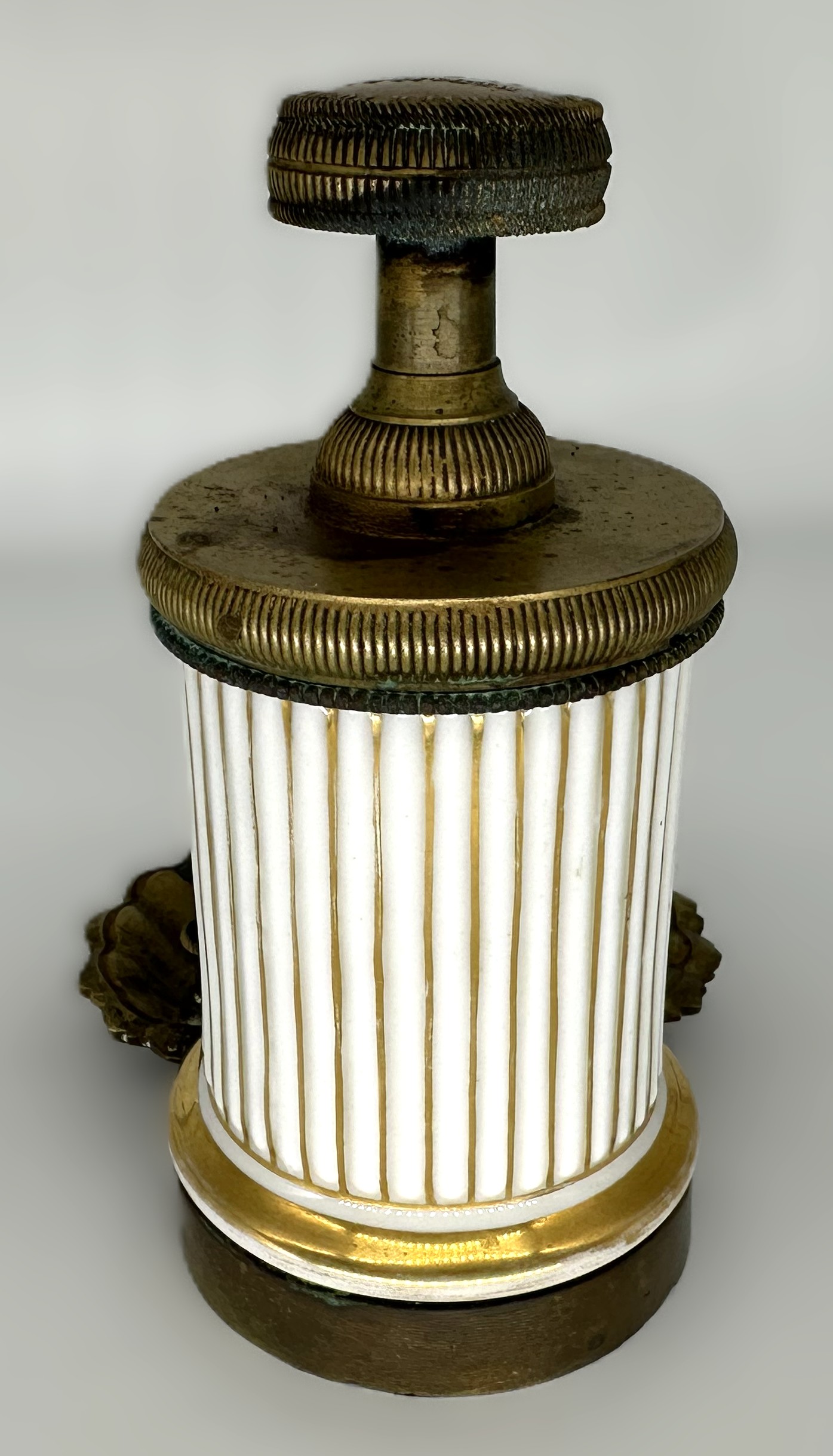
This Louis-Honoré Boquet “encrier pompe” (pump inkwell) is a sophisticated example of mid-19th-century French mechanical design, combining high-quality Paris porcelain with ornate bronze mounts.
Description
The inkstand is constructed from white porcelain decorated with vertical gold-leaf fluting, giving it a neoclassical, columnar appearance.
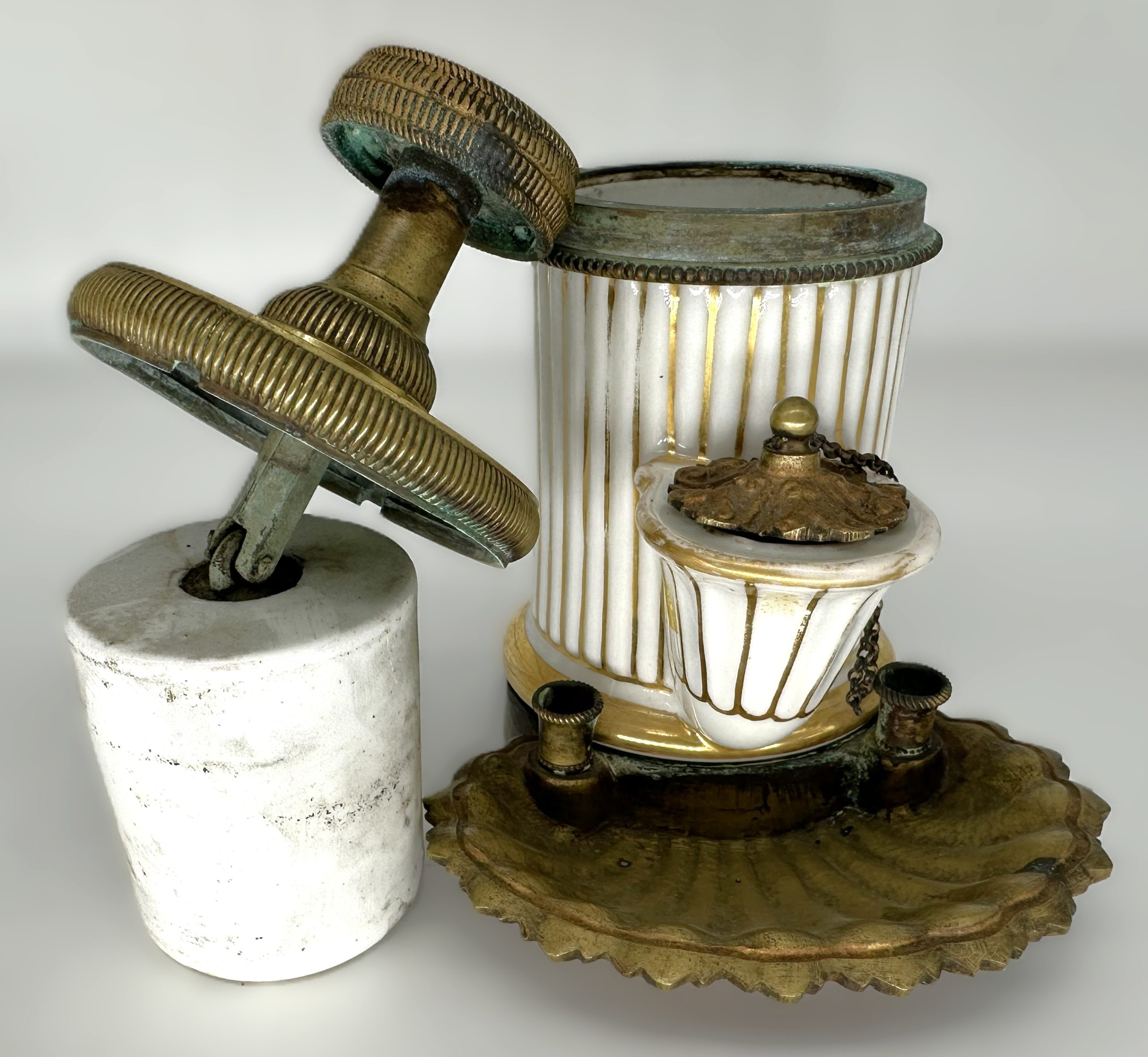
- The Base: The porcelain body is set into a heavy gilt bronze base that features a large, scalloped shell-form pen tray at the front. Flanking the central reservoir are two small, ribbed cylindrical holders intended to store quill or dip pens upright.
- The Font: On the side of the central column is a protruding porcelain dipping font. It is fitted with a bronze lid featuring a floral design and a safety chain to prevent it from being lost.
- Internal Plunger: The interior contains a heavy, white ceramic or porcelain cylindrical plunger. This plunger is attached to a threaded brass rod connected to the top knob.
How the Mechanism Works
The “pump” system was a revolutionary improvement over standard open inkwells because it kept the primary ink supply airtight, preventing evaporation and contamination from dust.
- The Reservoir: Ink is poured into the main porcelain cylinder.
- Displacement: When the user turns the knurled bronze knob at the top, the threaded rod lowers the heavy internal plunger into the ink reservoir.
- Pressure: As the plunger descends, it displaces the ink, forcing it through a small internal channel and up into the side dipping font.
- Control: This allows the writer to precisely control the level of ink in the font. To lower the ink level or return the ink to the main reservoir for storage, the knob is simply turned in the opposite direction to raise the plunger.
Designer History: Louis-Honoré Boquet
Louis-Honoré Boquet was a premier Parisian mechanician and inventor active during the mid-1800s. He specialized in “encriers à pompe,” which were considered luxury items for the professional and aristocratic classes.
Boquet operated out of a workshop at 28 Rue de Richelieu in Paris. His designs were so well-regarded for their precision and elegance that they were featured in the Exposition des produits de l’industrie française (Exhibition of French Industrial Products). These exhibitions were the precursor to the World’s Fairs and showcased the pinnacle of French craftsmanship.
The Knob Inscription
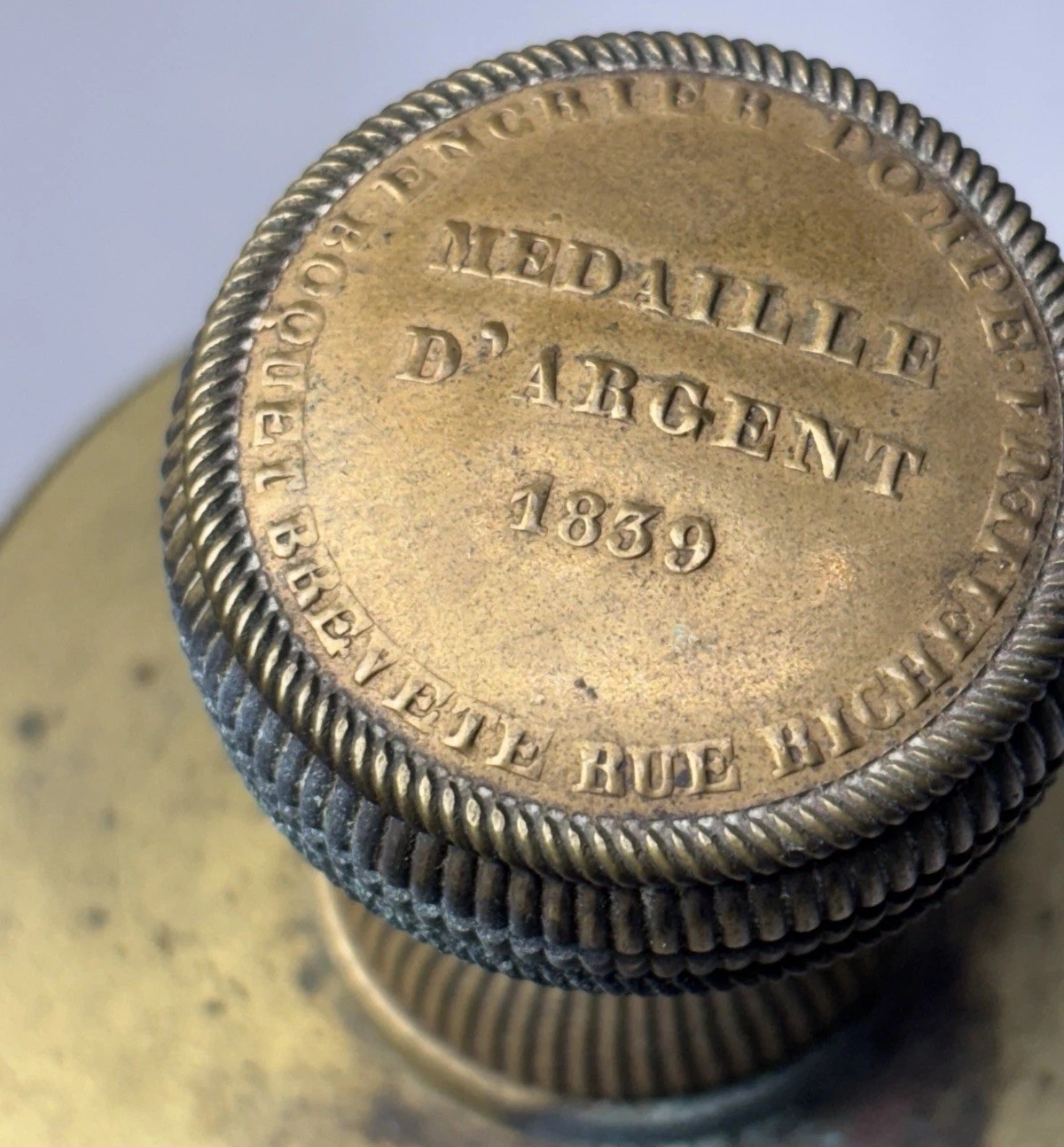
The impressed wording on the knurled knob serves as both a trademark and a badge of honor for the maker:
In the Center:
- MÉDAILLE
- D’ARGENT
- 1839 (This refers to the Silver Medal Boquet won at the 1839 Industrial Exhibition.)
Around the Outer Ring:
- BOQUET ENCRIER POMPE BREVETÉ RUE RICHELIEU 28 (Translated: Boquet Pump Inkwell, Patented, 28 Rue de Richelieu.)
To see how a pump inkwell works, check out this video:
Estimated value: $125
Content disclaimer. The information posted is the owner’s best knowledge and may not have been vetted by the SOIC. We welcome comments, corrections, and additions, working to make our website information comprehensive and accurate.
Join the Society of Inkwell Collectors (SOIC) – it’s free!
Founded in 1981 as a non-profit organization,
we are documenting inkwells (and accessories).
We’re here to help and inform!