




Austrian Bronze Cat
| Categories | Figural - Animals & Living Creatures |
| Type | Cat |
| Material | Bronze |
| Markings | See Narrative |
| Manufacturer | Franz Bergmann |
| Origin | Austria |
| Date or Era | circa 1900 |
| Measuring | 6” high |
This is a classic example of Vienna cold-painted bronze, produced by the renowned Franz Bergmann (or Bergmann Foundry). These pieces were highly prized in the late 19th century for their charm and the “secret” functionality of hidden compartments.
Description
- Posture & Expression: The cat is naturalistically modeled in an alert, seated position on its haunches. Its head is tilted slightly upward and to the left with an expectant, watchful expression. The front paws are planted firmly, and the tail is elegantly curled around the right side of the body, following the contour of the hind leg.
- Texture & Modeling: The bronze exhibits exceptionally fine casting, with detailed incised lines representing the texture of the fur across the entire body. A prominent “ruff” or collar of thicker fur is sculpted around the neck; this is a clever design choice that serves to aesthetically conceal the hinge line where the head opens.
- Finish (Cold-Painting): The piece features the traditional “cold-painted” technique, where multiple layers of polychrome enamel are applied to the bronze after casting. The coloration represents a “tabby” pattern with a warm palette of golden-tan, tawny browns, and dark charcoal stripes. The face is expressive, with pale yellow eyes, dark pupils, and a delicately painted pink nose.
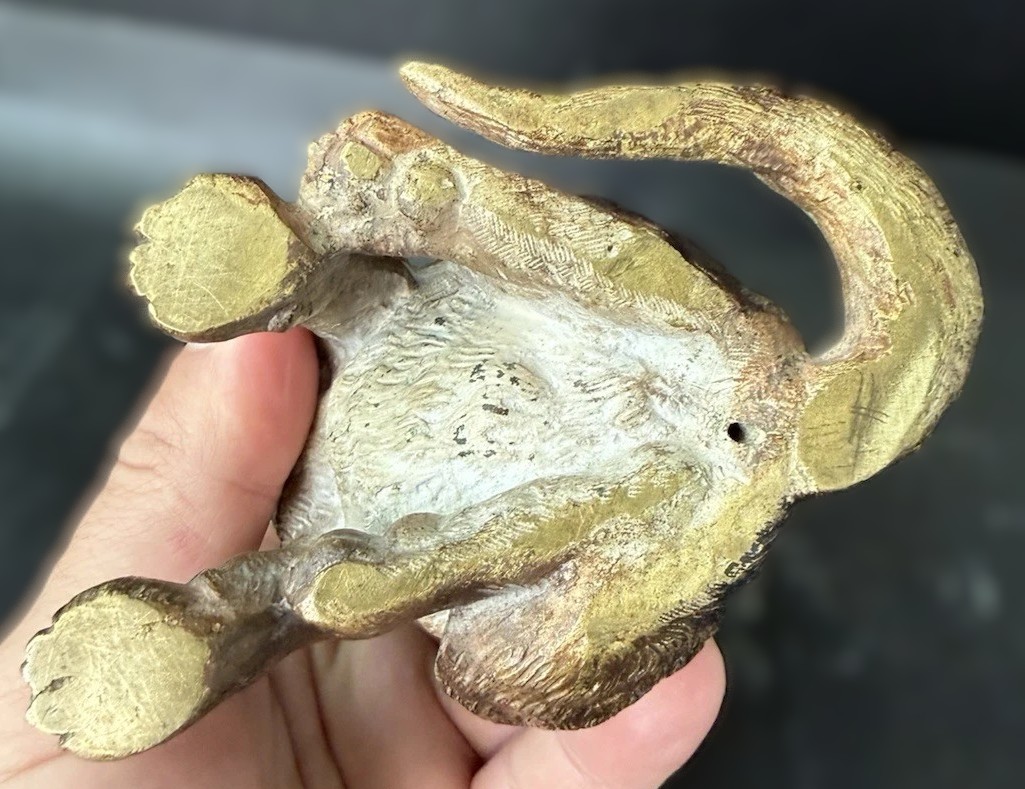
- Mechanism: The head is hinged at the back of the neck and swivels open to reveal a circular gilt-lined reservoir. This is missing its ceramic insert to contain the ink.
Maker’s Marks & Identification
There are several significant markings:
- The Bergmann Urn: To the left of the white-painted area on the belly, there is a small, stamped mark in the shape of an urn or amphora with a “B” inside. This is the official foundry mark of Franz Xaver Bergmann (1861–1936), the most famous producer of Vienna bronzes.
- “Geschützt”: Near the tail and hind leg, there is a stamped word. This appears to be “GESCHÜTZT”, which is the German equivalent of “Registered” or “Copyrighted,” a common mark on authentic Austrian pieces to protect the design from contemporary imitators.
- Origin Mark: There also appears to be a circular stamp that reads “AUSTRIA”.
Estimated Age
Given the style, the specific Bergmann marks, and the quality of the cold-painting, this inkwell dates to the late 19th or very early 20th century (circa 1880–1910). This was the peak period for the “Vienna Bronze” animalier movement.
Sold for $475 in April 2026
Content disclaimer. The information posted is the owner’s best knowledge and may not have been vetted by the SOIC. We welcome comments, corrections, and additions, working to make our website information comprehensive and accurate.
Join the Society of Inkwell Collectors (SOIC) – it’s free!
Founded in 1981 as a non-profit organization,
we are documenting inkwells (and accessories).
We’re here to help and inform!