

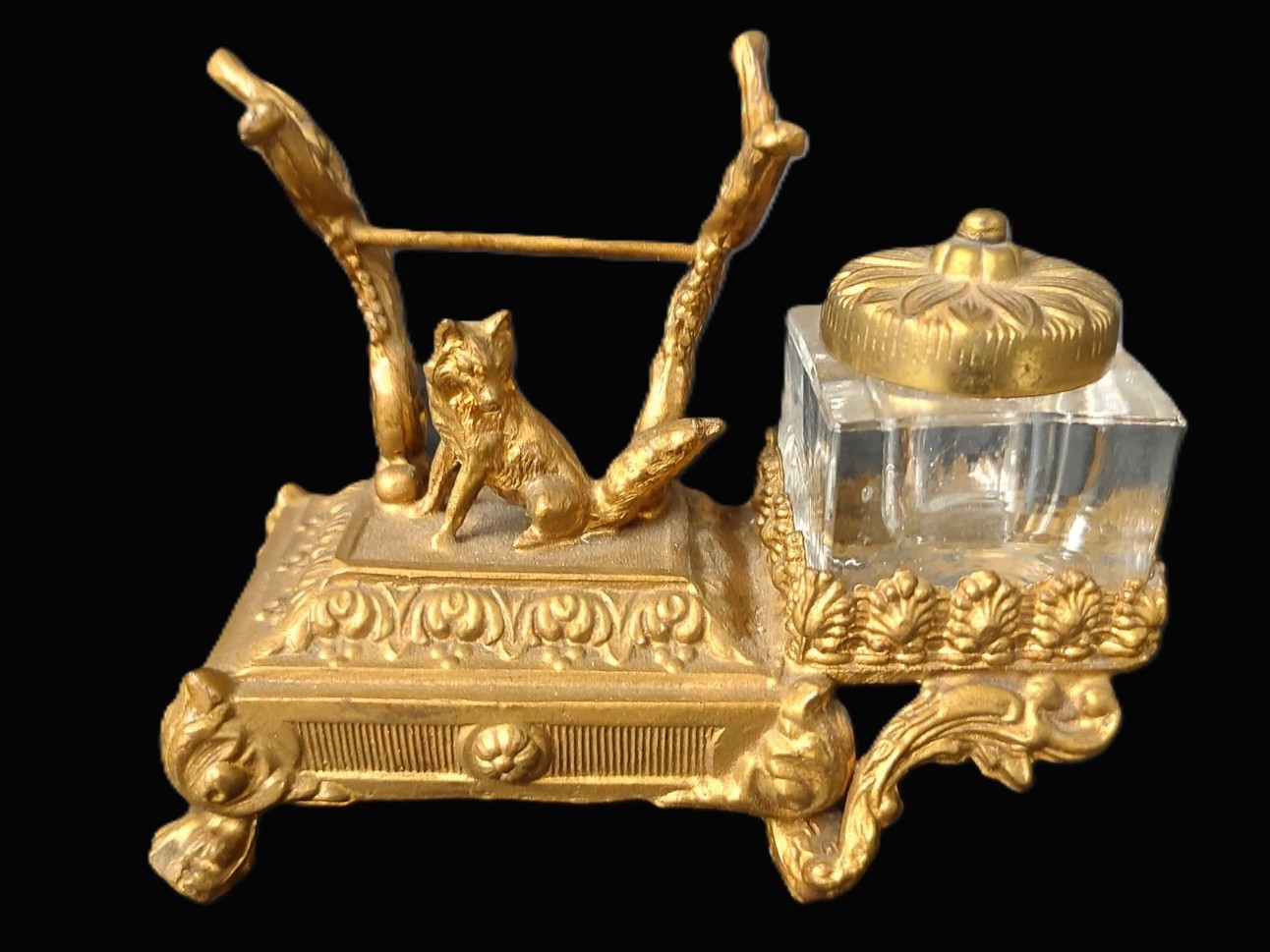
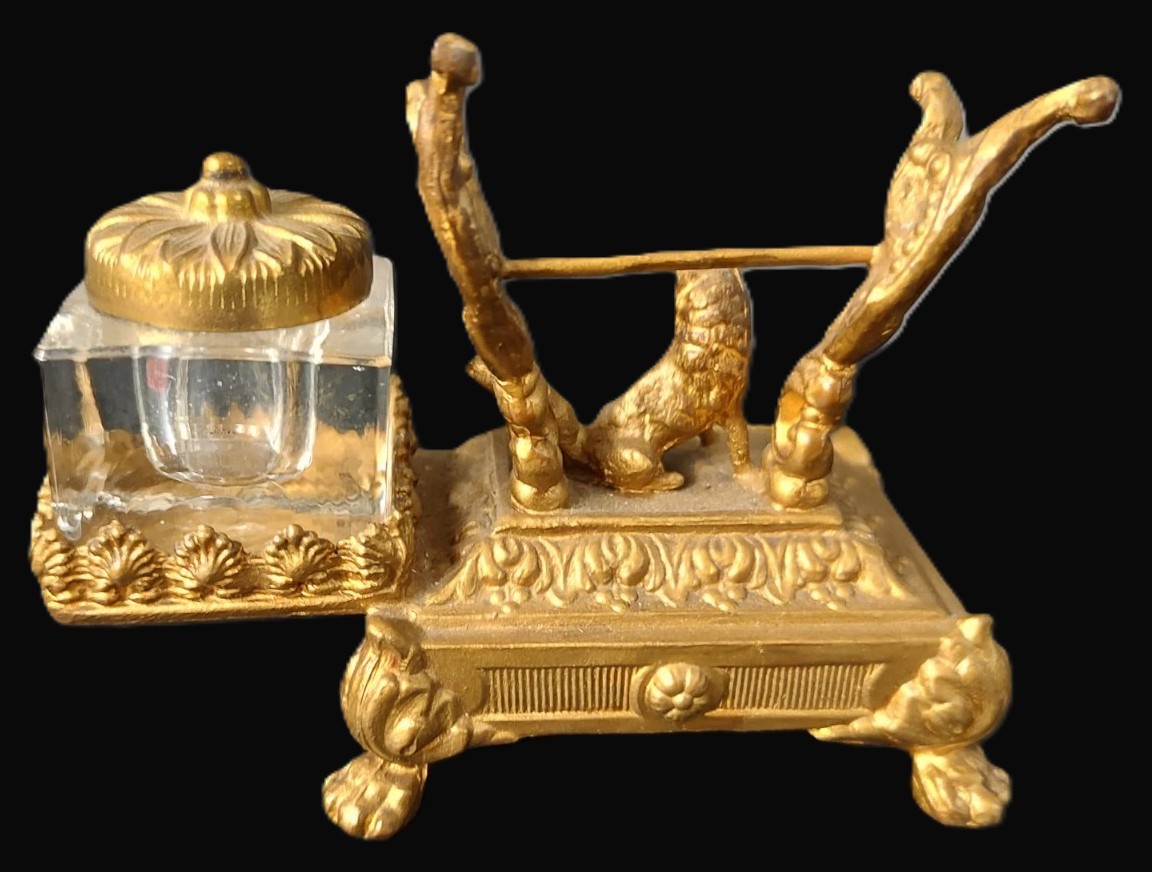
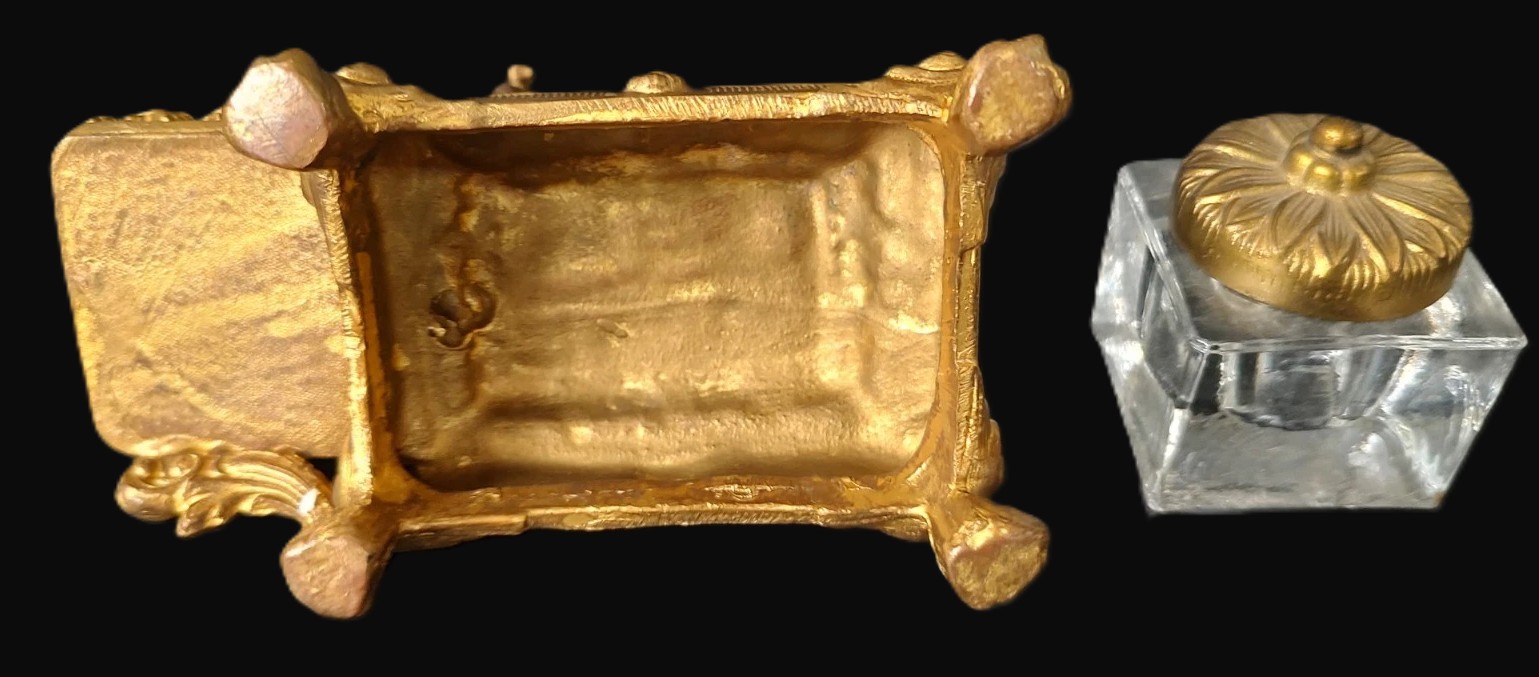
19th Century French Gilt Bronze Fox Inkstand
| Categories | Figural - Animals & Living Creatures |
| Type | Fox |
| Material | Gold Gilt Finish |
| Markings | Unmarked |
| Manufacturer | Undetermined |
| Origin | France |
| Date or Era | circa 1870 |
This French gilt bronze (ormolu) inkstand likely dates to around 1850 to 1870. The piece combines naturalistic “animalier” sculpture with the opulent, highly chased decorative style typical of Parisian luxury desk accessories.
Key Features and Composition
- The Base: An ornate, rectangular gilt bronze base elevated on four scrolling acanthus-leaf feet. The borders are finely chased with a repeating shell and foliage motif, while the top surface has a stippled texture that provides a contrasting background for the figural elements.
- The Fox: A seated gilt bronze fox, alert and looking toward the right. The casting is detailed, capturing the texture of the fur and the bushy “brush” of the tail.
- The Pen Holder: Located behind the fox is a naturalistic “branch” style pen rack. It consists of two textured uprights – designed to mimic tree branches – connected by a thin horizontal bar. This “cradle” design allowed a quill or dip pen to rest securely.
- The Inkwell Gallery: To the right of the fox, a scalloped, petal-like gallery holds a single square-cut clear glass inkwell.
- The Lid: The glass inkwell is topped with a matching gilt bronze lift-off lid. The lid features a radiating floral or petal-like decoration and is crowned with a small spherical finial.
Identification & Manufacturer
Identifying the exact manufacturer of a 19th-century French bronze without a clear signature can be challenging, as prominent Parisian “maisons” often collaborated with independent animalier sculptors.
- Potential Manufacturer: The “branch” motif for pen holders was a signature element used by Maison Tahan (Tahan à Paris) and Maison Alphonse Giroux. These houses were “Ebénistes du Roi” and specialized in high-end desk sets and “objets de vertu” for the French elite.
- The Mark: There is a small, embossed circular or oval mark on the interior left of the base’s cavity. While somewhat indistinct, such marks are often the foundry stamp (like Susse Frères) or a specific dealer’s mark.
- The Sculptor: The fox figure itself is in the style of the “Animalier” school. It bears a resemblance to the work of Pierre-Jules Mêne or Jules Moigniez, whose models were frequently purchased and cast by Parisian firms to be integrated into functional items like inkstands.
Date of Manufacture
Based on the Rococo Revival elements (the scrolling acanthus feet and shell motifs) and the naturalistic branch-form pen holder, this piece was likely manufactured between 1850 and 1875. The use of ormolu (gilt bronze) and the specific design of the glass gallery were most popular during the Second Empire under Napoleon III.
Sold for $125 in March 2026
Content disclaimer. The information posted is the owner’s best knowledge and may not have been vetted by the SOIC. We welcome comments, corrections, and additions, working to make our website information comprehensive and accurate.
Join the Society of Inkwell Collectors (SOIC) – it’s free!
Founded in 1981 as a non-profit organization,
we are documenting inkwells (and accessories).
We’re here to help and inform!