

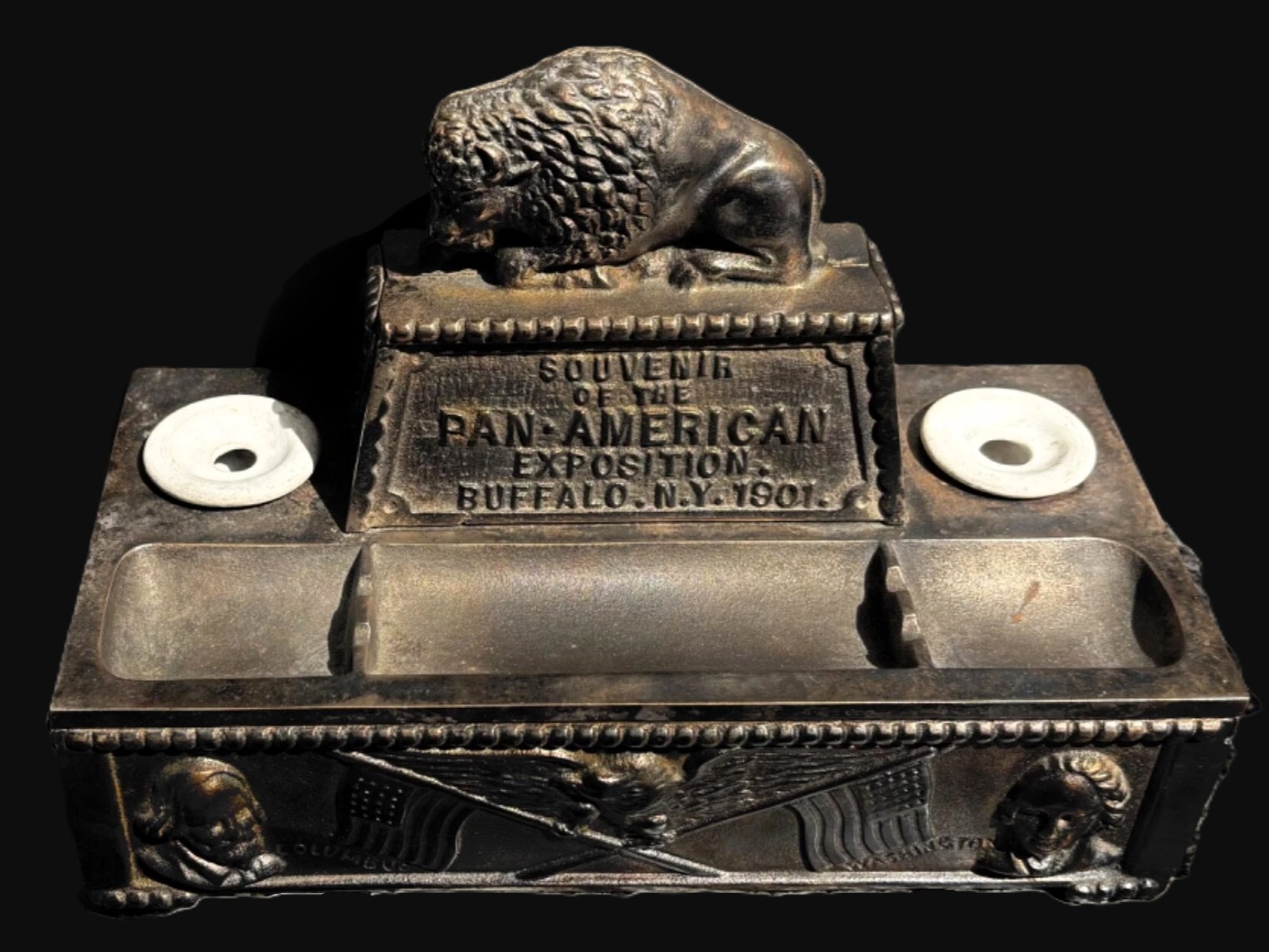

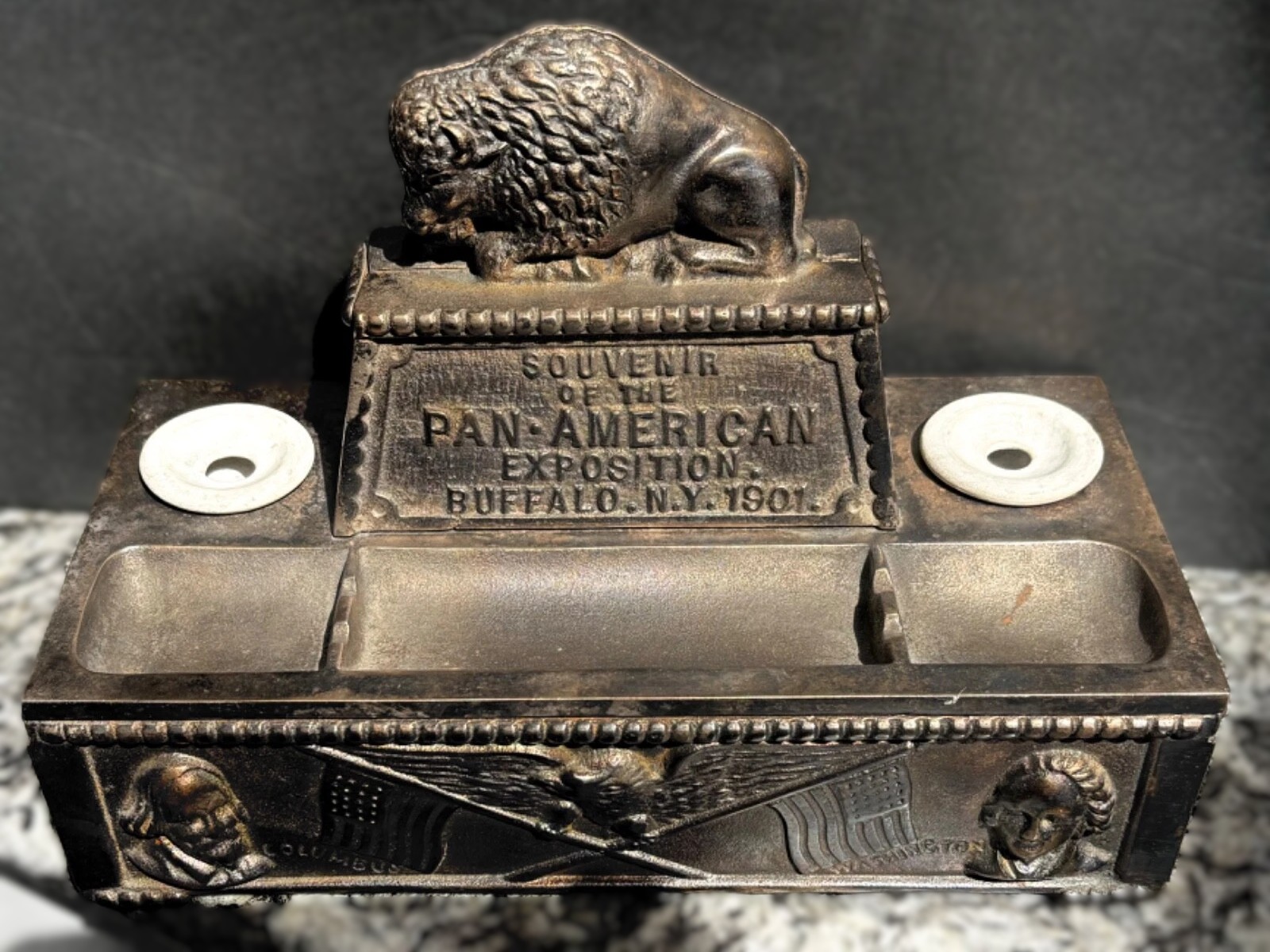

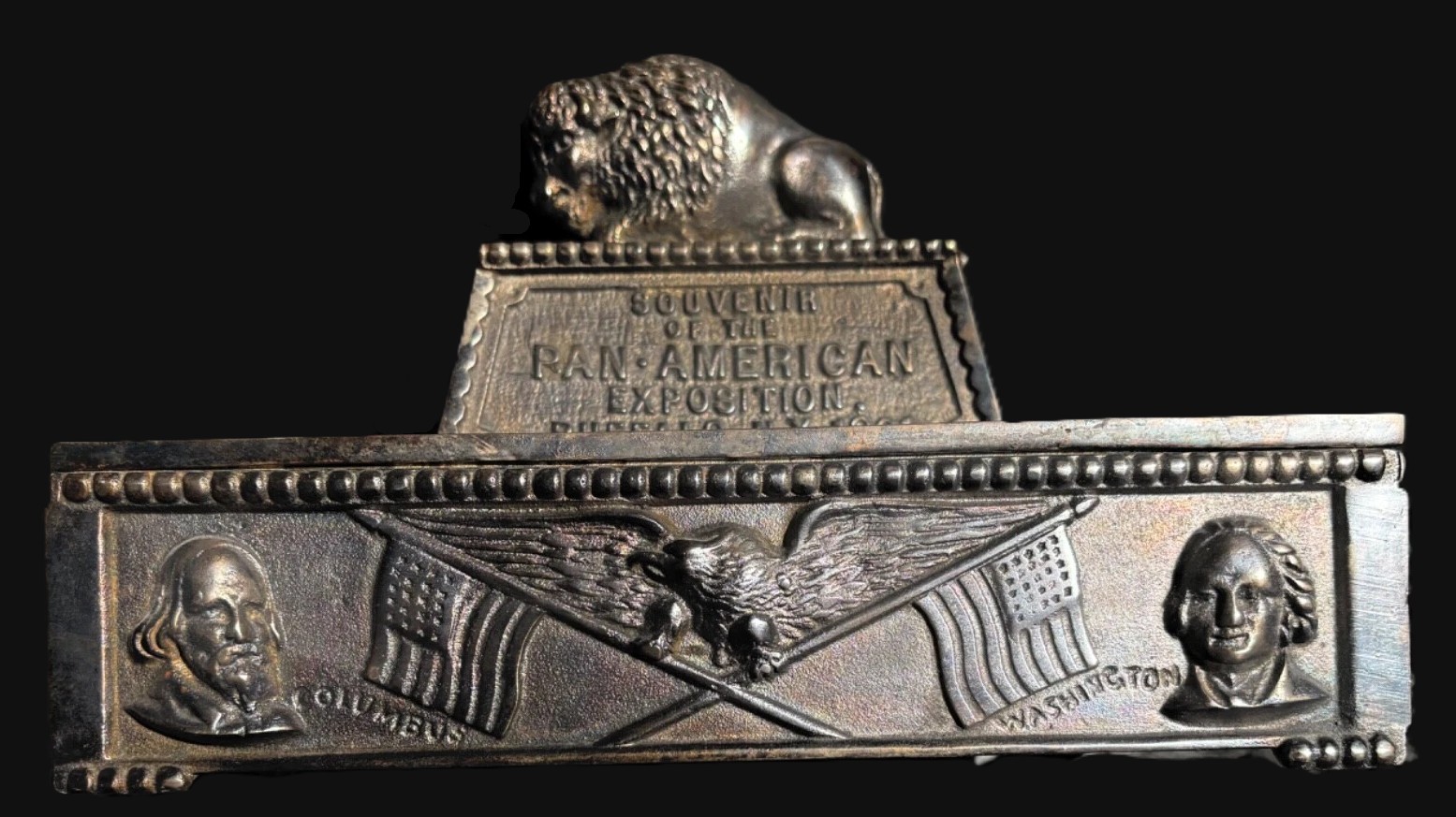


1901 Pan-American Exposition Souvenir Inkstand
| Categories | Souvenir |
| Type | World's Fair |
| Material | Cast iron |
| Markings | See Narrative |
| Manufacturer | Benedict Manufacturing Co |
| Origin | United States |
| Date or Era | circa 1901 |
| Measuring | 10 ½” x 5 ¼” x 7 ½” high |
Description
This heavy cast iron inkstand features a tripartite design:
- Figural Buffalo: A large, detailed bison (the official emblem of the 1901 Expo and the city of Buffalo) is depicted in a reclining position on the top riser.
- Central Inscription: Below the buffalo, a raised rectangular plaque reads: “SOUVENIR OF THE PAN-AMERICAN EXPOSITION – BUFFALO, N.Y. 1901” in stylized raised lettering.
- Front Panel Reliefs: The front of the inkstand is ornately decorated with symbolic figures:
- Eagle and Flags: A central eagle with outstretched wings holds two crossed American flags in its talons.
- Portraits: Flanking the eagle are two raised circular medallions. The left medallion depicts Christopher Columbus (representing the discovery of the Americas) and the right depicts George Washington (representing the host nation).
- Functionality: The stand includes a wide pen tray with scalloped edges to hold writing instruments. It contains two white ceramic or porcelain inkwell inserts.
- Side and Back Detail: The sides and rear of the base feature a “fretwork” or open geometric interlacing pattern.
Manufacturer Determination
While many of these items do not carry a visible maker’s mark on the exterior, this specific design is most often attributed to The Benedict Manufacturing Company of East Syracuse, New York.
- The Benedict Mfg. Co. was a premier manufacturer of “art metal” and silverplate goods during this era and was a major exhibitor at the 1901 Exposition, where they were awarded several medals for their designs.
- They specialized in souvenir wares and are known to have produced various cast metal desk accessories for the Buffalo fair.
Technically, Benedict Manufacturing Company and Benedict Art Studios (often simply called Benedict Studios) were part of the same entity, but they represented different production lines and eras of the company’s history.
The relationship can be broken down as follows:
The Parent Company: Benedict Manufacturing Co.
- Established: The M.S. Benedict Manufacturing Company was founded in 1894 in East Syracuse, New York.
- Primary Products: The parent company was widely known for manufacturing silver-plated and gold-plated wares, hollowware, and cast metal novelties, such as the 1901 Pan-American Exposition souvenir inkstand.
- Expansion: By 1906, under the leadership of Harry L. Benedict (the founder’s son), the company sought to diversify into the increasingly popular Arts and Crafts style.
The Artistic Division: Benedict Art Studios
- The Transition: In October 1906, Benedict Manufacturing purchased the Onondaga Metal Shops.
- The Name: Following the acquisition, the company rebranded that specific operation as Benedict Art Studios.
- Specialization: This division focused almost exclusively on Arts and Crafts movement pieces, characterized by hand-hammered copper, brass, and iron.
- Different Marks: While Benedict Manufacturing pieces often featured the “B B B” diamond logo or the name of the parent firm, Benedict Art Studios items typically used a shopmark featuring a hammer and anvil or a diamond with a bee in the center.
Summary of Differences
| Feature | Benedict Manufacturing Co. | Benedict Art Studios |
| Established | 1894 | 1906 (after acquisition) |
| Common Materials | Silverplate, gold-plate, cast white metal | Hand-hammered copper, brass, iron |
| Primary Style | Victorian, Beaux-Arts, and Souvenir ware | Arts and Crafts / Mission style |
| Relation | Parent Company | Specialty Division |
Because the 1901 Pan-American Exposition occurred five years before the “Studios” division was created, any souvenir inkstand from that fair would be a product of the original M.S. Benedict Manufacturing Company line rather than the Benedict Studios division.
Background: The 1901 Pan-American Exposition
The Pan-American Exposition was a World’s Fair held in Buffalo, New York, from May 1 to November 2, 1901.
- Theme of Pan-Americanism: The fair was designed to celebrate and promote cooperation, trade, and social ties between the nations of the Western Hemisphere (North, South, and Central America).
- “The City of Light”: The Exposition was most famous for its spectacular use of electricity. It was the first fair to be powered by large-scale hydroelectric power transmitted 25 miles from Niagara Falls. At night, the buildings—especially the 389-foot Electric Tower—were illuminated by hundreds of thousands of incandescent bulbs.
- The Symbol of the Buffalo: The American Bison (Buffalo) was chosen as the primary mascot for the event, appearing on everything from posters and coins to souvenirs like your inkstand.
- Historical Tragedy: The fair is tragically remembered as the site of the assassination of President William McKinley. On September 6, 1901, while greeting the public in the Temple of Music, he was shot by an anarchist. He died eight days later, and Vice President Theodore Roosevelt was sworn in as President in Buffalo.
Sold for $1,630 in April 2026
Content disclaimer. The information posted is the owner’s best knowledge and may not have been vetted by the SOIC. We welcome comments, corrections, and additions, working to make our website information comprehensive and accurate.
Join the Society of Inkwell Collectors (SOIC) – it’s free!
Founded in 1981 as a non-profit organization,
we are documenting inkwells (and accessories).
We’re here to help and inform!