

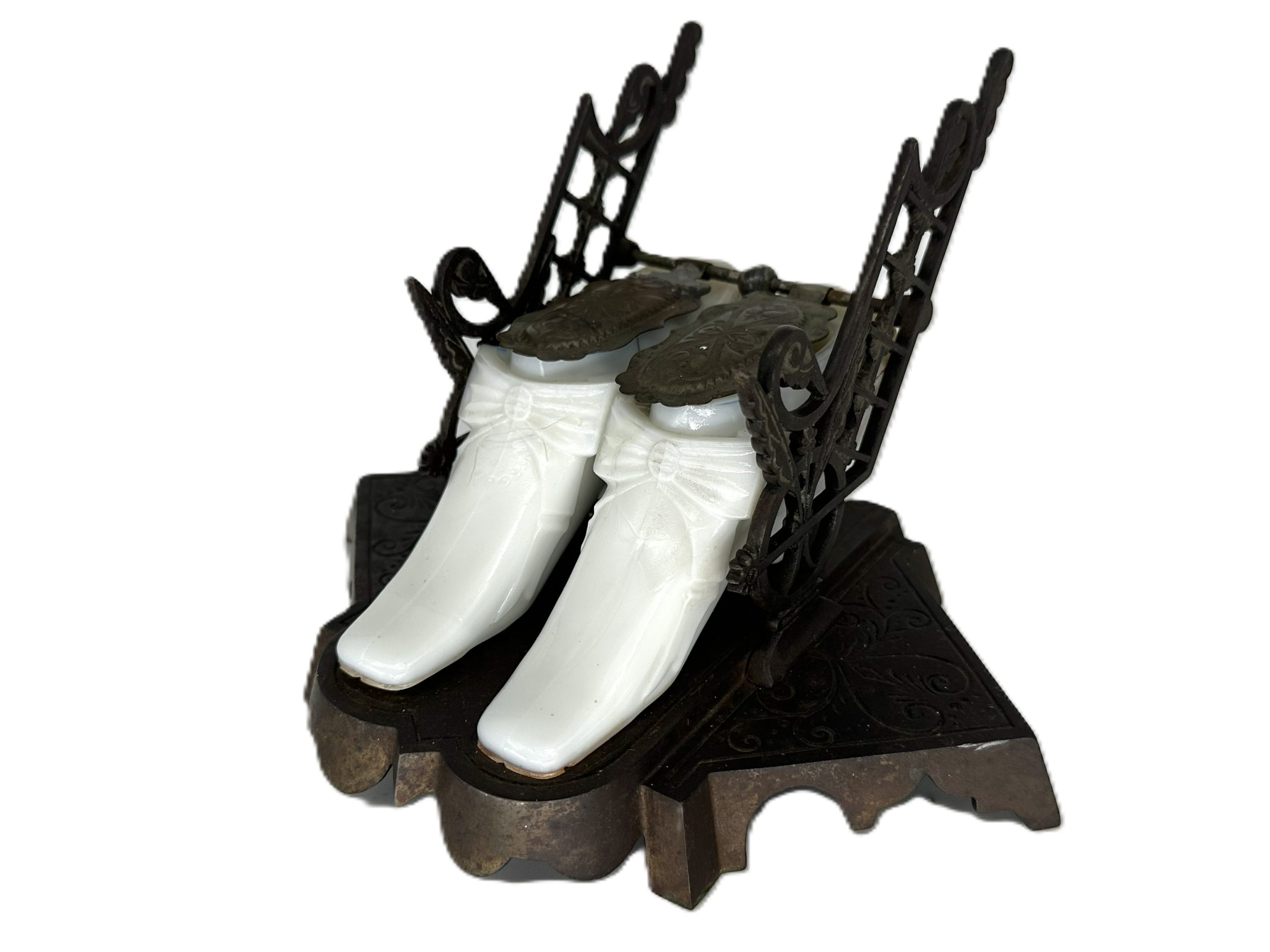
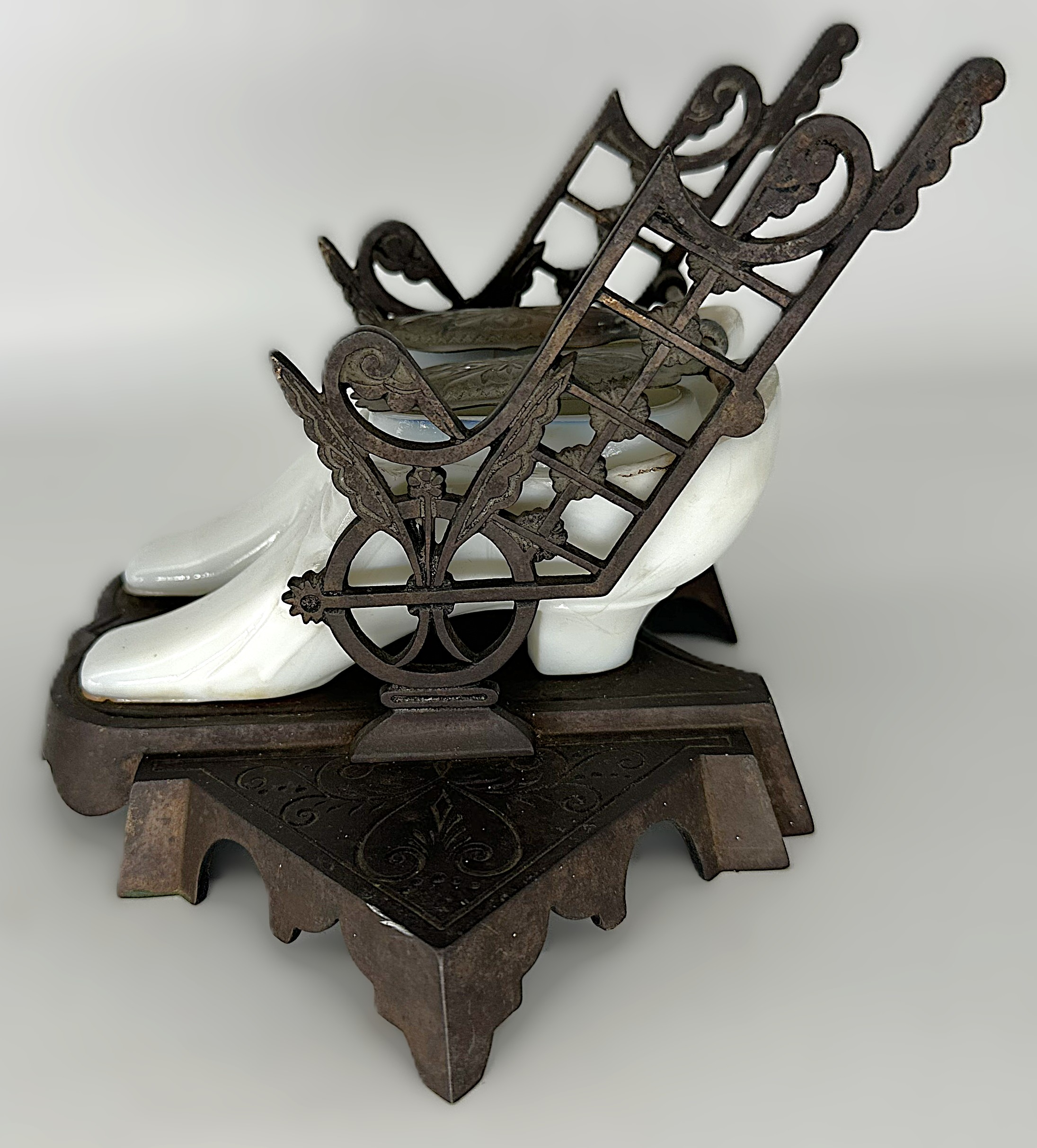
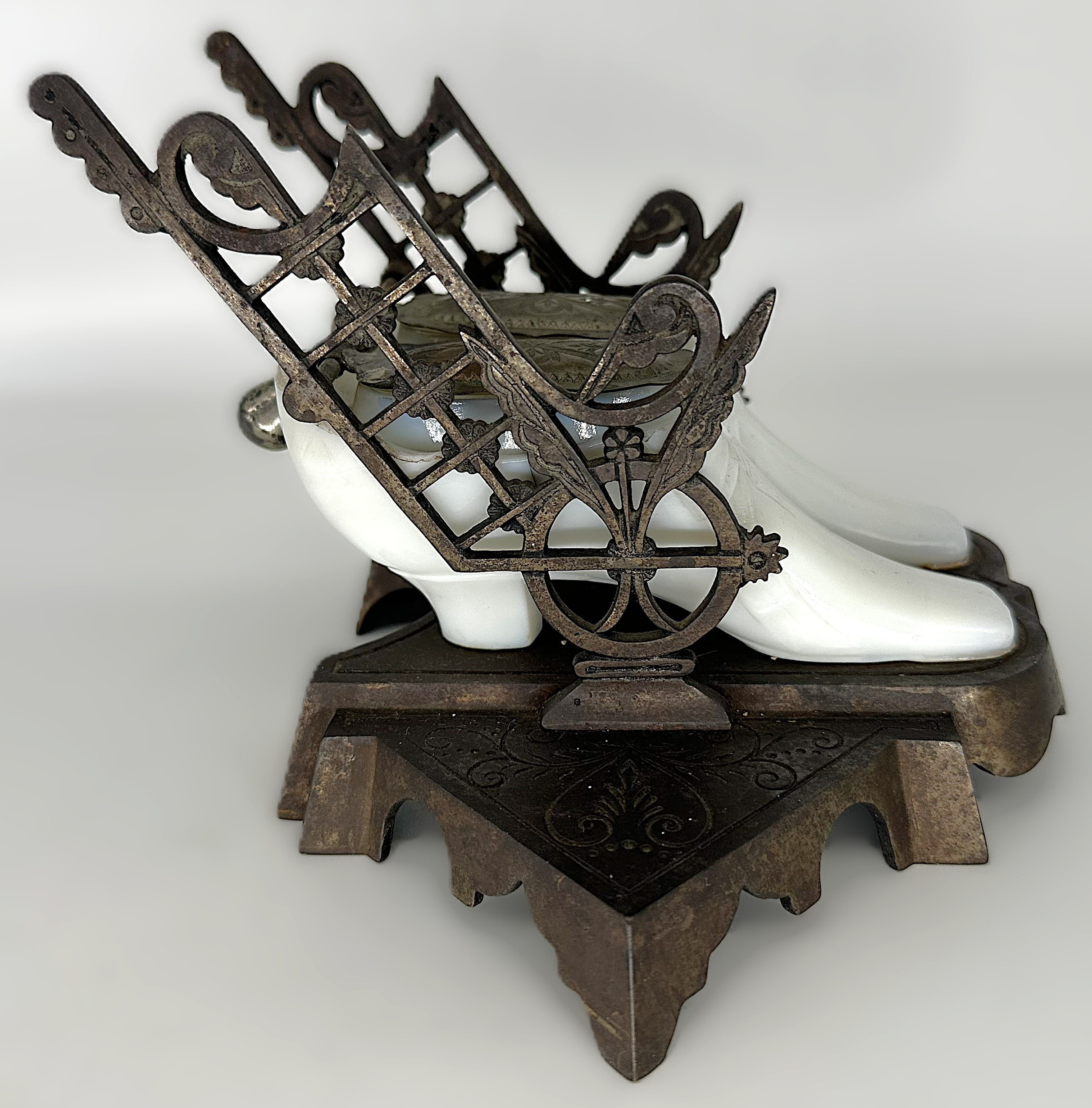
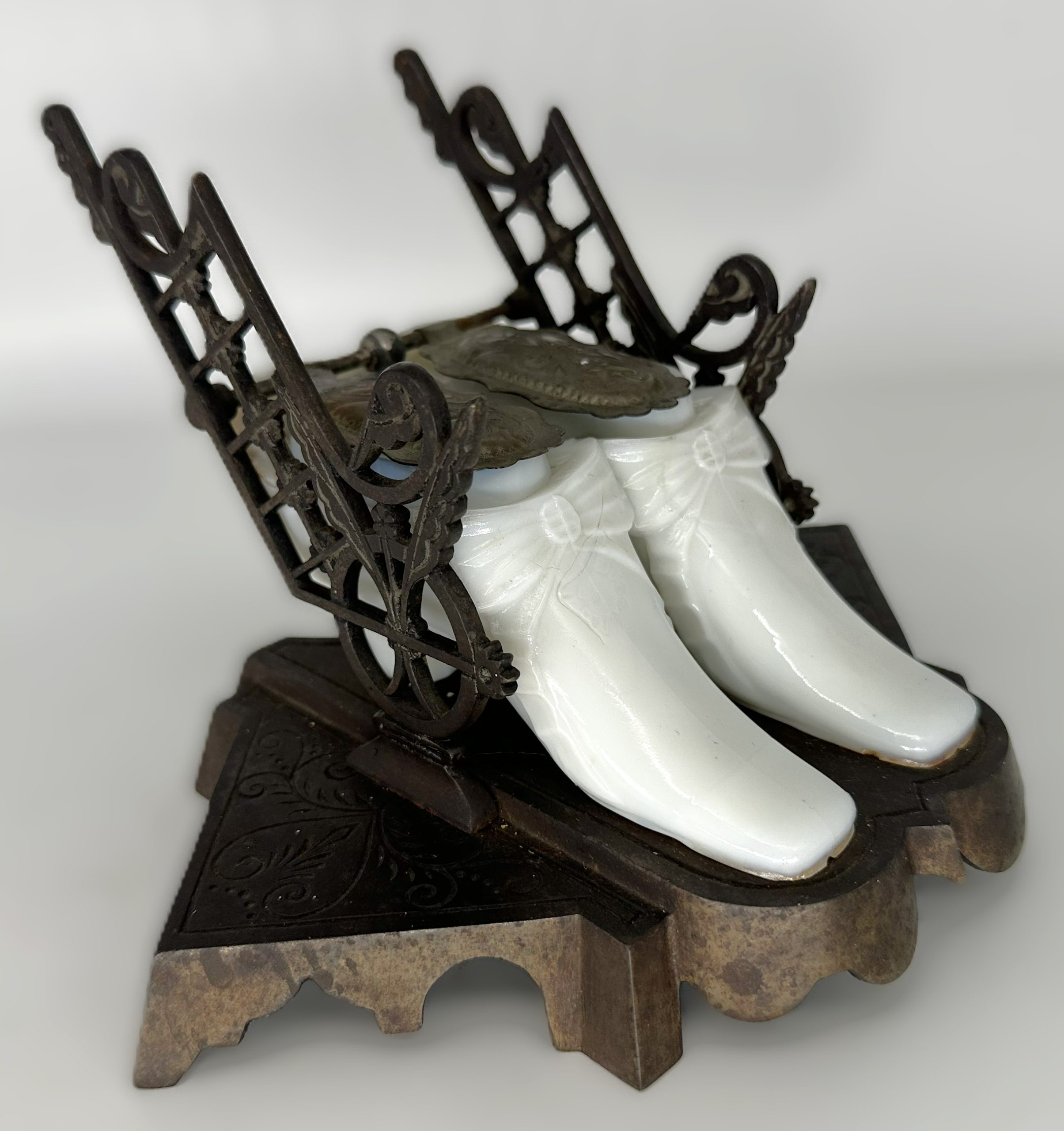
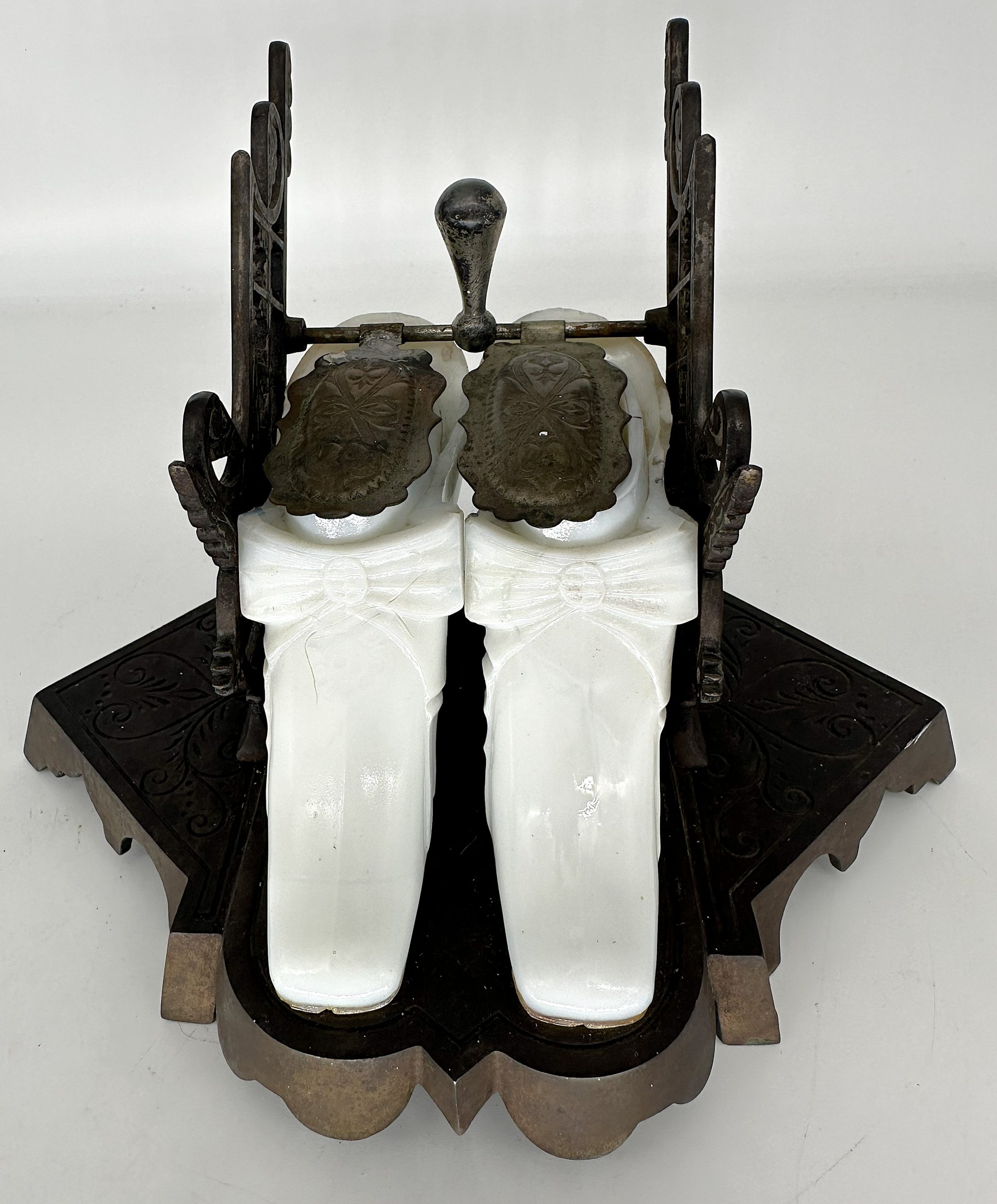
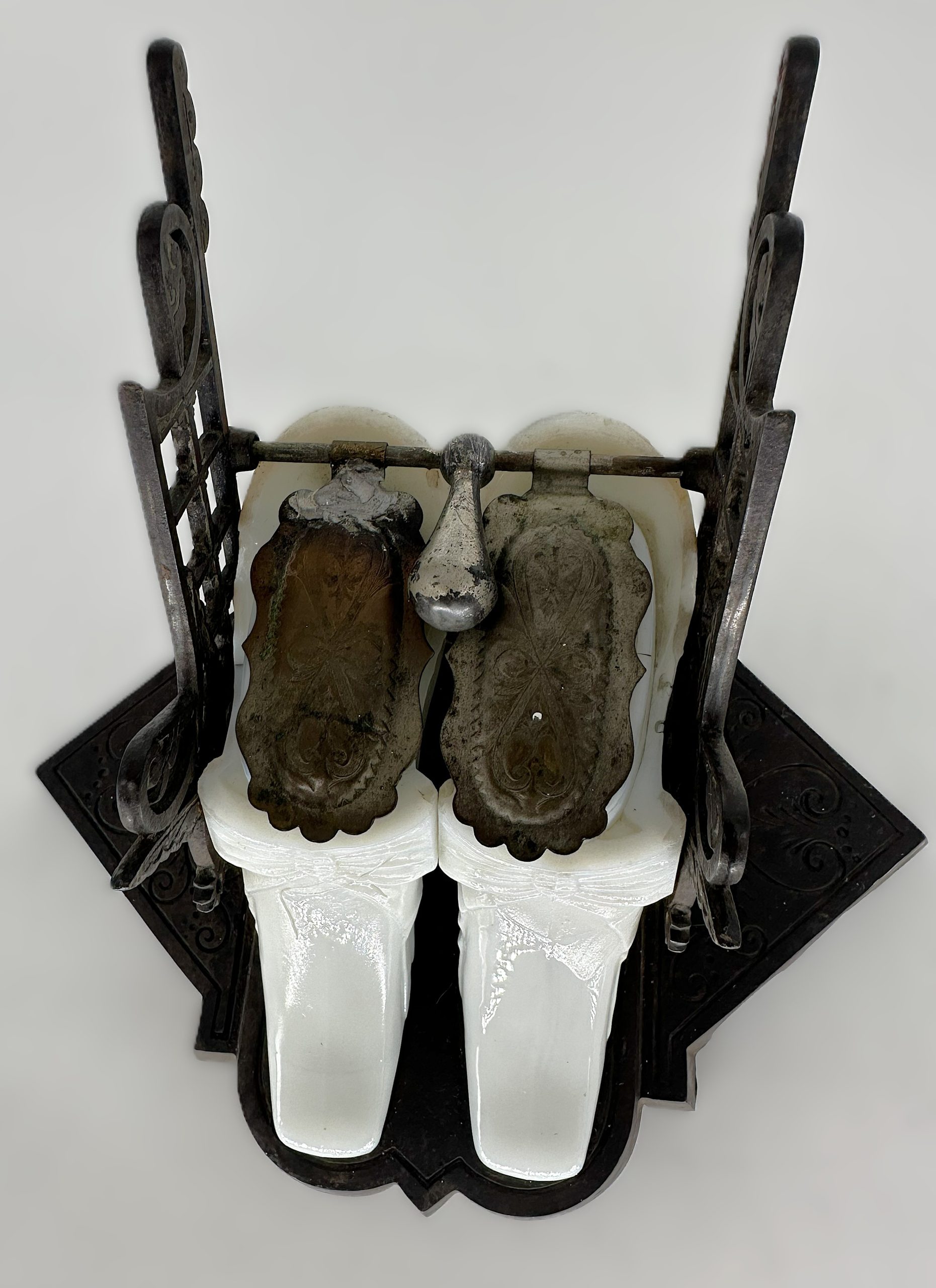
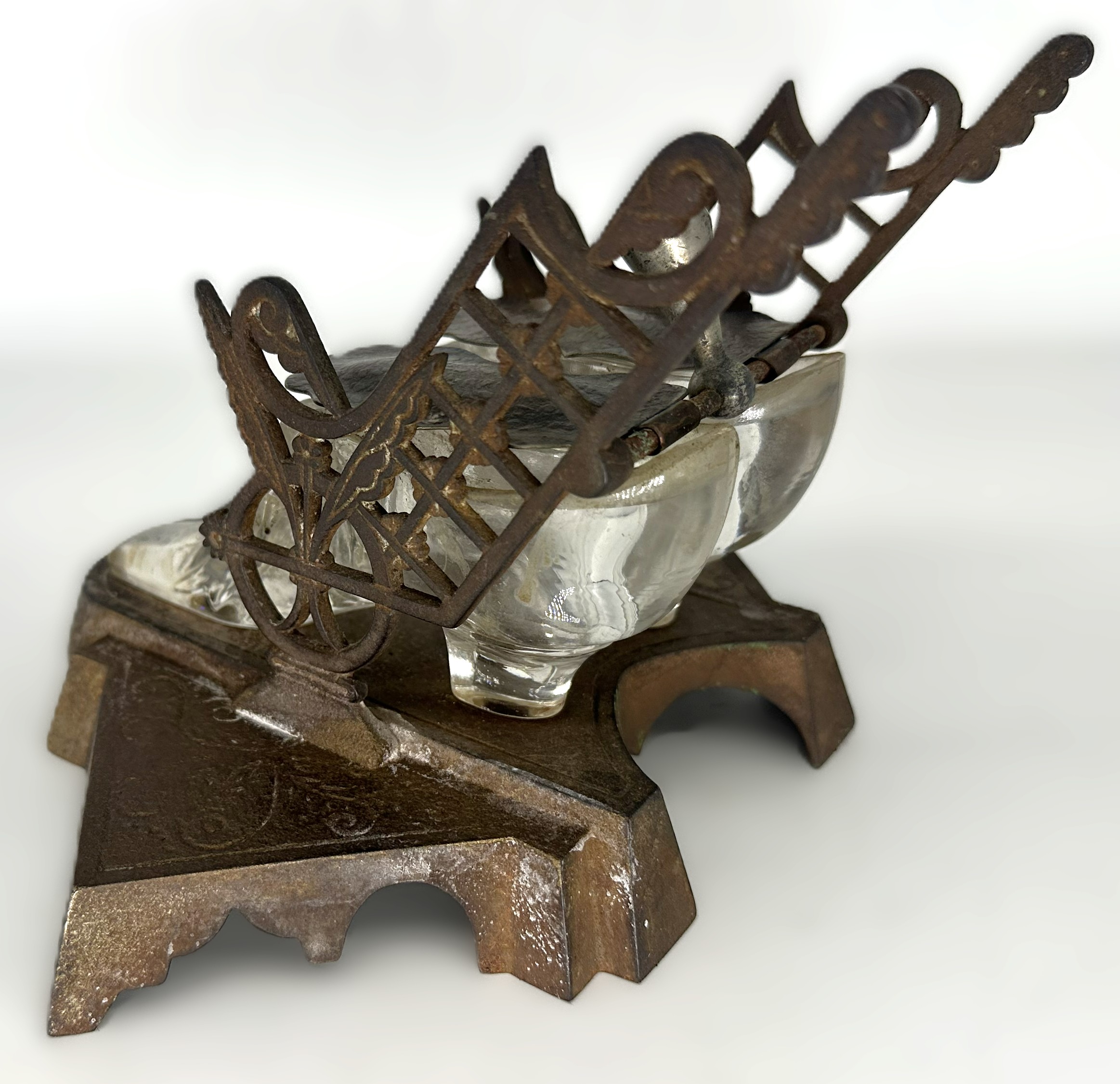
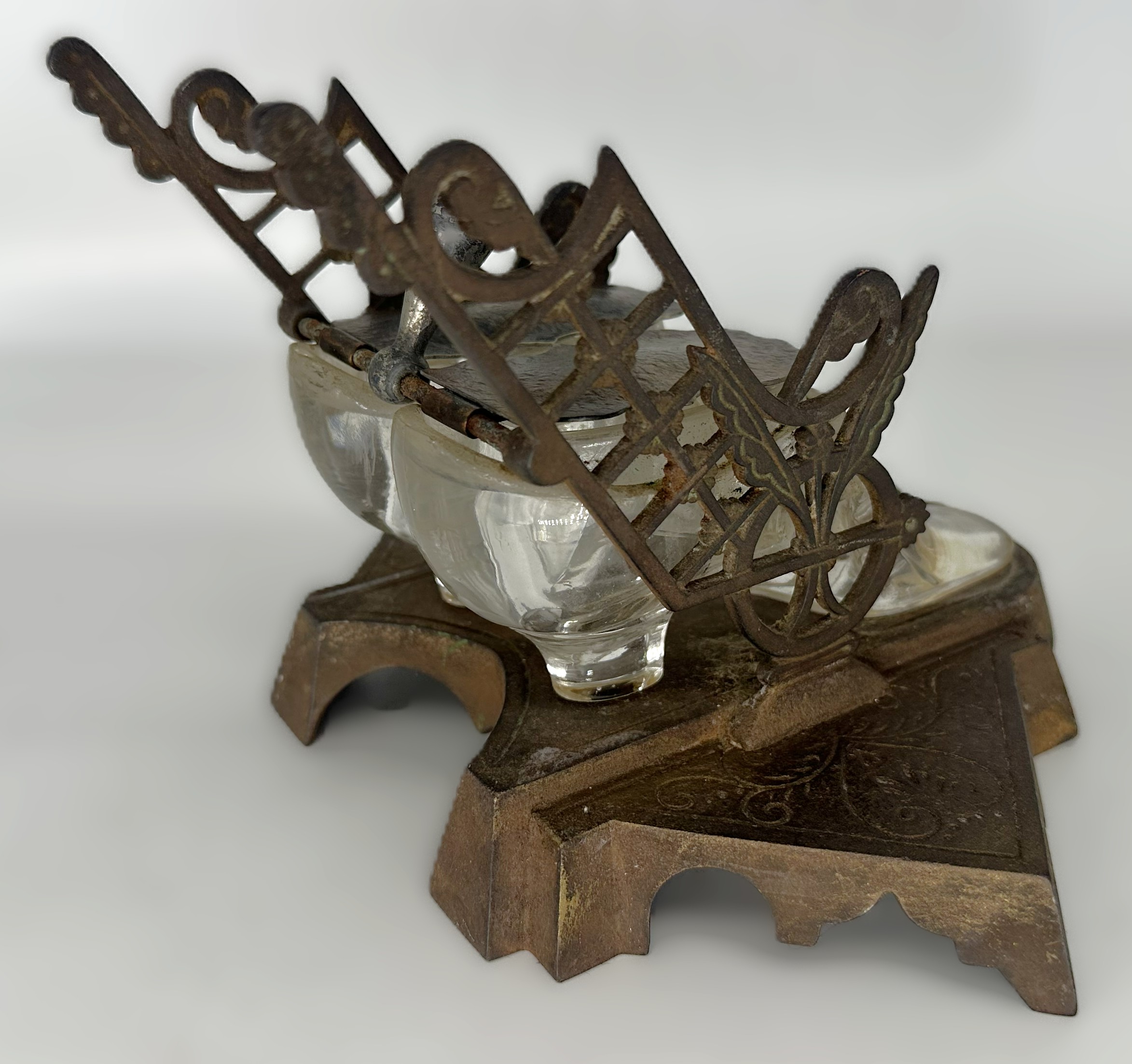
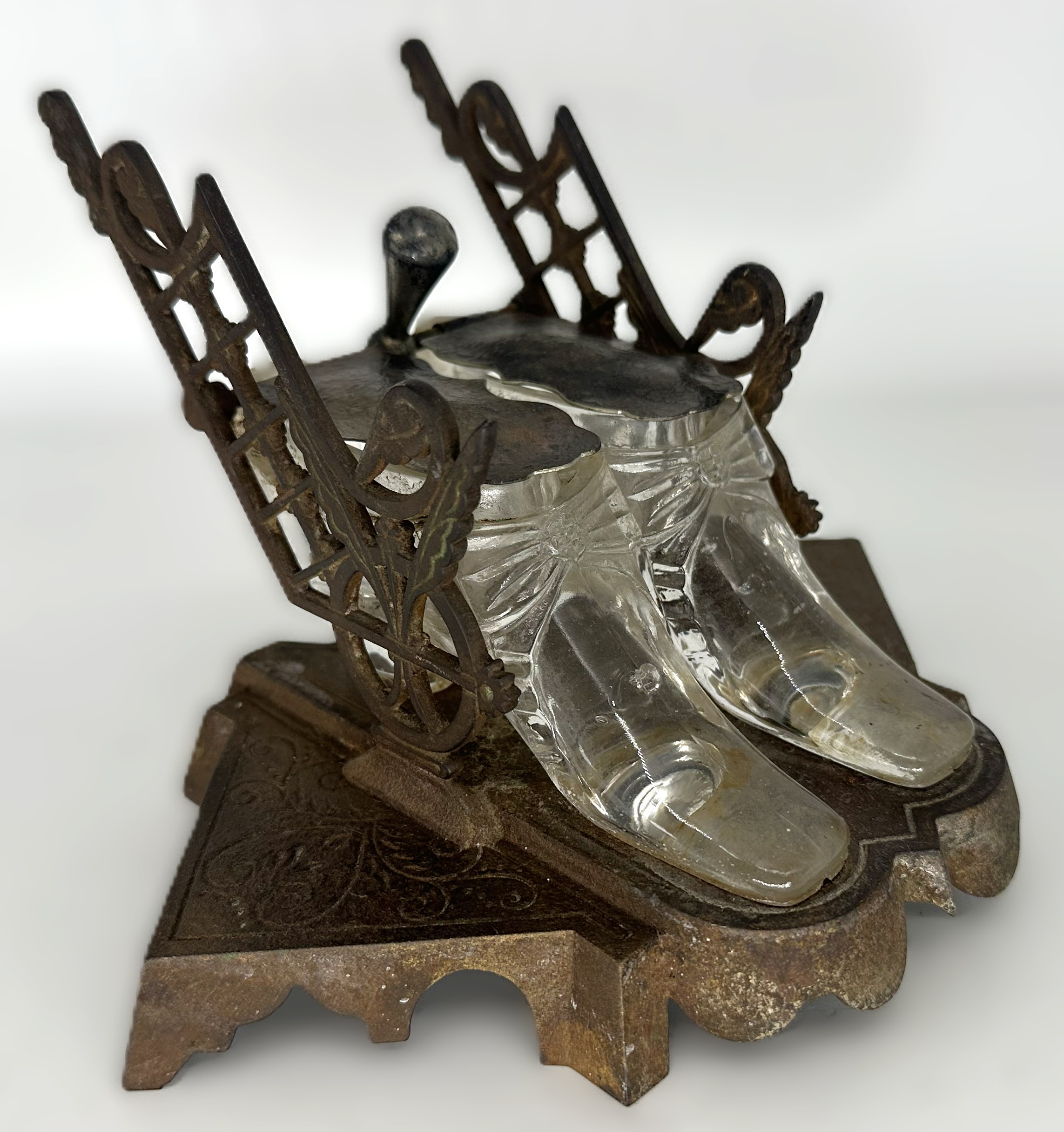
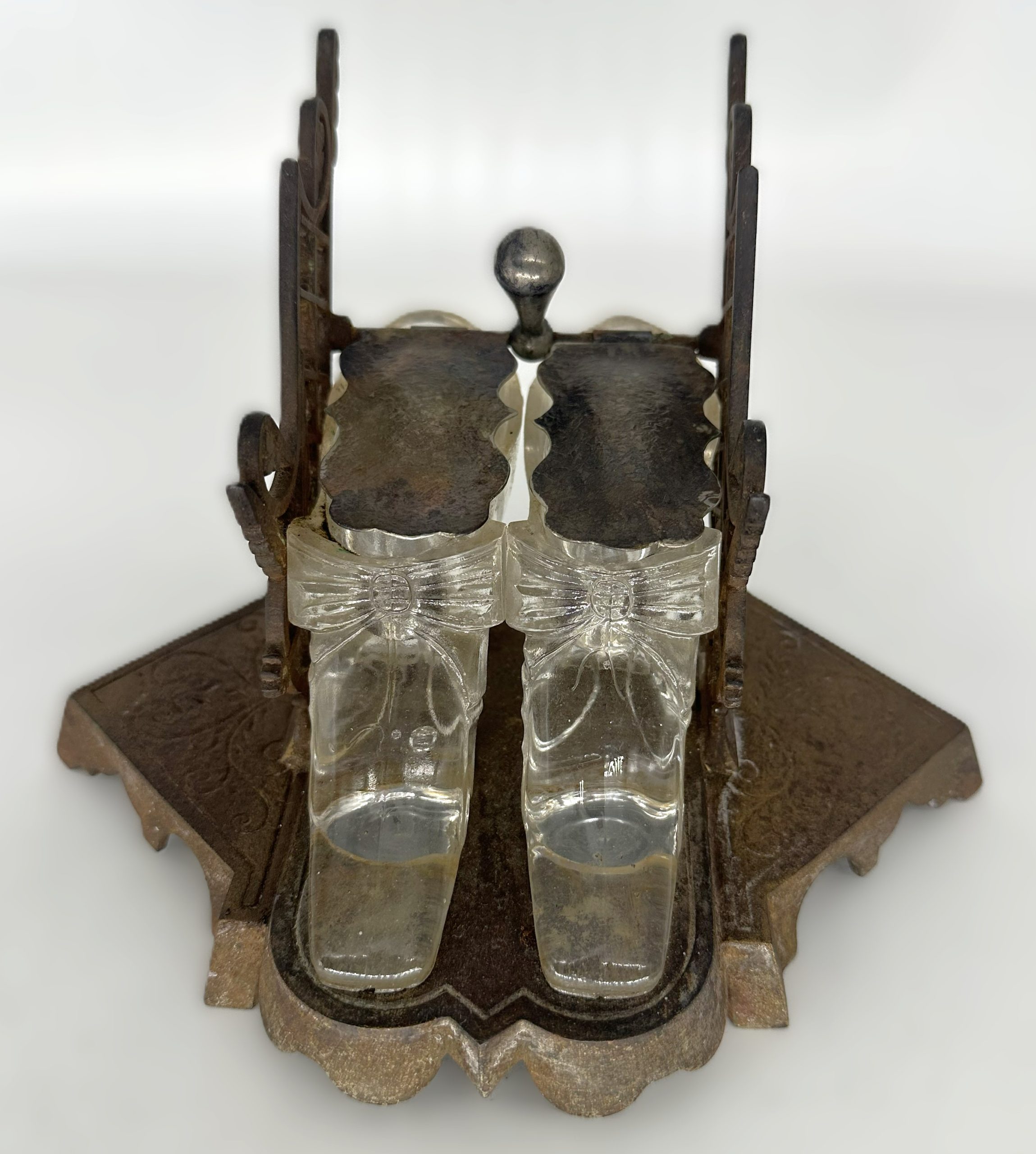
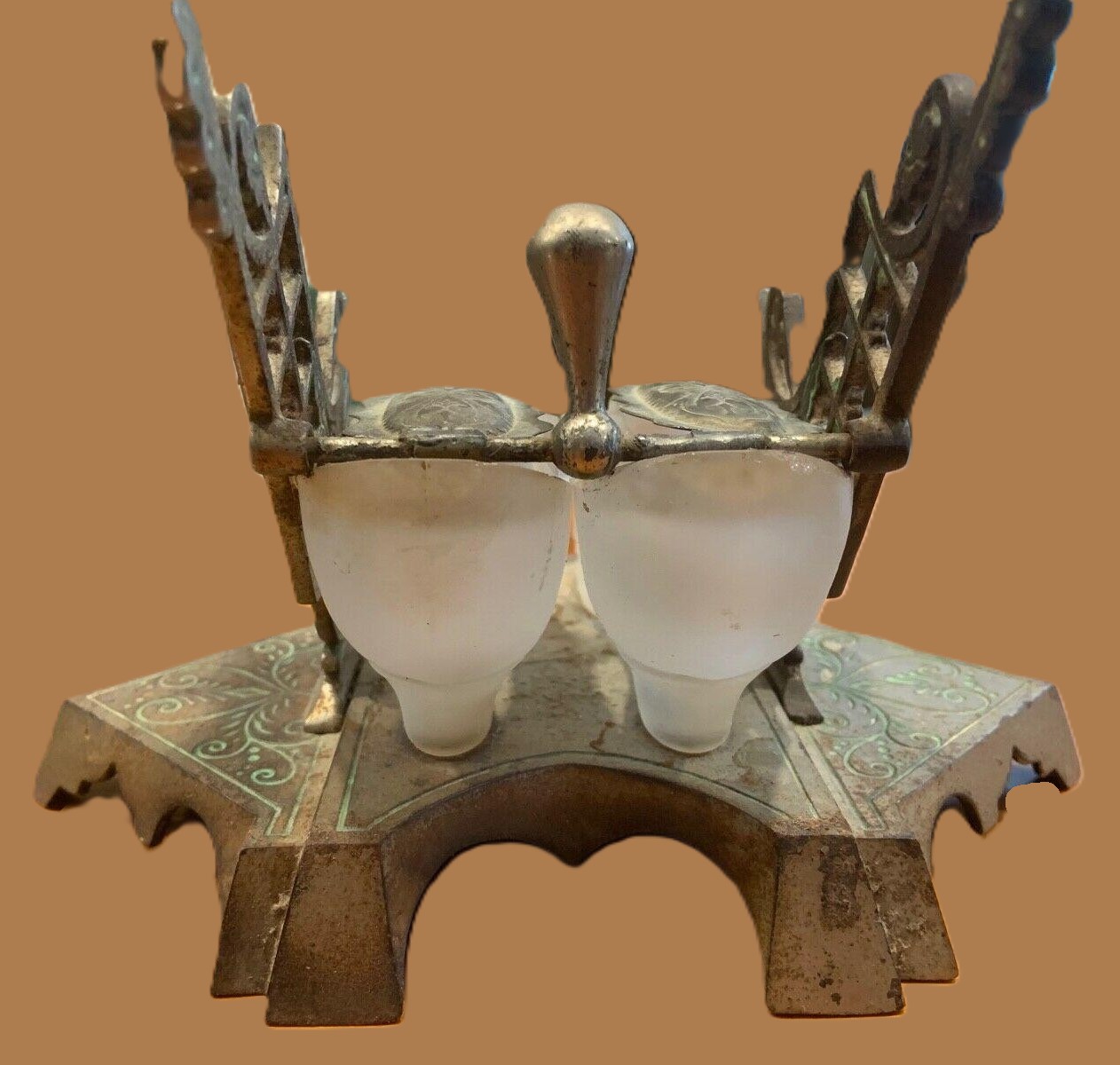
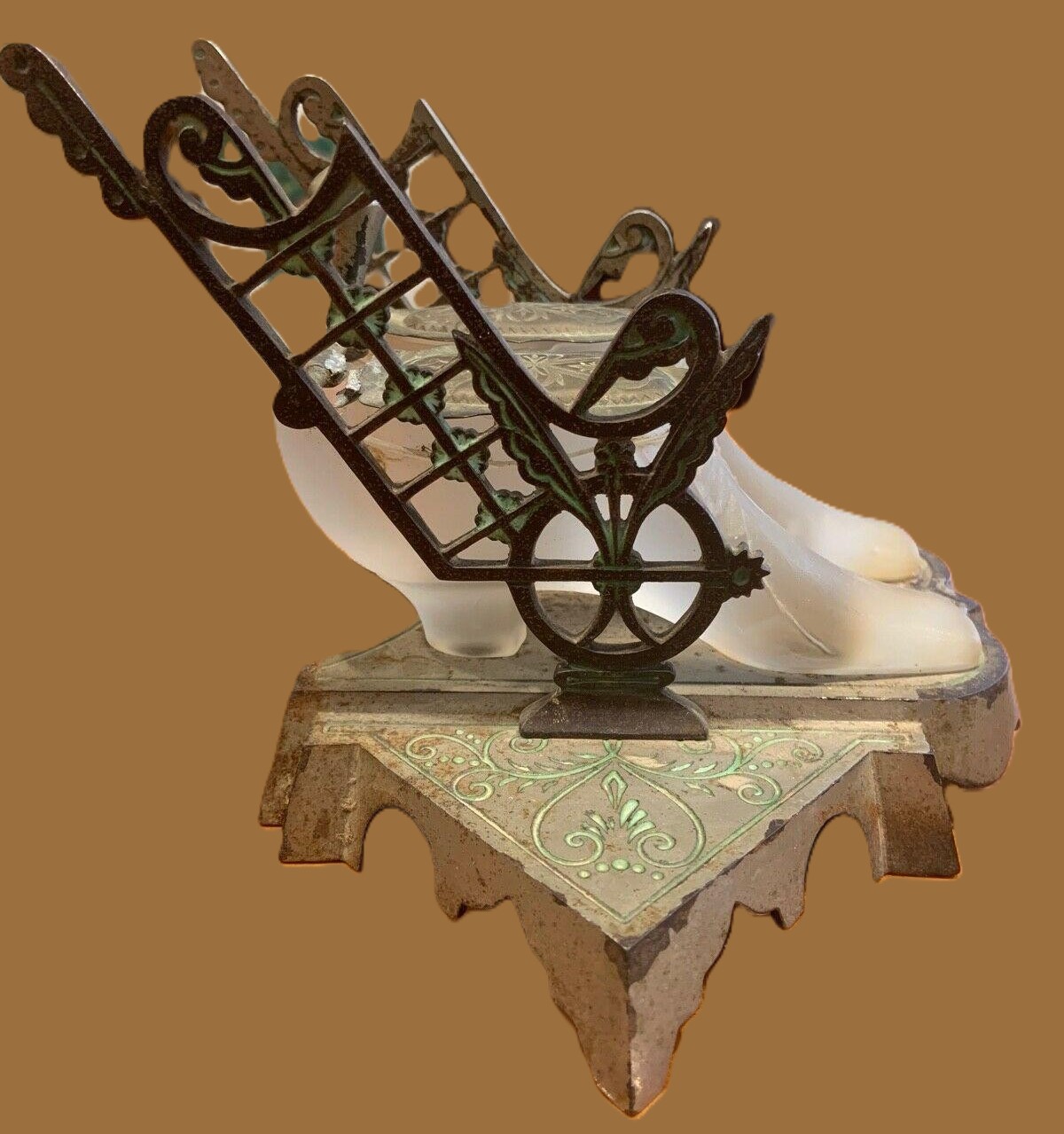
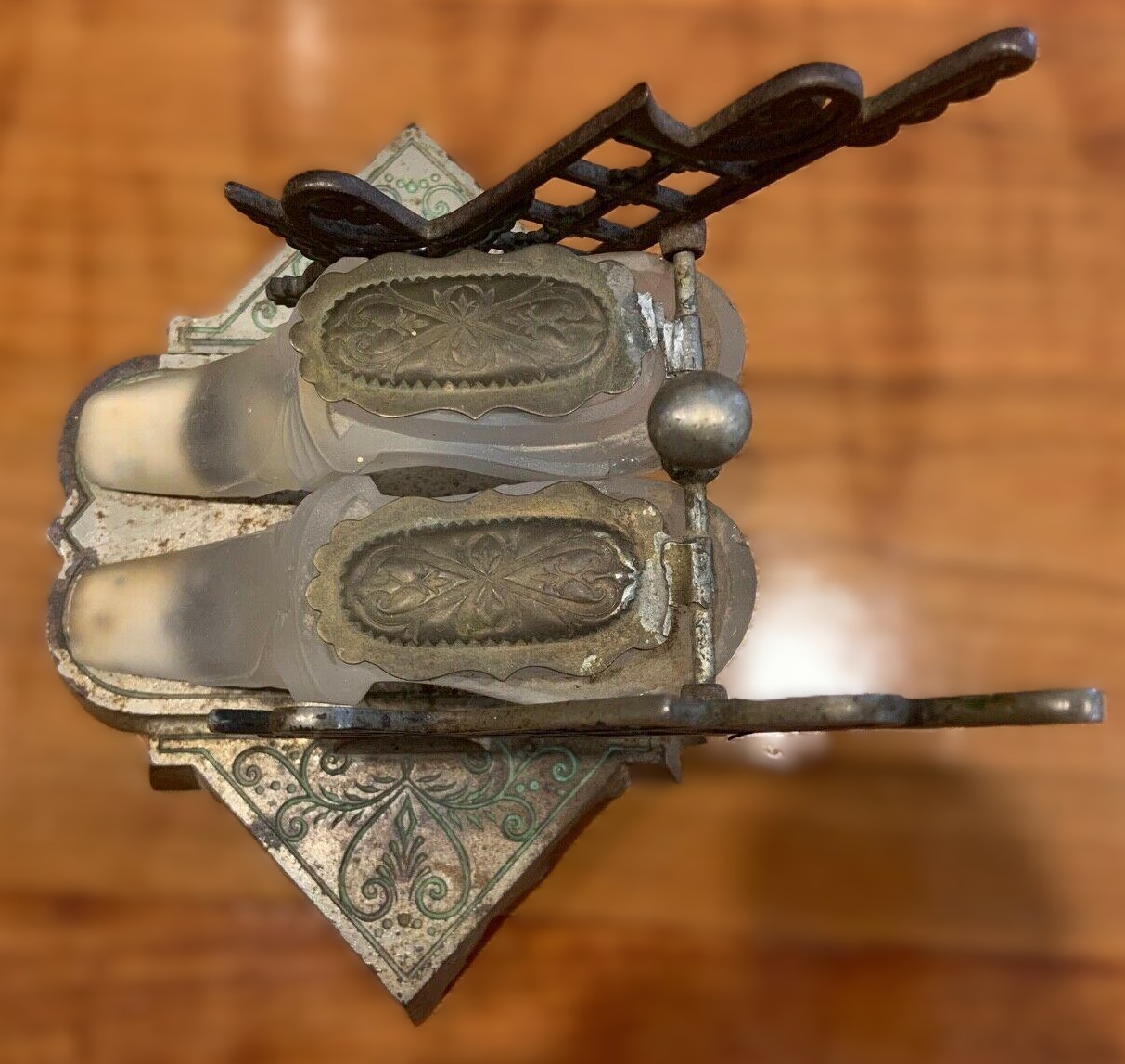
1876 Centennial Glass Slipper Double Inkstand
| Categories | Cast Iron, Figural - Inanimate, Souvenir |
| Type | Shoe |
| Material | Cast iron, Glass |
| Markings | See Narrative |
| Manufacturer | Undetermined |
| Origin | United States |
| Date or Era | circa 1876 |
| Measuring | 8” x 5 ¾” x 5” high |
| Patent | Patent Applied For - See Narrative |
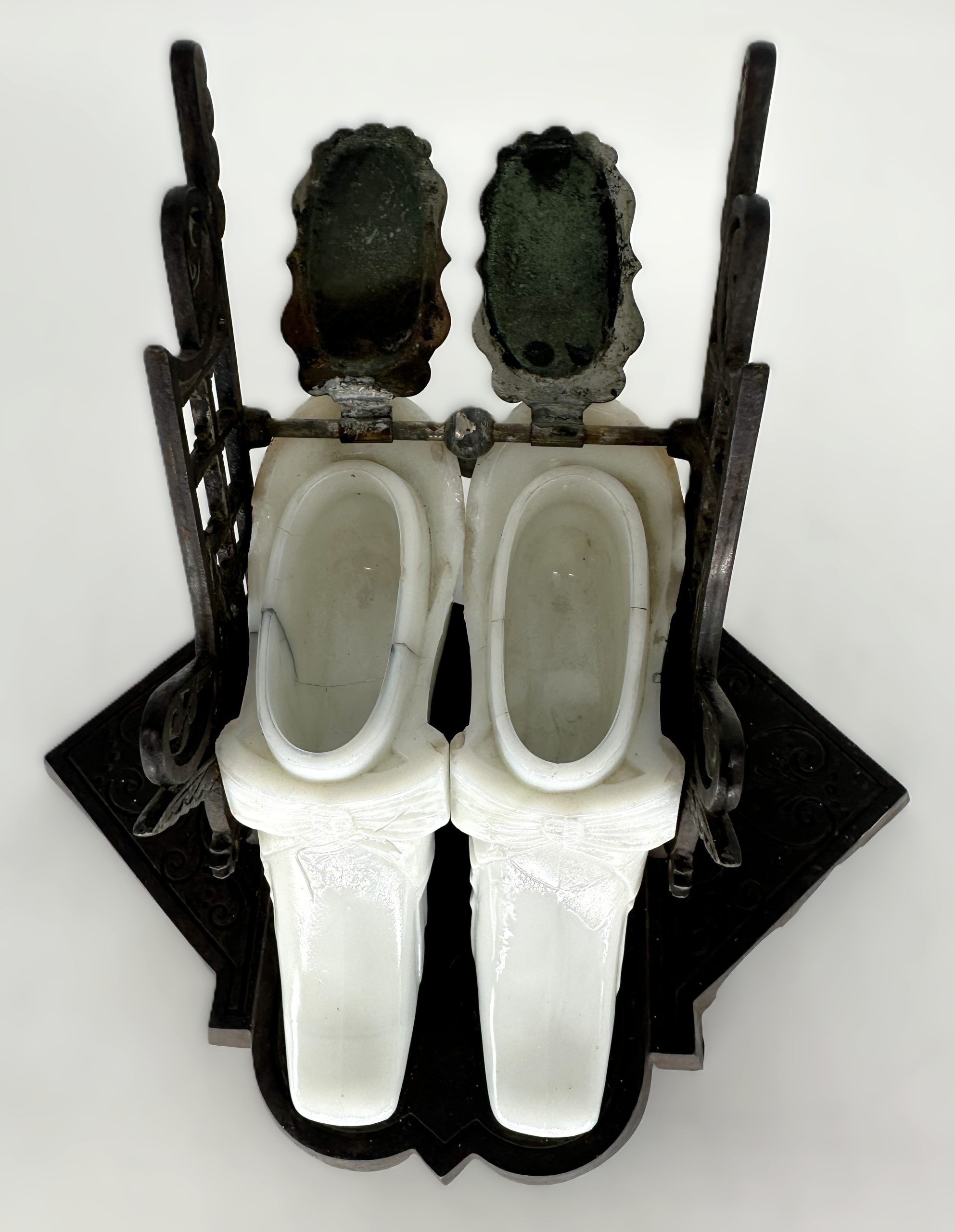
Attributed to Bradley & Hubbard (Meriden, CT), with glass components by Gillender & Sons (Philadelphia, PA), circa 1876–1880.
- Description & Design Details
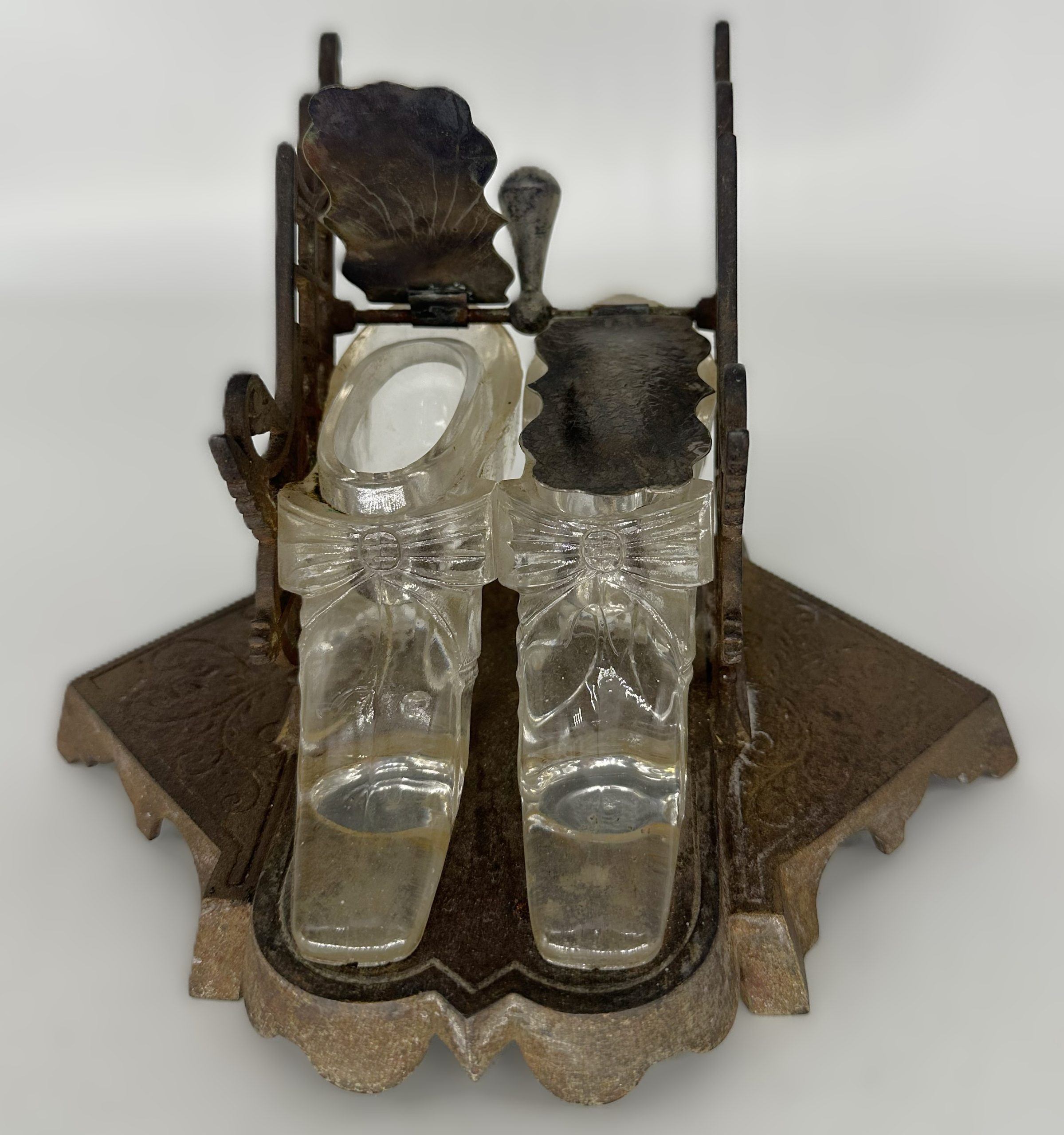
- The Base: A patterned cast iron stand with a dark, original japanned or patinated finish. The perimeter features stylized, scalloped Victorian gothic/geometric borders typical of Bradley & Hubbard’s 1870s catalog.
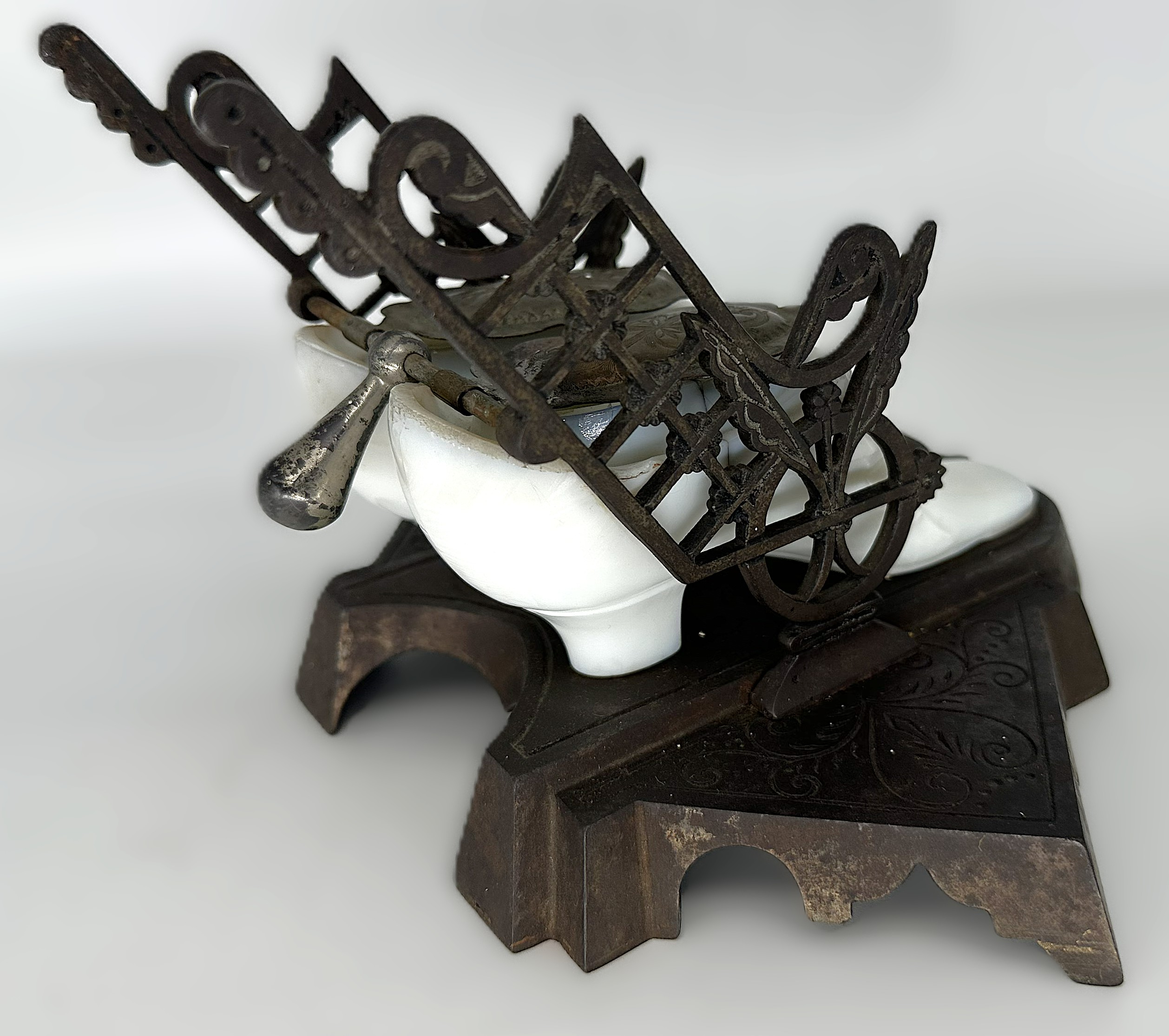
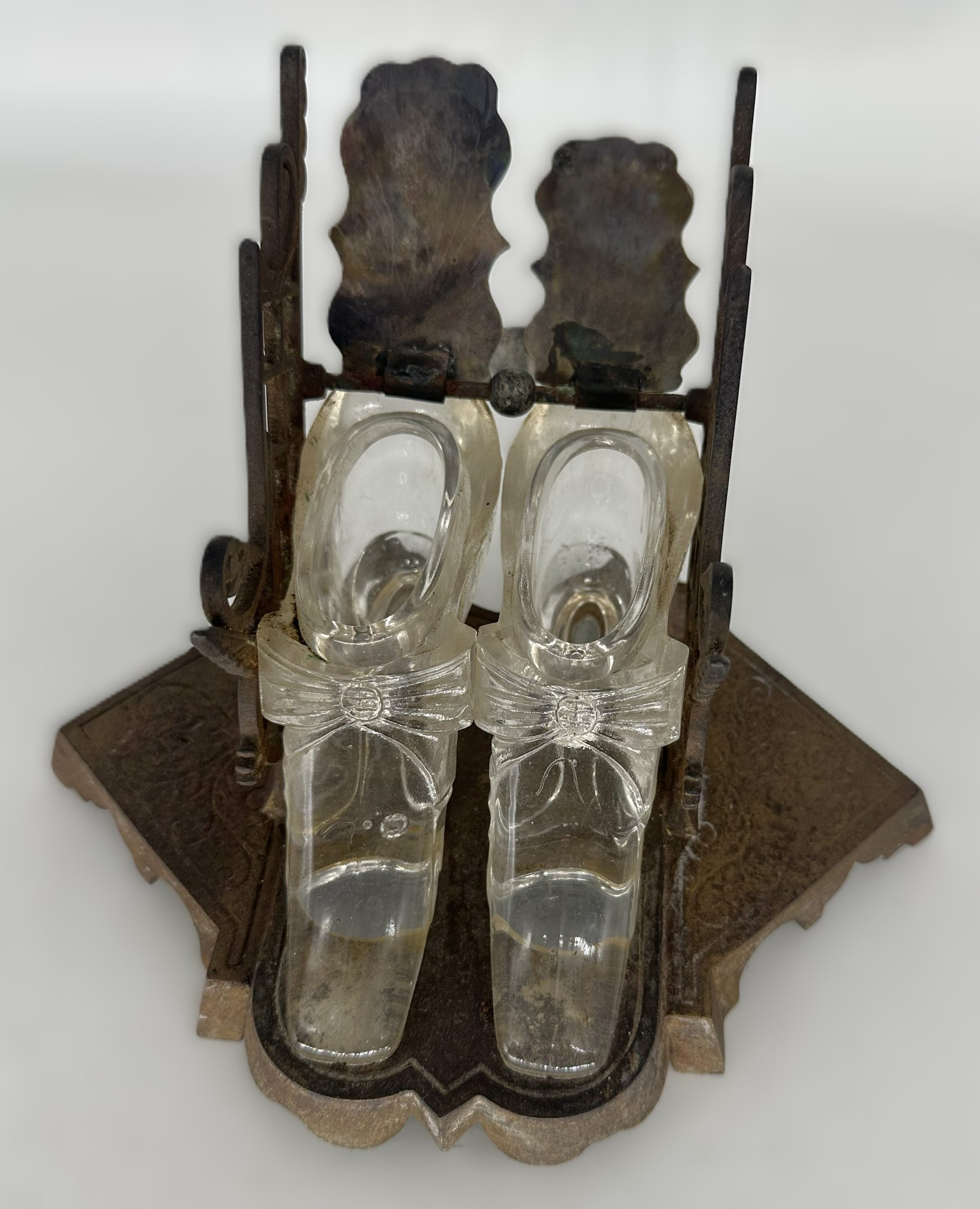
- The Pen Rack: Integrated directly into the design, the two ornate, pierced cast iron side brackets mimic the high, decorative back of a sleigh or an elaborate carriage. These openwork panels serve as a resting cradle for dip pens.
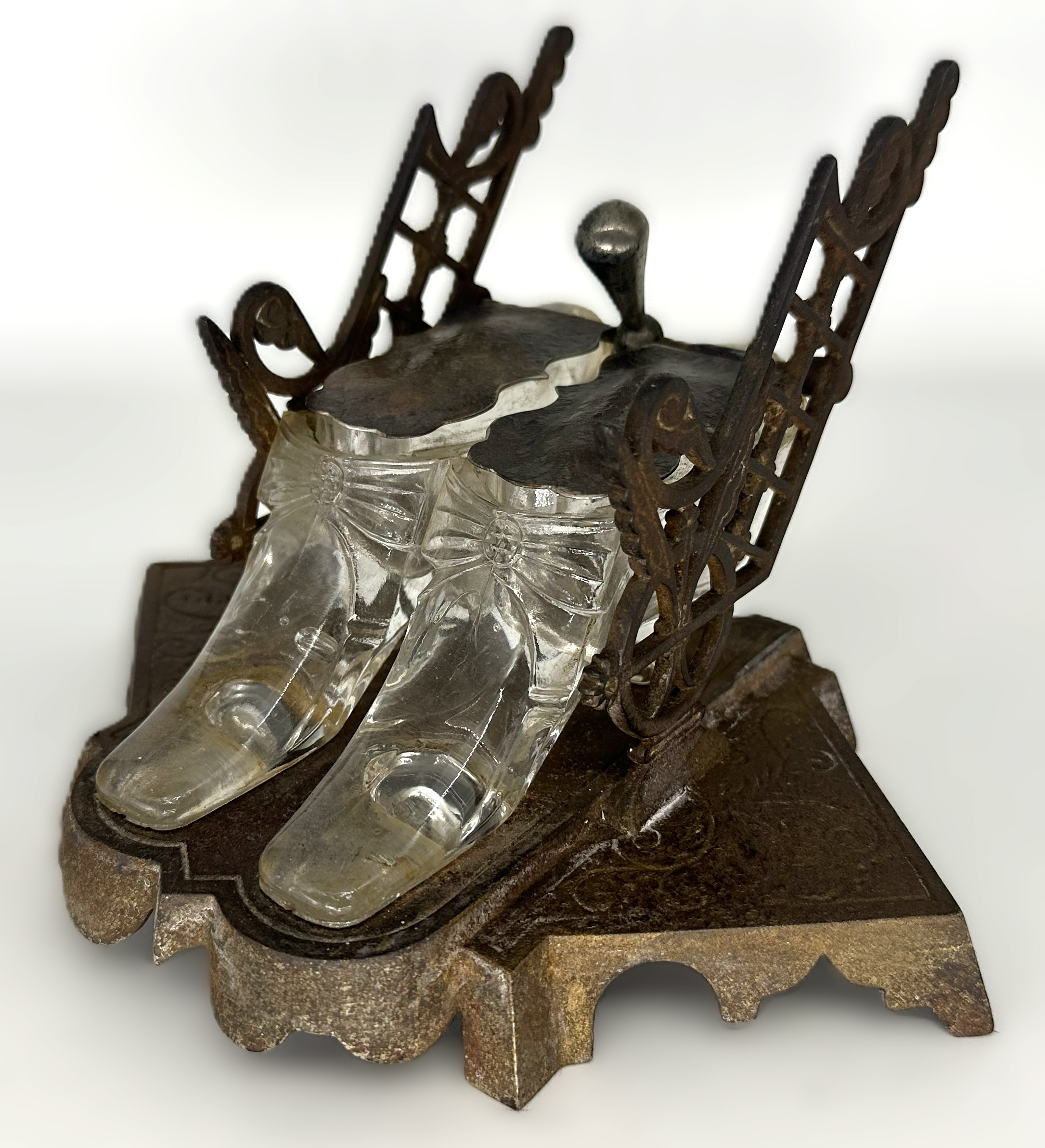
- The Inkwells: Two matching glass shoes molded in the shape of a elegant ladies’ footwear, complete with a neatly tied bow at the throat of the shoe. When the shoes sit side-by-side, they form a perfect double well. There are three known glass variants: milk glass (opal glass), clear glass, and satin (frosted) glass.
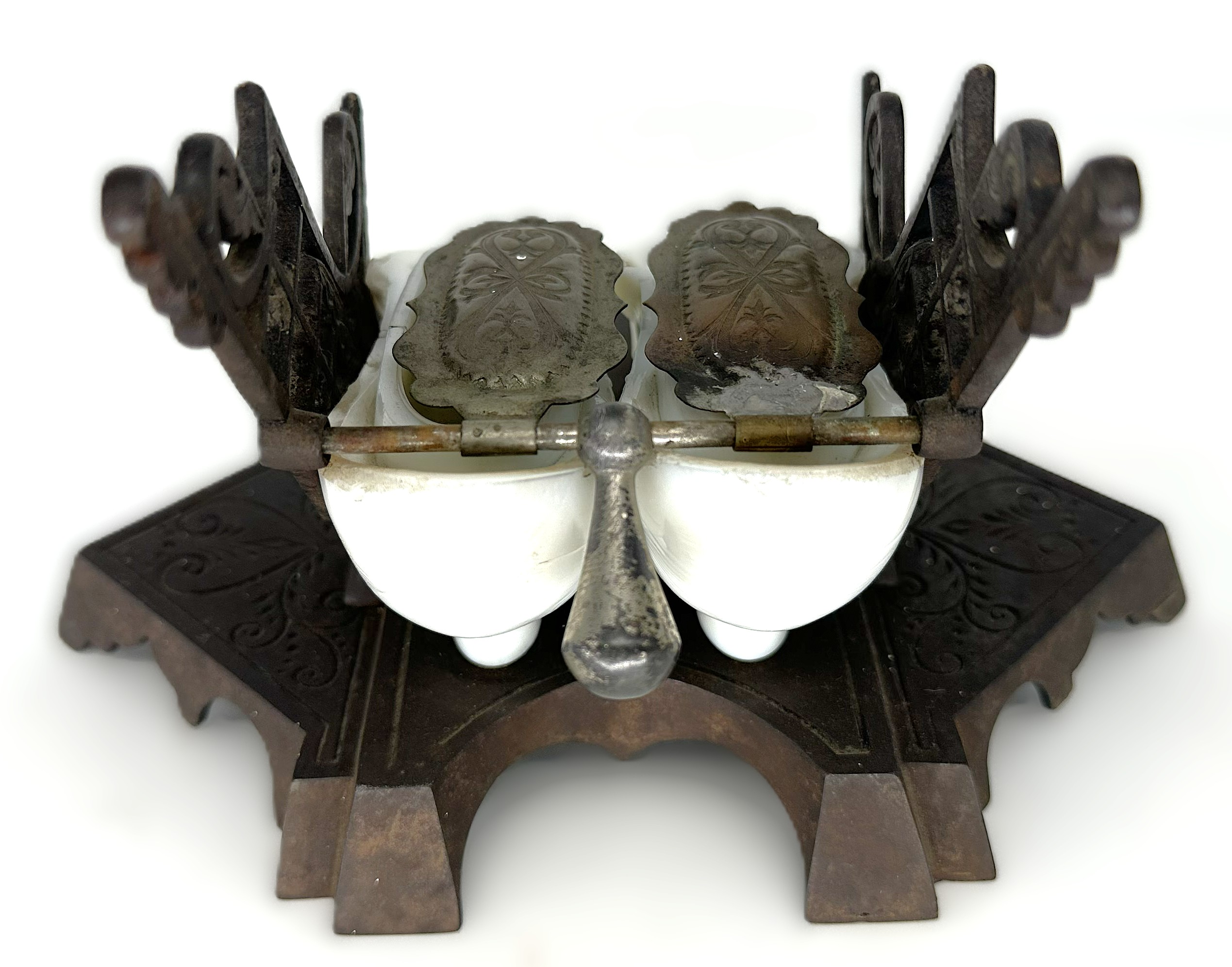
- The Hinge Mechanism: A clever mechanical design. A central teardrop-shaped iron weight/lever sits between the heels. When lifted or pulled, it rotates the common rod back, swinging the dual embossed brass decorative lids upward and backward simultaneously to reveal the clean, open ink reservoirs inside the ankles of the shoes.
This piece stands as a prime example of the high-quality, whimsical desk ephemera produced for America’s first World’s Fair.
- Manufacturer & Patent Identification
The Case for Bradley & Hubbard (Strong Probabilities)
- The Typography and Numbering System
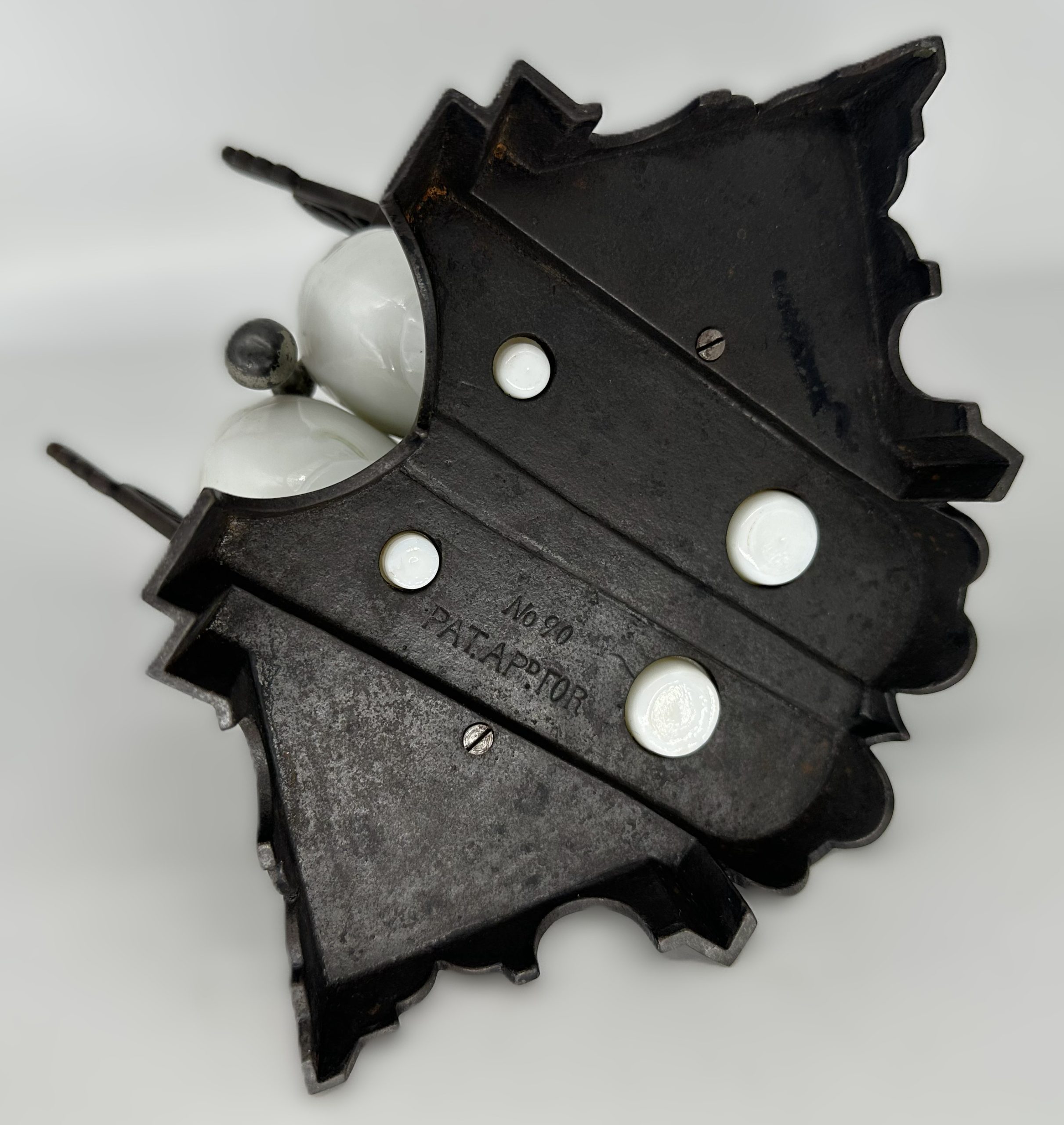
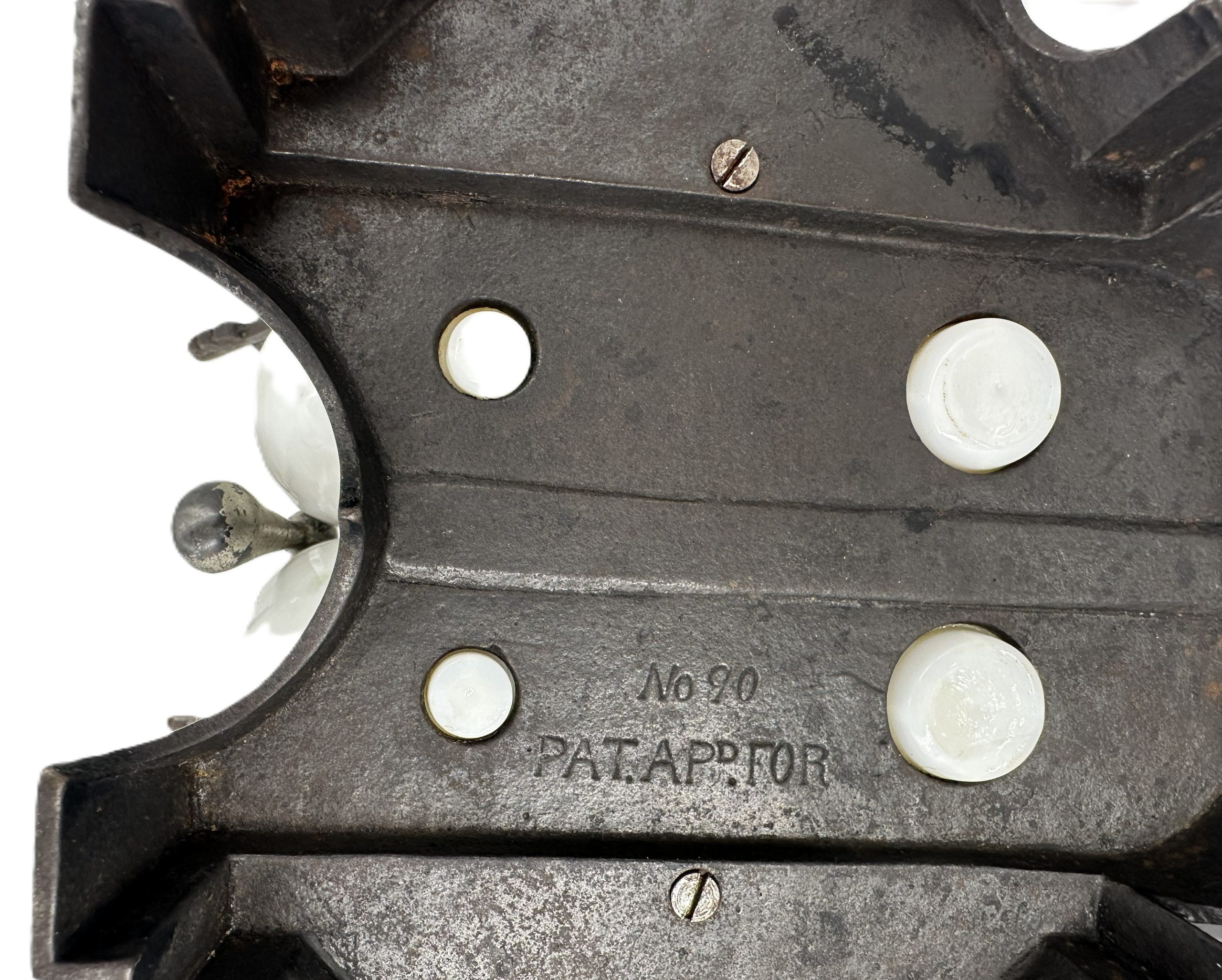
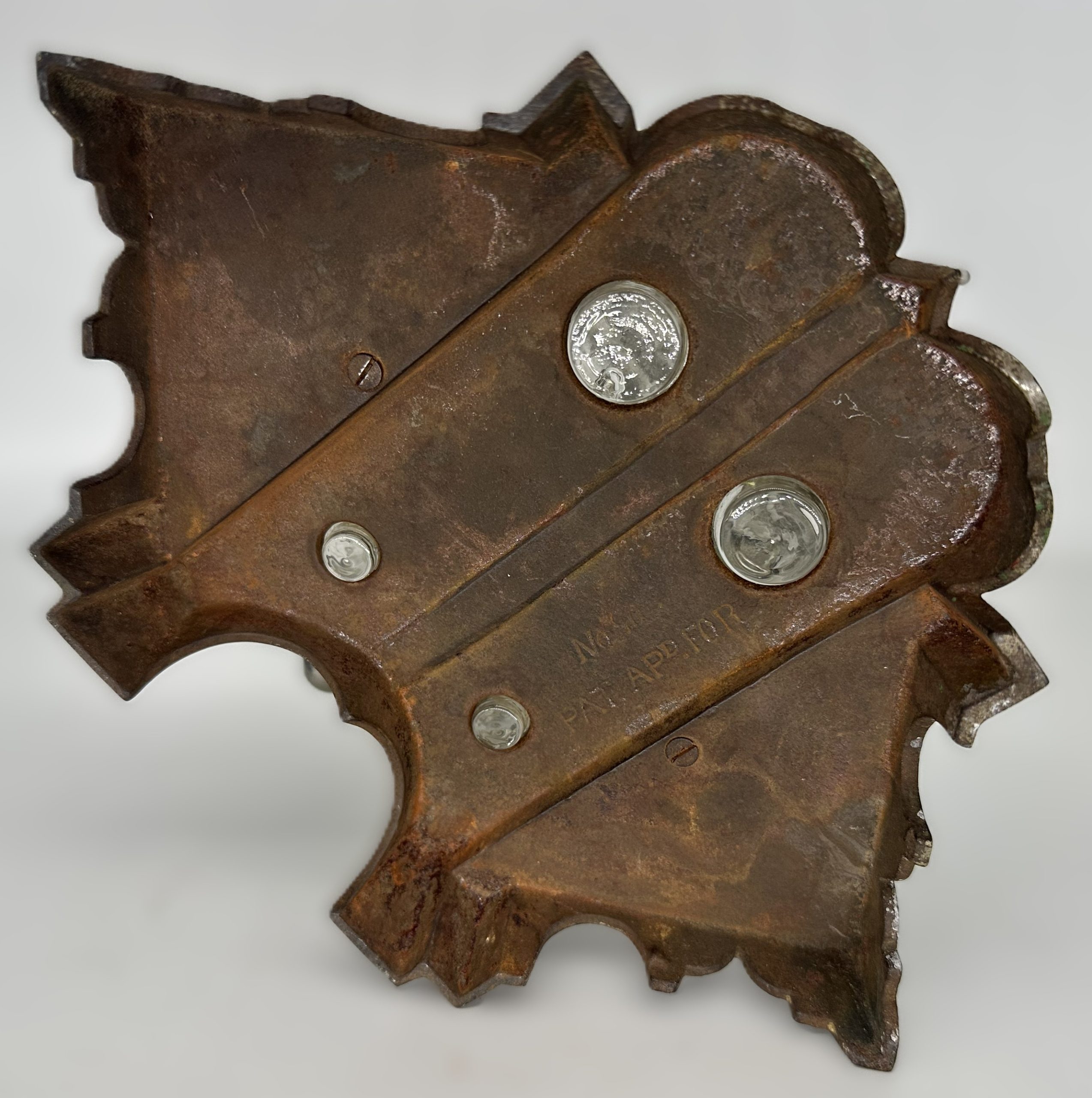
The specific serif font used for the “No 90” and “PAT. APP_D FOR” stamps is highly characteristic of Bradley & Hubbard’s foundry stamps from the late 1870s. Furthermore, B&H relied heavily on a numerical cataloging system where a clean two-digit or three-digit number was stamped directly into the master wooden pattern, leaving an identical recessed mark in every subsequent sand casting.
- The Integrated Hinge and Skeletonized Base
The engineering on the underside of this inkstand is the strongest calling card. B&H popularized the specific “skeleton frame” approach—casting a base with open structural ports so that the glass wells would lock into place mechanically under tension, rather than needing to be permanently plastered or glued down. The counterweighted crossbar hinge assembly is also in line with their mechanical desktop designs.
- Geographical and Commercial Proximity
Meriden, Connecticut (B&H’s home) and Philadelphia (Gillender’s home) were tightly linked by trade rail lines. B&H frequently sourced components from outside glass firms to supply parts they didn’t produce themselves, such as colorful pressed glass inserts, to stay competitive in the high-end novelty market.
The Case for Caution (The Skeptic’s Corner)
- The Missing “B&H” Mark
Bradley & Hubbard was notoriously proud of their brand. While they did leave some early pieces unsigned, by the late 1870s they were consistently stamping their famous “B&H” circular logo or spelling out their initials on the underside of their inkstands. The total absence of the B&H mark on a piece as elaborate as this is the primary reason to remain cautious.
- Formidable Competitors
The post-Centennial era saw intense competition among iron foundries, several of whom used almost identical catalog numbering styles and targeted the exact same souvenir market. Two other major manufacturers could easily have made this base:
- The Bradley & Hubbard Rivals: Competitors like J. & E. Stevens Co. (Cromwell, CT) and Murdock Parlor Grate Co. (Boston, MA) were producing highly ornate, whimsical cast iron desk sets, toy safes, and banks using very similar “Patent Applied For” stampings during the 1870s and 1880s.
- National Foundry (Newark, NJ): Another prolific caster of novelty desk ephemera and bookends that often used plain item numbers without explicit foundry logos.
The Patent Evidence
Bradley & Hubbard assigned specific catalog numbers to their vast line of cast iron inkstands. While it is stamped “Patent Applied For,” the design matches the mechanical trends they patented in the late 1870s. The four circular openings on the bottom are designed specifically to let the molded glass wells protrude slightly or sit flush, secured mechanically by the tension of the iron frame or individual small screws, minimizing the need for plaster or glue to hold the glass in place.
The Glass Component
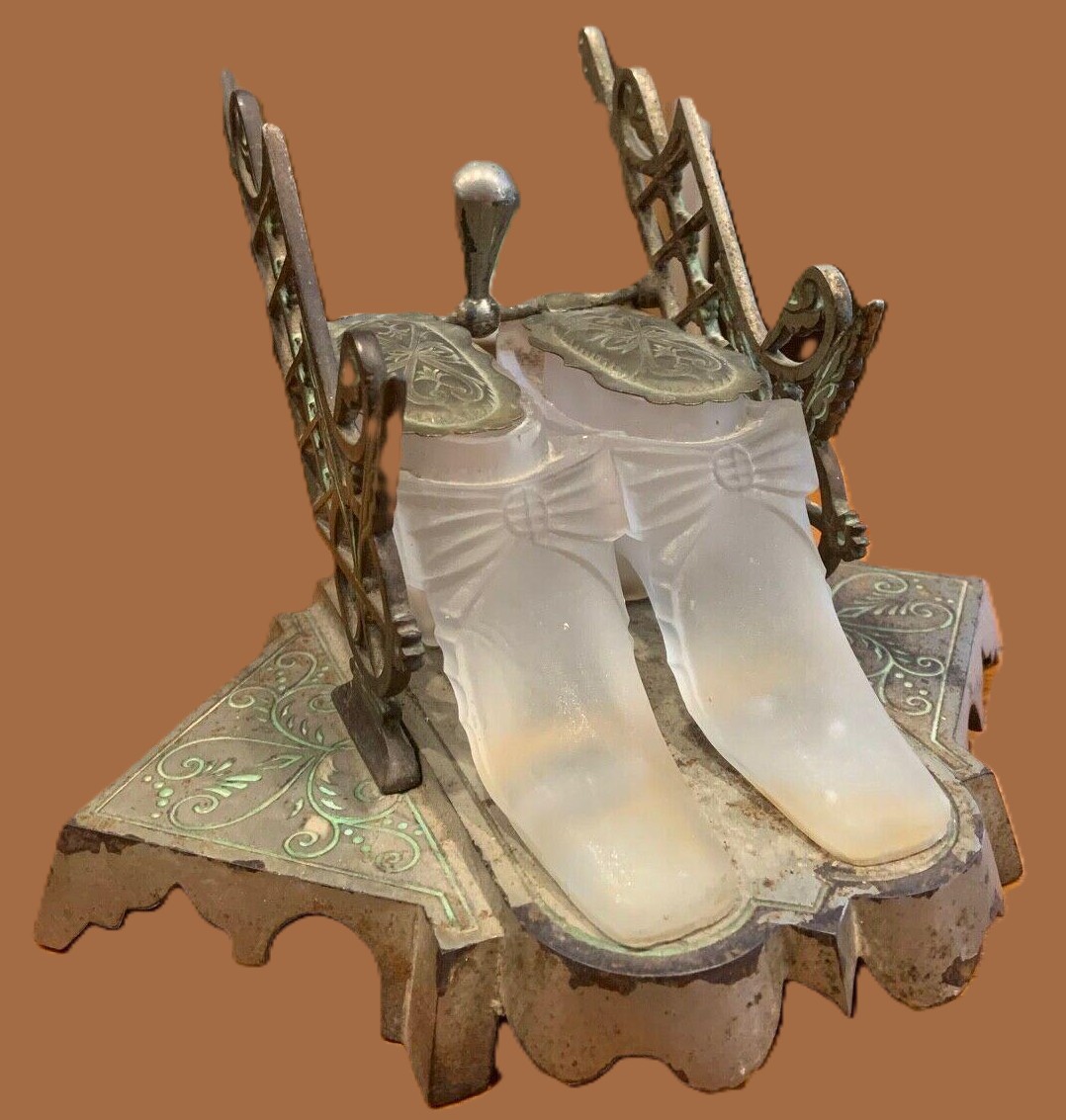
The glass slippers were produced by Gillender & Sons of Philadelphia. Pictured here are three variations of the glass slippers: milk glass, clear, and satin (frosted) glass.
- The Centennial Connection: Gillender & Sons famously set up a fully operational glassworks pavilion right on the exhibition grounds at the 1876 Centennial Exposition. Fairgoers watched glass being melted, blown, and pressed in real-time, buying the finished pieces as souvenirs.
- The Collaboration: Gillender supplied these pressed-glass “Centennial Slippers” (often molded with a bow, as seen here) to metalwork firms like Bradley & Hubbard, who bought the glass components wholesale to integrate into their own luxury cast iron desktop novelties.
Finding a single foundry base paired across an entire multi-variant glass palette is confirmation of how these pieces were produced and marketed.
- Confirmation of the “Jobber” Assembly System
This cross-variety proof demonstrates that the metal foundry (whether Bradley & Hubbard or a direct competitor) treated the cast iron frame as a universal chassis. They bought these novelty slippers in bulk barrels from the glassworks in every color and finish available, then assembled them to order or mixed them up to offer a varied product line at different price tiers.
- The Definitive Gillender & Sons Fingerprint
The presence of the clear and satin variants points directly to Gillender & Sons of Philadelphia.
- The Exhibition Catalog Evidence: Historical records from the 1876 Centennial Exposition explicitly note that Gillender was pressing their famous “Centennial Slipper” souvenir (molded with the exact bow at the throat seen here) in opal (milk) glass, crystal clear glass, and frosted/satin glass.
- The “Satin” Technique: Gillender was highly regarded for its acid-etching department. Fairgoers could watch clear glass items get dipped into an acid bath to instantly transform them into smooth, velvety satin glass right before their eyes.
- The Clues in the Finishes (Japanning vs. Polychrome)
The physical condition of these variants tells a fascinating story about how they were originally finished:
- The Clear Shoe Inkstand: The base shows a beautifully aged, completely dark, oxidized iron patina. On the underside, the mold number is heavily obscured by decades of surface rust and oxidation, leaving only “PAT. APP’D FOR” readable at a glance. This dark, single-tone finish was standard for everyday library or office use.
- The Satin Shoe Inkstand: This base retains its original polychrome or highlighted finish. Notice the vibrant green paint or faux-bronze/copper verdigris wash nestled deep within the scrolls of the side pen rack and the geometric borders of the base. This indicates it was sold as a premium, higher-end decorative model designed to mimic expensive French bronzes or whimsical art-metal items.
- Why Shoes? The Victorian Novelty Craze
Using footwear as a design motif was popular during the late 19th century, driven by a few distinct cultural factors:
- The Novelty Glass Phenomenon: The Victorian era was obsessed with whimsical design. Glass manufacturers competed to see who could mold glass into the most unexpected shapes—top hats, animals, mittens, and boots. Slippers and high-button shoes were among the most popular forms.
- The Centennial Souvenir Market: At the 1876 Exposition, functional souvenirs were highly prized. A pair of fashionable ladies’ slippers fashioned into inkwells combined historical commemoration with high Victorian tabletop vanity.
- Symbolism: In Victorian culture, shoes (particularly elegant ladies’ footwear or slippers) carried connotations of domestic comfort, good luck, and fashion. Giving or displaying a slipper souvenir was considered charming and lucky.
- Cinderalla and the Glass Slipper
The Cinderella fairy tale had an enormous, direct relevance to the popularity of these slippers! In fact, the Victorian obsession with the story is precisely why Gillender & Sons manufactured hundreds of thousands of these glass shoes, and why they became a definitive staple of American popular culture in the late 1870s.
To a Victorian consumer, a glass slipper was not just a generic shoe—it was an instant, romantic shorthand for the ultimate rag-to-riches story. Several cultural currents converged to create a perfect storm for this design:
- The Victorian Cinderella Obsession
The 19th century was infatuated with the Cinderella fairy tale. It was widely published in beautifully illustrated children’s books, translated into lavish theatrical “pantomimes” and stage plays, and constantly referenced in popular music.
Because Victorians viewed the home as a sanctuary of morality and domestic charm, fairy tale motifs were frequently integrated into functional household items. Displaying a “glass slipper” on a desk or mantle piece was a nod to romance, destiny, and the ultimate reward of inner virtue and beauty.
- A “Cinderella” Marketing Masterstroke
When Gillender & Sons built their working glass factory on the grounds of the 1876 Philadelphia Centennial Exposition, they needed a souvenir that was cheap to produce, visually captivating to watch being molded, and universally appealing.
By taking a fashionable, bow-tied lady’s slipper and casting it in literal crystal clear glass, they were giving fairgoers the extraordinary opportunity to hold a real-life, physical manifestation of the famous “Cinderella glass slipper.”
It was an absolute sensation. Records indicate that over 100,000 of these slippers were sold right off the cooling lines at the exposition. It became the definitive “must-have” novelty of the fair.
- The “Satin Glass” Twist
The Cinderella connection becomes even more interesting when looking at the satin (frosted) glass version. In the 1870s, there was an active, lively debate among literary scholars and folklorists regarding a famous translation quirk in Charles Perrault’s 1697 French version of the tale:
- Did Cinderella wear a slipper made of glass (verre)?
- Or was it originally a slipper made of white squirrel fur (vair), misspelled over generations of storytelling?
The Victorian public universally rejected the fur theory—they wanted the magic of glass. However, glass manufacturers leaned into the texture debate by offering the slippers in a frosted “satin” finish. The satin glass brilliantly bridged the gap: it was made of literal glass, but it had a soft, velvety, almost fabric-like texture to the touch.
The Collector’s Takeaway
When Bradley & Hubbard (or their contemporary foundry rival) mounted these specific Gillender shoes into their “No. 90” carriage-style double inkstand, they weren’t just making a desk accessory—they were capitalizing on an absolute pop-culture phenomenon. To the Victorian eye, these inkstands elegantly captured the whimsy of a literal fairy tale carriage waiting to sweep a pair of glass slippers away to the ball.
Patent Applied For
Determining the exact patent application number or an official “approved” designation for this specific model reveals a fascinating quirk of 19th-century manufacturing law and Bradley & Hubbard’s (or their contemporary foundry rival) corporate strategy.
The short answer is that there is no recorded approved patent or serial number that perfectly links to “No. 90” as a standalone shoe inkstand mechanism. A dive into USPTO records from the late 1870s and early 1880s explains why this piece remains marked exactly as it is:
- The Strategy Behind “PAT. APP’D FOR”
In the 1870s, the U.S. Patent Office did not assign tracking numbers to pending applications the way they do today (modern serial numbers were not systematically formalized until 1915). When a company stamped “PAT. APP’D FOR” on cast iron, it served primarily as a legal deterrent to competitors while the paperwork was processed.
However, many novelty items marked “Patent Applied For” were never actually granted final individual patents. There are two primary reasons why this inkstand likely stayed in “Applied For” status permanently:
- The Utility Hurdle (The Hinge): For a utility patent to be approved, the mechanism had to be entirely novel. Double-hinged lids operated by a central crossbar or weighted rod were already widely used by other desktop manufacturers. If the patent examiner deemed the counterweighted crossbar to be “obvious variation of prior art,” the utility application would have been rejected or abandoned.
- The Design Patent Hurdle (The Shoes): If they applied for a Design Patent (which protects the specific look of an item), they ran into a major legal conflict: Gillender & Sons owned the rights to the molded slipper design. Because Bradley & Hubbard (or their contemporary foundry rival) was buying the glass components wholesale from a third-party glassworks rather than inventing the shoe shape themselves, they couldn’t claim an exclusive proprietary design for the completed unit.
- What Does “No. 90” Mean?
The “No. 90” is not a patent number; it is an internal factory catalog or model number.
Because cast iron required expensive, hand-carved wooden master patterns to create the sand molds, every single base shape was meticulously logged. When a retail store or a salesman wanted to order this exact “Double Centennial Slipper Sleigh” inkstand, they ordered it strictly as “Inkstand No. 90.”
- The Closest Approved Relatives
While this specific assembly didn’t secure an independent patent, Bradley & Hubbard’s chief designers – namely John A. Evarts and Frederick R. Seidensticker – were patenting desk ironwork at a furious pace during this exact window.
The closest approved design philosophy to this piece can be found in patents like U.S. Patent No. 211,383 (granted January 14, 1879) for a multi-compartment frame. In these approved patents, B&H focused heavily on protecting the underside engineering—specifically, using skeletonized cast iron frameworks with precise circular cutouts that allowed glass inserts to drop in perfectly from the top and sit flush without needing plaster.
Summary
These inkstands represent a classic 1876–1879 production run where the mechanical application was either rejected or simply abandoned because the item sold incredibly well anyway. For a collector, the “PAT. APP’D FOR” combined with the catalog “No. 90” is actually an historical fingerprint—it dates the casting of that base precisely to a narrow, high-energy window immediately following the Centennial Exposition!
Satin glass version sold for $315 in February 2022
Content disclaimer. The information posted is the owner’s best knowledge and may not have been vetted by the SOIC. We welcome comments, corrections, and additions, working to make our website information comprehensive and accurate.
Join the Society of Inkwell Collectors (SOIC) – it’s free!
Founded in 1981 as a non-profit organization,
we are documenting inkwells (and accessories).
We’re here to help and inform!