

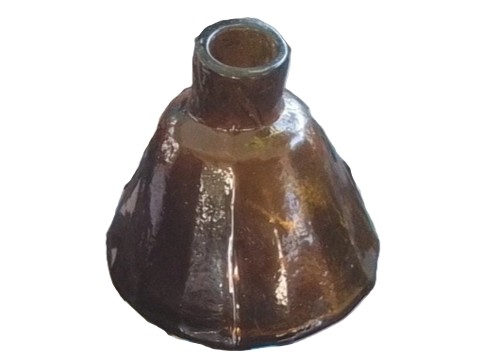




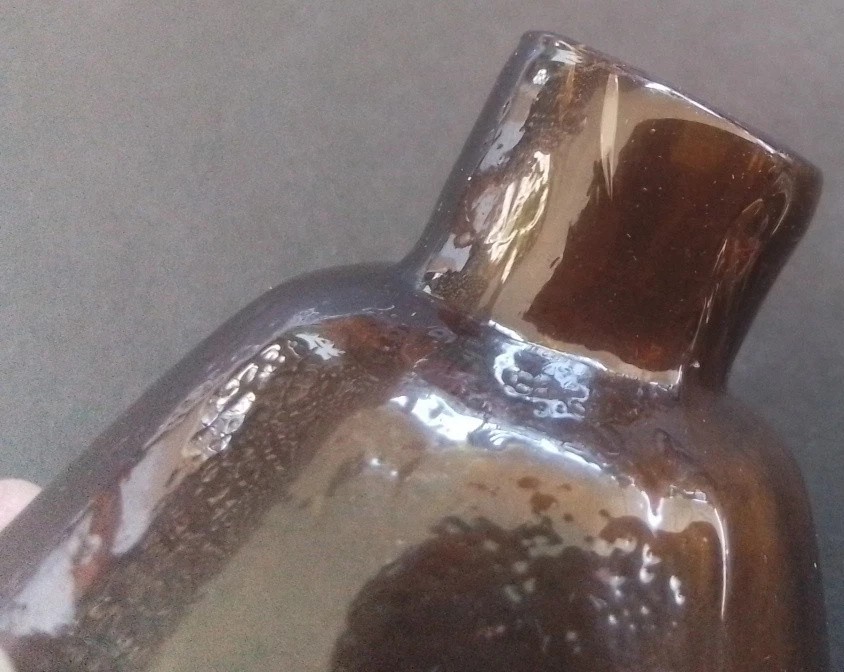

1850s New England 16-sided Umbrella Ink Bottle
| Categories | Ink Bottle |
| Material | Glass |
| Markings | Unmarked |
| Origin | United States |
| Date or Era | circa 1850 |
| Measuring | 2 ⅛” diameter |
Description
This is an exceptional mid-19th-century umbrella ink bottle (dating to the 1840s–1860s), a design classic specifically engineered to prevent accidental tipping.
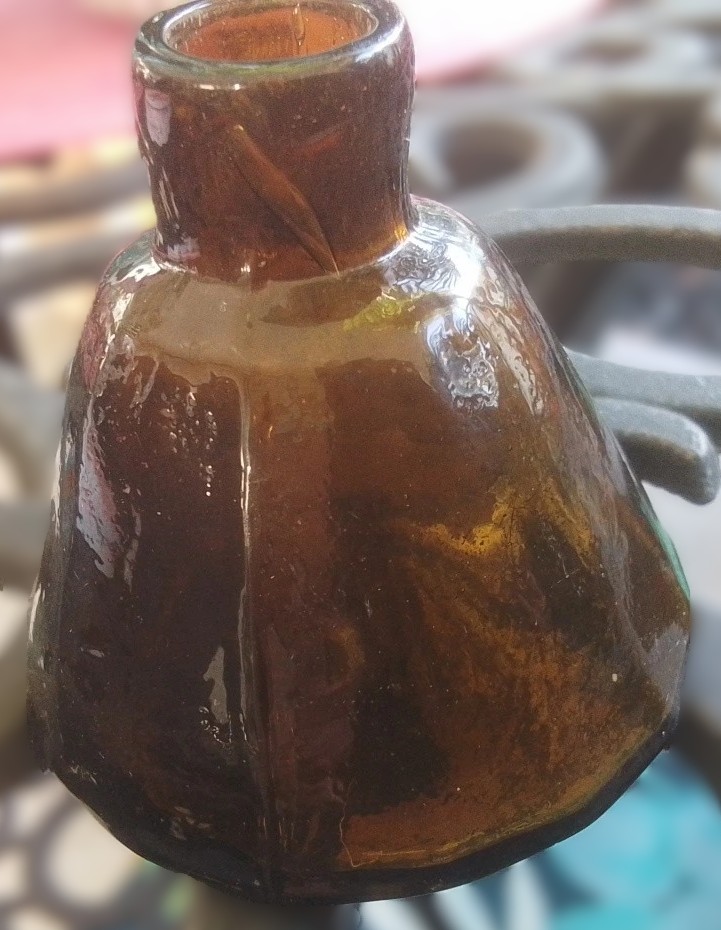
- Form & Structure: This specimen features a distinctive conical shape with 16 flat, vertical side panels that taper seamlessly toward the shoulder.
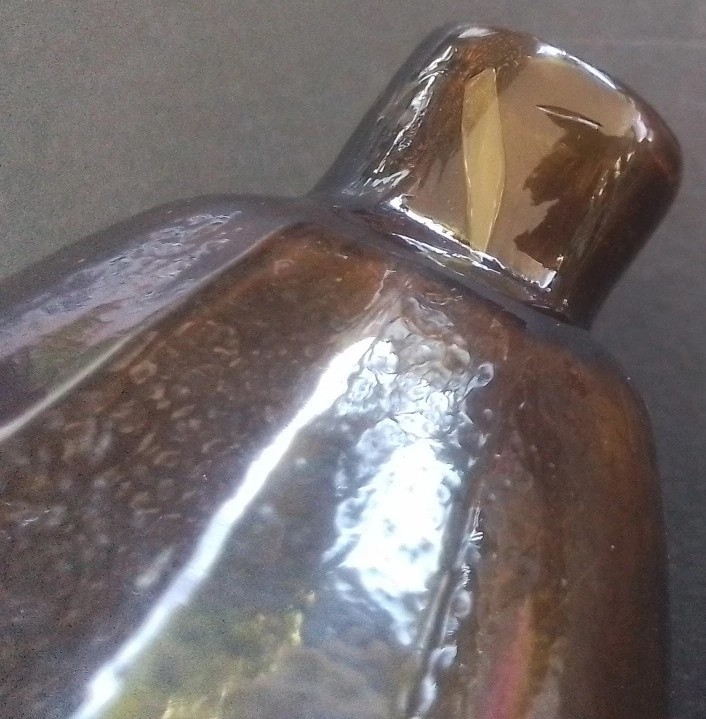
- Color & Condition: It exhibits a deep, rich amber/olive-amber color that reveals beautiful golden tones when backlit. The glass displays remarkable clarity and character, including long, elongated air bubbles trapped within the finish. The surface is well-preserved with no structural cracks or major chips.
How This Inkwell Was Made
This piece was made during the height of early American utilitarian glassblowing, a highly physical and technical process:
- Blow-Back / Mold Blown: A gather of molten amber glass was placed on the end of a blowpipe and lowered into a multi-part metal or clay mold (likely a two-piece or three-piece mold). The glassblower blew down the pipe, forcing the expanding glass outward to match the 16-sided, multi-paneled design of the mold cavity.
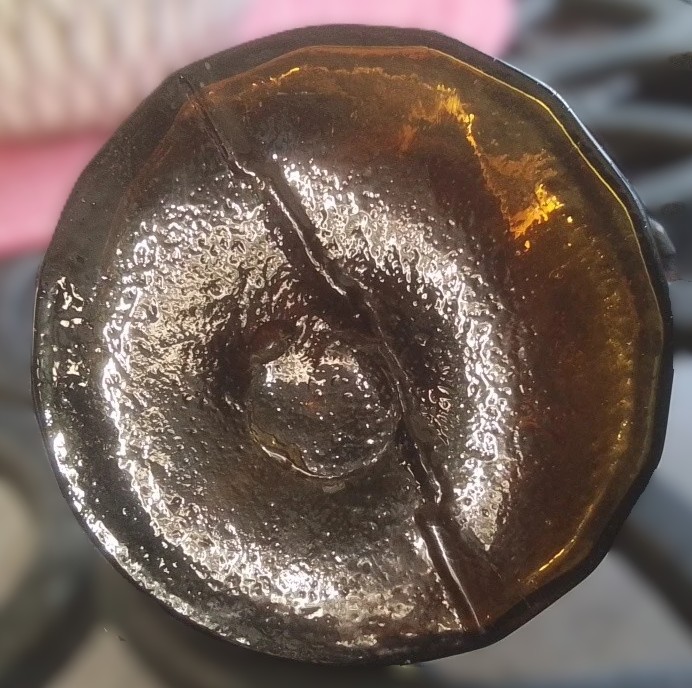
- The Seam Lines: Evidence of this process is left behind in the faint, raised vertical mold seams that cross the base and travel up the paneled body.
- The Pontil Attachment: To finish the top of the bottle, the glassmaker attached a secondary solid iron rod (a pontil rod) or a blowpipe to the base of the bottle using a small dab of molten glass. The primary blowpipe was then snapped off from the neck.
- Sheared Mouth / Tooled Lip: With the bottle held by its base via the pontil rod, the artisan sheared the neck with shears or worked it with a hand-tool to finish the mouth. This manual tooling created the distinctively irregular, slightly inward-folded rim.
- The Pontil Scar: Once the mouth was finished, the pontil rod was snapped off the bottom, leaving behind the jagged, circular, recessed blowpipe pontil scar (or open pontil mark) on the base.
Can We Confirm it is From Stoddard Glass Works?
While an absolute 100% guarantee is difficult because utility bottles of this period were almost never explicitly embossed with a factory name, there is a remarkably strong and highly probable attribution to the Stoddard glasshouses of New Hampshire (such as the Granite Glass Co. or Weeks & Gilson, operating between 1842 and 1873):
- The 16-Panel Mold Archetype: The 16-sided umbrella ink configuration is a well-documented specialty of the Stoddard glass factories. While 8-sided and 12-sided versions were produced widely across New England (including Keene, NH), the 16-sided mold in this specific height and base diameter is a regional signature highly sought after as a Stoddard product.
- Glass Composition & Color: The glass composition itself—rich in impurities, producing that textbook “Stoddard amber/olive-amber” tone and littered with charming manufacturing characteristics like the seed bubbles and the beautiful teardrop bubble in the neck strongly aligns with the exact chemical output of the New Hampshire wilderness glasshouses.
This bottle stands as a beautiful, textbook representation of early American historical glass.
Sold for $377 in May 2026
Content disclaimer. The information posted is the owner’s best knowledge and may not have been vetted by the SOIC. We welcome comments, corrections, and additions, working to make our website information comprehensive and accurate.
Join the Society of Inkwell Collectors (SOIC) – it’s free!
Founded in 1981 as a non-profit organization,
we are documenting inkwells (and accessories).
We’re here to help and inform!