

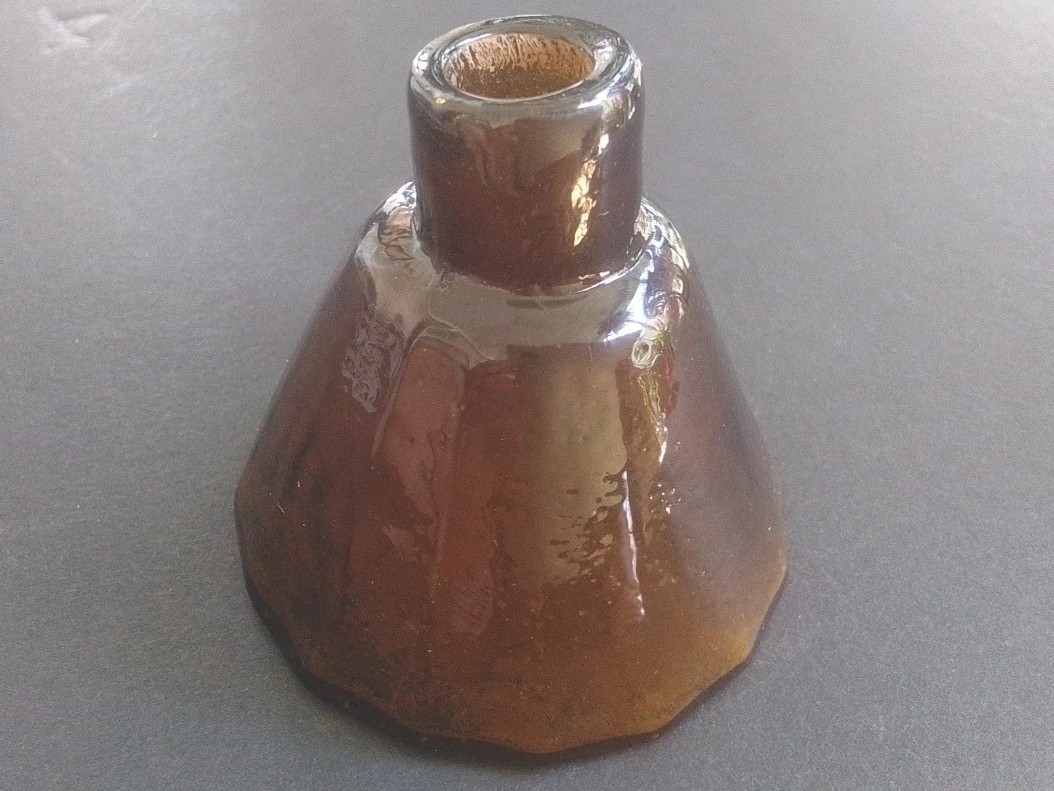


16-Sided Umbrella Ink Bottle
| Categories | Ink Bottle |
| Type | Umbrella |
| Material | Glass |
| Markings | Unmarked |
| Origin | United States |
| Date or Era | circa 1850 |
- Age and Attribution (1840s–1860s)
This conical, multi-sided form is colloquially known as an “umbrella” ink bottle due to its flared, faceted silhouette. While they were produced from the 1840s up through the 1880s, the crude manufacturing characteristics visible on this piece place it in the early window of production (c. 1840s–1860s).
Attributing it to the Stoddard Glass Works (New Hampshire) is a probable hypothesis. Stoddard is famous for producing utilitarian wares in these distinct, rugged “black glass” and rich amber tones using iron-rich sand.
- Panel Count
This is a classic 16-sided umbrella ink. This high panel count gives it a sharp, reflective, and architectural geometry prized over more common 8-sided variants.
- Color
In normal, indoor lighting, the glass looks so dense it borders on “black glass” (a very dark olive-amber). However, when back-lit by the sun, the true composition comes alive. It is a stunning, warm yellow-olive or “tobacco” amber. This specific color profile—filled with microscopic seed bubbles and impurities—is textbook New England glasshouse style.
- Condition
The bottle is in excellent antique condition. The surface retains a brilliant, glossy luster with no obvious structural cracks or heavy modern bruising. The glass exhibits “whittling” or texture from a cold iron mold, which can sometimes be mistaken for scratches, but is actually an original mint-state manufacturing texture.
How This Ink Bottle Was Made
Based on the physical clues on the bottle, here is how a glassblower made it around 1850:
Step 1: Gathering and Blowing into a Key Mold
A gather of molten amber glass was pulled from the furnace on the end of a hollow blowpipe. The blower inserted the hot glass bulb into a multi-part metal mold (likely a two-part or three-part “chilled” iron mold). As they blew into the pipe, the glass expanded to fill the 16-sided umbrella shape of the mold.
- The Clue: One can clearly see a vertical mold seam running right up the base and splitting the side panels. This proves it was a molded bottle, not free-blown.
Step 2: The Pontil Rod Attachment
Once the body was formed, the bottle needed to be detached from the blowpipe so the maker could finish the neck and lip. To hold the blazing-hot bottle, an assistant attached a solid iron rod called a pontil rod (or punty) to the very bottom of the bottle using a small dab of hot glass.
- The Clue: The prominent, jagged, circular scar in the center is a sheared pontil mark. When the rod was snapped off at the very end of production, it tore away a small bit of the bottle’s base glass, leaving this rough scar. This is the ultimate hallmark of a genuine early-to-mid-19th-century bottle.
Step 3: Shearing and Finishing the Lip
With the pontil rod holding the base, the blowpipe was cracked off the top. The glassblower then took shears to trim the jagged opening at the neck. To finish it, they used a hand tool to manipulate the hot glass, folding or rolling it slightly inward or outward to create a smooth, functional pouring lip.
- The Clue: The lip is a crude, rolled-in or sheared finish. It is slightly asymmetrical and lacks the perfectly uniform ring of later, machine-molded bottles.
Step 4: Annealing
Finally, the pontil rod was tapped, snapping cleanly away from the base (leaving the scar). The bottle was placed into an annealing oven (lehr) to cool down slowly over many hours. This relieved internal thermal stress, preventing the glass from shattering.
Summary
This is an authentic 16-sided umbrella ink bottle, likely originating from a New England glasshouse like Stoddard or Coventry between 1840 and 1860. It features a phenomenal pontil scar, excellent color depth, and wonderful historical character. It is a true survivor of early American industrial utility!
Sold for $347 in May 2026
Content disclaimer. The information posted is the owner’s best knowledge and may not have been vetted by the SOIC. We welcome comments, corrections, and additions, working to make our website information comprehensive and accurate.
Join the Society of Inkwell Collectors (SOIC) – it’s free!
Founded in 1981 as a non-profit organization,
we are documenting inkwells (and accessories).
We’re here to help and inform!