

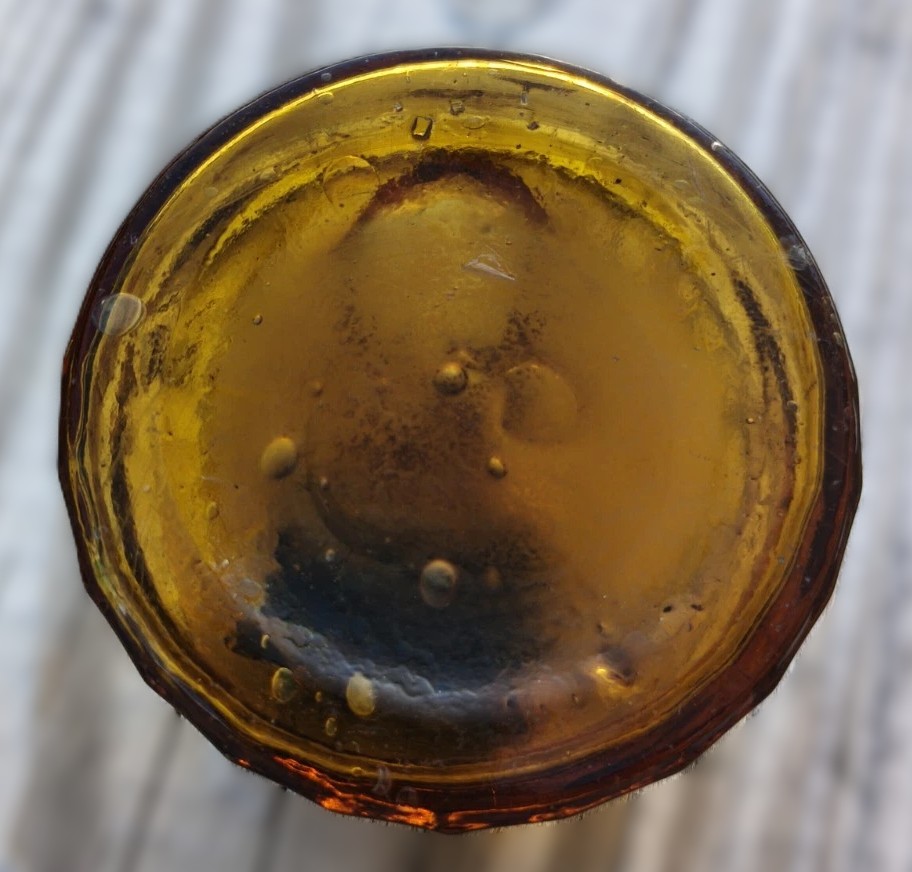
Yellow / Amber “Igloo” Ink Bottle
| Categories | Ink Bottle |
| Type | Igloo |
| Material | Glass |
| Markings | Unmarked |
| Manufacturer | Undetermined |
| Origin | United States |
| Date or Era | circa 1870 |
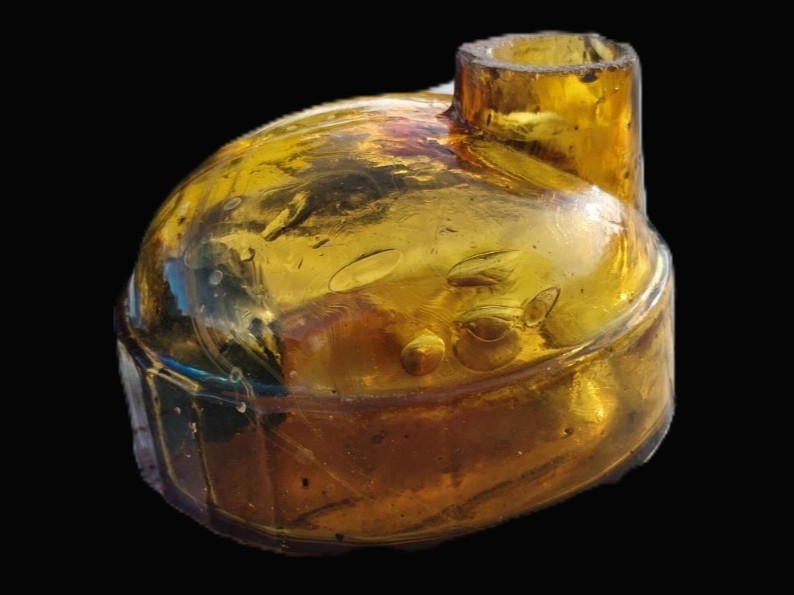
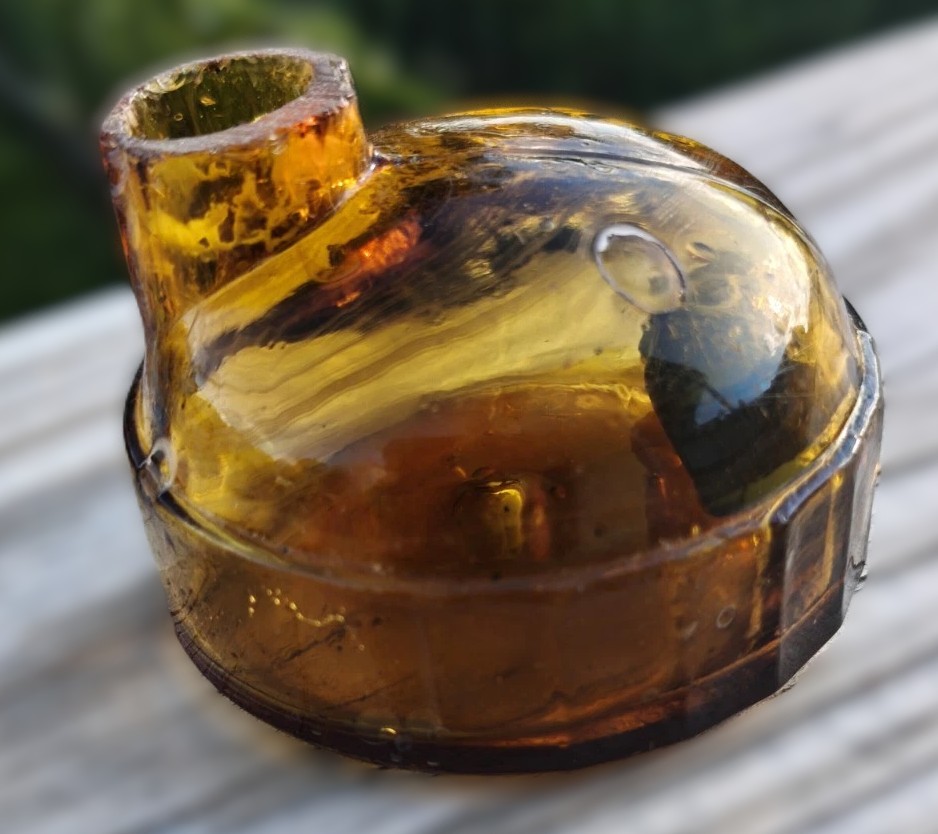
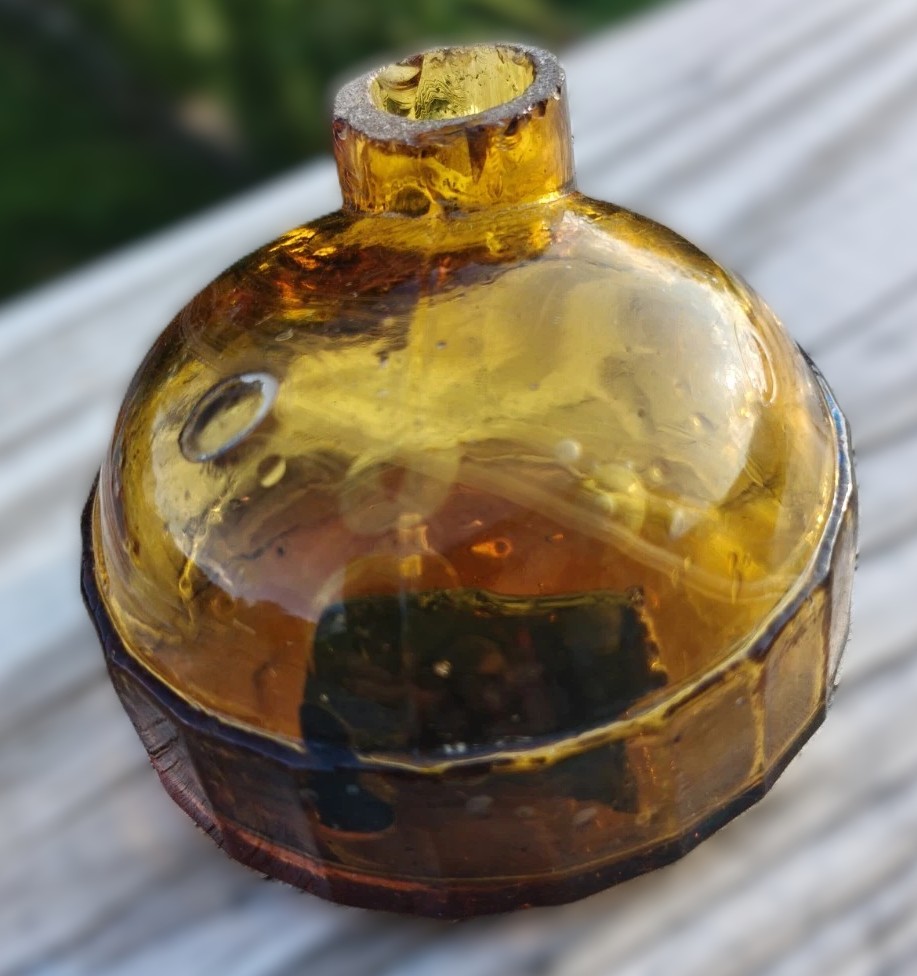
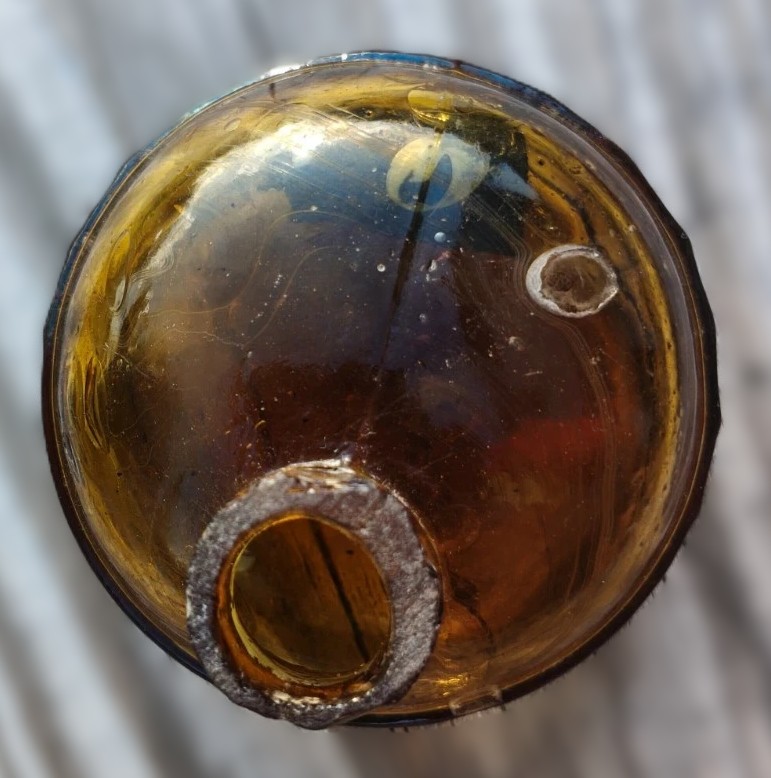
This little ink bottle features a classic “igloo” or domed beehive silhouette rendered in a warm, rich amber-to-honey glass. The lower portion boasts a fluted base that transitions smoothly into a sweeping, rounded dome, offset by a short, vertical neck positioned off-center.
Characteristics & Craftsmanship
- Color and Clarity: The deep amber hue displays characteristic variations in glass thickness, shifting from a brilliant golden glow under direct light to darker, smoky tones in the lower panels.
- Inclusions & Impurities: Numerous seed bubbles (small, trapped air pockets) and internal swirl lines are scattered throughout the body, particularly visible across the domed shoulder and base.
- The Finish: The top lip shows a rustic, rough-shewn sheared or cracked-off finish rather than a fire-polished rim, typical of utilitarian ink production where the neck was severed from the blowpipe and left unfinished.
Dating and Provenance
- Era: Mid-to-late 19th century, most likely dating between 1860 and 1880, a period when portable and desk inkwells were produced in massive quantities for schools, offices, and domestic writing desks.
- Origin: Similar umbrella, igloo, and beehive ink bottles were produced extensively by American glass houses (such as those in New England, the Midwest, or Southern New Jersey). Without a maker’s mark or pontil scar history, a precise regional attribution remains open, though the style is a staple of 19th-century Anglo-American bottle collecting.
Manufacturing Technique
- How it was made: This piece was free-blown into a mold (or dip-molded). The glassblower gathered molten amber glass on a blowpipe, inserted it into a small ribbed or paneled mold to impress the geometric facets along the base, and then expanded the upper dome freehand.
- The Neck: The off-center neck was shaped using forming tools while still attached to the pipe before being sheared off at the top. The smooth, flat base shows the characteristic gentle concavity and cooling marks left by contact with the mold or baseplate, lacking a traditional iron pontil scar, which points toward the later end of the mouth-blown era when snap cases began replacing pontil rods.
Sold for $300 in August 2026
Content disclaimer. The information posted is the owner’s best knowledge and may not have been vetted by the SOIC. We welcome comments, corrections, and additions, working to make our website information comprehensive and accurate.
Join the Society of Inkwell Collectors (SOIC) – it’s free!
Founded in 1981 as a non-profit organization,
we are documenting inkwells (and accessories).
We’re here to help and inform!