

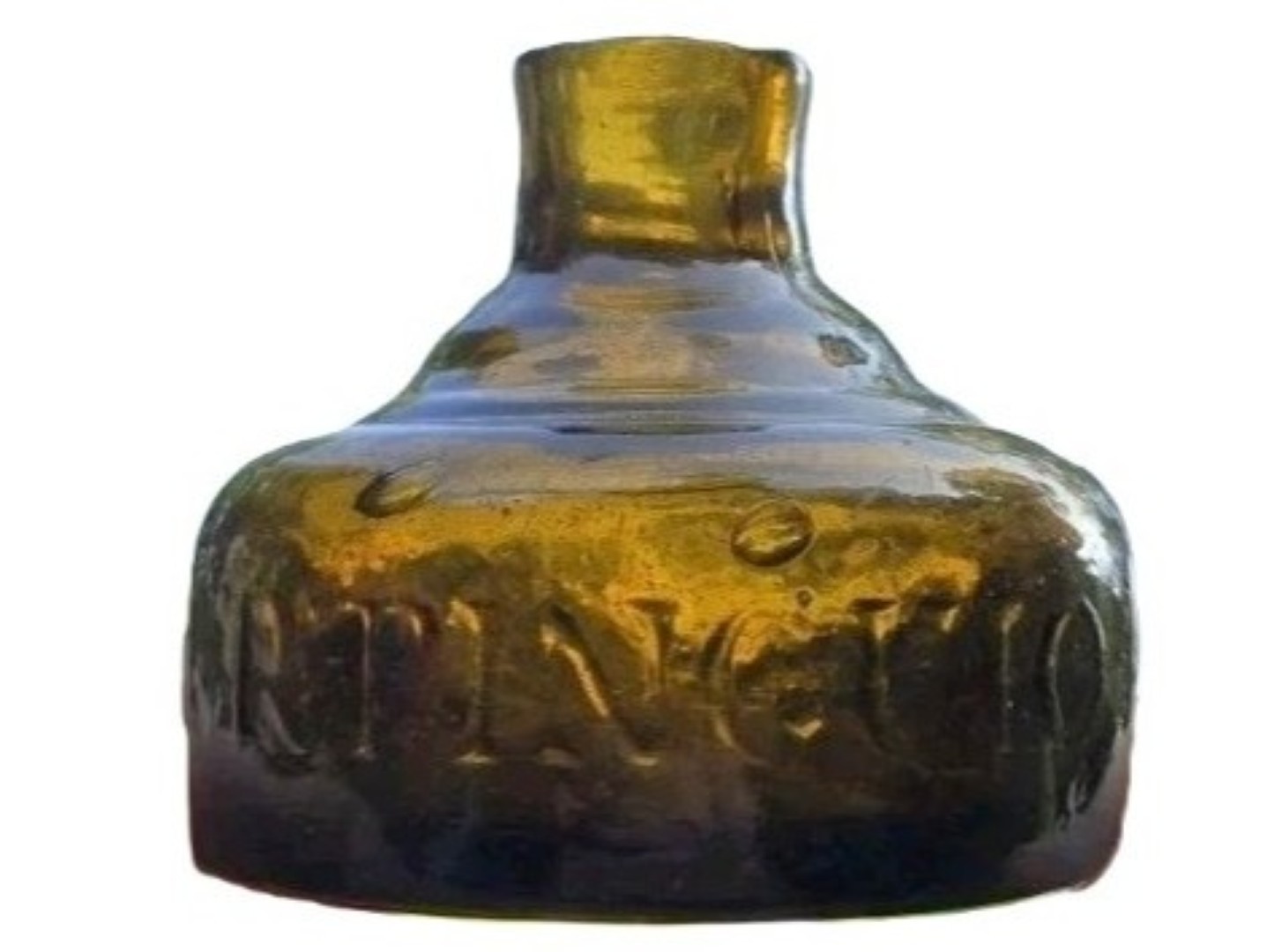
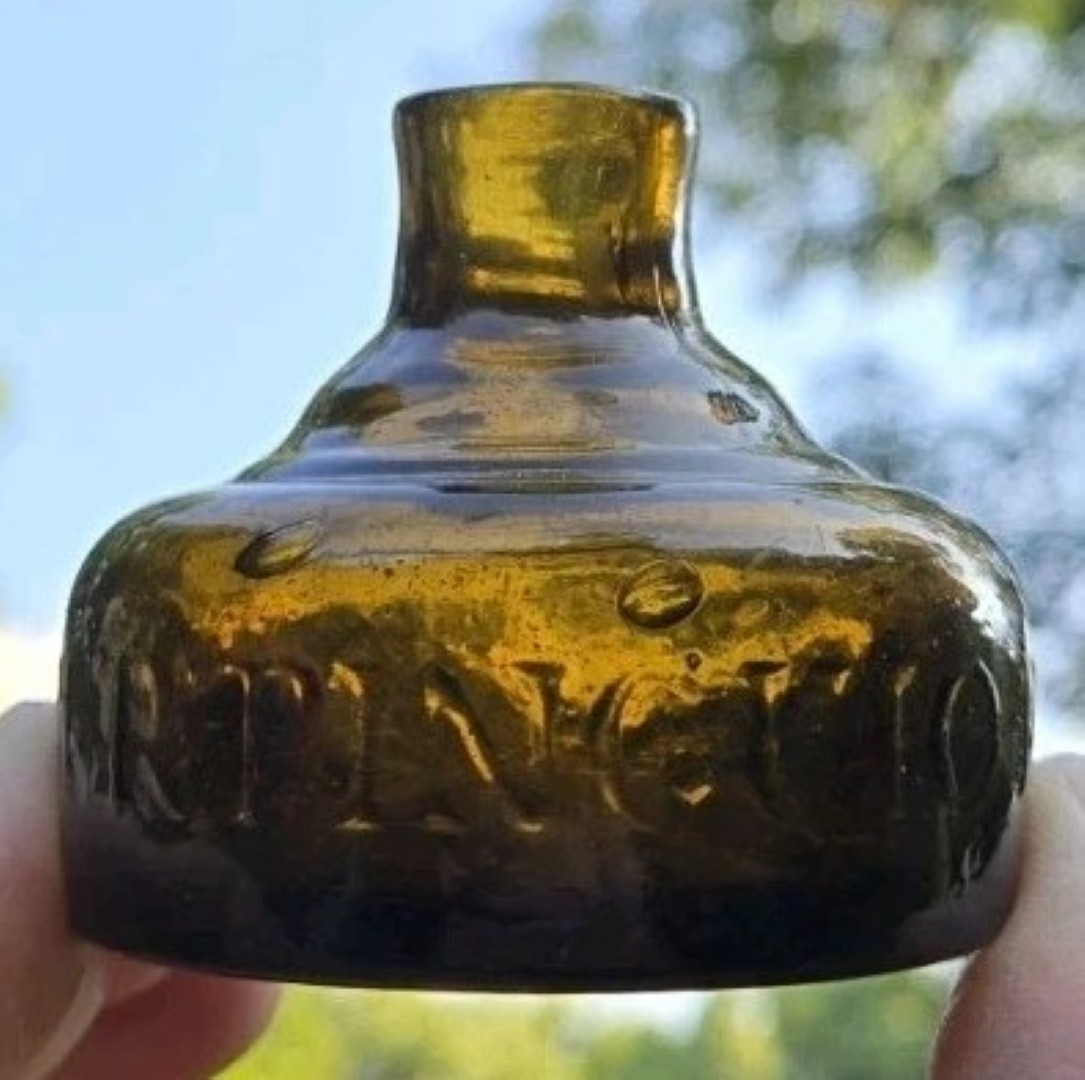
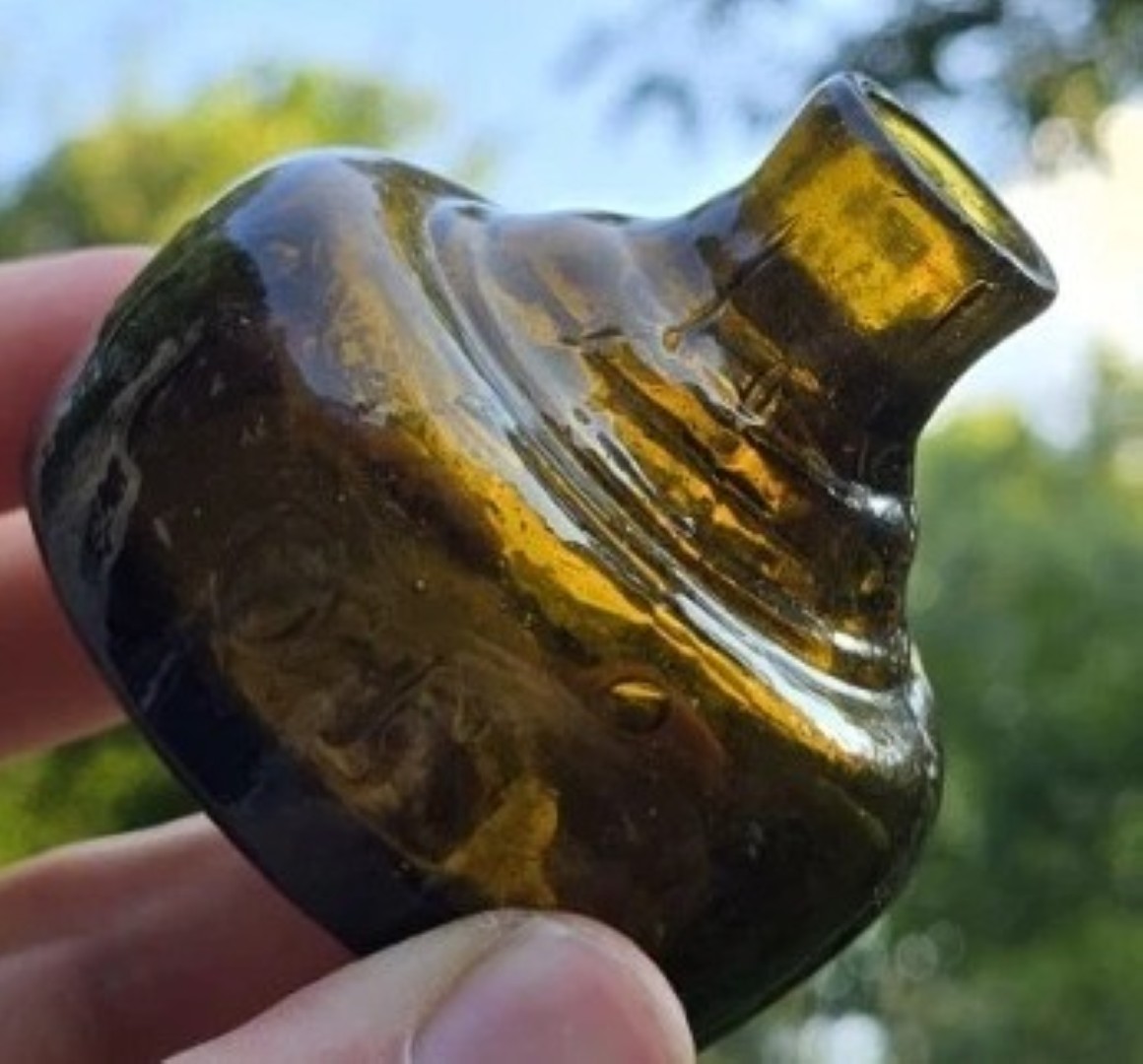
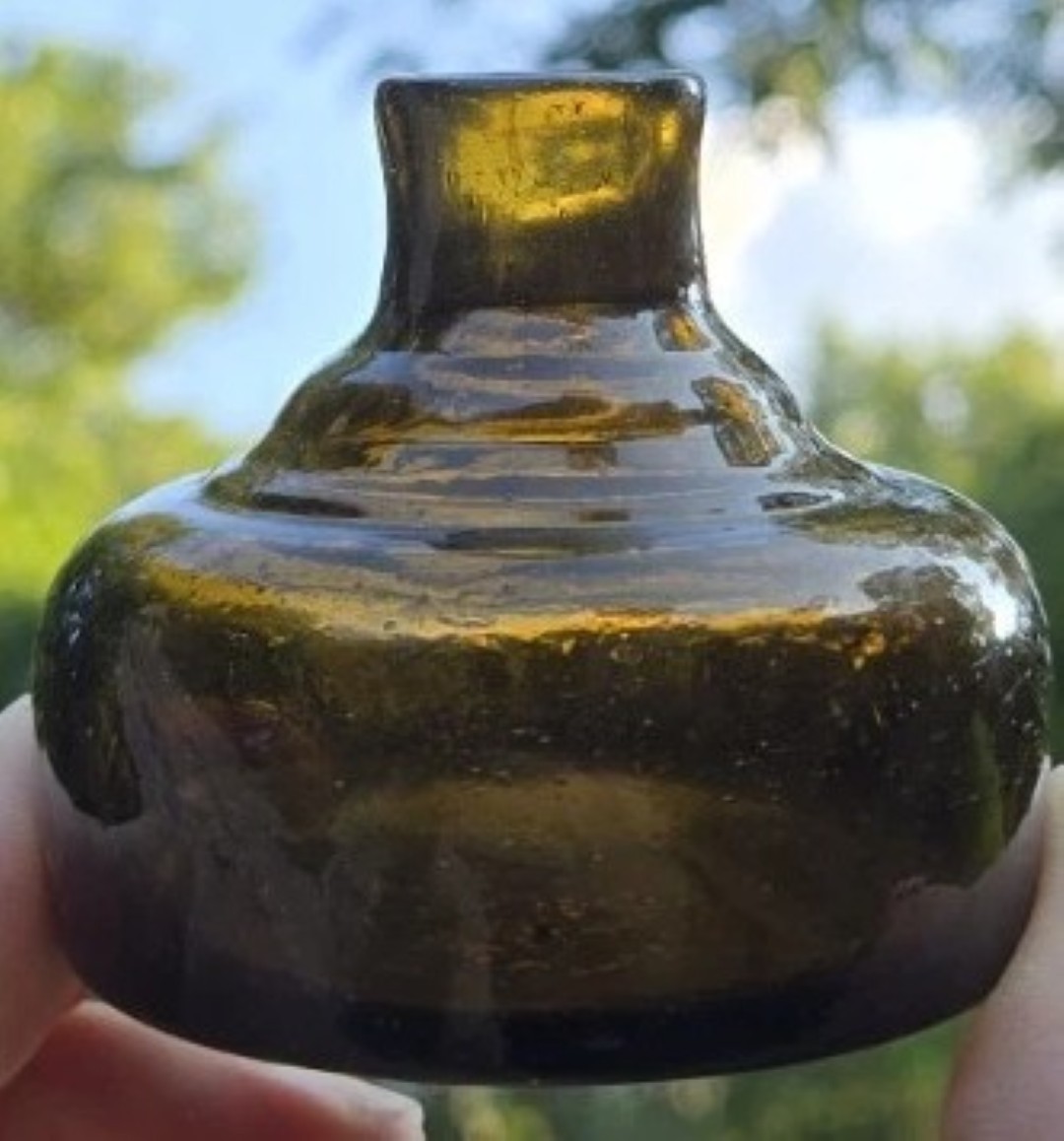
Blown Olive-Amber Stepped-Dome Ink Bottle
| Categories | Ink Bottle |
| Material | Glass |
| Markings | "BERTINGUIOT" |
| Manufacturer | Undetermined |
| Origin | United States |
| Date or Era | circa 1840 |
| Measuring | 2 ⅜” H × 2 ⅜” D |
Description
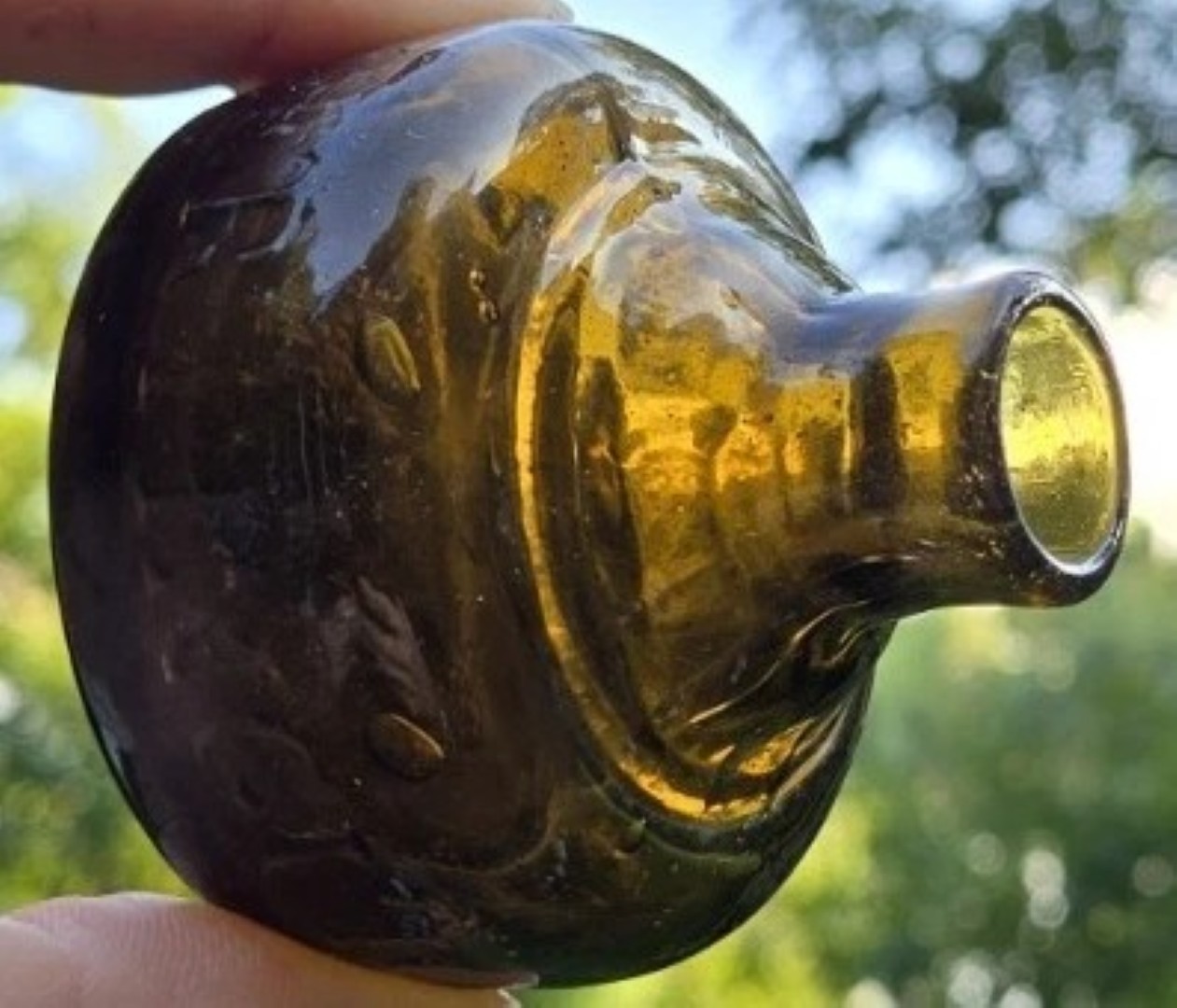
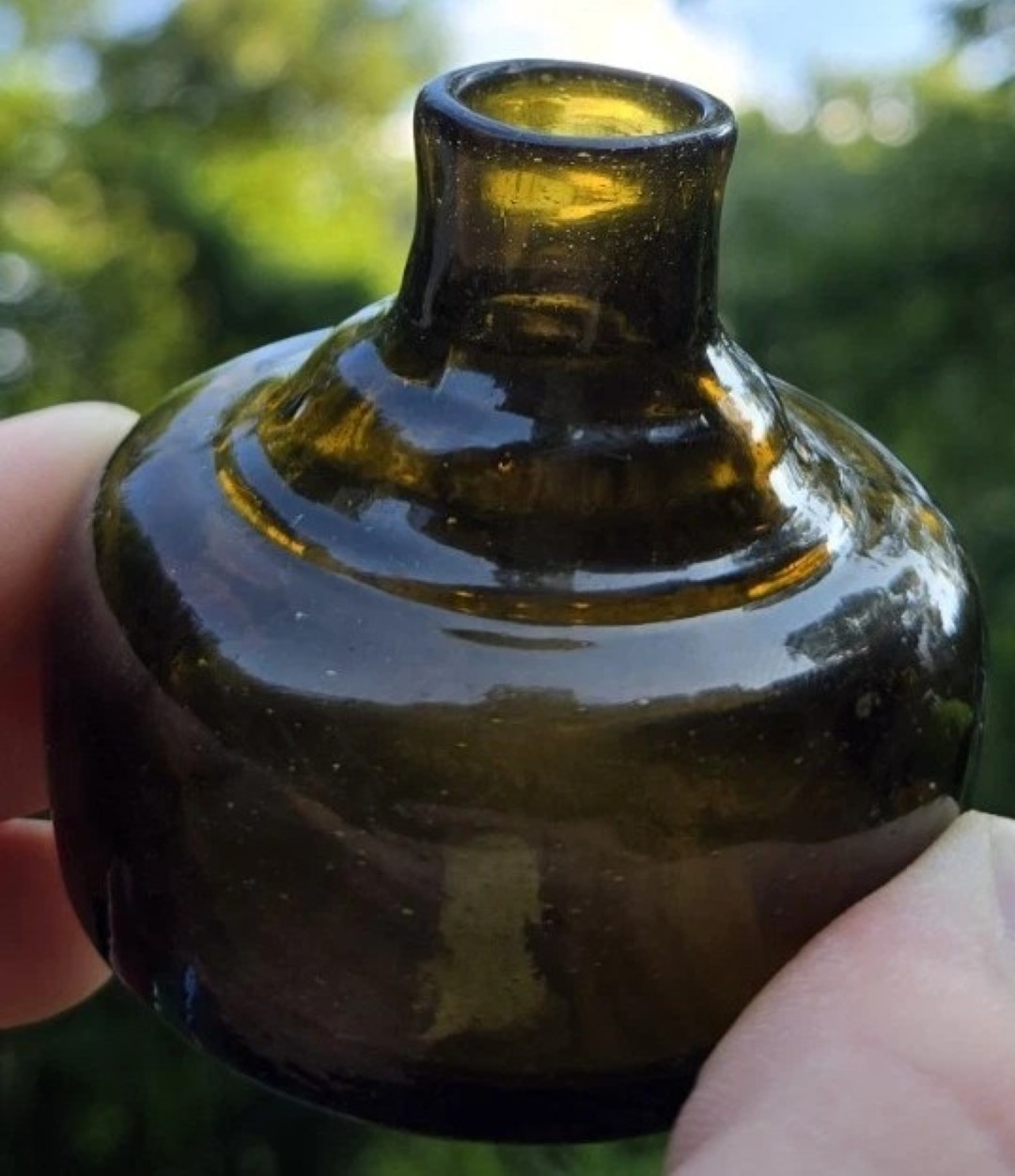
- Form: Stepped-dome cylindrical ink with a three-tier shoulder profile tapering into a cylindrical neck.
- Lip & Finish: Period-correct sheared, fire-polished lip with a smooth, slightly rounded rim.
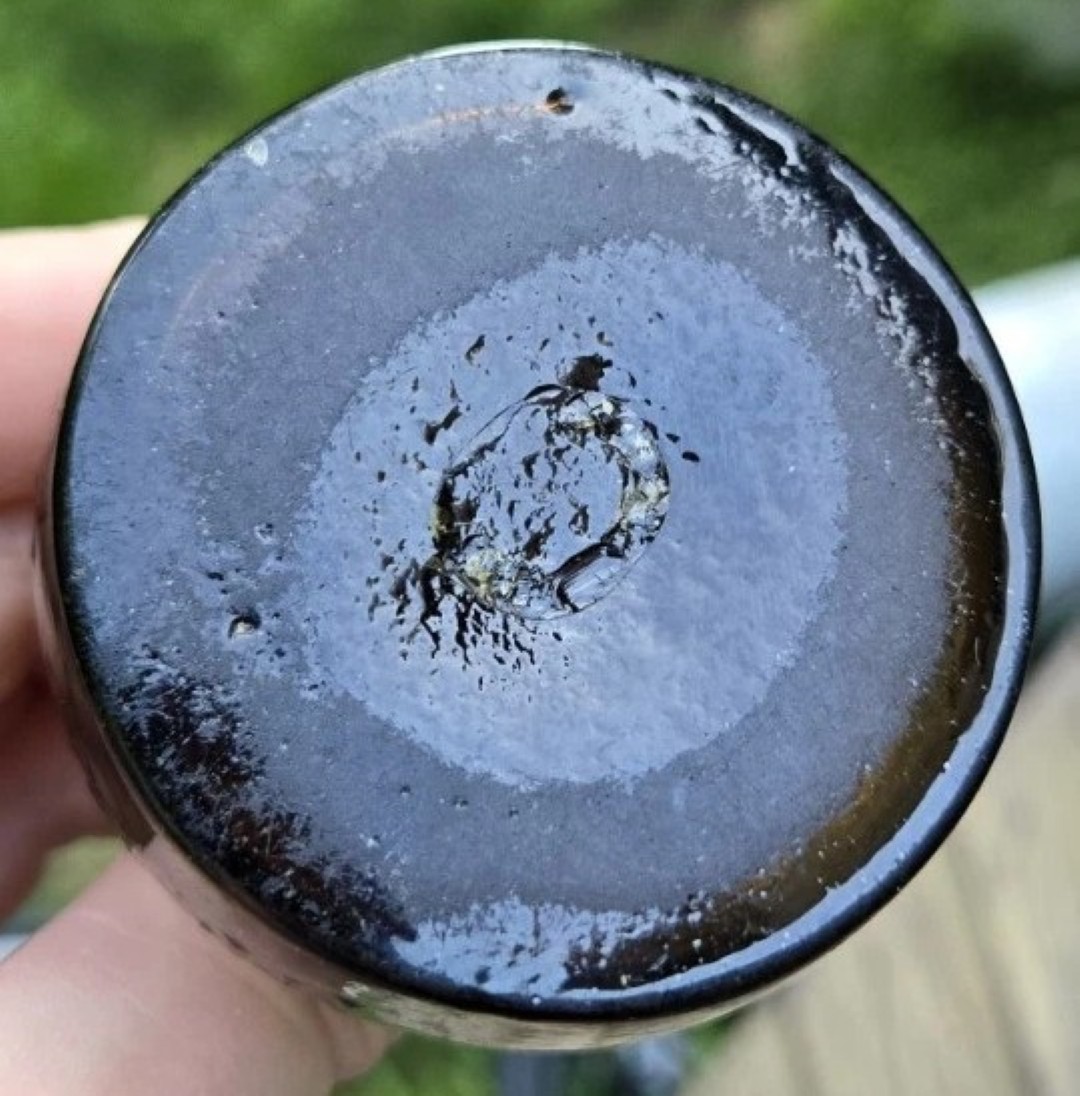
- Base: Blowpipe / open pontil scar centered within a concavity, displaying sharp glass residue and prominent circular base wear along the resting ring from decades of tabletop contact.
- Glass Characteristics: Rich olive-amber coloration with strong golden-olive undertones under transmitted natural light; filled with characterful seed bubbles and slight mold striations typical of early mid-19th-century batch glass.
- Dimensions: 2 ⅜” H × 2 ⅜” D.
- Condition: Excellent / Near Mint. Free of chips, cracks, pot stones, open surface bubbles, or sickness/staining. Embossing is soft in areas, consistent with early blown-in-mold utility ware of this era.
Production Context
- Origin & Glasshouse Characteristics: The stepped shoulder and olive-amber metal strongly align with early New England black glass and utility wares produced between the 1830s and late 1840s (such as those from Connecticut houses like Coventry, West Willington, or early Keene/Stoddard in New Hampshire). However, the specific embossing and stepped-tier dome architecture also share distinctive characteristics with select Continental (notably French) commercial ink houses of the mid-19th century that imported bottles or had private molds blown for merchant distribution.
- Embossing: Embossed in bold, serif capital letters reading “BERTINGUIOT” across the lower body cylinder. The mold shows typical utility-grade depth, where the letters slightly wash out near the margins—a hallmark of viscous amber glass blown into iron or brass molds without pressurized finishing.
- Dating Benchmark: The combination of a distinct open pontil, hand-tooled fire-polished sheared mouth, and early metal composition firmly indicates manufacture prior to the broad adoption of snap-case tools (circa 1855).
Summary
Rare Early Blown Olive-Amber Stepped-Dome Ink
Circa 1835–1850 | Likely New England or Continental Merchant Bottle
Blown in an attractive dark olive-amber glass with pronounced yellow-green highlights. Features a classic tiered stepped-dome shoulder, sheared and fire-polished lip, and an authentic open pontil base showing heavy natural shelf wear. Embossed “BERTINGUIOT” in raised serif lettering across the front panel. Measures 2 ⅜” tall by 2 ⅜” diameter. Superb attic condition with crisp, clean glass—no chips, cracks, pot stones, or interior staining.
“BERTINGUIOT” was the original manufacturer’s surname, which functioned simultaneously as the brand name for the ink.
In the early 19th century, chemical inks were branded and marketed directly under the names of their master makers or proprietors.
-
The Maker Behind the Name: The firm originated in Paris, France, where the ink manufactory of Maurin – Bertinguiot was founded in 1790. In 1837, proprietor Adrien Maurin officially succeeded Bertinguiot, running the business under billheads noting him as the “Successor of Bertinguiot – Manufacture of Inks and Sealing Wax”. Later mid-19th-century bottles from this line are often found embossed “AM BERTINGUIOT” (with “AM” representing Adrien Maurin).
-
The Brand on the American Market: Period American stationery advertisements—such as notices in Washington, D.C.’s The Globe in the mid-1830s—promoted the imported product explicitly as a branded specialty: “Bertinguiot’s French Ink” (available in both red and black).
-
The French-American Connection: While the ink itself was formulated and manufactured in France, shipping crates of pre-filled, fragile glass across the Atlantic was risky and costly. Bulk ink was routinely shipped in casks or jugs to U.S. merchants and commercial stationers, who contracted American glasshouses (predominantly in New England, with strong attributions to the Coventry Glass Works in Connecticut) to blow dedicated, privately embossed utility bottles for local packaging and retail sale.
Sold for $450 in August 2026
Content disclaimer. The information posted is the owner’s best knowledge and may not have been vetted by the SOIC. We welcome comments, corrections, and additions, working to make our website information comprehensive and accurate.
Join the Society of Inkwell Collectors (SOIC) – it’s free!
Founded in 1981 as a non-profit organization,
we are documenting inkwells (and accessories).
We’re here to help and inform!