

Inkipedia
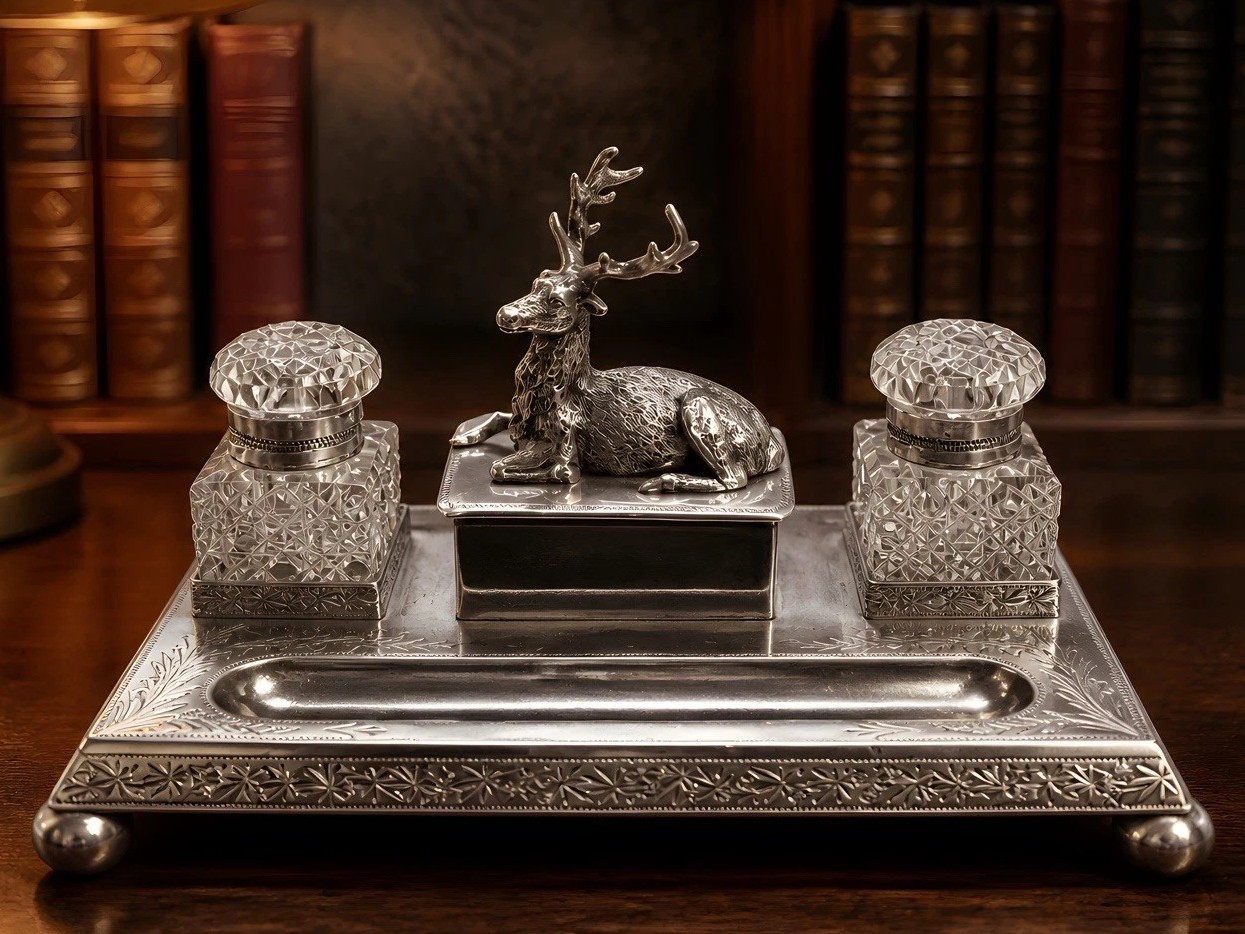
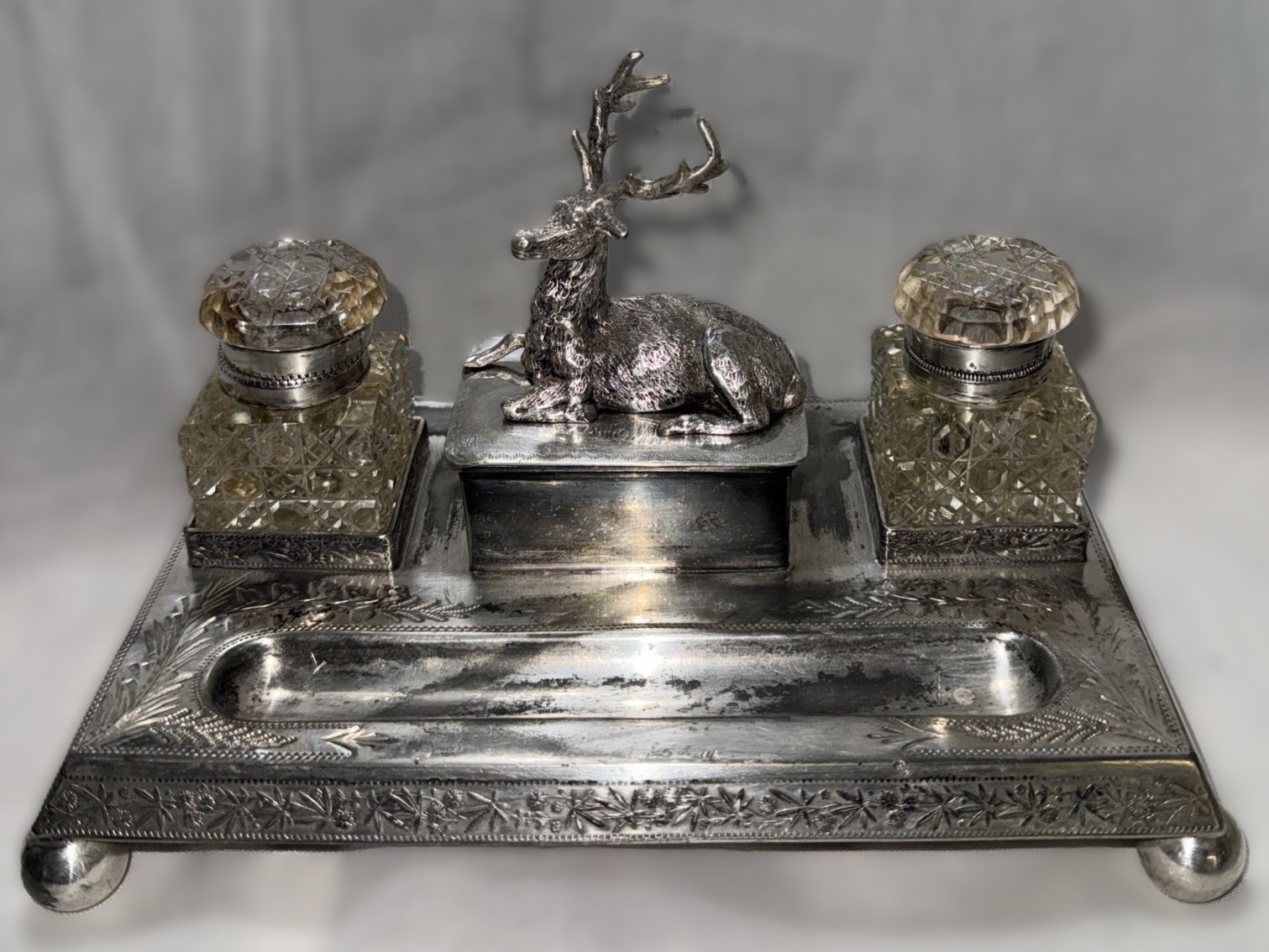
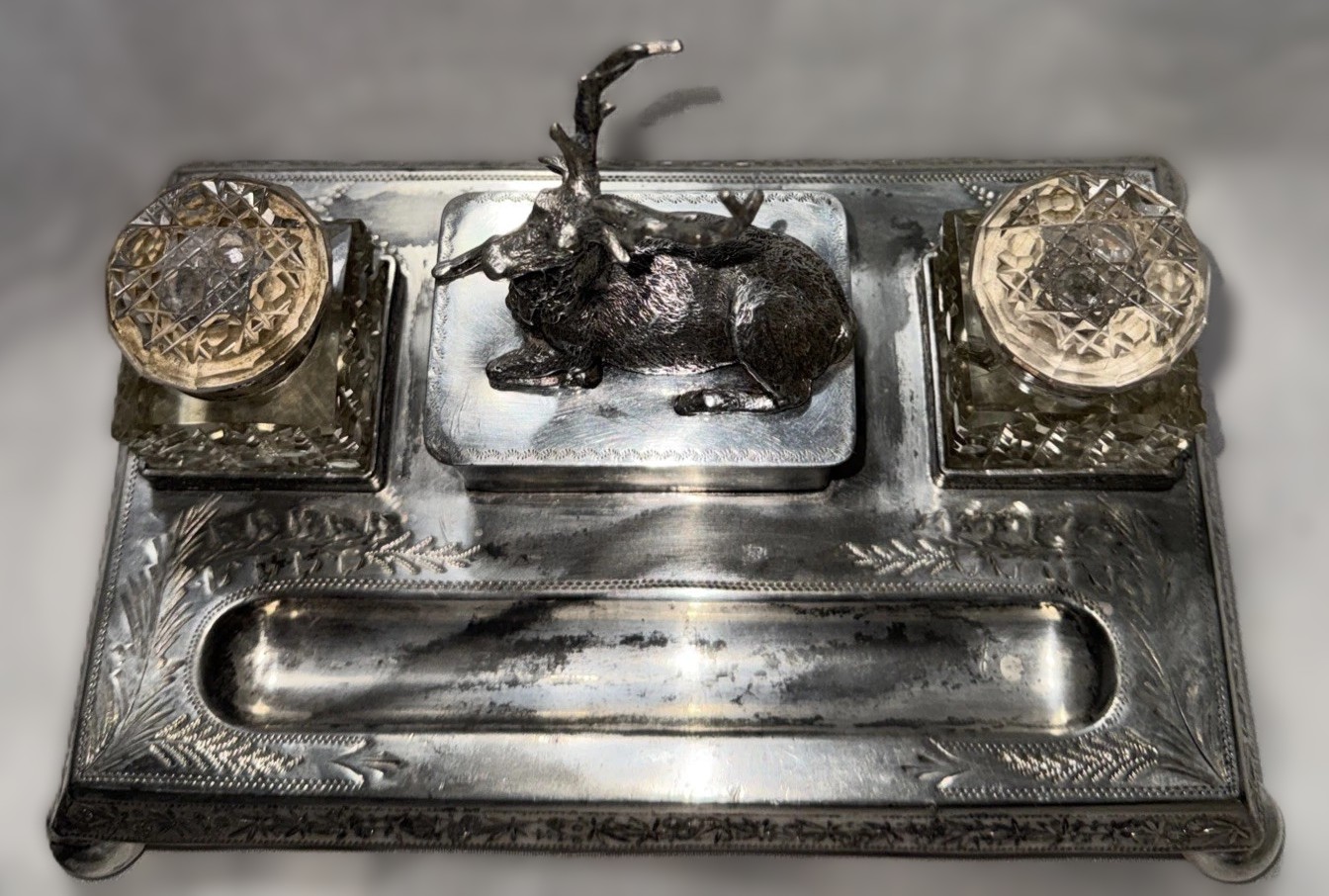
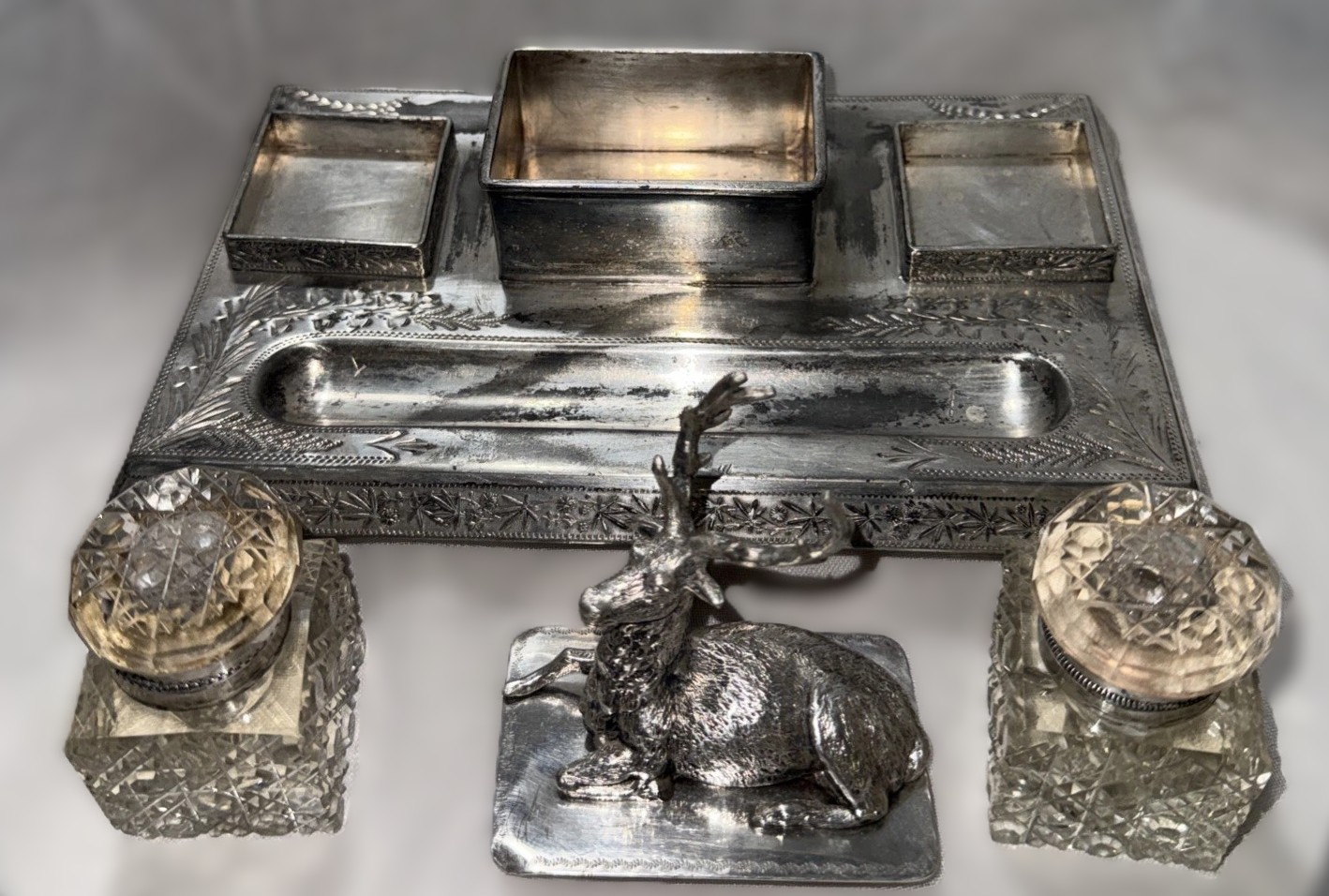
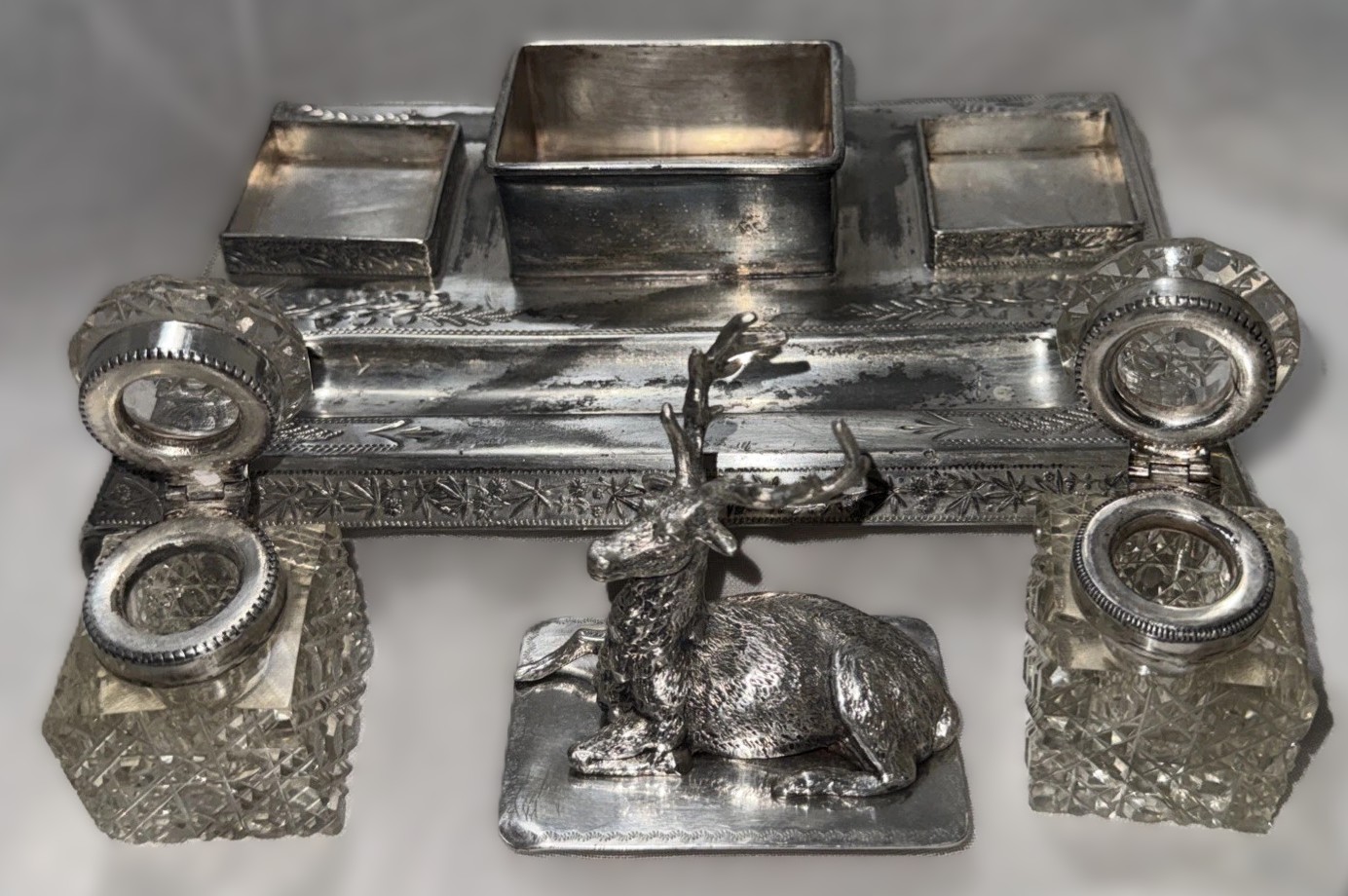
Silverplated Inkstand with Recumbent Stag
| Categories | Figural - Animals & Living Creatures |
| Type | Stag/Elk/Reindeer |
| Material | Silverplate |
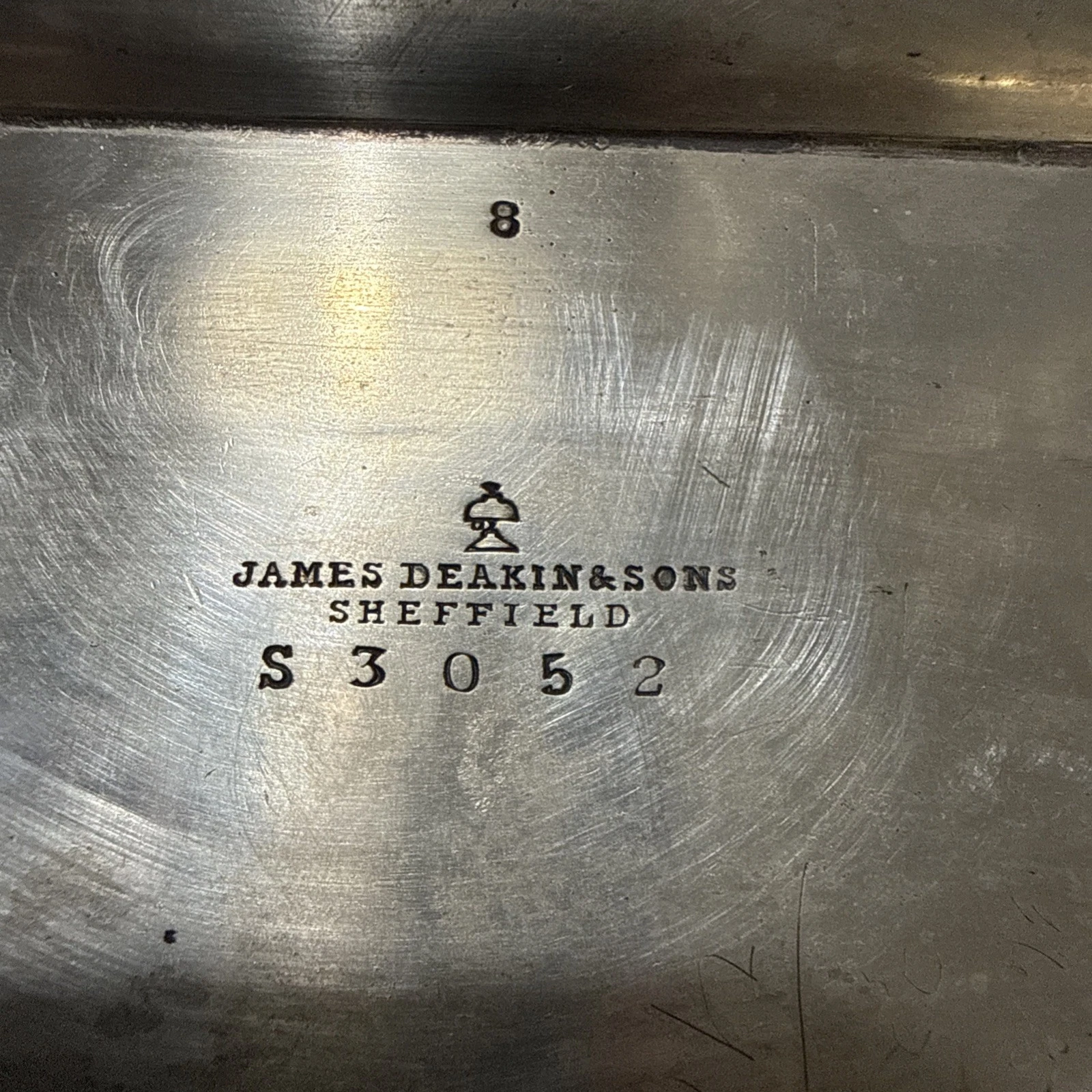
| Markings | See Narrative |
| Manufacturer | James Deakin & Sons |
| Origin | England |
| Date or Era | circa 1890 |
| Measuring | 9” across |
Description
This silverplated inkstand features a detailed, recumbent stag figure fixed to a raised central lid, flanked by two square cut-glass inkwells.
- Base & Ornamentation: The rectangular base rests on four spherical ball feet. The upper surface features a deep, elongated pen trough in the front. Fine hand-chased foliage and feathering flank the pen well, while the outer borders display repeat starburst motifs and beaded rim details.
- Central Box: The middle section houses a raised rectangular stamp or nib box. The cover—surmounted by the resting stag with multi-pointed antlers—lifts to reveal an internal compartment.
- Inkwells: On either side are matching square cut-glass inkwells sitting within raised, square collar retainers. The heavy glass bodies feature a classic daisy and button (hobnail) cut pattern. Each inkwell is fitted with a hinged silverplated collar and a star-cut domed cap.
Date of Manufacture
Based on the maker’s mark and structural features, this inkstand was manufactured between c. 1886 and 1897.
- Name Stamp: The stamp reads JAMES DEAKIN & SONS / SHEFFIELD. The “Sons” designation was adopted in 1886 when brothers John and Albert joined the partnership.
- Absence of “Ltd”: The mark lacks “Ltd.” (or “Ld.”). James Deakin & Sons officially converted into a limited liability company on May 27, 1897 (James Deakin & Sons Ltd). Pieces produced after May 1897 include “LTD” in their stamp.
- Trade Mark: Above the name is the firm’s classic desk bell (or counter bell) trade mark. Deakin adopted this symbol to distinguish its initials (“JD&S”) from its local Sheffield competitor, James Dixon & Sons.
- Production Markings: The number S3052 is the pattern/catalog production number used by the factory for ordering purposes, while the single digit 8 is a internal factory batch or workman’s tally mark.
History of James Deakin & Sons
- Founding (1866): The firm was established in Sheffield, England, by James Deakin, operating out of the Sidney Works on Matilda Street. It initially traded as James Deakin & Co.
- Expansion (1870s–1880s): James’s son, William Pitchford Deakin, joined the firm in the 1870s. In 1886, two more sons, John and Albert, entered the partnership, formalizing the name James Deakin & Sons. The company expanded rapidly, opening showrooms across the UK, including London, Glasgow, Belfast, Birmingham, and Chester.
- Incorporation & Subsidiaries (1890s): After James Deakin retired in 1893, his sons continued operations and incorporated as a limited company in 1897. Over the years, they acquired other major Sheffield firms, such as electro-plate manufacturers Shaw & Fisher (1894) and Walter Latham & Son (c. 1919).
- Later History & Legacy: In 1935, the company joined a merger called Silver & Steelcrafts Ltd alongside Fenton Bros and J.H. Potter & Sons, though this venture collapsed within three years. By the mid-20th century, the brand name was absorbed into the Monogram Cutlery Group under I.S. Dearden & Sons.
Sold for $305 in July 2026
Content disclaimer. The information posted is the owner’s best knowledge and may not have been vetted by the SOIC. We welcome comments, corrections, and additions, working to make our website information comprehensive and accurate.
Join the Society of Inkwell Collectors (SOIC) – it’s free!
Founded in 1981 as a non-profit organization,
we are documenting inkwells (and accessories).
We’re here to help and inform!