


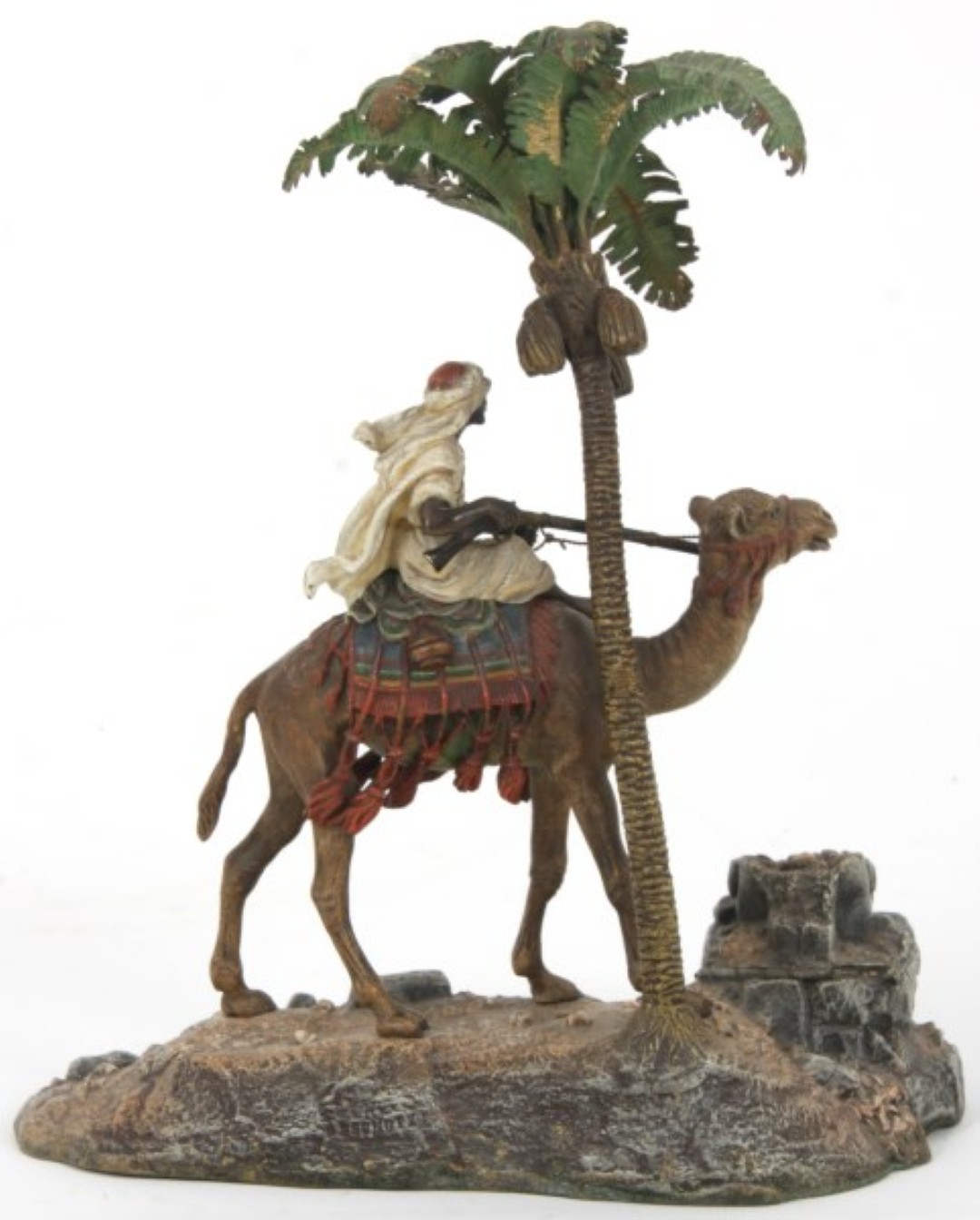




Austrian Bronze Camel and Rider
| Categories | Figural - Animals & Living Creatures, Middle East / Africa |
| Type | Arab, Camel |
| Material | Bronze |
| Markings | GESCHÜTZT |
| Manufacturer | Undetermined |
| Origin | Austria |
| Date or Era | circa 1900 |
| Measuring | 8 ½” high |
This Viennese cold-painted bronze Orientalist inkstand dates from the late 19th century to the very early 20th century (circa 1890–1910).
During this era, European fascination with the “Exotic East”—driven by the Orientalism movement—fueled a massive demand for highly detailed, narrative desk accessories. Vienna was the epicenter of this craft.
Design
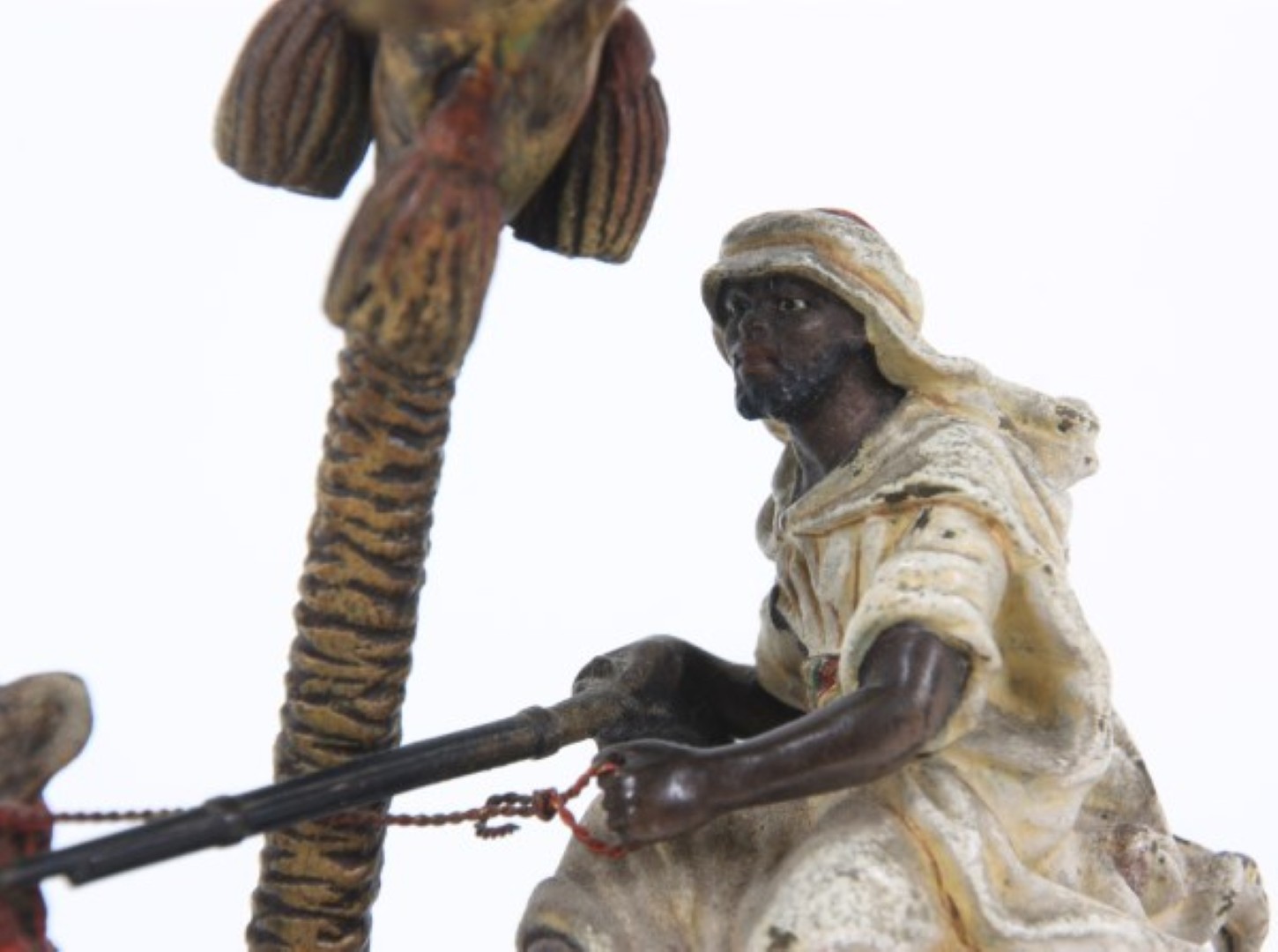
- The Subject Matter: The inkstand captures a classic dramatic Orientalist vignette. An Arab nomad or warrior clad in flowing cream-colored robes (thobe and keffiyeh) rides a finely caparisoned dromedary camel. He holds a long-barreled rifle across his lap, scanning the horizon with a vigilant expression.
- The Setting: The figures pass beneath a realistically detailed palm tree complete with textured bark and hanging clusters of dates. The base is cast as a textured, multi-toned desert terrain.
- The Inkwell Mechanism: To the rider’s right sits an element disguised as an ancient architectural ruin. The top of the weathered, stone-like block features a seamless hinge that flips open to reveal the well cavity where the original glass or porcelain insert would have sat.
Material & Technique
This piece utilizes the “cold-painted bronze” method, a specialty of Viennese foundries. Unlike traditional bronzes that are chemically patinated or gilded, these figures were cast in bronze and then decorated with multiple layers of unfired oil-based paints or enamels.
These original pigments are well preserved:
- The deep, lifelike brown and ochre tones of the camel’s hide.
- The rich polychrome detail of the woven saddle blanket (saddle rug), complete with hanging red tassels.
- The distinct green of the palm fronds, showing the typical gentle, authentic wear/rubbing along the raised edges where the underlying bronze peaks through.
The Stamping & Attribution
The back of the base is clearly stamped with GESCHÜTZT (partially obscured as …SCHÜTZ).
- This is a German legal term meaning “Protected” or “Copyrighted” (similar to Registered Design or Patent Pending).
- In the context of Vienna bronzes, this stamp was used extensively by premier foundries to protect their highly prized designs from being pirated by local or international competitors.
- While only marked Geschützt, the exceptional casting quality, the specific modeling of the camel’s anatomy, the facial structure of the rider, and the clever integrated “ruin” inkwell strongly point to the work of Franz Xaver Bergman (1861–1936) or his contemporary Viennese foundries like Carl Kauba or Anton Chotka, who dominated the high-end Orientalist bronze market during this exact period.
Sold for $1,000 in September 2016
Content disclaimer. The information posted is the owner’s best knowledge and may not have been vetted by the SOIC. We welcome comments, corrections, and additions, working to make our website information comprehensive and accurate.
Join the Society of Inkwell Collectors (SOIC) – it’s free!
Founded in 1981 as a non-profit organization,
we are documenting inkwells (and accessories).
We’re here to help and inform!