



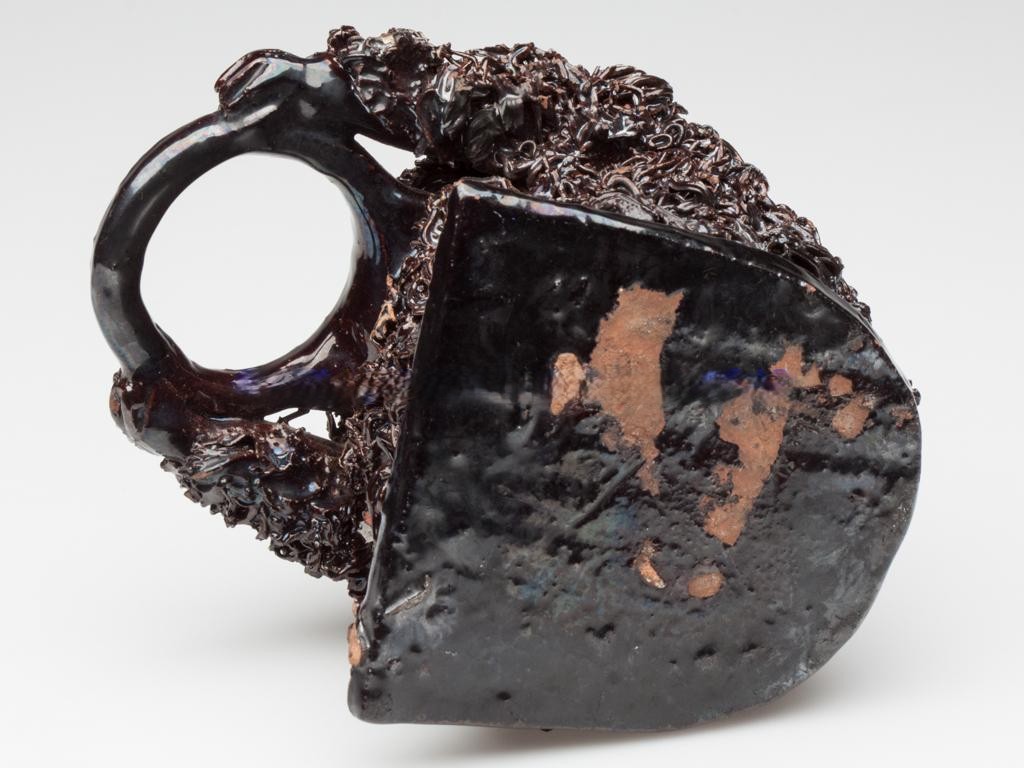
Folk Art – Earthenware Bear
| Categories | Figural - Animals & Living Creatures |
| Type | Bear |
| Material | Earthenware |
| Markings | Unmarked |
| Origin | United States |
| Date or Era | circa 1870 |
| Measuring | 4” x 4” x 7” high |
Overall Form
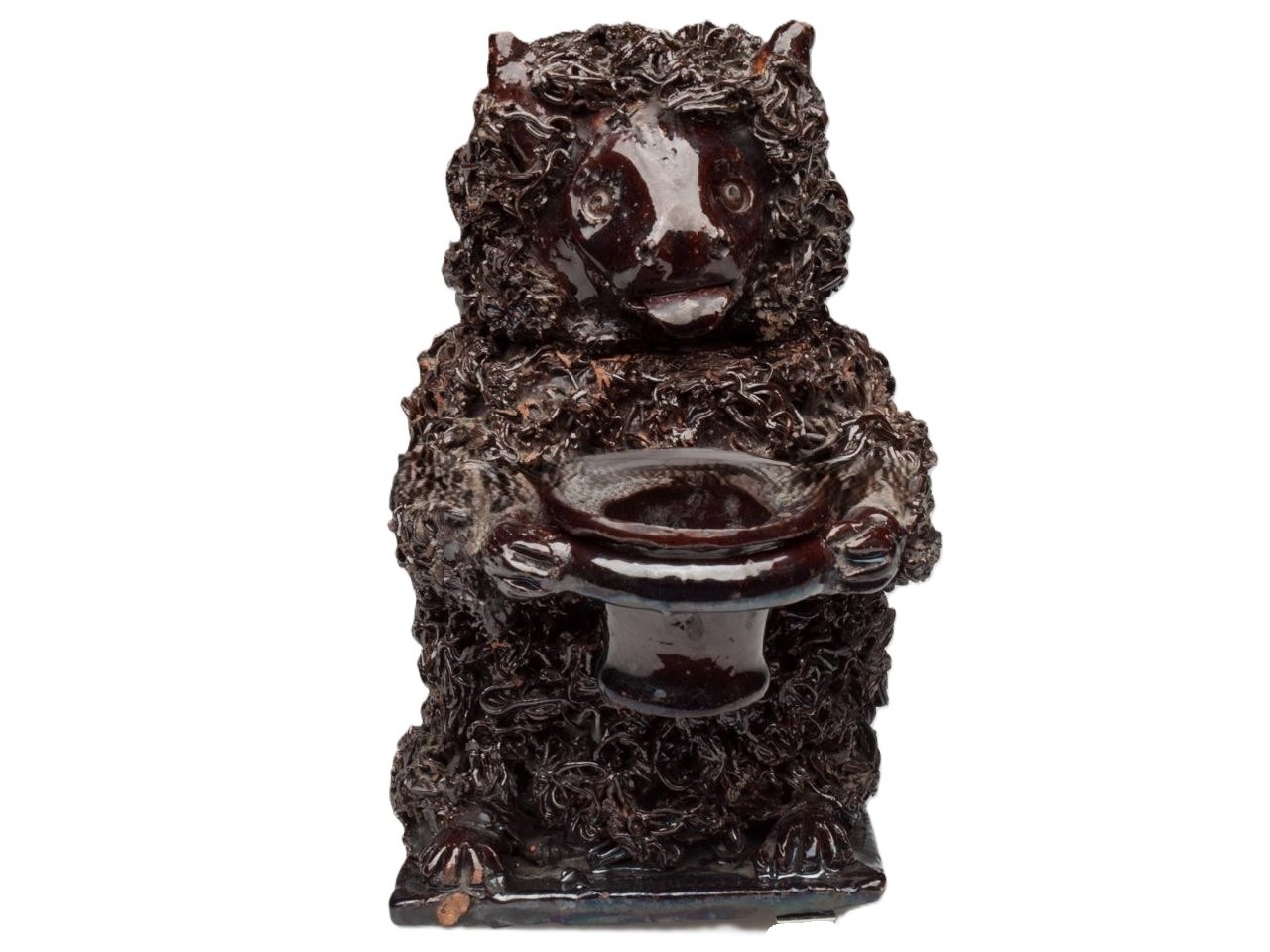
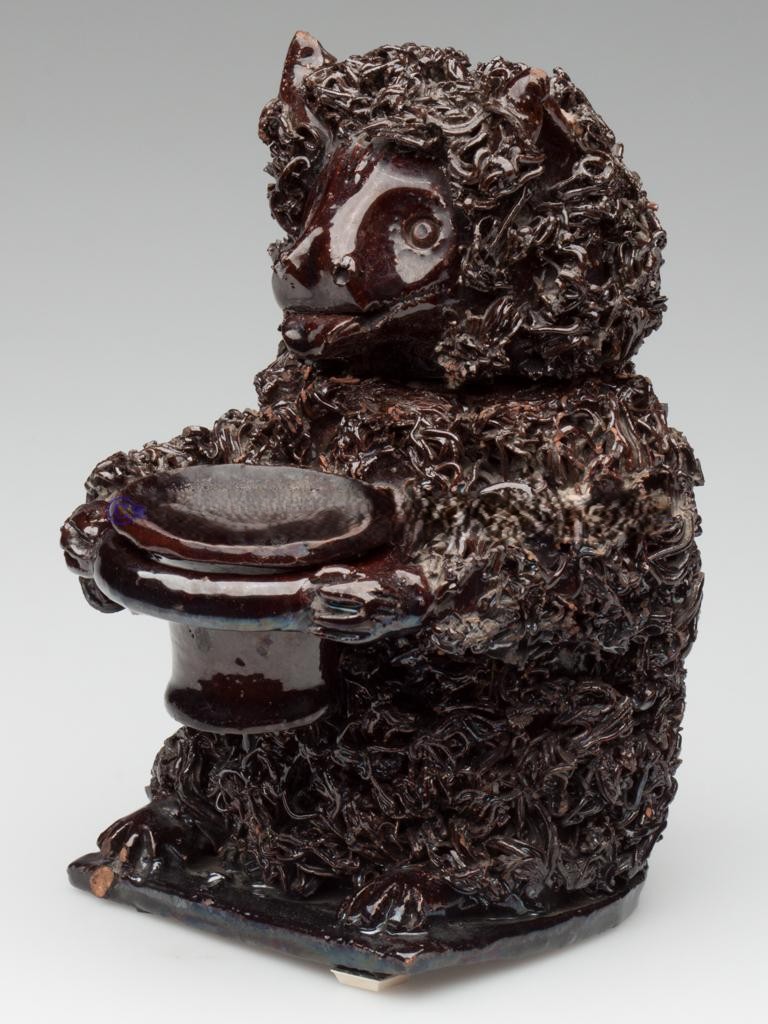
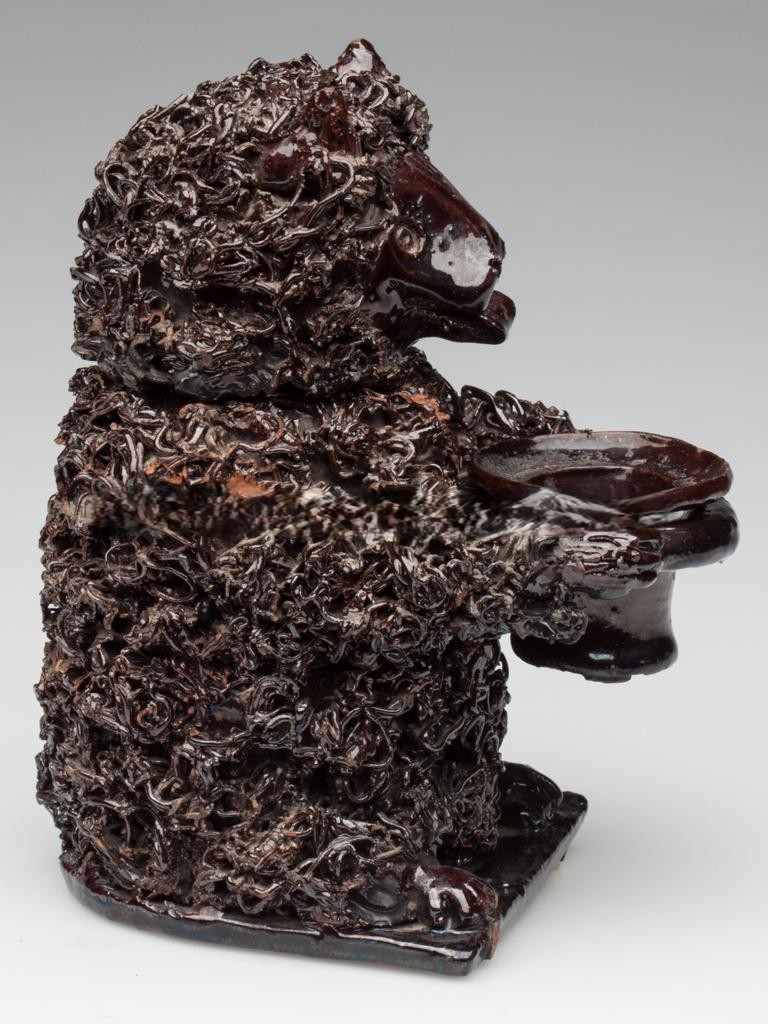
This rare, hand-modeled Shenandoah Valley figural redware inkstand features a seated bear rendered in a rich folk art aesthetic, positioned atop a flat-bottomed D-shaped slab base.
The bear is sculpted with outstretched, curved arms meeting at the front to securely grip a large, molded ceramic ring designed to hold the removable inkwell insert. The exterior is entirely coated in a lustrous, mottled lead and manganese glaze, giving the earthenware a deep, dark chocolate-brown to near-black color with dynamic tonal variations where the glaze pools.
The Textured “Cole-Slaw” Fur
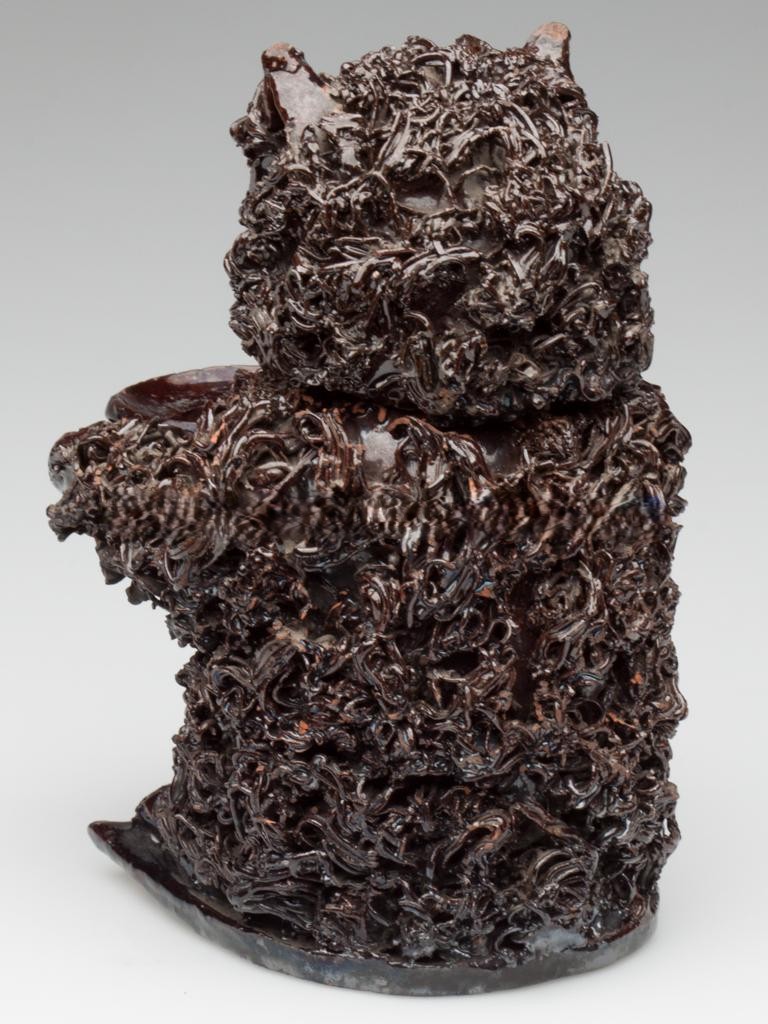
The defining visual characteristic of the piece is the intensive use of applied “cole-slaw” fur. This classic regional pottery technique uses extruded, finely extruded ceramic strands to intricately cover the bear’s entire torso, arms, back, and the sides of its head. The spaghetti-like texture mimics a dense, shaggy coat, contrasting beautifully with the smooth, mirror-like surfaces of its face, paws, and the accompanying desk vessels.
The Four Component Parts
What distinguishes this specific inkstand as an absolute masterpiece of Anthony Bacher’s oeuvre is its unique construction. While other Bacher animal figures are known, this is the only recorded example comprised of four separate, functional parts:
- The Seated Bear Body & Base: The primary structure forms a hollow, earthenware housing that terminates at a smooth, circular opening at the neckline.
- The Removable Bear-Head Cover: Serving as a lid for the main chamber, the hand-modeled head features a smooth, glazed muzzle and eye patches. It is modeled with small, pointed ears, rounded incised eyes, and a charmingly expressive extended tongue. The head can be lifted completely away to reveal an interior compartment, as well as a small, separate circular collar opening on the bear’s left shoulder.
- The Central Inkwell Inserts (Two Separate Vessels):
- The Main Ink Pot: A smooth, flared, top-hat-shaped cup with a wide rim that nests directly inside the ring held by the bear’s front paws.
- The Sander / Secondary Insert: A second, slightly taller and narrower cylindrical insert with an unglazed lower edge. This cup drops down directly into the secondary hole exposed on the bear’s shoulder when the head cover is removed.
Condition, Base, & Markings
- The Glaze and Clay Body: The exposed unglazed sections of clay (visible on the inner rims of the neck cavity, the broken upper edge of the secondary hole, and the bottom of the sander) reveal a warm, reddish-orange Shenandoah earthenware body.
- The Underside: The bottom of the D-shaped base is completely flat, coated primarily in a dark manganese glaze showing expected minor shelf wear, with distinct, irregular patches where the raw redware body shows through from production or kiln placement. No stamped maker’s marks are present, which is consistent with many of Bacher’s highly customized, hand-modeled figural folk-art pieces.
Historical Significance
Attribution: Attributed to Anthony Weis Bacher/Baecher (1824–1889), Winchester, Virginia. Circa: 1860–1890.
Master potter Anthony Bacher is celebrated in early American ceramics for his imaginative, highly detailed animal figures. While his domestic bear pieces frequently took the form of doorstops or simple desk novelties, this four-part inkstand represents the pinnacle of his functional folk sculpture, with parallel forms documented in Comstock’s The Pottery of the Shenandoah Valley Region (p. 179, figs. 4.280, 4.281).
Sold for $13,800 in November 2012
Content disclaimer. The information posted is the owner’s best knowledge and may not have been vetted by the SOIC. We welcome comments, corrections, and additions, working to make our website information comprehensive and accurate.
Join the Society of Inkwell Collectors (SOIC) – it’s free!
Founded in 1981 as a non-profit organization,
we are documenting inkwells (and accessories).
We’re here to help and inform!