




Crescent City Black Ink
| Categories | Ink Bottle |
| Material | Glass |
| Markings | See narrative |
| Origin | United States |
| Date or Era | circa 1880 |
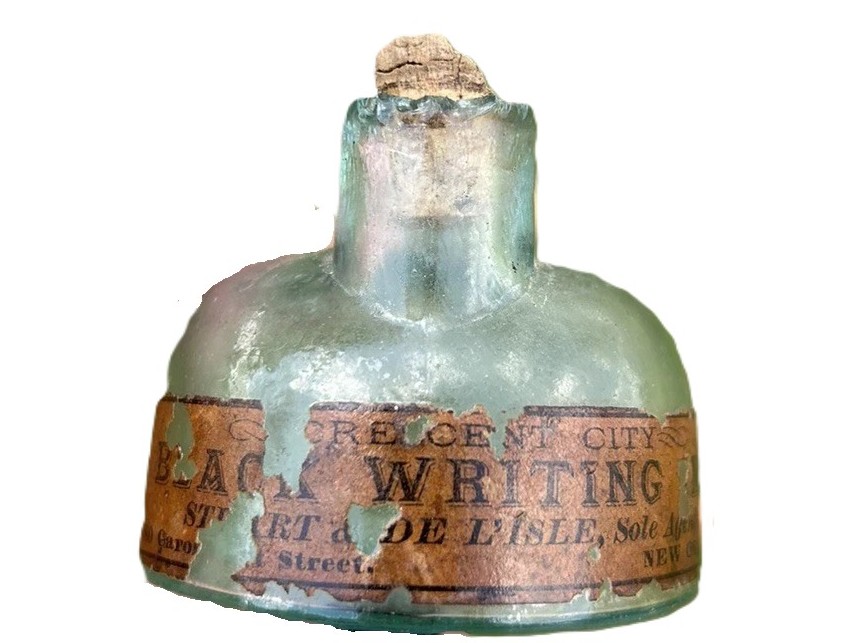
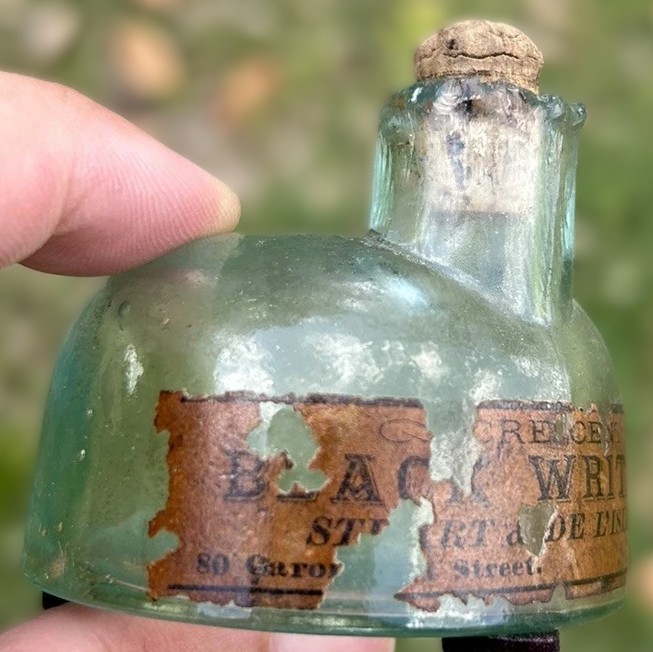
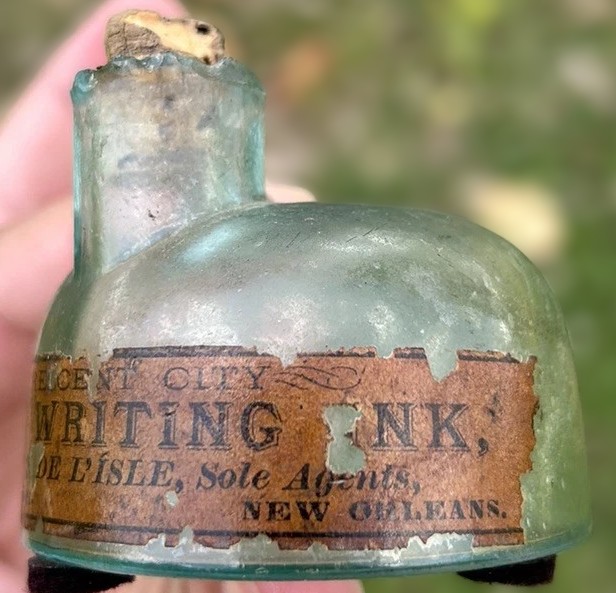
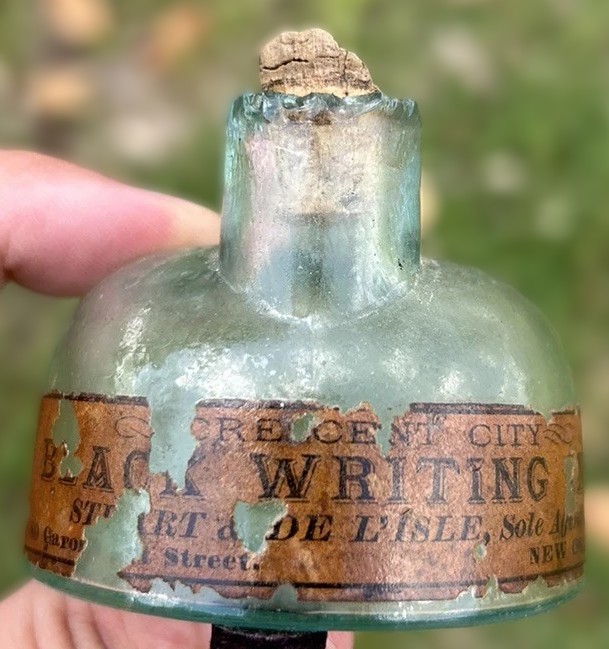
This “Crescent City Black Ink” bottle is a nice example of an antique “turtle” or “dome” style inkwell.
Bottle Description and Condition
- Design: Known to collectors as a “turtle” ink because of its low, rounded profile and offset neck, this shape was designed to be stable on a desk and prevent tipping.
- Glass: The bottle is made of aqua-colored glass with visible seed bubbles and a rough, sheared or “ground” lip. The base features a circular indentation typical of late 19th-century mold-blown bottles.
- Label: The original paper label is a significant find, as paper rarely survives on these utilitarian items. It identifies the product as “CRESCENT CITY BLACK WRITING INK.”
- Sole Agents: The label lists “STUART & DE L’ISLE” as the sole agents, located at 80 Carondelet Street, New Orleans.
Crescent City Ink & Stuart & De L’Isle
The Crescent City Ink brand was a prominent New Orleans product during the mid-to-late 19th century.
- The Partnership: Stuart & De L’Isle (comprised of William Stuart and Louis De L’Isle) were active in New Orleans as stationers and ink manufacturers/agents starting in the late 1860s.
- Local Significance: While many inks were shipped from the Northeast or Europe, Crescent City Ink was marketed heavily to the Southern United States, capitalizing on local pride and the “Crescent City” moniker.
- Product Line: They produced various formulations beyond black ink, including “Violet” and “Copying” inks, often sold in these small turtle bottles for personal use or larger master bottles for refilling.
Approximate Age
Based on the address at 80 Carondelet Street and the manufacturing technique of the bottle (a bimal mold with a sheared lip), this bottle likely dates to circa 1870–1885.
By the late 1880s and 1890s, many ink manufacturers shifted toward more standardized, machine-finished tops and more ornate, embossed glass branding rather than relying solely on paper labels. The survival of this specific label makes it a special piece.
Sold for $266 in April 2026
Content disclaimer. The information posted is the owner’s best knowledge and may not have been vetted by the SOIC. We welcome comments, corrections, and additions, working to make our website information comprehensive and accurate.
Join the Society of Inkwell Collectors (SOIC) – it’s free!
Founded in 1981 as a non-profit organization,
we are documenting inkwells (and accessories).
We’re here to help and inform!