




Viennese Bronze – Fox Stalking a Hare
| Categories | Figural - Animals & Living Creatures |
| Type | Fox, Rabbit |
| Material | Bronze, Marble |
| Markings | Unmarked |
| Manufacturer | Undetermined |
| Origin | Austria |
| Date or Era | circa 1900 |
| Measuring | 6 ¾” x 4 ¾” x 2 ⅜” high |
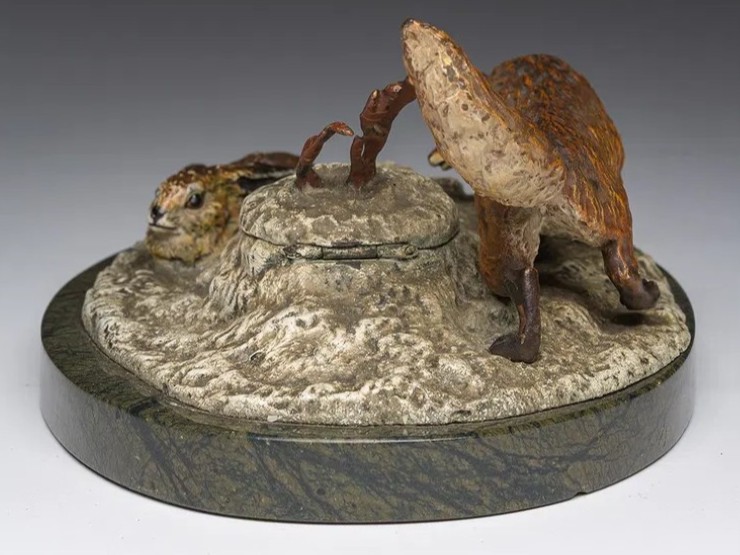
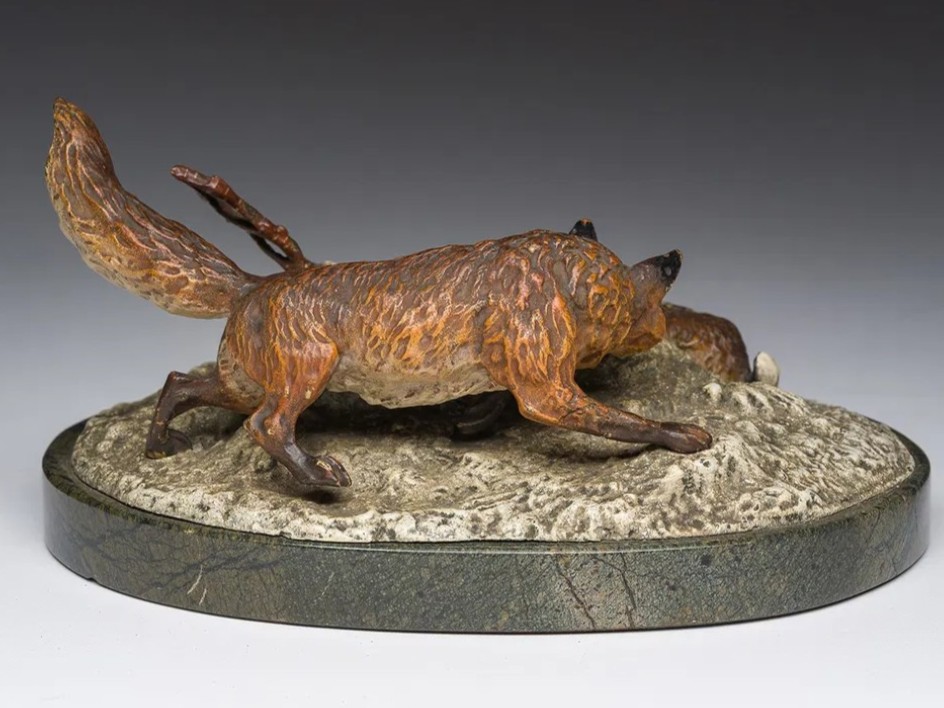
This is a nice example of late 19th or early 20th-century animalier bronze, specifically a Viennese cold-painted bronze inkstand. The piece captures a high-tension narrative moment, common in the naturalistic and often dramatic style favored by Austrian bronze foundries of the era.
Description
- Subject Matter: The inkwell features a meticulously detailed fox in a low, prowling “stalking” posture. Its gaze is fixed intently on a hare (or rabbit) hunkered down in the foreground. The hare is depicted in a “form” – a shallow depression in the ground – with its ears laid back, conveying a sense of stillness and vulnerability.
- Composition: The figures are set upon a textured, rocky terrain that conceals the inkwell. Behind the hare, a small hillock features a hinged lid that opens to reveal the ink reservoir.
- Cold-Painted Technique: The bronze is finished using the “cold-painting” method, where multiple layers of unfired oil-based pigments are applied to the cast metal.
- The Fox: Rendered in rich russet and burnt orange tones with realistic fur texture. Note the darker tipping on the ears and the subtle white “brush” at the end of the voluminous tail.
- The Hare: Finished in mottled browns and tans, designed to mimic the animal’s natural camouflage.
- The Terrain: Painted in earthy greys and whites.
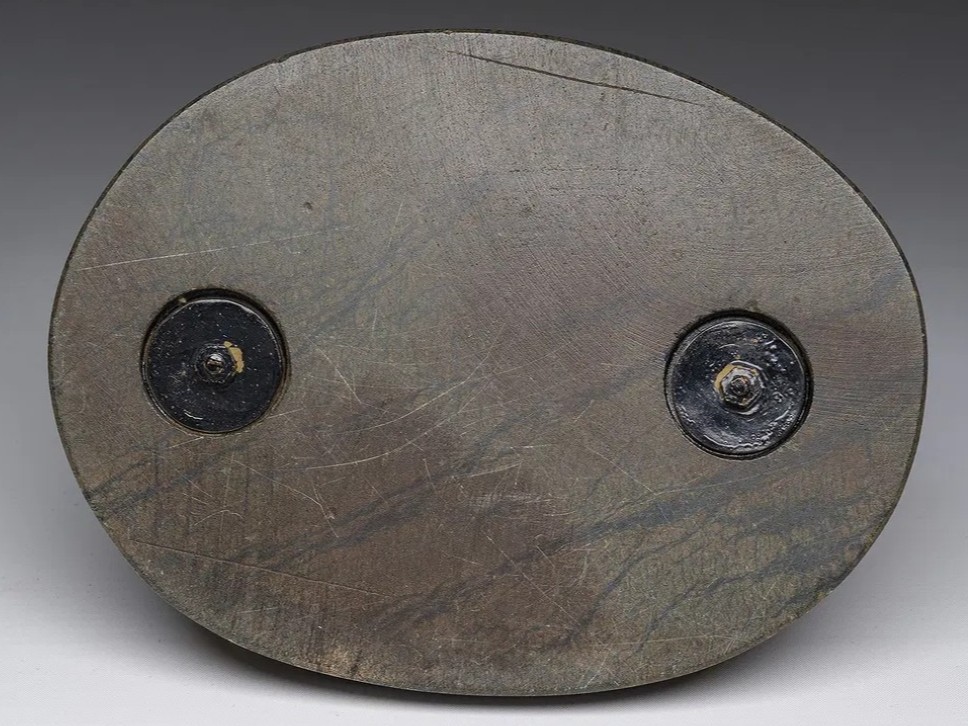
- Base: The entire bronze assembly is mounted on a thick, oval verde antico (green serpentine) marble base. The underside of the marble reveals the mechanical attachment points—two large recessed nuts and bolts that secure the heavy bronze casting to the stone.
- Interior: Lifting the hinged lid reveals a circular opening which holds a removable white ceramic insert.
Estimated Age and Origin
- Period: Circa 1890–1910. This was the “Golden Age” of Vienna bronzes, when the demand for high-quality, whimsical, or naturalistic desk ornaments was at its peak.
- Origin: Vienna, Austria. The specific style of cold painting, the realistic animal anatomy, and the use of the hidden-well “terrain” design are hallmark characteristics of Viennese workshops.
Potential Manufacturer
While the piece is unmarked (common for many authentic Vienna bronzes), the quality of the casting and the dynamic tension of the pose allow for some educated attributions:
- Franz Xaver Bergman (or Bergmann): The most famous of the Vienna bronze founders. While many of his pieces bear a “B” in a vase or a “Nam Greb” stamp, many earlier or smaller workshop pieces remained unsigned. The realism of the fox’s expression is very much in his workshop’s wheelhouse.
- Franz Josef Huber: Known for creating very similar naturalistic animal scenes often mounted on marble bases.
- Fritz Bermann: Another prolific foundry that specialized in “animalier” bronzes and desk sets.
Sold for $111 in April 2026
Content disclaimer. The information posted is the owner’s best knowledge and may not have been vetted by the SOIC. We welcome comments, corrections, and additions, working to make our website information comprehensive and accurate.
Join the Society of Inkwell Collectors (SOIC) – it’s free!
Founded in 1981 as a non-profit organization,
we are documenting inkwells (and accessories).
We’re here to help and inform!