


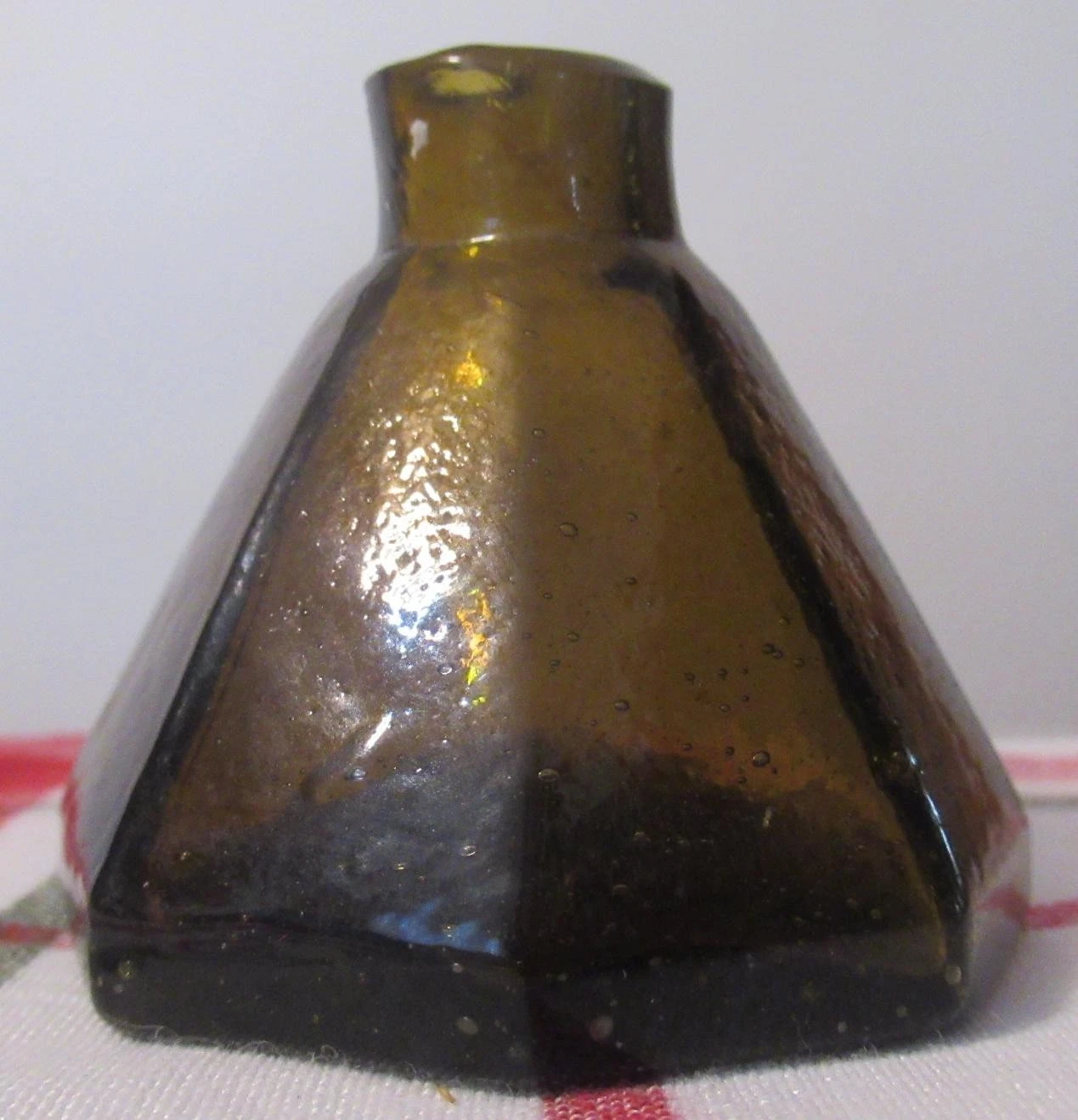


Yellow-Olive Umbrella Ink Bottle
| Categories | Ink Bottle |
| Type | Umbrella |
| Material | Glass |
| Markings | Unmarked |
| Manufacturer | Undetermined |
| Origin | United States |
| Date or Era | circa 1860 |
| Measuring | 2 ⅛” high |
Description
- Form: An 8-sided (octagonal) pyramidal body that tapers sharply from the base to a narrow, cylindrical neck. The “dip” – where the bottle leans slightly to one side—is a classic characteristic of hand-blown glass, often caused by the bottle being slightly off-center when it was removed from the mold or while the lip was being finished.
- Color: A vibrant yellow-olive. While deep olive green and “black glass” (very dark olive) are common for these utility bottles, the yellow-olive hue is significantly rarer. It has a high degree of translucency that allows light to catch the interior “seed” bubbles and flow lines.
- Dimensions: It stands 2 ⅛ inches tall, which is the standard size for these individual-use inkwells.
- Glass Character: The surfaces are “sparkling,” indicating the glass has not suffered from “sick glass” (de-vitrification) or burial. The presence of tiny air bubbles throughout the glass gives it the tactile, “whittled” look prized by collectors of early American glass.
Manufacturing Details
- Lip/Finish: It features a tooled lip. This means that after the bottle was blown into the mold and detached, a finishing tool was used to shape the mouth. This specific style is often called a “flared” or “plain” tooled lip.
- Base: The base shows a clear pontil mark. It appears to be a glass-tipped pontil (or blowpipe) scar, where a rod was used to hold the bottle while the lip was being finished. This is a primary indicator of age, placing the bottle before the widespread use of the snap-case (which left no mark).
Origin and Age
Estimated Age: Circa 1840–1860. The combination of the umbrella shape, the pontil mark, and the tooled lip firmly places this bottle in the mid-19th century. By the late 1860s, most glass houses transitioned to the snap-case, which eliminated the rough pontil scar on the bottom.
Where it was made: This bottle is American, specifically from the New England region.
- Stoddard, New Hampshire: The most likely candidate. The glass houses in Stoddard (like the Granite Glass Co. or the New Weeks & Gilson) are legendary for this exact “yellow-olive” and “olive-amber” glass. Their glass often has that distinct, “clean” and bubbly quality.
- Keene, New Hampshire (Marlboro St. Glassworks): Another strong possibility, as they produced vast quantities of umbrella inks in various shades of green and amber.
- Coventry, Connecticut: While they also made umbrella inks, their glass tends to lean more toward a deeper amber-heavy olive.
Condition Note
The fact that this is “not dug or tumbled” and remains in “as made” condition is exceptional. Most of these were utility items, often discarded and later recovered from privy pits (which causes “haze” or “stain”). A pristine surface with its original “factory” gloss makes this a top-shelf specimen.
Sold for $216 in March 2026
Content disclaimer. The information posted is the owner’s best knowledge and may not have been vetted by the SOIC. We welcome comments, corrections, and additions, working to make our website information comprehensive and accurate.
Join the Society of Inkwell Collectors (SOIC) – it’s free!
Founded in 1981 as a non-profit organization,
we are documenting inkwells (and accessories).
We’re here to help and inform!