


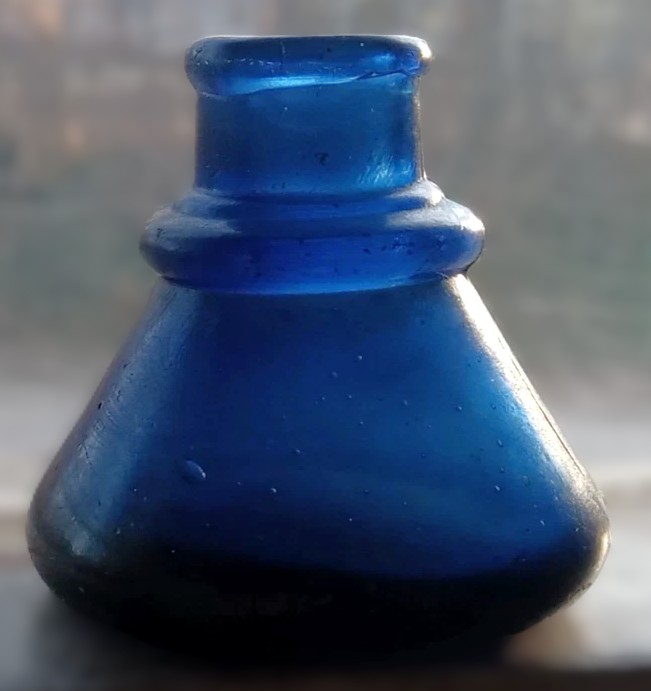
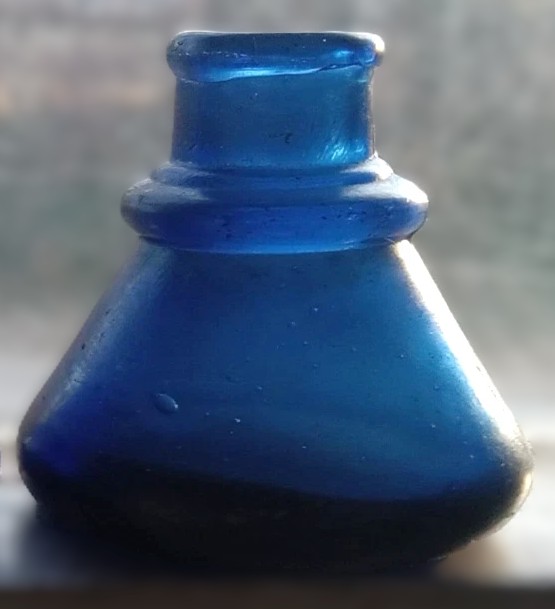

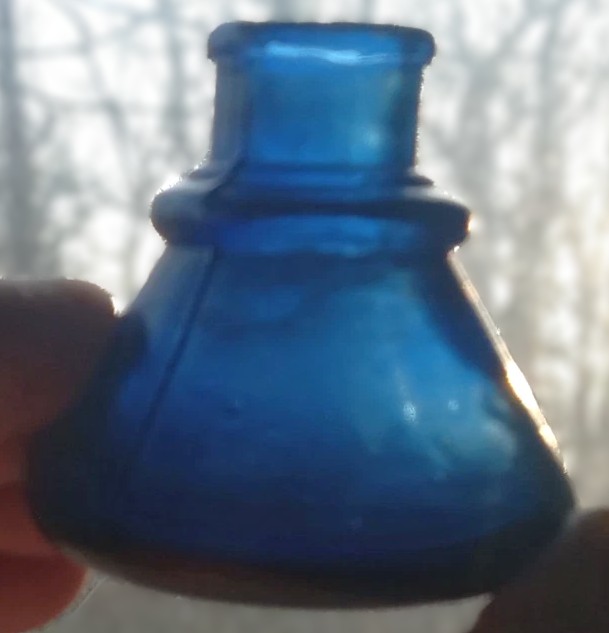
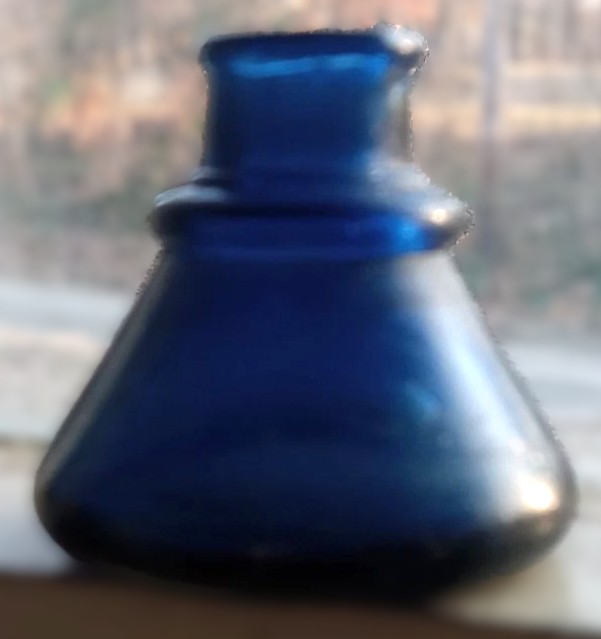
Prussian Blue Conical Ink Bottle
| Categories | Ink Bottle |
| Type | Conical |
| Material | Glass |
| Markings | Unmarked |
| Manufacturer | Undetermined |
| Origin | United States |
| Date or Era | circa 1880 |
| Measuring | 2 ¼” high |
This is a striking example of a late 19th-century utilitarian object. The rich color and hand-finished details give it a wonderful character that modern machine-made glass lacks.
Color: Prussian Blue
The term Prussian Blue refers to a deep, dark, and slightly “moody” blue. In the world of antique glass:
- Visual Characteristic: It is much darker and more saturated than “cobalt” or “cornflower” blue. When held away from the light, it can appear almost black or midnight blue.
- The “Glow”: When backlit, it reveals a vivid, translucent indigo with a slight grayish or “steely” undertone.
- Historical Context: Prussian blue was one of the first synthetic pigments, and in glassmaking, it was often achieved using iron and potassium rather than the more expensive cobalt.
Physical Description
- Form: This is a round-base cone ink. The shoulder ring (the raised band above the cone) provided a grip point and helped catch drips of ink before they ran down the side.
- Manufacturing Details: Hand-Blown in Mold: The vertical seam running up the side of the body confirms it was blown into a two-piece mold.
- Tooled Lip: The “ring lip” at the top shows the slight irregularities of being finished by hand with a lipping tool while the glass was still hot, rather than being perfectly uniform like a modern screw-top.
- Base: The bottom shows a smooth, slightly concave surface typical of late 19th-century bottles that were “snapped” from the blowpipe without leaving a rough pontil mark.
- Condition: The glass is full of seed bubbles and small “whittle marks” (the texture from the cold mold), which are highly desirable traits for collectors as they prove its age and handmade nature.
Historical Context
Bottles like this were common between 1870 and 1890. Because there is no embossing, it was likely sold with a paper label (which has long since perished) from a stationery company. Prussian blue glass was often used for higher-quality inks to protect the fluid from light degradation.
Sold for $180 in January 2026
Content disclaimer. The information posted is the owner’s best knowledge and may not have been vetted by the SOIC. We welcome comments, corrections, and additions, working to make our website information comprehensive and accurate.
Join the Society of Inkwell Collectors (SOIC) – it’s free!
Founded in 1981 as a non-profit organization,
we are documenting inkwells (and accessories).
We’re here to help and inform!