

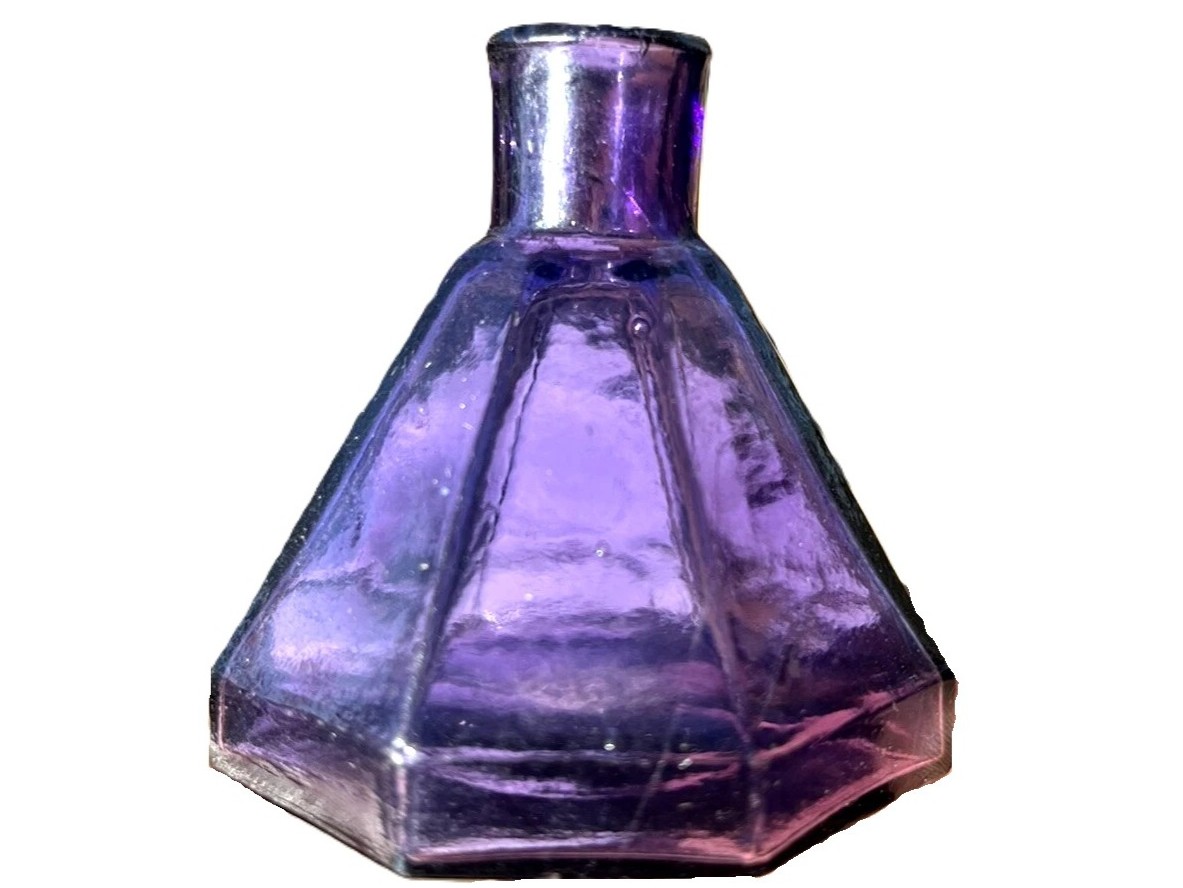




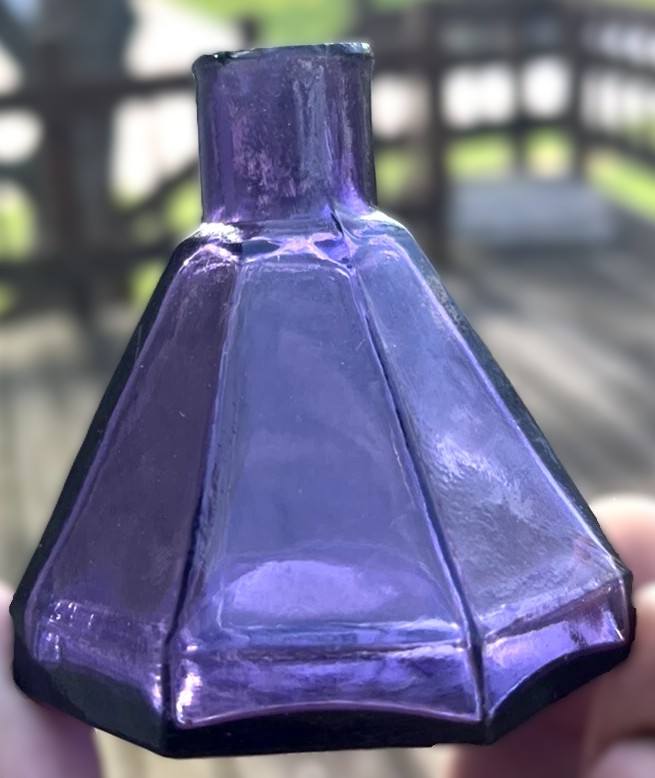

Amethyst Eight-Sided Umbrella Ink Bottle
| Categories | Ink Bottle |
| Type | Umbrella |
| Material | Glass |
| Markings | Unmarked |
| Manufacturer | Undetermined |
| Origin | United States |
| Date or Era | circa 1860 |
| Measuring | 2 ½” high |
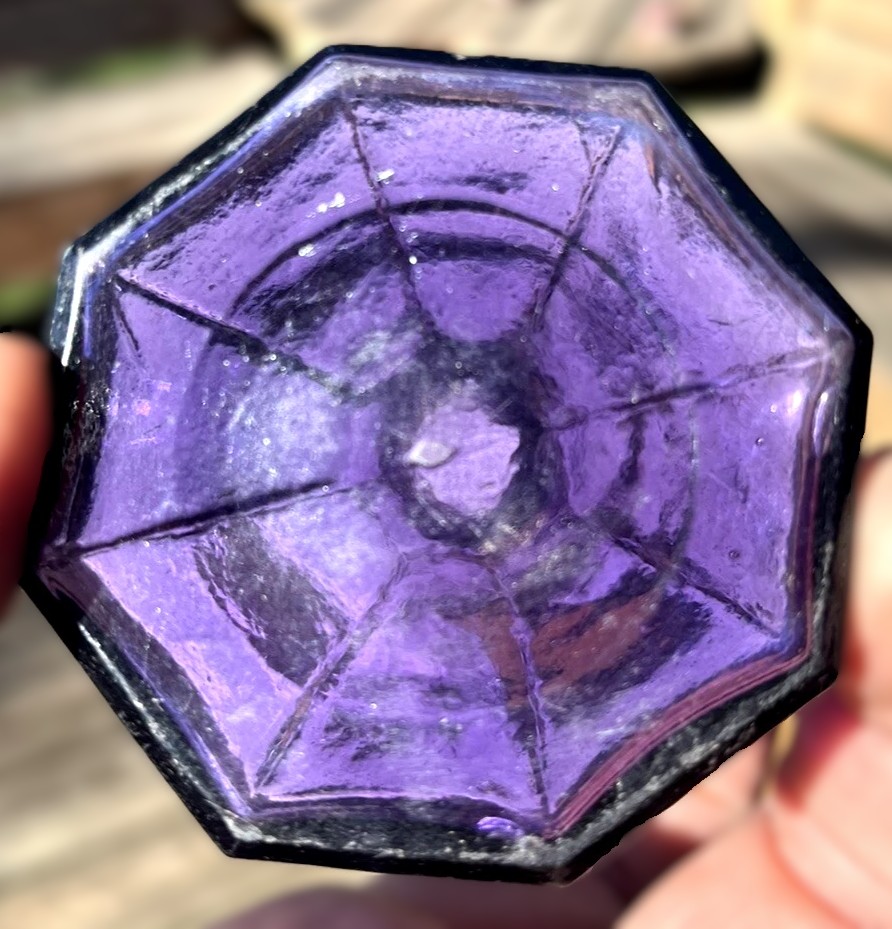
This is a scarce amethyst eight-sided umbrella ink bottle dating to the 1860s. This bottle is classified as an Umbrella Ink due to its distinctive shape—a fluted cone base with eight connecting vertical panels that resemble a closed umbrella.
Key Features
The combination of the glass color, shape, and specific manufacturing marks points to a mid-19th-century American-made glass container.
- Color: Amethyst
- Rarity: Amethyst (a purple tint) is one of the less common colors for these typically aqua or clear ink bottles. The color is achieved by adding manganese dioxide to the glass batch.
- Dating Cue: Manganese was used as a decolorizing agent in clear glass to counteract the greenish tint caused by iron impurities. Over time, when exposed to direct sunlight, the manganese would react, causing the clear glass to “sun-color” into a beautiful pale to deep amethyst/purple.
- Form and Dimensions
- Style: Eight-Sided Umbrella Ink (also known as a fluted cone or octagon ink). This was a very popular, common-sense design from the 1840s through the 1880s because its wide, low base made it stable and difficult to tip over on a desk.
- Height: The bottle is approximately 2 ½” high.
- Manufacturing Marks (Dating & Technique)
The finishing details confirm its age as a transitional, hand-blown piece from the 1860s.
- Hand Blown: The overall character and diagnostic marks confirm the bottle was mouth-blown into a mold.
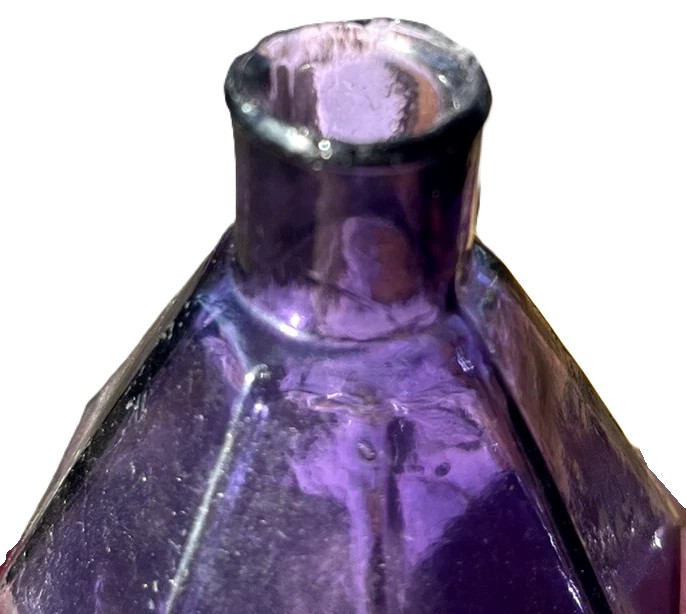
- Sheared Lip: The top of the bottle has a sheared lip (or cracked-off/burst-off lip). This finish means the glassblower separated the neck from the blowpipe by cutting or snapping the hot glass. The raw edge was then quickly reheated and sometimes slightly rounded (fire polished) to remove sharp points but was not fully tooled to form a distinct rim. This method generally dates the bottle to pre-1870.
- Straight Line Hinge Mold Seam on the Bottom: This refers to the mold seam that runs up the side of the bottle and straight across the base. This marks the junction of the two halves of a two-piece hinge mold. The fact that the seam runs across the base, rather than stopping at a separate base plate or having a pontil scar, indicates the use of a hinge-style mold or a snap case during the finishing process, a common characteristic for bottles made in the mid-to-late 1860s as manufacturers transitioned away from the earlier pontil-rod method.
Sold for $240 in October 2025
Content disclaimer. The information posted is the owner’s best knowledge and may not have been vetted by the SOIC. We welcome comments, corrections, and additions, working to make our website information comprehensive and accurate.
Join the Society of Inkwell Collectors (SOIC) – it’s free!
Founded in 1981 as a non-profit organization,
we are documenting inkwells (and accessories).
We’re here to help and inform!