

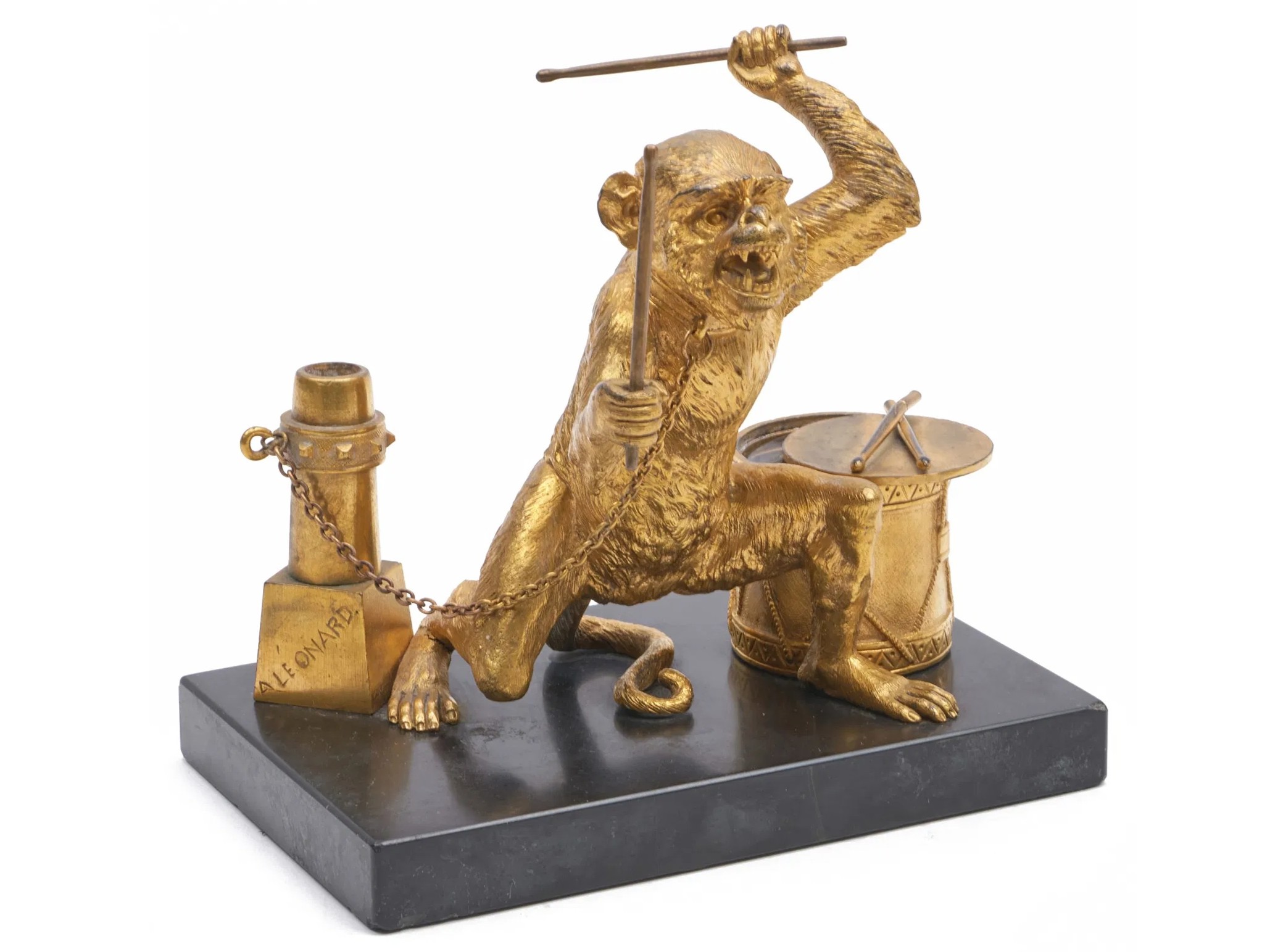


“Mad” Monkey Drummer
| Categories | Figural - Animals & Living Creatures |
| Type | Monkey |
| Material | Gold Gilt Finish |
| Markings | See Narrative |
| Manufacturer | Agathon Léonard |
| Origin | France |
| Date or Era | circa 1890 |
| Measuring | 7” x 5 ½” x 7” high |
This piece is an ornate, figural inkstand that combines a whimsical subject with fine French metalwork, indicative of the fin de siècle period. The signature “A. Leonard” refers to Agathon Léonard.
Description of the Inkstand
The inkstand is a figural desktop accessory combining sculpture and function, characteristic of decorative arts from the late 19th and early 20th centuries.
- Materials: The primary structure is a gilt bronze (bronze that has been gilded, or gold-plated) figure set upon a heavy, polished black stone base (likely slate).
- The Monkey Figure: The central feature is a monkey, posed theatrically. Its expression is animated and “crazed,” with an open mouth and wide, excited eyes, lending the piece a distinct, slightly manic energy typical of whimsical French animalier work of the period. The monkey holds two drumsticks in its hands, poised to strike the drum.
- The Inkwell (The Drum): The functional inkwell is cleverly integrated into the scene, forming the drum the monkey is playing. The top of the drum acts as the lid, and the interior holds the glass ink liner.
- The Post (The Stanchion): The vertical element next to the monkey, a “post,” is a stanchion or support column for a pen. This support is where the signature “A. Leonard“ is inscribed.
Biography of Agathon Léonard
The signature “A. Leonard” refers to the distinguished French sculptor Agathon Léonard (Agathon Léonard van Weydeveld, 1841–1923).
While Léonard is most famous for his fluid, Art Nouveau dancing figures (“Jeu de l’Écharpe” or “Scarf Dance”), he was a prolific sculptor who also created smaller bronze decorative objects, particularly during the late 19th century. Figural inkstands were a popular format for sculptors to produce smaller, marketable works. The high quality, material choice (gilt bronze and stone), and complex figural design are all consistent with a French sculptor of his standing.
Biographical Information: Agathon Léonard (1841–1923)
| Detail | Biographical Information |
| Full Name | Agathon Léonard van Weydeveld |
| Lifespan | August 28, 1841 (Lille, France) – April 12, 1923 (Paris, France) |
| Movement | Primarily Art Nouveau (active in the fin de siècle and early 20th century). |
| Career Highlights | Académie des Beaux-Arts: He studied under renowned sculptors like Jean-Baptiste Carpeaux. Sèvres Porcelain Factory: He became the official sculptor for the prestigious national Sèvres Porcelain Manufactory. |
| Notable Works | The “Jeu de l’Écharpe” (Scarf Dance) series, which features 15 individual bronze statuettes of dancers, is his most famous contribution to Art Nouveau sculpture. |
| Style | His work is characterized by graceful movement, flowing lines, and soft forms. Even his earlier, more whimsical pieces like the monkey inkstand often show a dynamic energy and high level of detail. |
| Significance | Léonard was a respected figure who bridged the gap between academic sculpture and the emerging decorative arts movements of the 1900s, producing works in bronze, marble, and porcelain. |
Sold for $680 in October 2025
Content disclaimer. The information posted is the owner’s best knowledge and may not have been vetted by the SOIC. We welcome comments, corrections, and additions, working to make our website information comprehensive and accurate.
Join the Society of Inkwell Collectors (SOIC) – it’s free!
Founded in 1981 as a non-profit organization,
we are documenting inkwells (and accessories).
We’re here to help and inform!