

Inkipedia
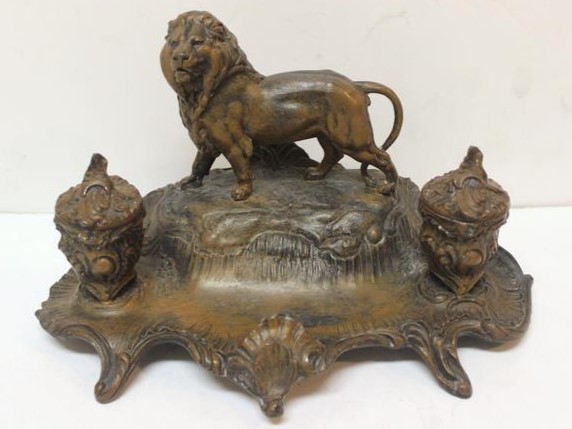




Lion Double Inkstand
| Categories | Figural - Animals & Living Creatures |
| Type | Lion |
| Material | Bronze finish |
| Markings | Sign A BOSSU |
| Manufacturer | Undetermined |
| Origin | France |
| Date or Era | circa 1890 |
| Measuring | 10 ½” x 7” x 6 ½” high |
- Description of the Inkstand
- The Sculpture: The centerpiece is a large, muscular lion depicted in a “passant” (walking) stance with its mouth open in a roar. The modeling focuses on the texture of the mane and the musculature of the legs, typical of the French Animalier school which prioritized realistic animal depictions.
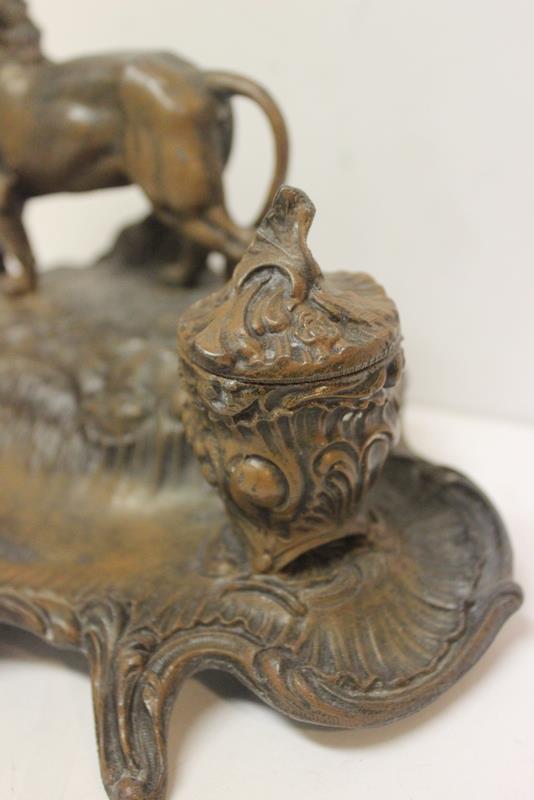
- The Base: The lion stands on a raised, rocky plinth that flows into a wide Rococo-style base. The tray features heavy scrolling foliage, acanthus leaves, and a central depression serving as the pen tray.
- The Inkwells: Flanking the lion are two matching urn-shaped inkwells. They feature hinged lids decorated with organic finials. They retain their clear glass inserts, which are antique mold-blown glass.
- Material: This is bronzed spelter (known in France as Régule).
- Evidence: The underside shows the hollow, rough grey metal characteristic of spelter casting. It has been coated with a polychrome or bronze-like patina to mimic the more expensive solid bronze sculptures of the era.
- The Artist: A. Bossu
- Identity: A. Bossu was a French sculptor active during the Art Nouveau period (late 19th/early 20th century).
- Reputation: While not as famous as the “founding fathers” of the Animalier movement (like Antoine-Louis Barye), Bossu was a prolific sculptor who specialized in decorative spelter figures for the middle-class market. He is best known for his sculptures of birds, lions, and pastoral figures that were incorporated into clocks, lamps, and desk sets.
- Signature: The signature “A. Bossu” is cast into the base.
- Origin and Age
- Made in France
- The use of “Régule” (spelter), the specific “Animalier” style of the lion, and the Rococo revival base are hallmarks of French decorative arts production from Paris foundries.
- Items signed by Bossu were almost exclusively produced in France for both domestic use and export.
- When was it made? Circa 1890–1915.
- This period, known as the Belle Époque, saw a massive demand for decorative office items that looked like luxury bronze but were made of affordable spelter. The “Roaring Lion” was a favorite motif symbolizing strength and nobility.
Sold for $137.50 in November 2016
Painted version sold for $464 in November 2025
Content disclaimer. The information posted is the owner’s best knowledge and may not have been vetted by the SOIC. We welcome comments, corrections, and additions, working to make our website information comprehensive and accurate.
Join the Society of Inkwell Collectors (SOIC) – it’s free!
Founded in 1981 as a non-profit organization,
we are documenting inkwells (and accessories).
We’re here to help and inform!