

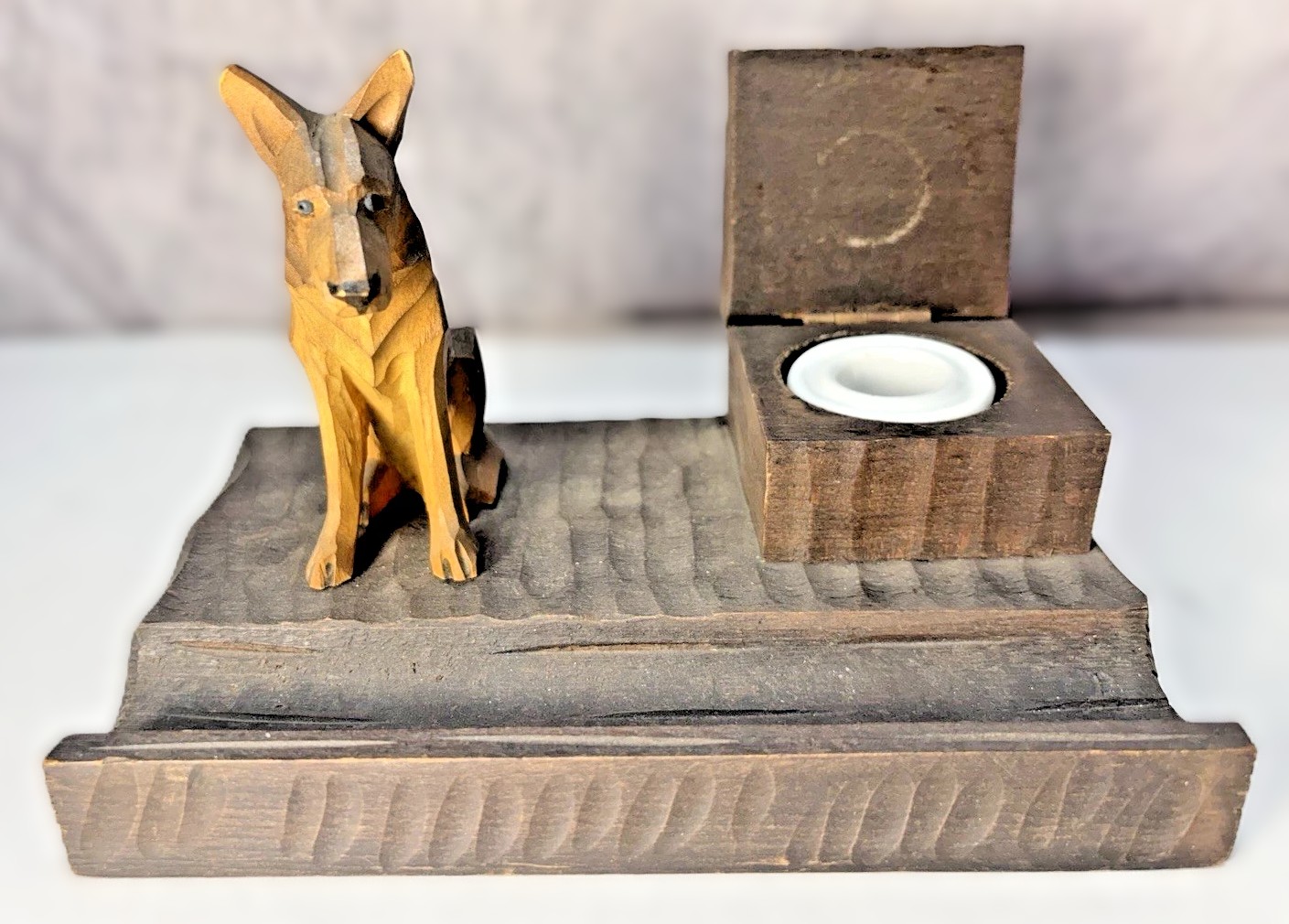
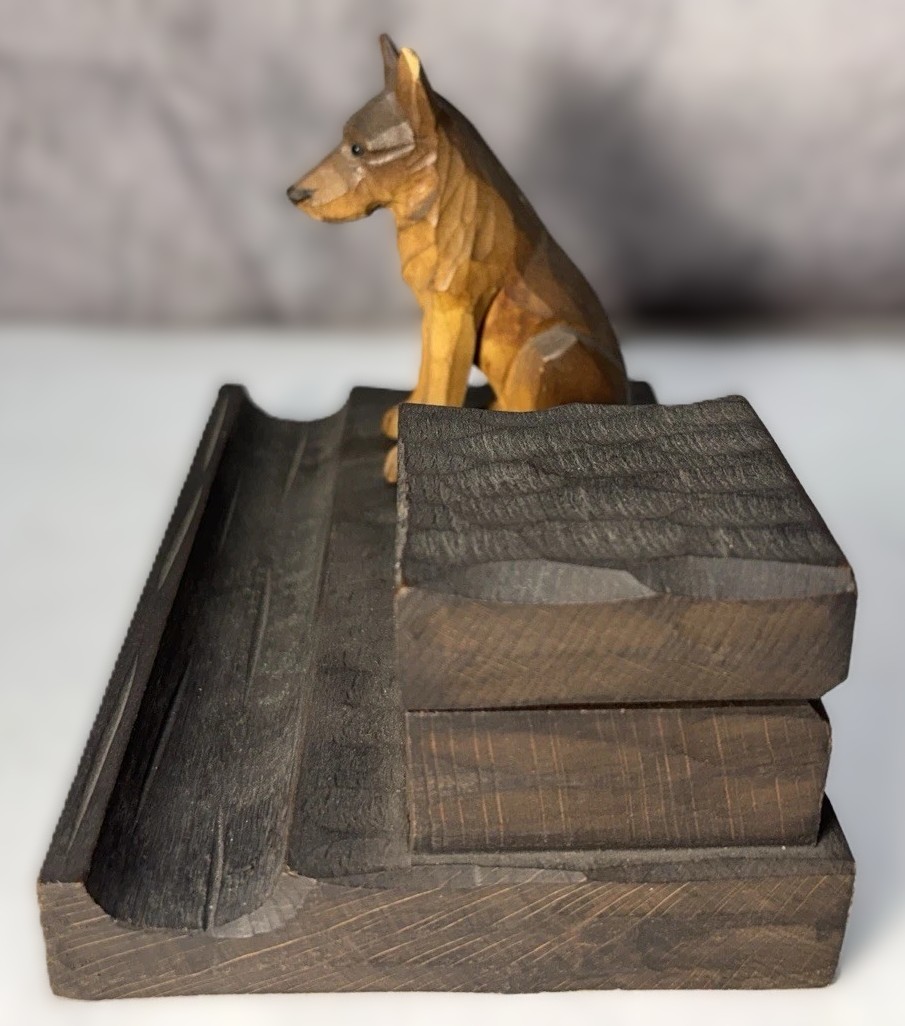
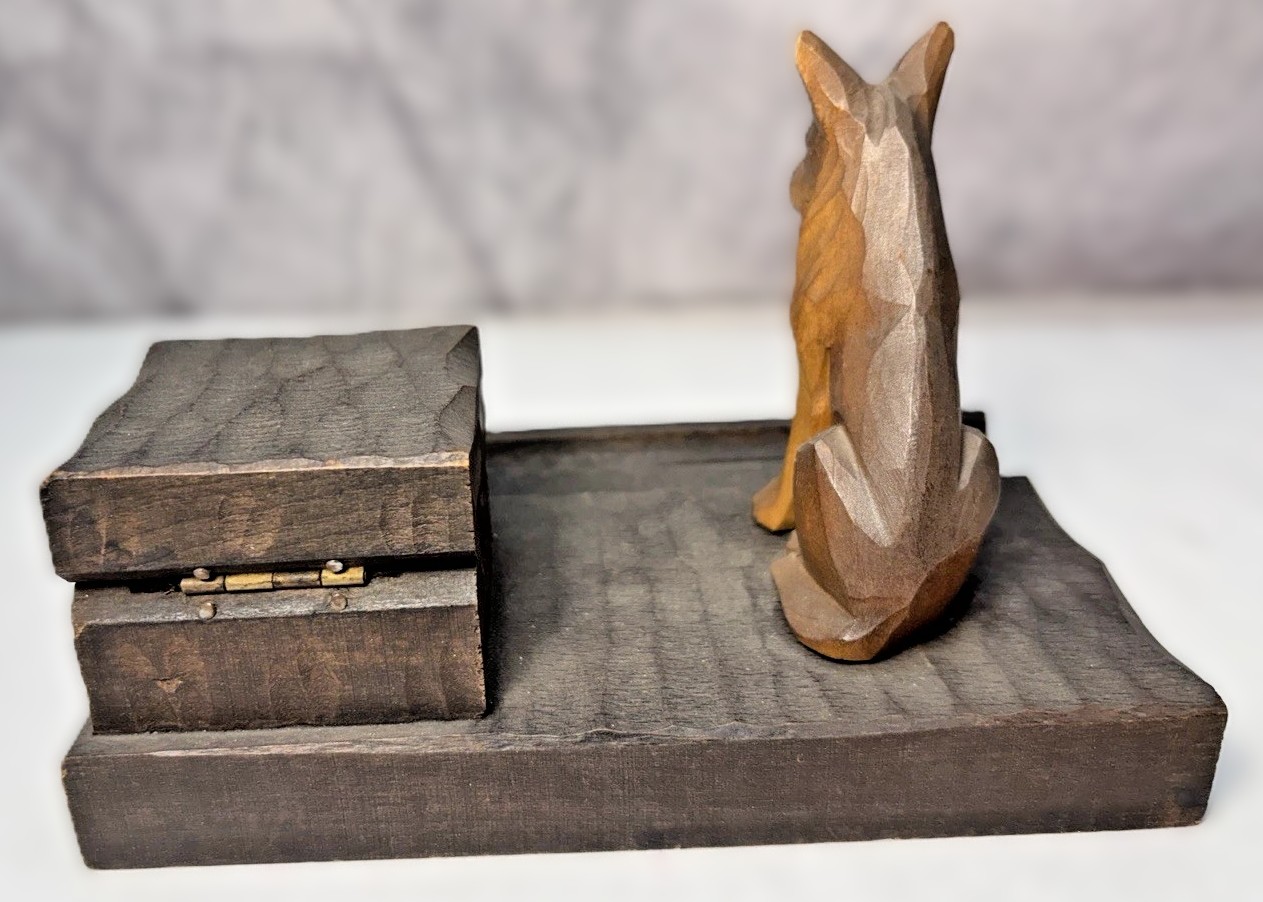
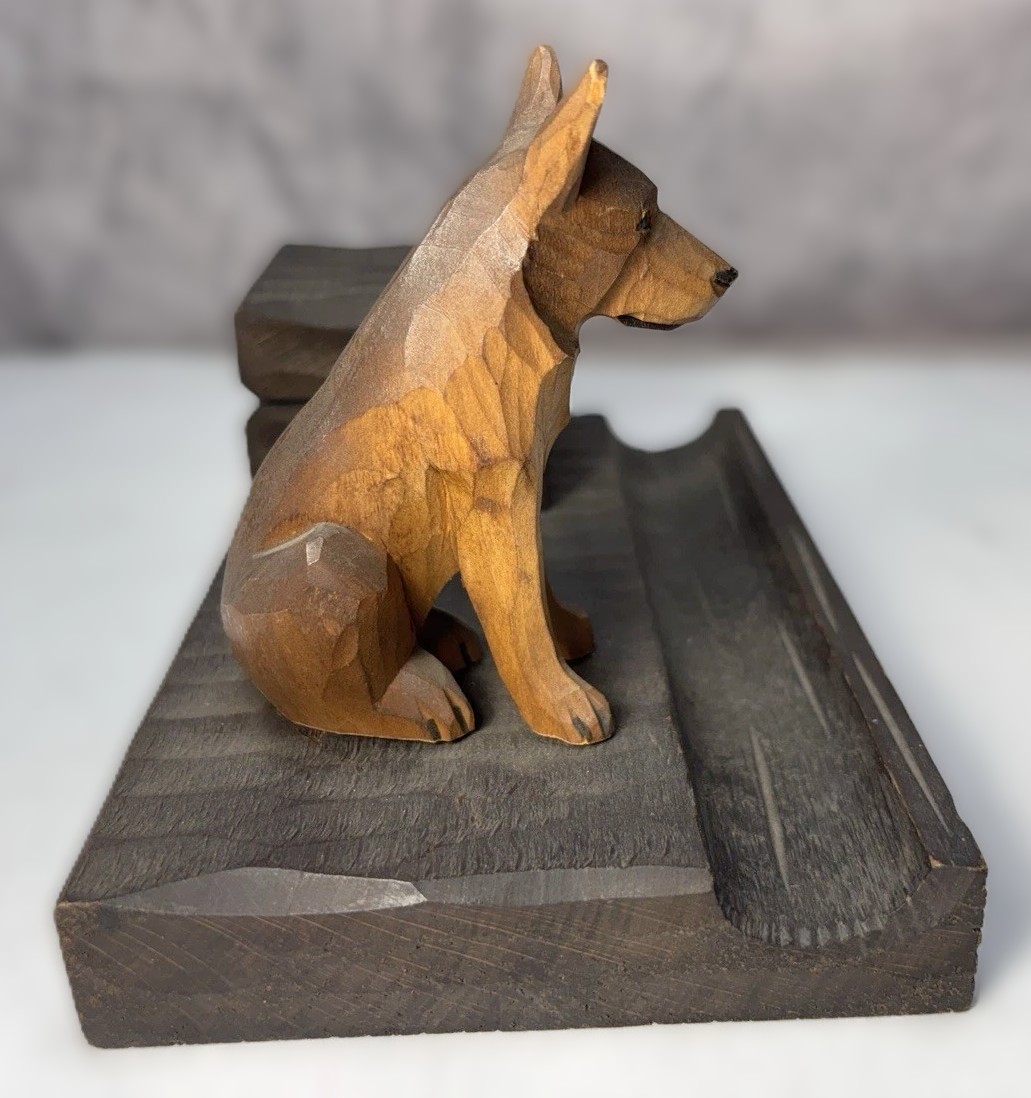
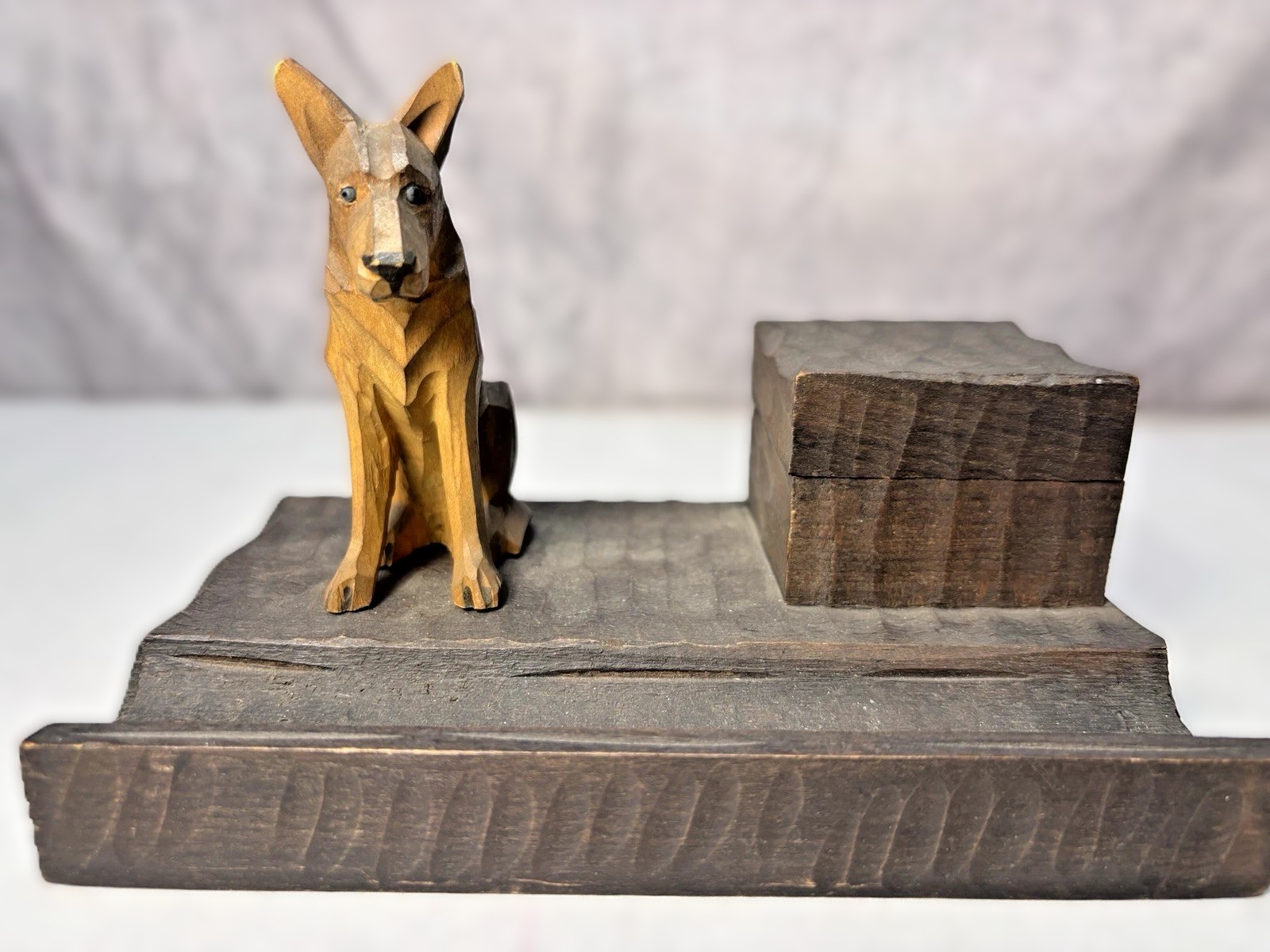
Carved wooden shepherd inkstand
| Categories | Figural - Animals & Living Creatures |
| Type | carved, dog |
| Material | Wood |
| Markings | None |
| Manufacturer | Black Forest |
| Origin | Switzerland |
| Date or Era | circa 1930 |
| Measuring | base 7 inches by 4 Inches, dog stands 3.5 inches tall |
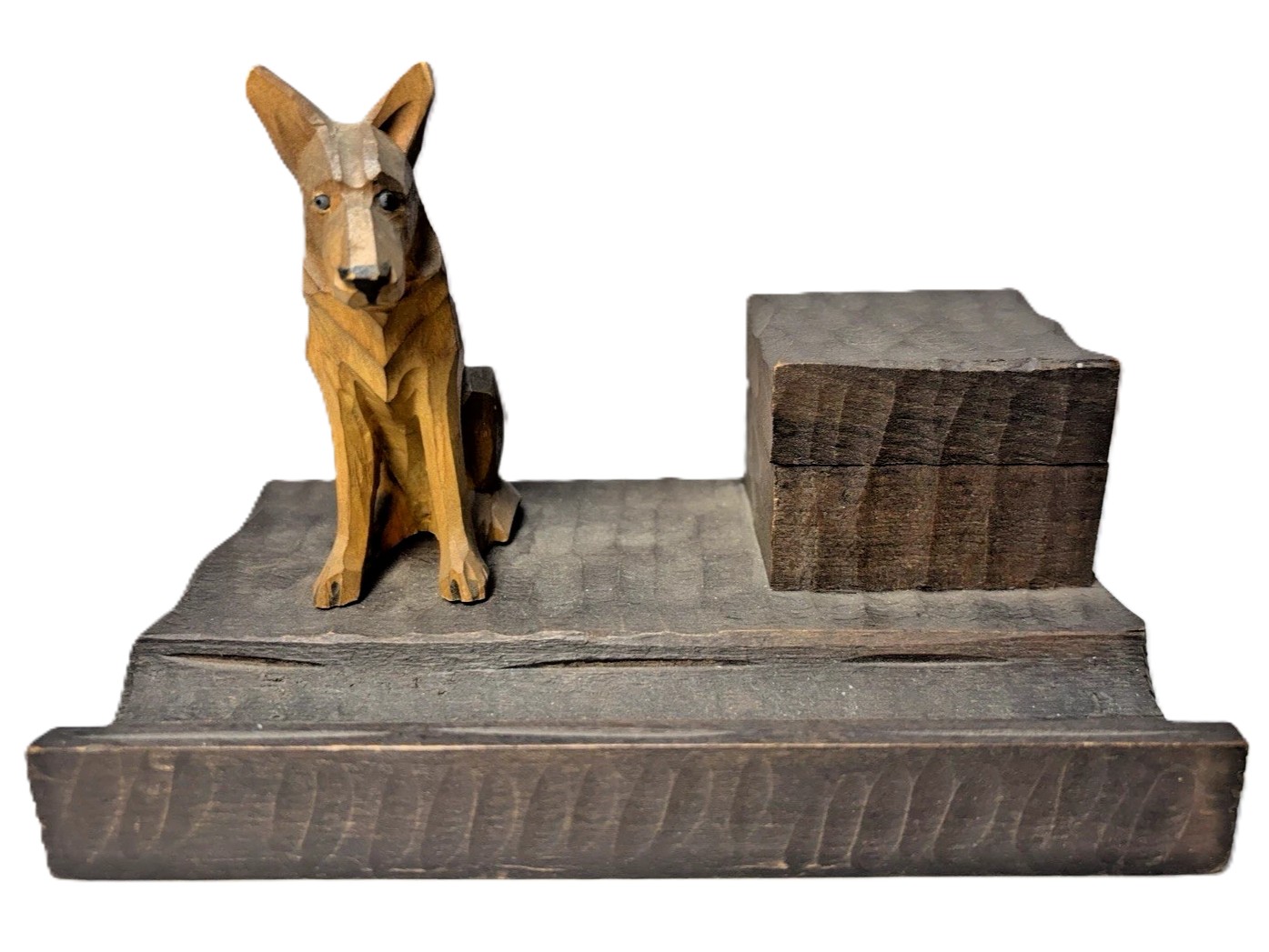
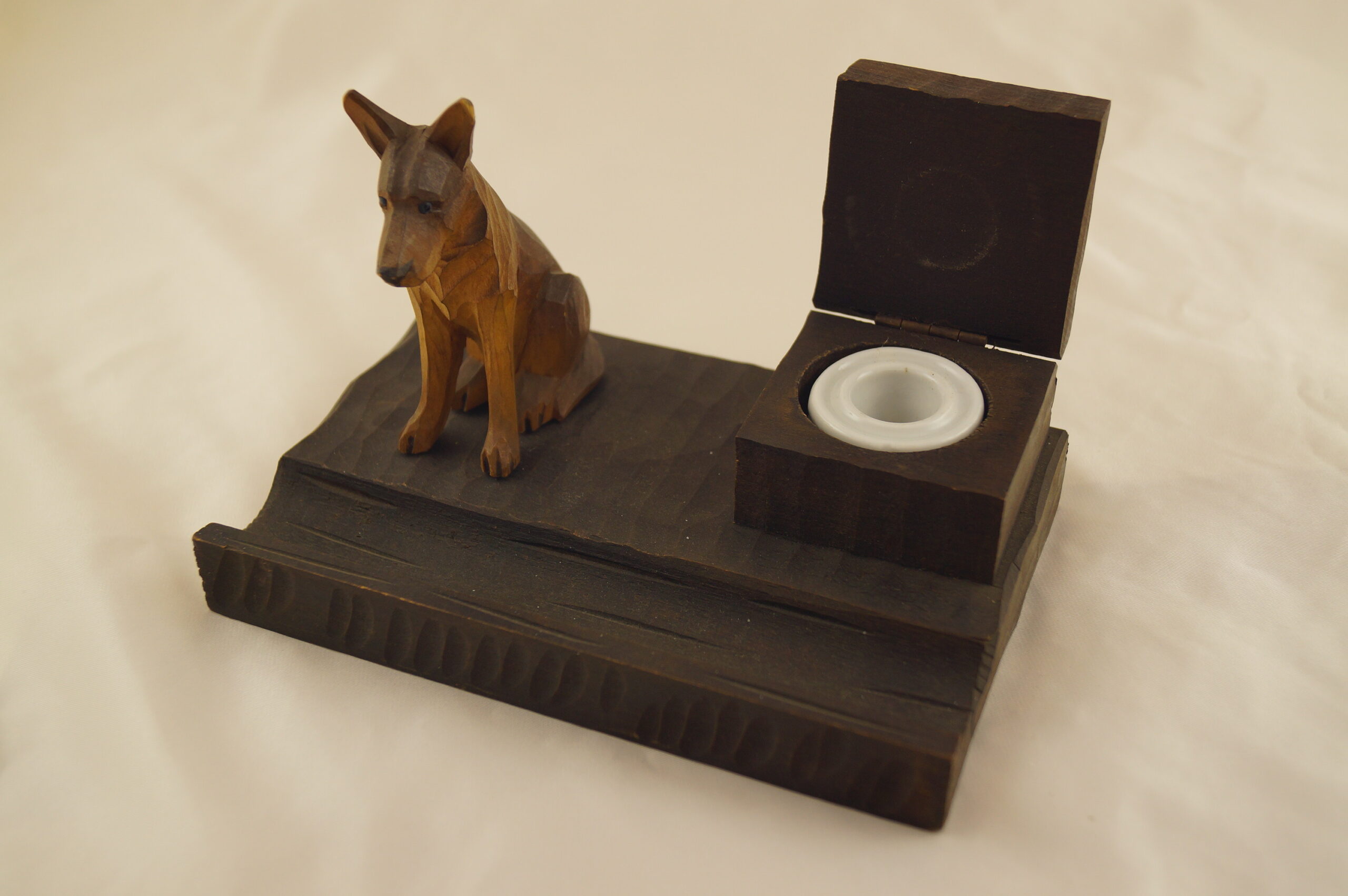
Man’s best friend is a nicely carved German Shepherd inkstand with a white porcelain inkpot and pen rest. From the collection of Thomas Gombar.
This hand-carved wooden inkstand, crafted in the Black Forest or Brienz style, combines functional utility with the naturalistic animal carving popular in the early-to-mid 20th century.
Overview
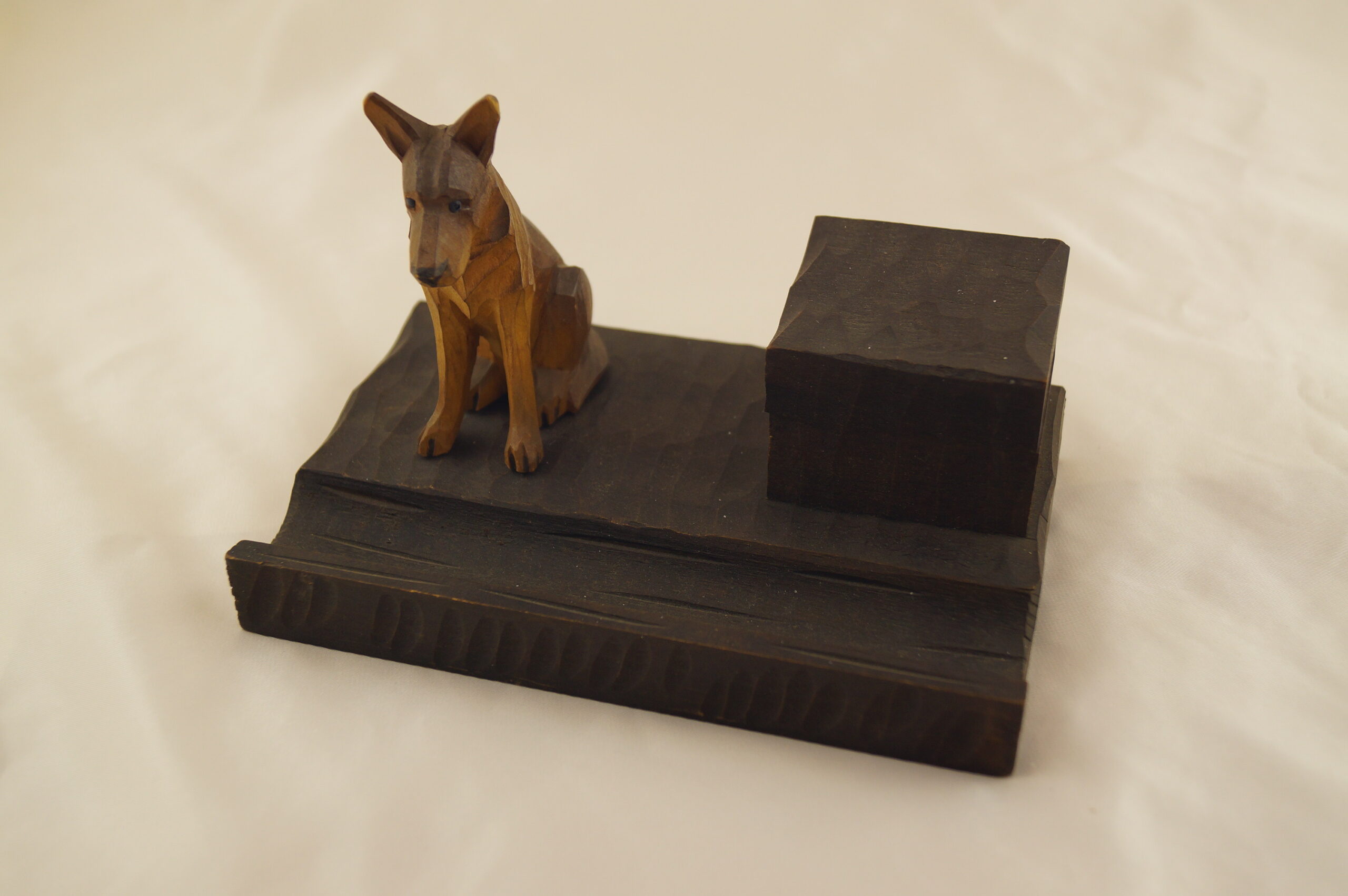
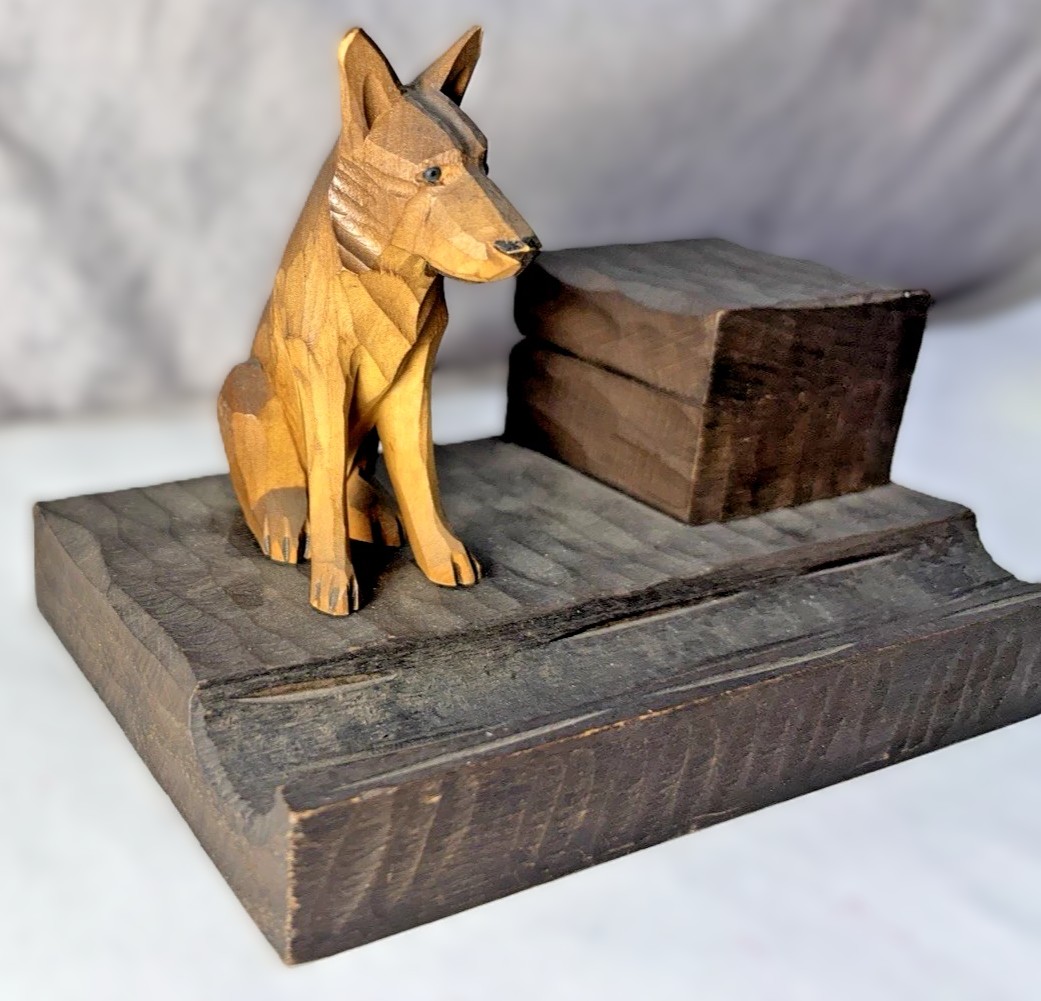
A hand-carved wooden desktop inkstand featuring a German Shepherd (Alsatian) figure. The base is carved from a solid block of wood with a rich, dark patina, showcasing traditional “flat-plane” or faceted carving techniques where the chisel marks are left visible to create texture and form.
The Figure
- Subject: An alert German Shepherd sits in a traditional “stately” pose on the left side of the base.
- Detailing: The dog features upright, pointed ears and a focused expression. The carving uses a lighter-toned wood for the body with darker stained accents on the “saddle,” ears, and muzzle to mimic the breed’s natural markings.
- Technique: The carving is stylized rather than perfectly smooth, giving it a rugged, artisanal character.
The Base and Inkwell
- Structure: The rectangular base is heavily textured with rhythmic, horizontal chisel marks.
- Pen Channel: A wide, deep pen trough runs across the front length of the stand. The front vertical face of the stand features decorative scalloped carvings.
- Inkwell Box: On the right sits a square, hinged wooden box. The lid is attached with a simple metal pin hinge.
- Insert: Inside the wooden housing is a removable white porcelain inkwell insert.
Condition and Craftsmanship
- Material: Likely carved from linden, walnut, or maple, which were traditional woods for European carvers.
- Artistry: The piece is a fine example of folk-art desktop accessories. The contrast between the dark, weathered base and the warmer tones of the dog suggests a well-preserved original finish.
This inkstand likely dates to the 1920s to 1940s.
This period marks the intersection of the German Shepherd’s peak popularity and the specific “faceted” or “flat-plane” woodcarving style seen in this piece.
- The Breed’s Popularity (Post-1920)
While the German Shepherd breed was standardized in 1899, it did not become a global pop-culture icon until after World War I. The breed’s intelligence and loyalty during the war, followed by the massive fame of movie stars like Rin Tin Tin in the 1920s, led to a surge in German Shepherd-themed decorative arts. Before the 1920s, “Black Forest” carvings more commonly featured St. Bernards, Pugs, or Hunting Hounds.
- The “Faceted” Carving Style
The technique used here—where the carver leaves bold, visible chisel marks rather than sanding the wood smooth—is known as flat-plane or faceted carving.
- Origin: This style was popularized in the late 19th and early 20th centuries by carvers in the Swiss Brienz and German Oberammergau regions, as well as by Scandinavian masters like Axel Petersson.
- 1920s-1940s Context: During this time, these carvings were highly popular souvenirs for European travelers. The simplified, rugged look was a precursor to modern “minimalist” folk art and was a efficient way for skilled artisans to produce high-quality, expressive pieces for the growing middle-class market.
- Desktop Utility and Materials
- The Porcelain Insert: The use of a removable white porcelain inkwell is a hallmark of early-to-mid 20th-century desk sets.
- Base Design: The wide pen channel and the scalloped decorative carving on the front edge are consistent with European desktop accessories from the Interwar period (1918–1939).
Estimated value: $75
Content disclaimer. The information posted is the owner’s best knowledge and may not have been vetted by the SOIC. We welcome comments, corrections, and additions, working to make our website information comprehensive and accurate.
Join the Society of Inkwell Collectors (SOIC) – it’s free!
Founded in 1981 as a non-profit organization,
we are documenting inkwells (and accessories).
We’re here to help and inform!