


WWI French Commemorative Inkstand
| Categories | Figural - Inanimate |
| Type | Military |
| Material | White metal |
| Markings | See Narrative |
| Manufacturer | Richer |
| Origin | France |
| Date or Era | circa 1920 |
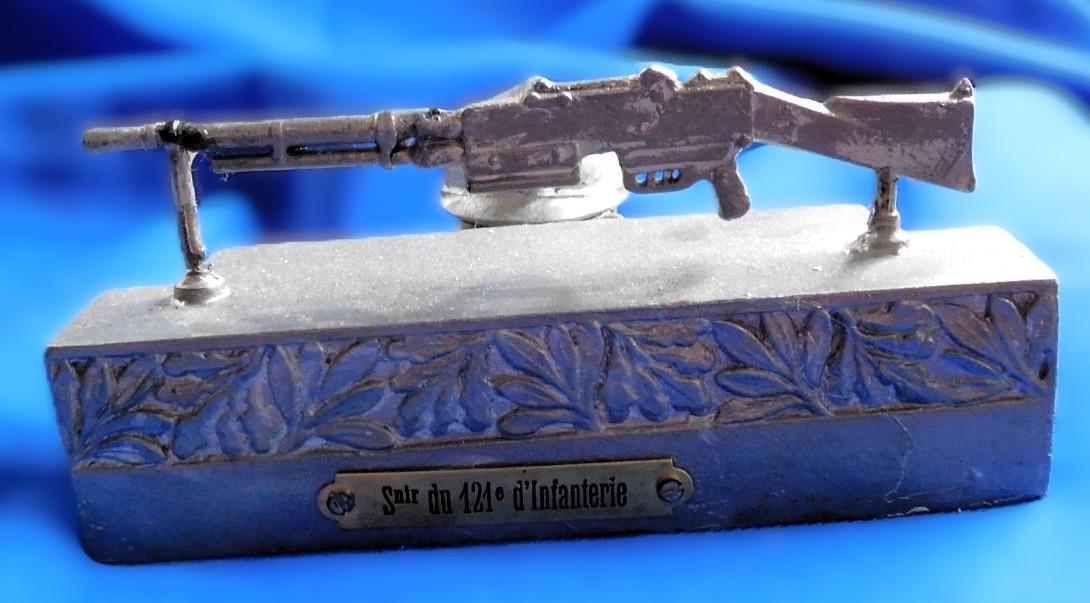
This is a World War I commemorative inkstand, a sculptural souvenir honoring a French infantry regiment.
- Material: The inkstand is cast from spelter, a zinc-based metal that was frequently used for decorative and sculptural items in the late 19th and early 20th centuries.
- Central Feature: The main component is a bust of a French “Poilu” (WWI soldier). The bust shows the soldier from the shoulders up.
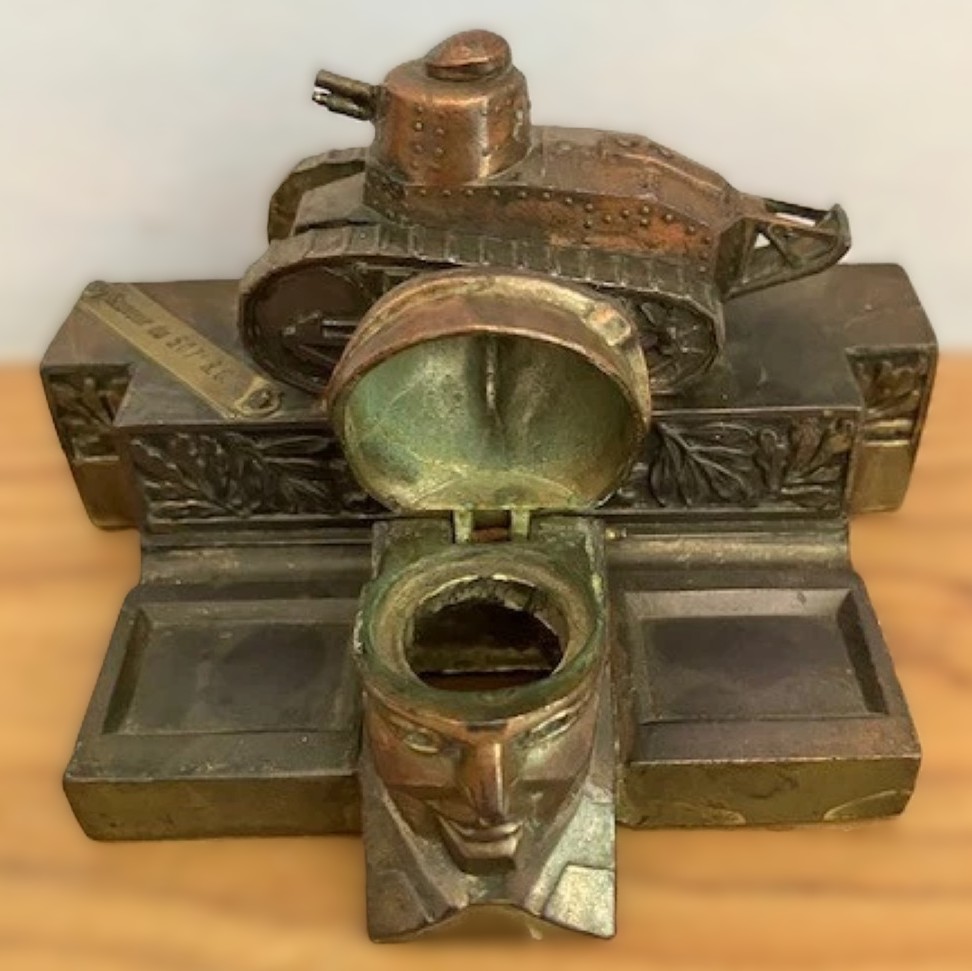
- Inkwell and Helmet: The soldier’s iconic helmet is hinged at the back, allowing the entire top section to be opened to reveal the inkwell insert.
- Rifle: A replica of a military rifle, which appears to be a Lebel Model 1886, is cast as a separate element on the base of the inkstand, positioned behind the soldier’s bust. This was the standard-issue rifle for the French Army during World War I. Its key identifying features—the bolt action, the long barrel, and the distinct shape of the stock and sights—are all present.
- Plaque: A plaque is affixed to the rear, bearing the inscription “Snir du 121e d’Infanterie,” which is a French abbreviation for “Souvenir of the 121st Infantry.” The 121st Infantry Regiment was a unit of the French Army that saw significant combat in World War I, including actions at Verdun and on the Somme.
This piece is a compelling example of a French post-WWI souvenir, likely created in the 1920s to honor the service and sacrifice of the 121st Infantry Regiment.
Pictures added of a second inkstand for a tank regiment using the same base:
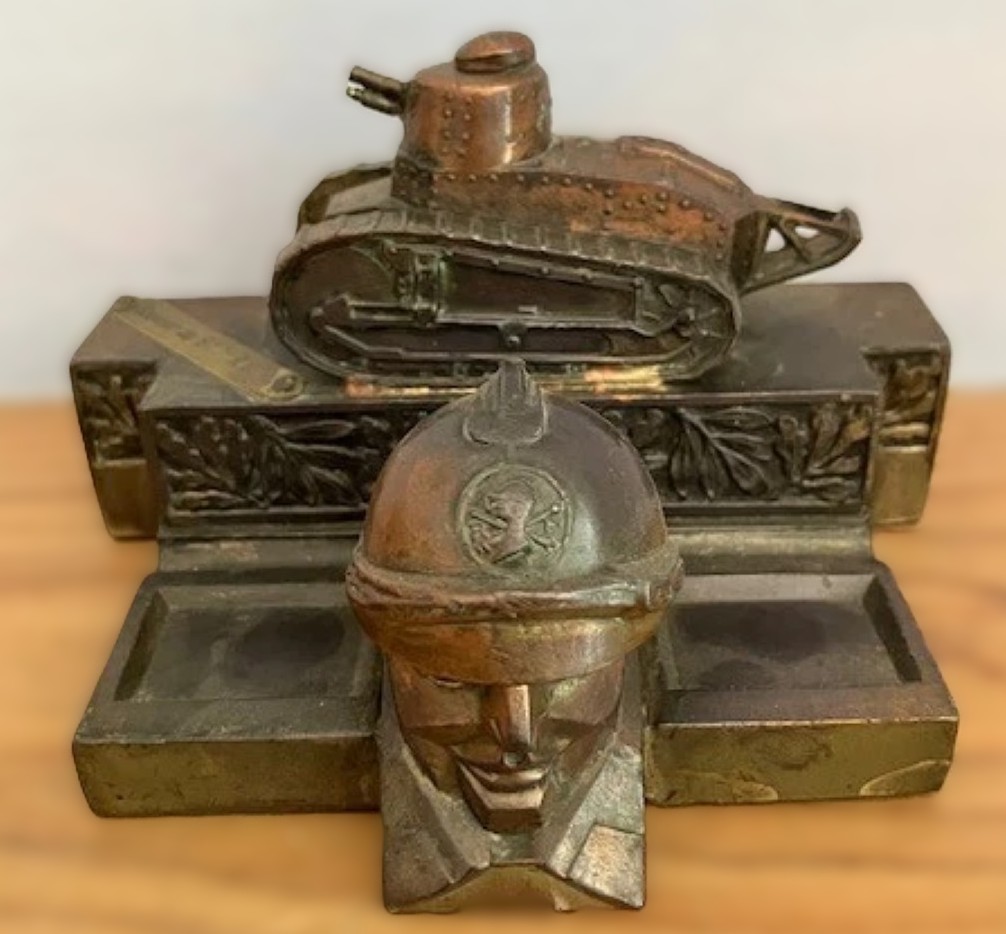
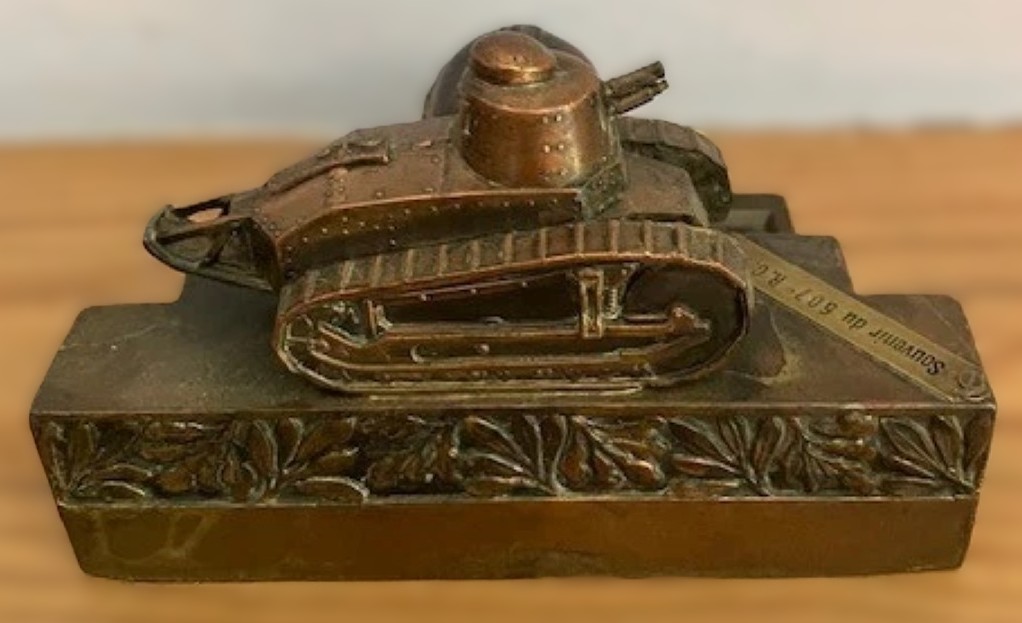
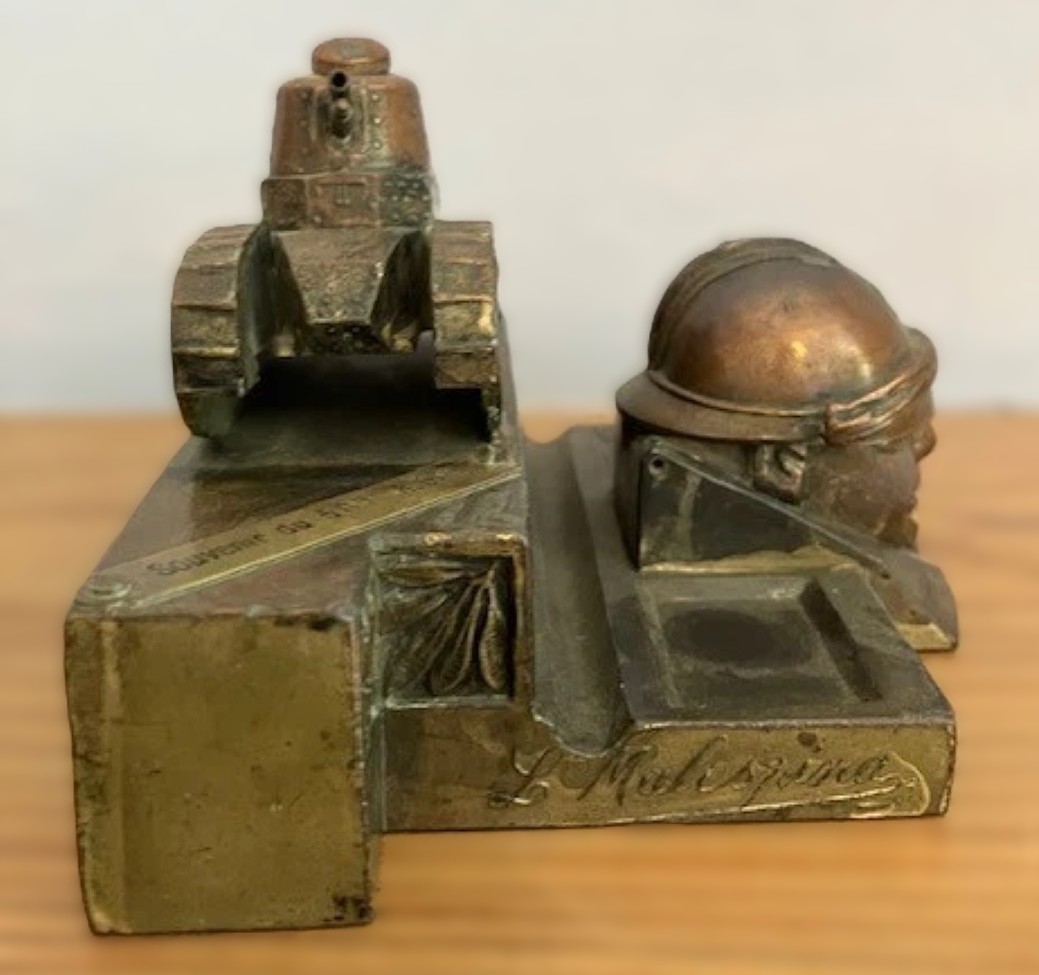
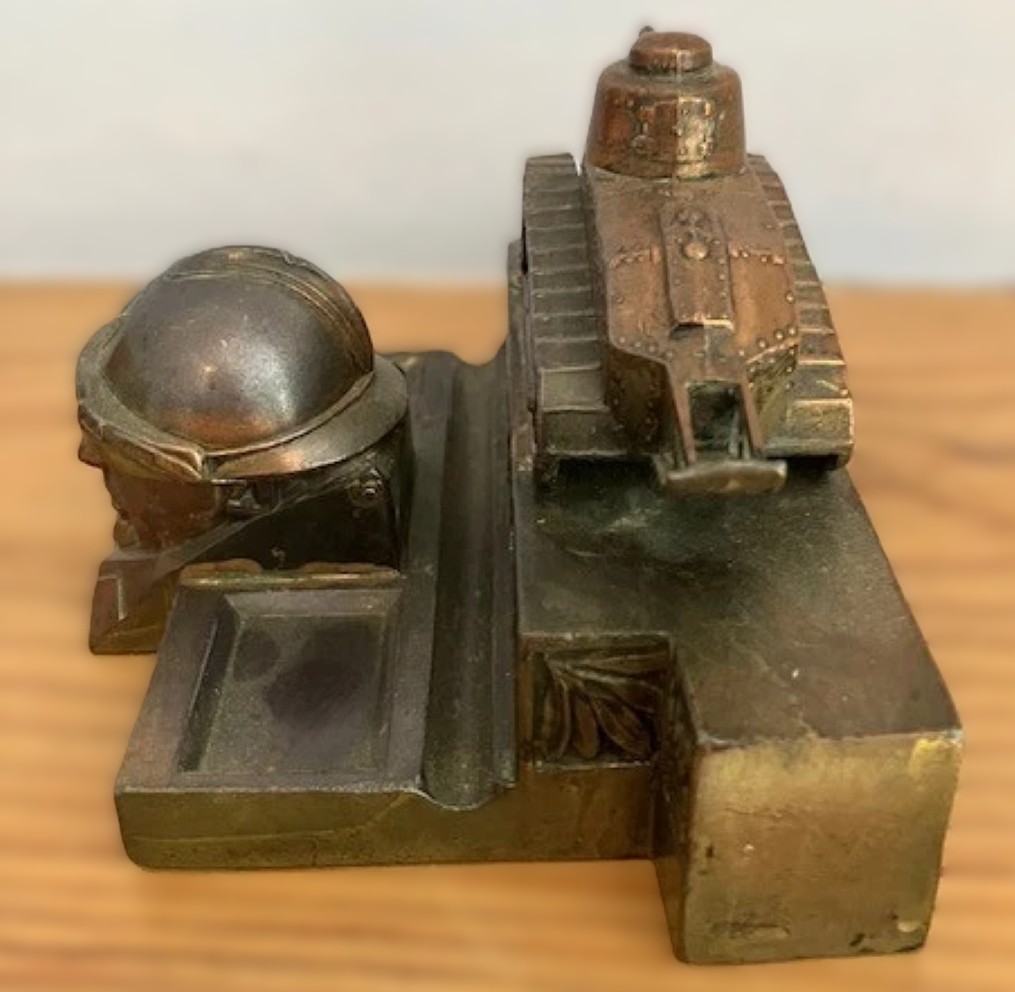
French Inkstand – 507e Régiment de Chars de Combat – Tank
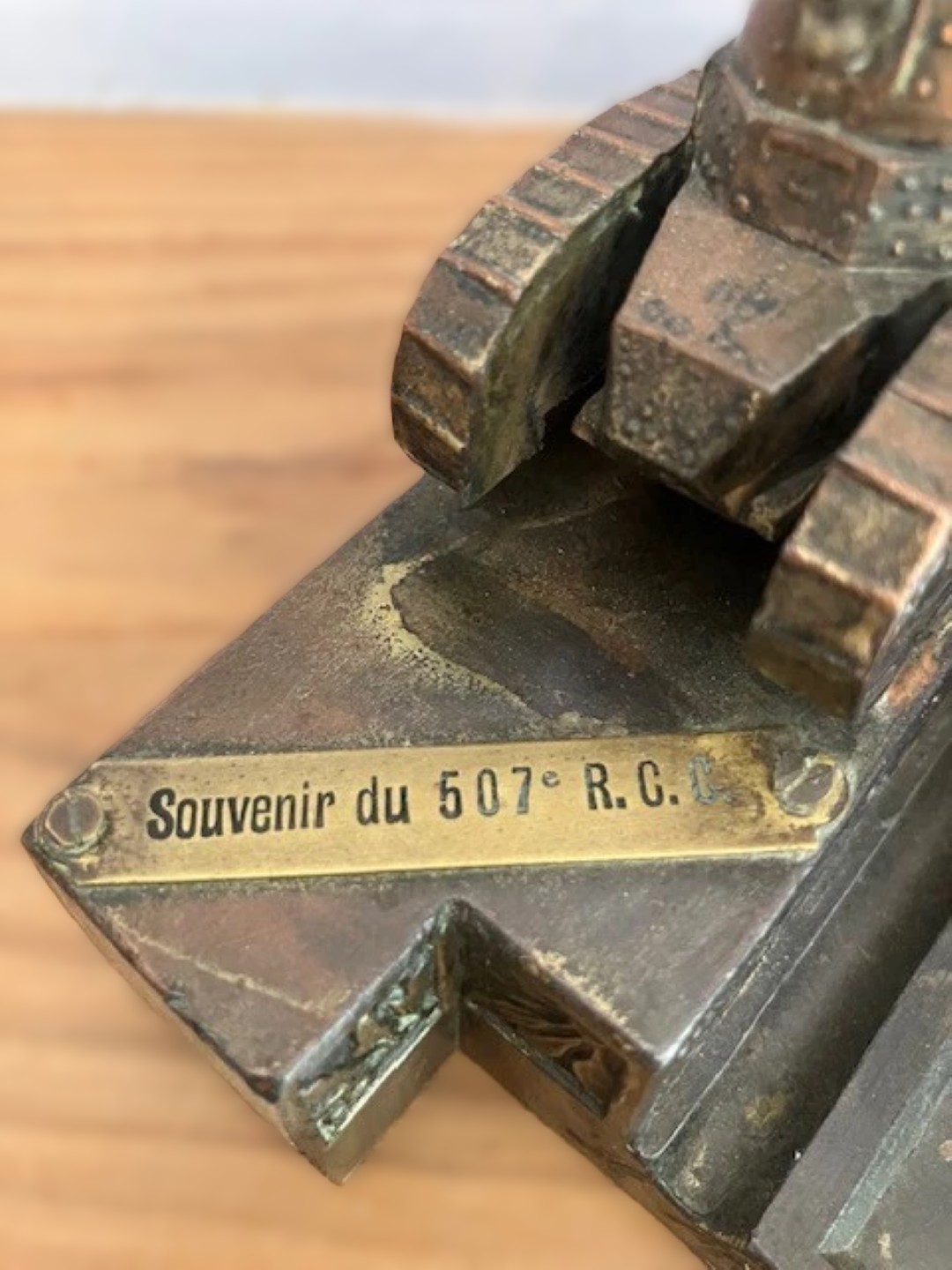
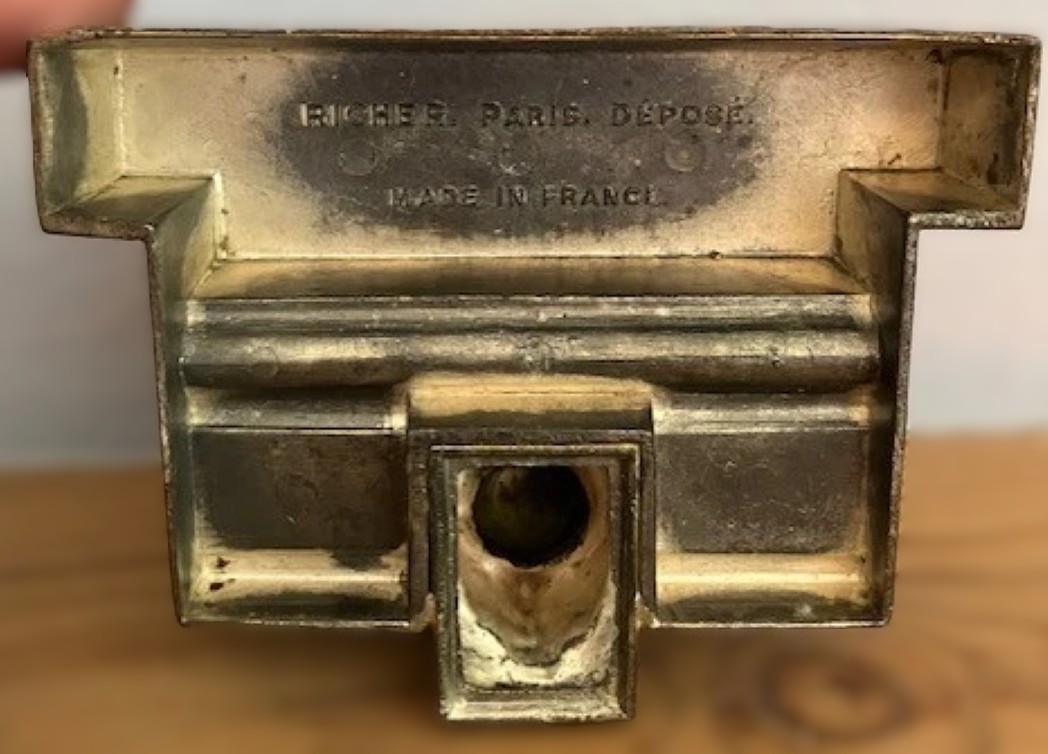
Cast spelter with patinated bronze finish, modeled with a stylized cubist-influenced Poilu bust whose hinged Adrian helmet opens to an inkwell (missing insert). Surmounted on a stepped plinth by an accurately detailed Renault FT light tank and laurel relief trim. Affixed brass plaque reads “Souvenir du 507e R.C.C.” Signed L. Malespina on the plinth; underside marked RICHER PARIS, DÉPOSÉ – MADE IN FRANCE. France, circa 1920–1930.
Overview
- Artistic Style: The sculpted face shows distinct Art Deco / Cubist geometric faceting, typical of 1920s French decorative bronze and spelter work rather than wartime trench art.
- Insignia Detail: The soldier’s Adrian helmet features the specific embossed medallion of the French Tank Corps (Artillerie Spéciale / Chars de Combat), showing a medieval knight’s helmet superimposed over crossed cannon barrels.
Historical Context
- The Tank (Renault FT):
- Identity: French Renault FT (often called the FT-17) light tank.
- Significance: Designed by Louis Renault and introduced in 1917, it is recognized as the world’s first modern tank design, establishing the standard layout still used today: fully rotating turret on top, crew compartment in front, and engine in the rear.
- The Plaque & Regiment (507e R.C.C.):
- Designation: 507e Régiment de Chars de Combat (507th Combat Tank Regiment).
- History: Created towards the end of WWI (1918) as armored units were formalized out of the Artillerie Spéciale. Based primarily in Metz during the interwar period.
- Famous Connection: Colonel Charles de Gaulle served as the commanding officer of the 507e RCC from 1937 to 1939 before the outbreak of World War II.
- The Sculptor (L. Malespina):
- Identity: Louis Malespina, a French sculptor and medalist active during the early-to-mid 20th century.
- Work: Known for military subjects, commemorative busts, desk accessories, and automotive radiator mascots (bouchons de radiateur) from the 1920s and 1930s.
- The Manufacturer (Richer Paris):
- Identity: A Parisian foundry and art editor specializing in decorative cast spelter (régule) and bronze goods, desk pieces, and commemorative souvenirs.
- Markings: Déposé indicates a registered copyright/design patent under French law, while Made in France reflects standard export and manufacturing stamping of the interwar era.
Rifle inkstand sold for $72 in August 2025.
Tank inkstand sold for $120 in July 2026.
Content disclaimer. The information posted is the owner’s best knowledge and may not have been vetted by the SOIC. We welcome comments, corrections, and additions, working to make our website information comprehensive and accurate.
Join the Society of Inkwell Collectors (SOIC) – it’s free!
Founded in 1981 as a non-profit organization,
we are documenting inkwells (and accessories).
We’re here to help and inform!