

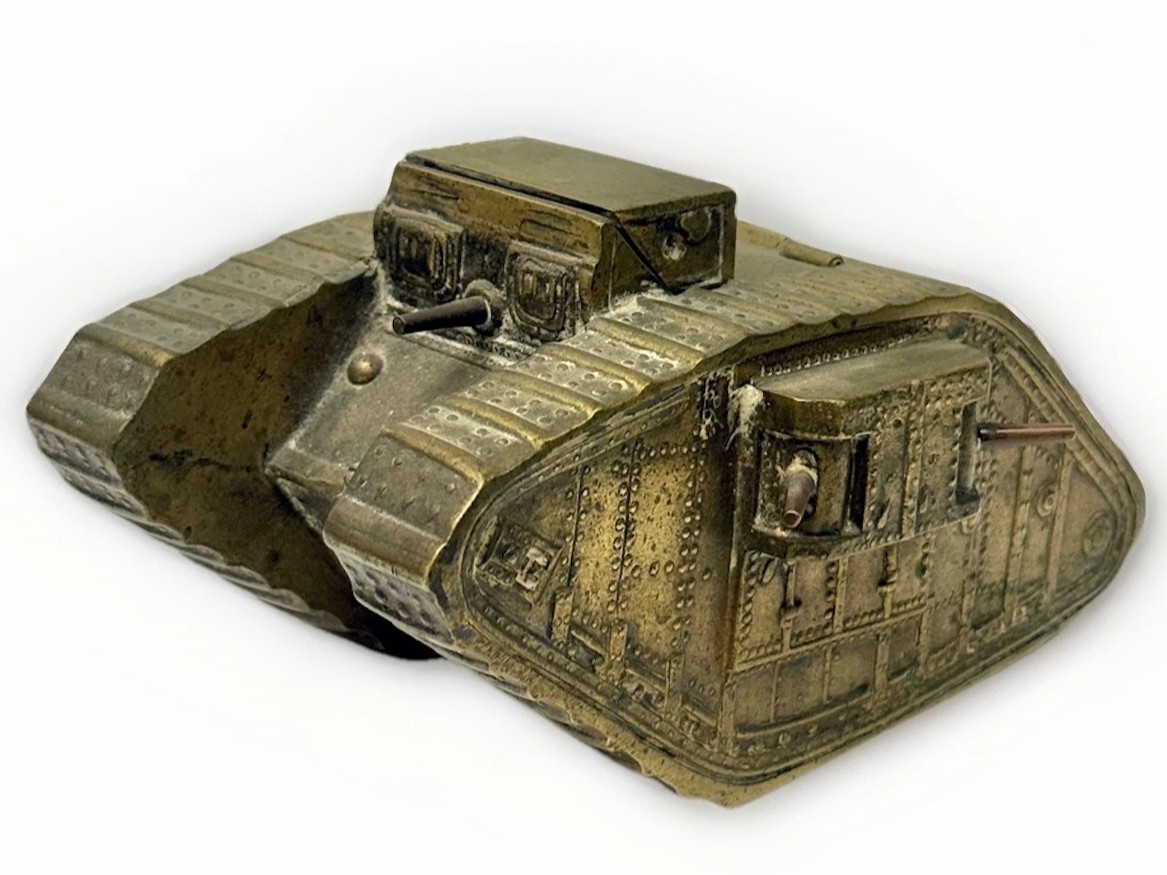
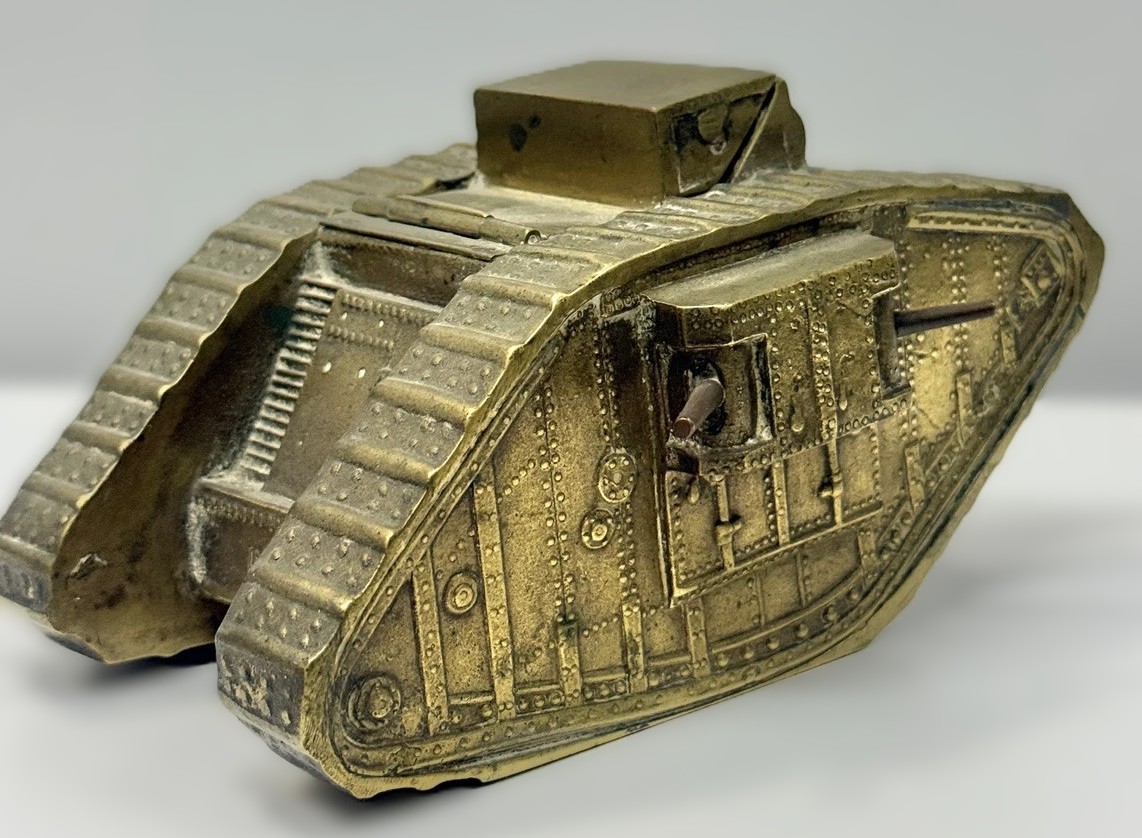


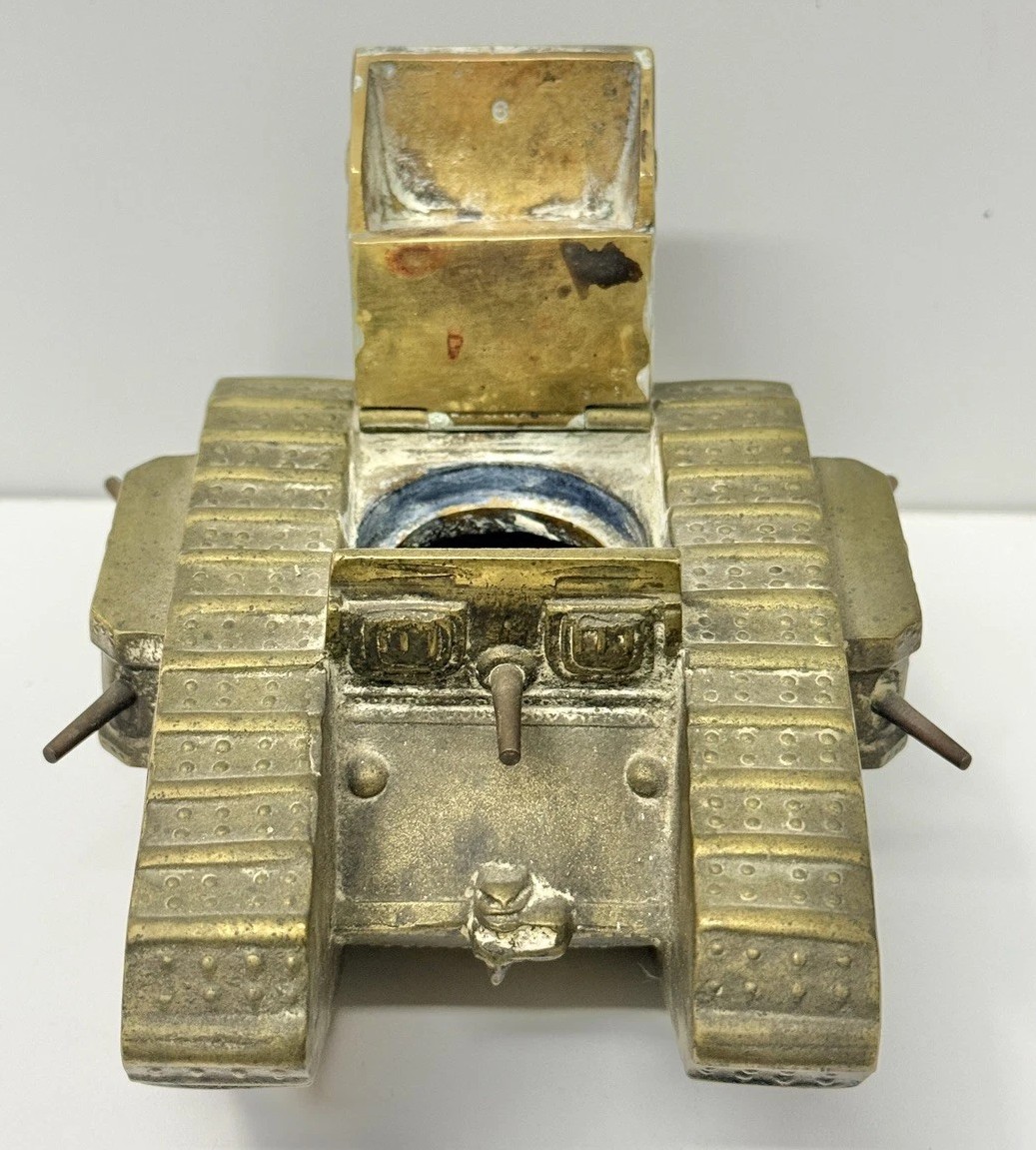


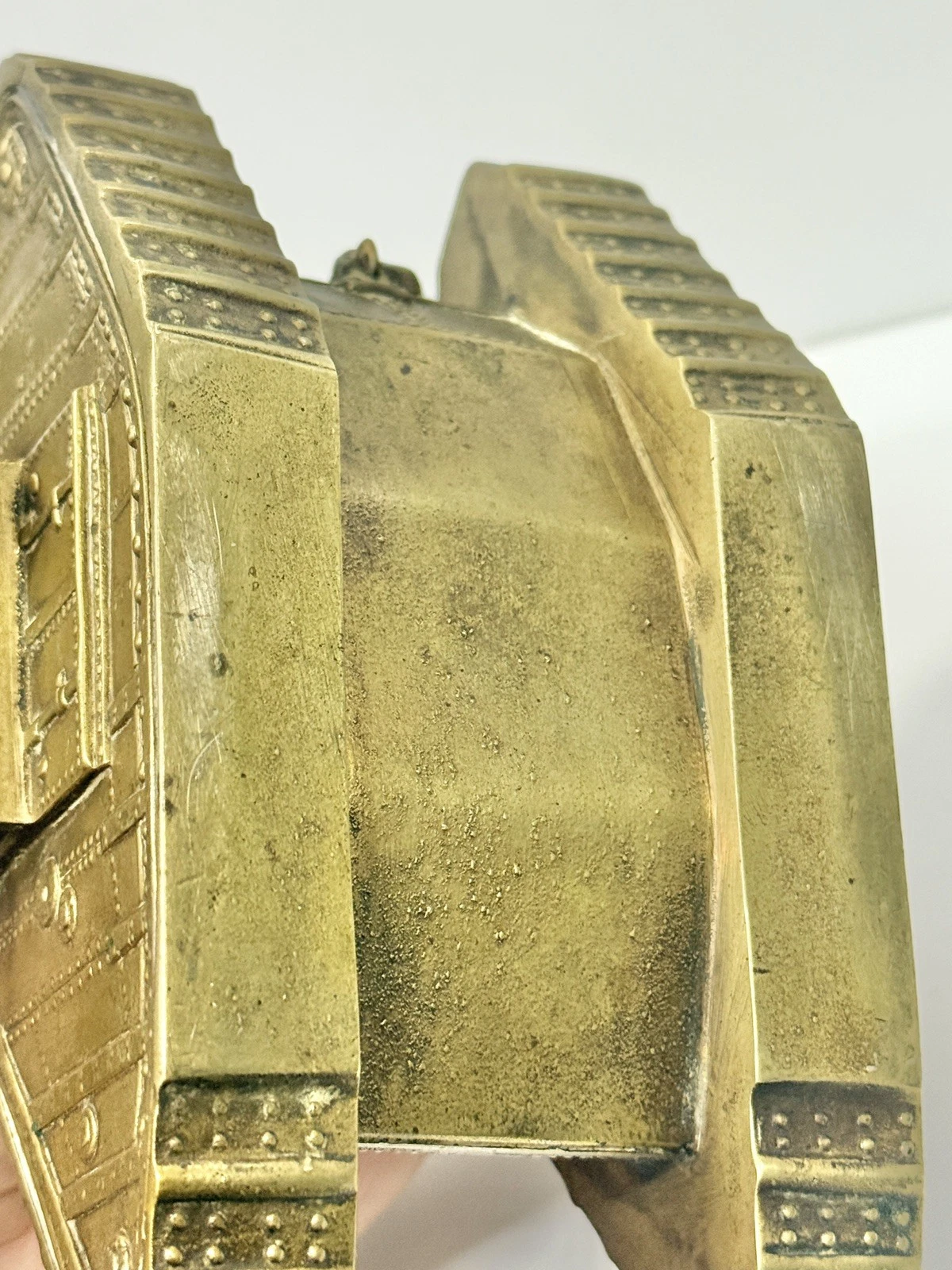
WWI British Mark IV Tank
| Categories | Figural - Inanimate |
| Type | Military |
| Material | Spelter |
| Markings | 1918 |
| Manufacturer | Undetermined |
| Origin | England |
| Date or Era | circa 1918 |
Description & Details
The casting captures the signature “rhomboidal” profile of early British armored fighting vehicles.
- The Sponsons & Armament: The inkwell depicts a “Male” tank variant, designated by the protruding side sponsons housing large-caliber naval guns (6-pounders) alongside secondary machine guns protruding from the front and sides.
- Surface Detailing: The piece boasts crispness in its mold details, highlighting the extensive riveting patterns along the armor plating, individual track links wrapping entirely around the frame, and the driver’s cab ventilation and vision slits.
- The Inkwell Mechanism: The central top hatch—modeled after the tank’s command turret/cab—is fitted with a flush hinge that flips open to reveal a recessed, circular well designed to hold an ink pot.
- The Inscription: Distinctly cast into the low-recessed rear armor plate is the date 1918 flanking a stylized, concentric circular emblem or copyright mark.
History of the Mark IV Tank
The Mark IV is arguably the most iconic British heavy tank of the Great War. Introduced in May 1917, it was a direct development of the pioneering Mark I design.
- Improvements: It featured significantly heavier armor to withstand German armor-piercing machine-gun fire, a relocated internal fuel tank for crew safety, and a strengthened drivetrain.
- Logistics: Crucially, its large side sponsons were redesigned to slide inward or unbolt easily so the massive 28-ton vehicles could fit onto standard railway cars for transport to the front lines.
- Historical Significance: A total of 1,220 Mark IVs were built. They formed the backbone of the historic British tank assault at the Battle of Cambrai in November 1917, proving for the first time that massed armor could smash through entrenched lines. They remained in heavy service through the end of the war in 1918.
Manufacturer & Date of Production
The Date: 1918
The integrated casting on the rear plate firmly establishes 1918 as either the date of manufacture or immediate commemoration. Because the date is part of the original mold, this is a commercially produced casting.
The Manufacturer: A Mystery of “Victory Souvenirs”
Identifying the exact foundry or maker for this specific model is notoriously difficult. Following the signing of the Armistice in November 1918, a massive wave of patriotism swept through Great Britain and the Allied nations.
Foundries in Birmingham and across the English Midlands quickly pivoted from wartime munitions work to producing “Victory” desk souvenirs, including tank-shaped banks, paperweights, and inkwells.
- The central mark between the “19” and “18” appears to be a stylized registration or copyright emblem rather than a known foundry mark (such as those used by classic British makers like Peerless or Pearson-Page).
- This specific casting pattern is well-documented among seasoned militaria collectors. It was sold immediately post-war as a premium commemorative desk accessory for veterans, families, and a fascinated civilian public celebrating the novel machine that helped win the war.
Sold for $190 in May 2026
Content disclaimer. The information posted is the owner’s best knowledge and may not have been vetted by the SOIC. We welcome comments, corrections, and additions, working to make our website information comprehensive and accurate.
Join the Society of Inkwell Collectors (SOIC) – it’s free!
Founded in 1981 as a non-profit organization,
we are documenting inkwells (and accessories).
We’re here to help and inform!