

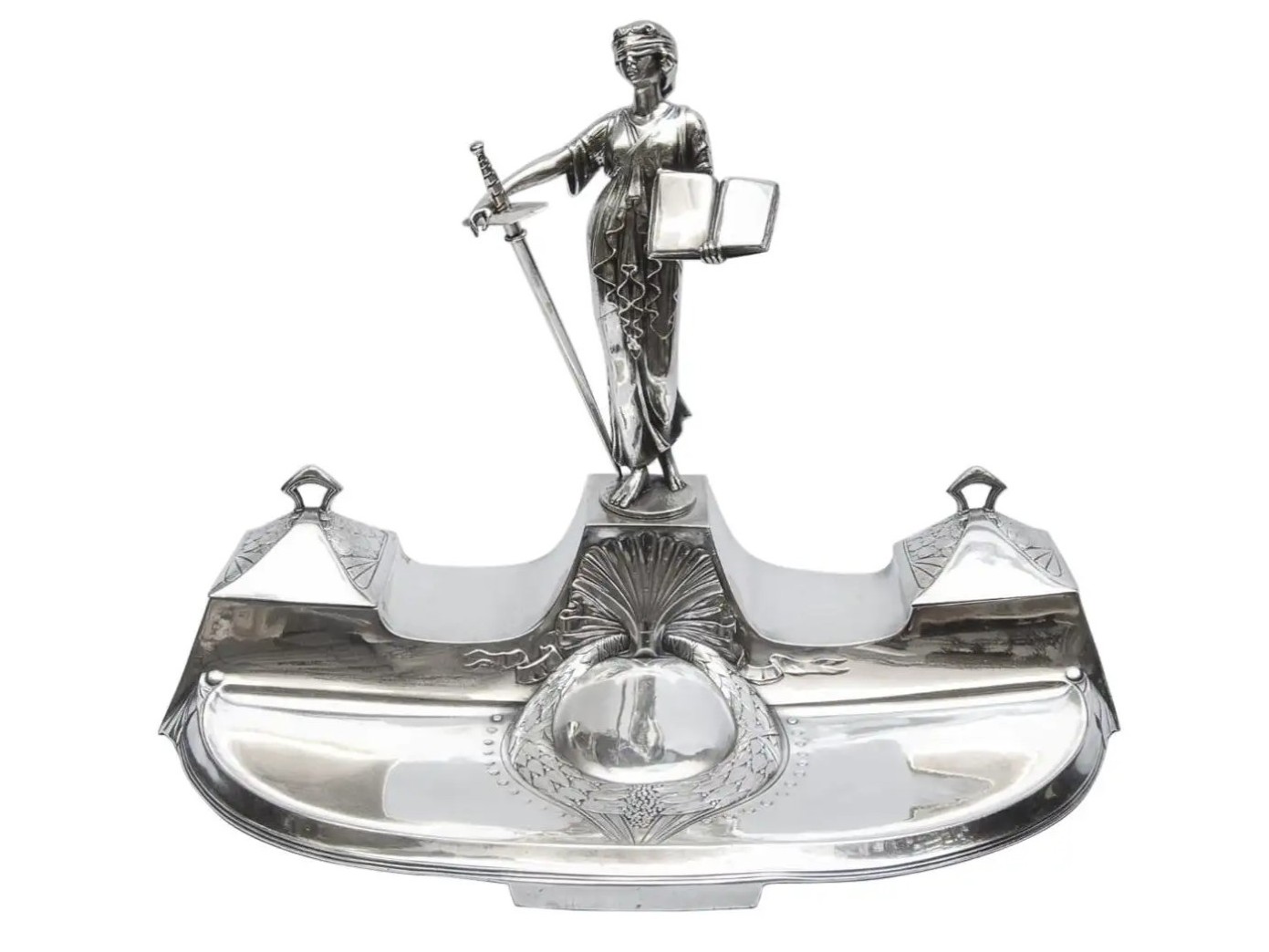
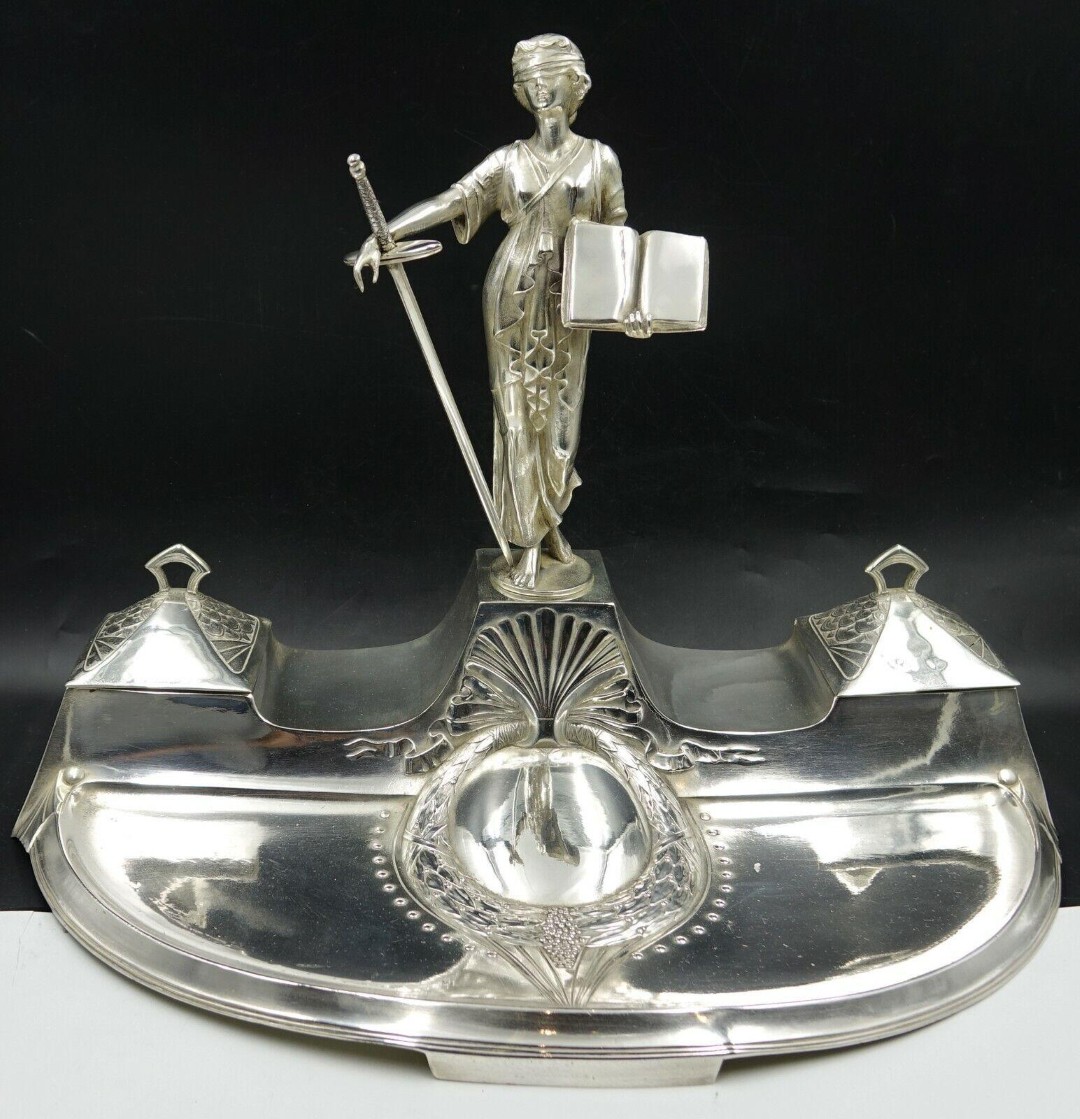


WMF Lady Justice Inkstand
| Categories | Art Nouveau |
| Material | Silverplate |
| Markings | See Narrative |
| Manufacturer | WMF |
| Origin | Germany |
| Date or Era | circa 1910 |
| Measuring | 17 ¾” x 3 ⅛” x 11 ¾” high |
This German Art Nouveau (Jugendstil) desk set is a masterful creation by WMF, blending the flowing lines of early 20th-century design with powerful legal iconography.
The Hallmarks
The stamped letters on the bottom of this piece are classic, descriptive, WMF quality control and manufacturing symbols. Here is what they mean:
- WMF: The primary manufacturer’s mark for Württembergische Metallwarenfabrik.
- B: Stands for Britannia Metal (Britanniametall). This indicates that the base metal underneath the silver plate is a high-quality, pewter-like alloy of tin, antimony, and copper, which was favored for Art Nouveau pieces because it allowed for incredibly crisp, fluid sculptural casting.
- I/O: This is WMF’s standard code for the thickness of the silver plating. “I/O” means that a normal mass/standard thickness of silver was electrolytically deposited onto the base metal.
- O/X (sometimes written as OX): This denotes an oxidized or artificially darkened/patinated finish. WMF applied a special chemical treatment to deep, recessed lines (such as the drapery of the robe or the lines of the central cartouche) to darken them, creating a dramatic, high-contrast relief that emphasizes the depth and detail of the sculpture.
How Old is This Piece?
Based on the specific configuration of these stamps and the distinctive Art Nouveau style, this inkstand was manufactured between 1900 and 1910.
Iconography & Description of the Lady
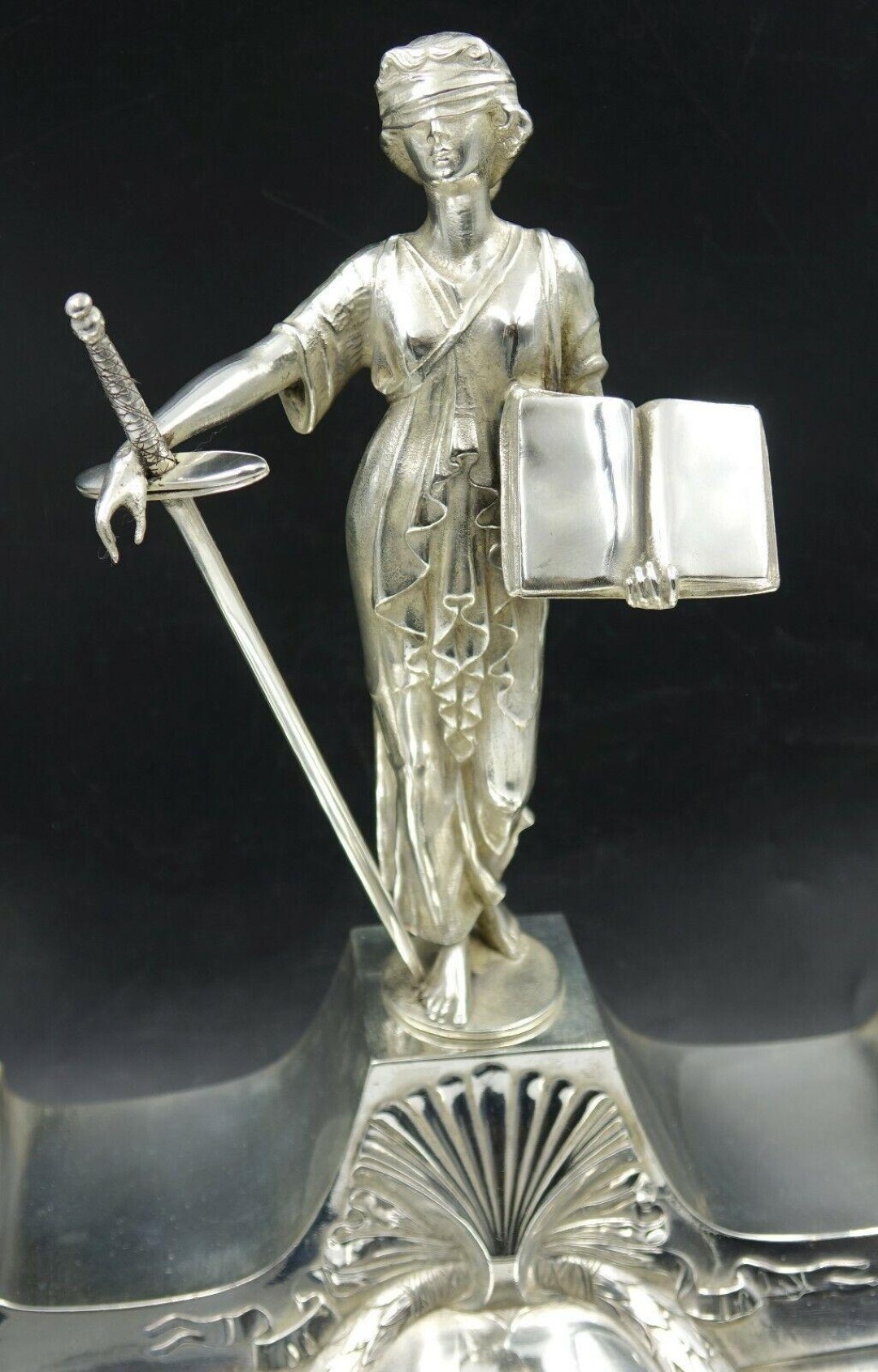
The central figure dominating the inkstand is Lady Justice (derived from the Roman goddess Justitia or the Greek goddess Themis). She serves as the ultimate allegorical personification of the moral force in judicial systems.
Her depiction on this piece features classical, deliberate attributes:
- The Blindfold: Represents objectivity and impartiality. It signifies that justice should be meted out without fear or favor, regardless of identity, wealth, or power.
- The Sword: Held firmly in her right hand, resting downwards. The sword symbolizes the judiciary’s power of enforcement, coercion, and the finality of a legal decision. WMF’s choice to have her lean on it gives her a poised, authoritative stance.
- The Book: Instead of the more common scales, she holds an open law book in her left hand. This emphasizes written law, codification, knowledge, and the constitution as the bedrock foundation upon which justice is weighed.
Design
The inkstand is engineered as a symmetrical, harmonious desk accessory:
- The Wells: Flanking the central statue are two square inkwells with hinged, pyramidal lids. When opened, they reveal the original inserts. The lids themselves feature stylized fan and scale patterns typical of the transition into late Jugendstil.
- The Pen Tray: The front of the stand features a wide, smoothly recessed crescent tray meant for resting dip pens or fountain pens.
- Central Cartouche: Directly below the statue’s plinth is an elaborate embossed design featuring a smooth, polished oval shield wrapped in a heavy laurel and berry wreath—a traditional symbol of victory, honor, and achievement.
- Architectural Reverse: The back view highlights an openwork, geometric cutout base that sits flat against a desk surface, showcasing the structural elegance WMF brought even to the reverse side of their products.
About the Maker: WMF
Württembergische Metallwarenfabrik (WMF) was founded in 1853 in Geislingen an der Steige, Germany, by Daniel Straub and the Schweizer brothers. By the turn of the 20th century, WMF had grown into a global powerhouse of metalware production and was the world’s largest manufacturer and exporter of household metalware.
During the Art Nouveau period (roughly 1895–1910), WMF hit its artistic peak. The company established its own specialized art studio directed by the famous sculptor and designer Albert Mayer. Mayer and his team specialized in Jugendstil—the German branch of Art Nouveau characterized by organic curves, stylized floral motifs, and allegorical female figures with flowing hair and classical drapery.
Sold for $2,324 in August 2022
Content disclaimer. The information posted is the owner’s best knowledge and may not have been vetted by the SOIC. We welcome comments, corrections, and additions, working to make our website information comprehensive and accurate.
Join the Society of Inkwell Collectors (SOIC) – it’s free!
Founded in 1981 as a non-profit organization,
we are documenting inkwells (and accessories).
We’re here to help and inform!