

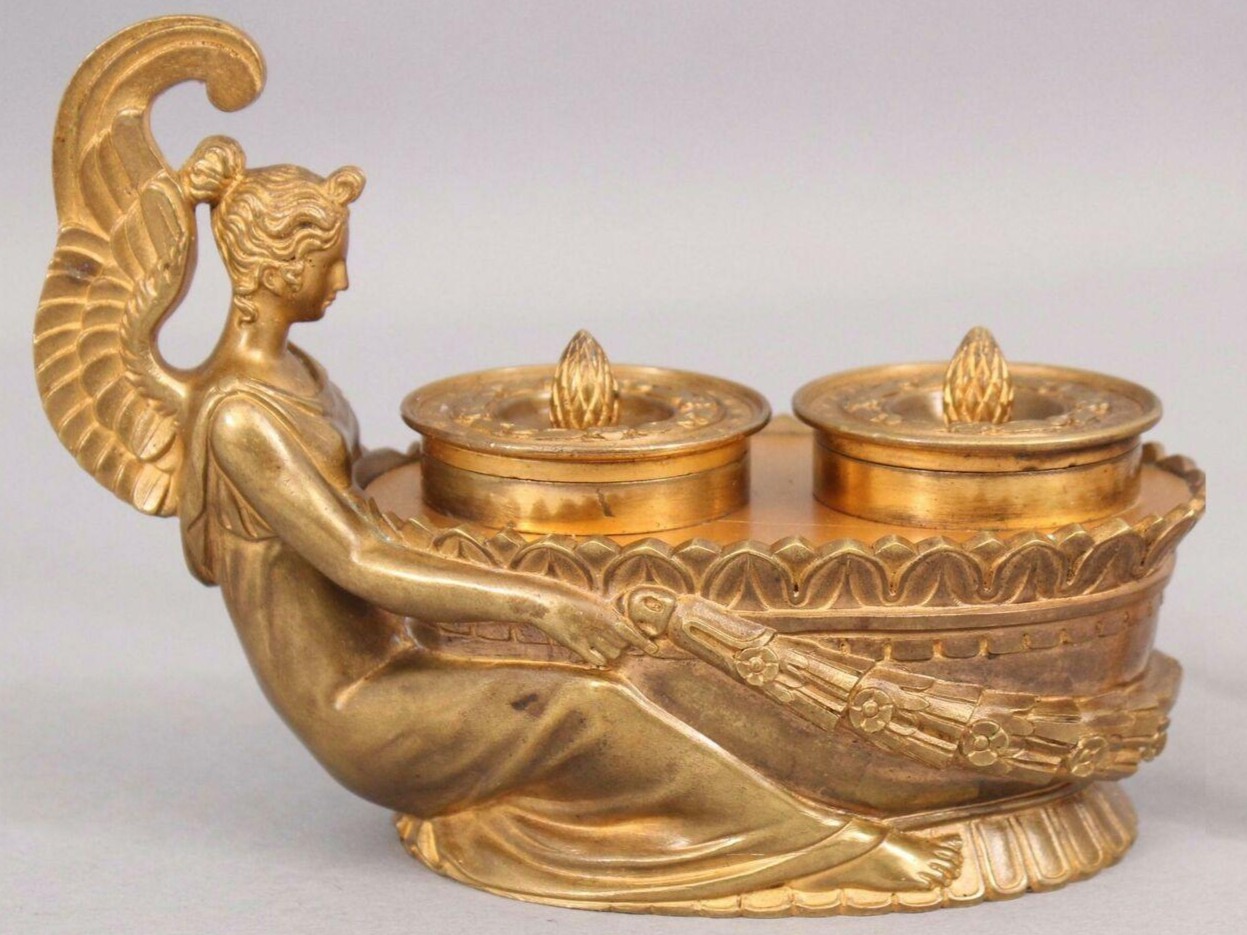
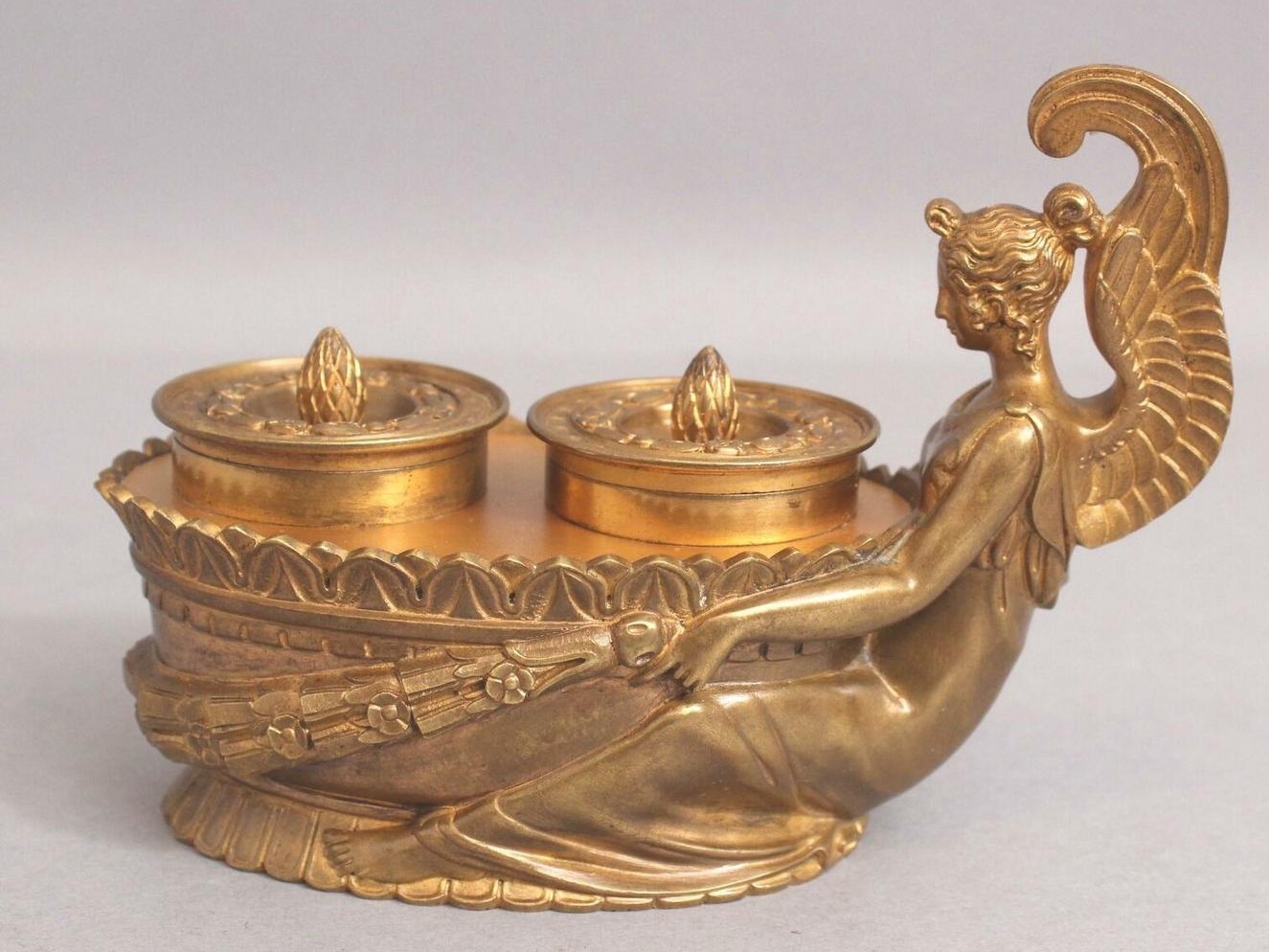
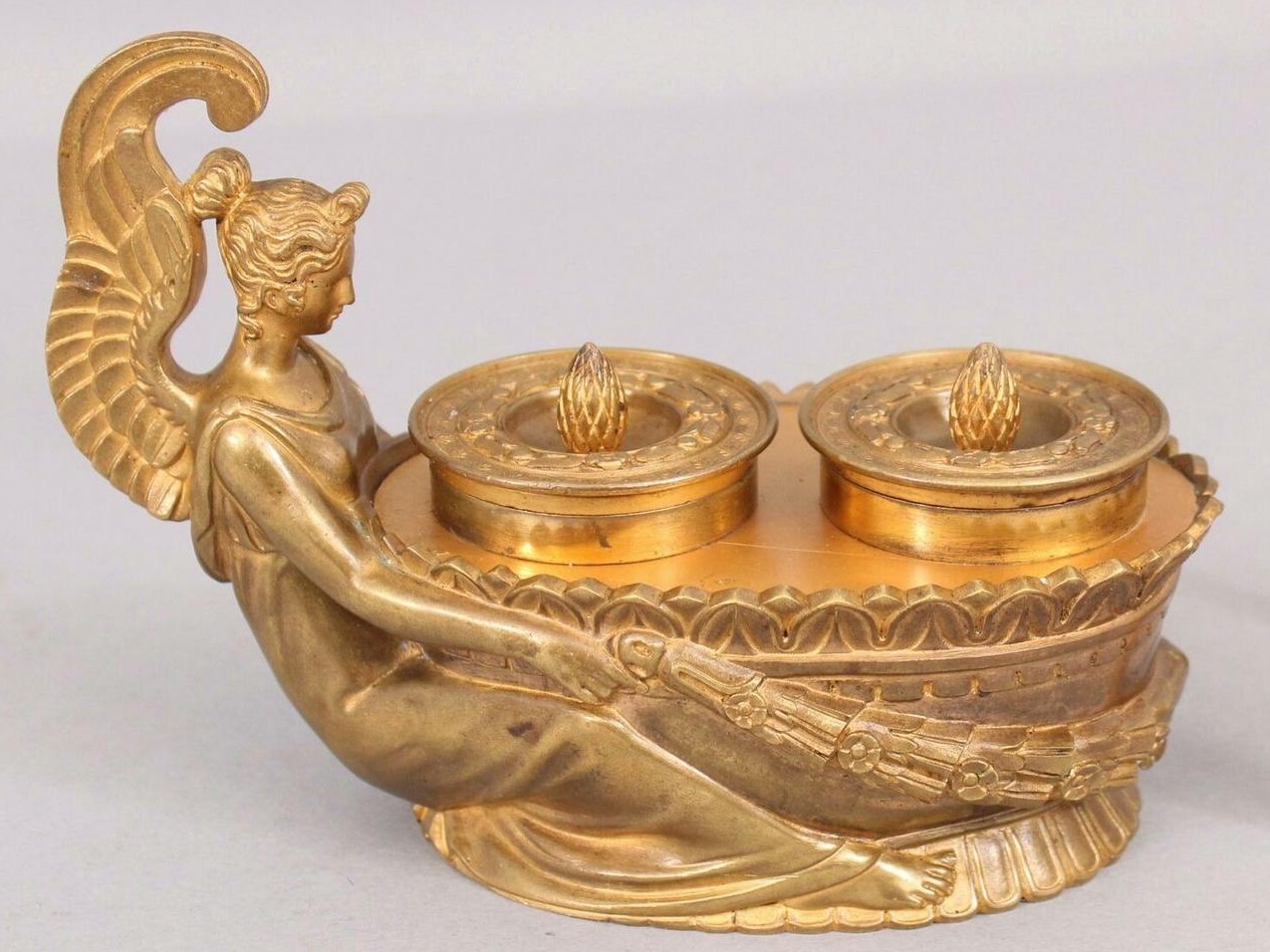
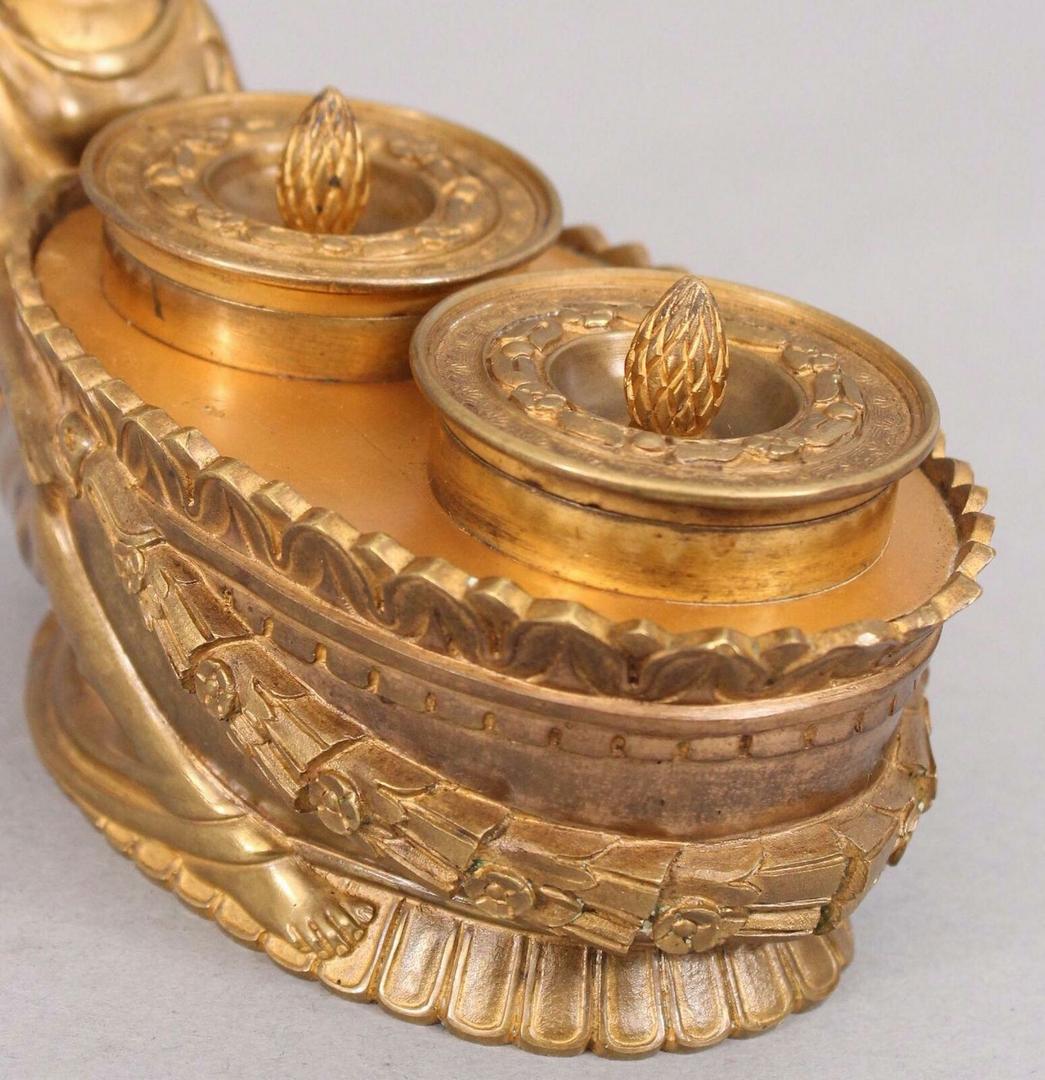
Winged Goddess Inkstand with Floral Garland
| Categories | Figural - Mythology; Literature; Religion; Fictional |
| Type | Cupid / Cherub / Angel |
| Material | Gilt Bronze |
| Markings | Unmarked |
| Manufacturer | Undetermined |
| Origin | France |
| Date or Era | circa 1820 |
| Measuring | 5” x 3” x 4” high |
This French double inkstand dates to the early 19th century, specifically the Empire period (circa 1810–1830).
Who is Depicted? (Mythology & Iconography)
The figure is a winged female daimon or minor goddess from classical mythology, stylized in the neoclassical taste of the French Empire (style Empire).
- The Wings: Unlike Christian angels, classical winged figures of this era often represent personifications of abstract concepts like Victory (Nike), Fame (Fama), or Eternity, or they take the form of classical genii and spirits. The upward-curving, sharply articulated wings with layered feathers are a classic hallmark of French Empire bronze work, mirroring motifs found in Greco-Roman art popularized during the Napoleonic excavations and revivals.
- The Attire and Hairstyle: Her hair is gathered in a classical topknot with soft curls framing her face (à la antique), and she wears a classically draped chiton fastened at the shoulder.
- The Swag: She embraces the inkwell basin while clutching a finely chased floral and rosette garland (festoon) that wraps entirely around the body of the inkstand—a classic neoclassical decorative element symbolizing celebration, abundance, and architectural grace.
Age and Style
- Period: French Empire / Restoration Period (approx. 1810–1830).
- Materials & Craftsmanship: The piece is crafted from ormolu (gilt-bronze, or bronze doré), featuring a rich combination of bright fire-gilding and subtle contrasting matte finishes. The two inset inkwells feature covers topped with cast pinecone finials—a ubiquitous neoclassical motif signifying immortality and regeneration.
- Design Context: Double inkstands of this compact scale were luxury desk accessories intended for fashionable writing tables (secrétaires or bureau plats) in bourgeois or aristocratic French salons. The integration of a sculptural figural terminal supporting a vessel body is characteristic of high-end Parisian bronze-makers (bronziers) of the early 1800s.
Sold for $580 in November 2019
Content disclaimer. The information posted is the owner’s best knowledge and may not have been vetted by the SOIC. We welcome comments, corrections, and additions, working to make our website information comprehensive and accurate.
Join the Society of Inkwell Collectors (SOIC) – it’s free!
Founded in 1981 as a non-profit organization,
we are documenting inkwells (and accessories).
We’re here to help and inform!