


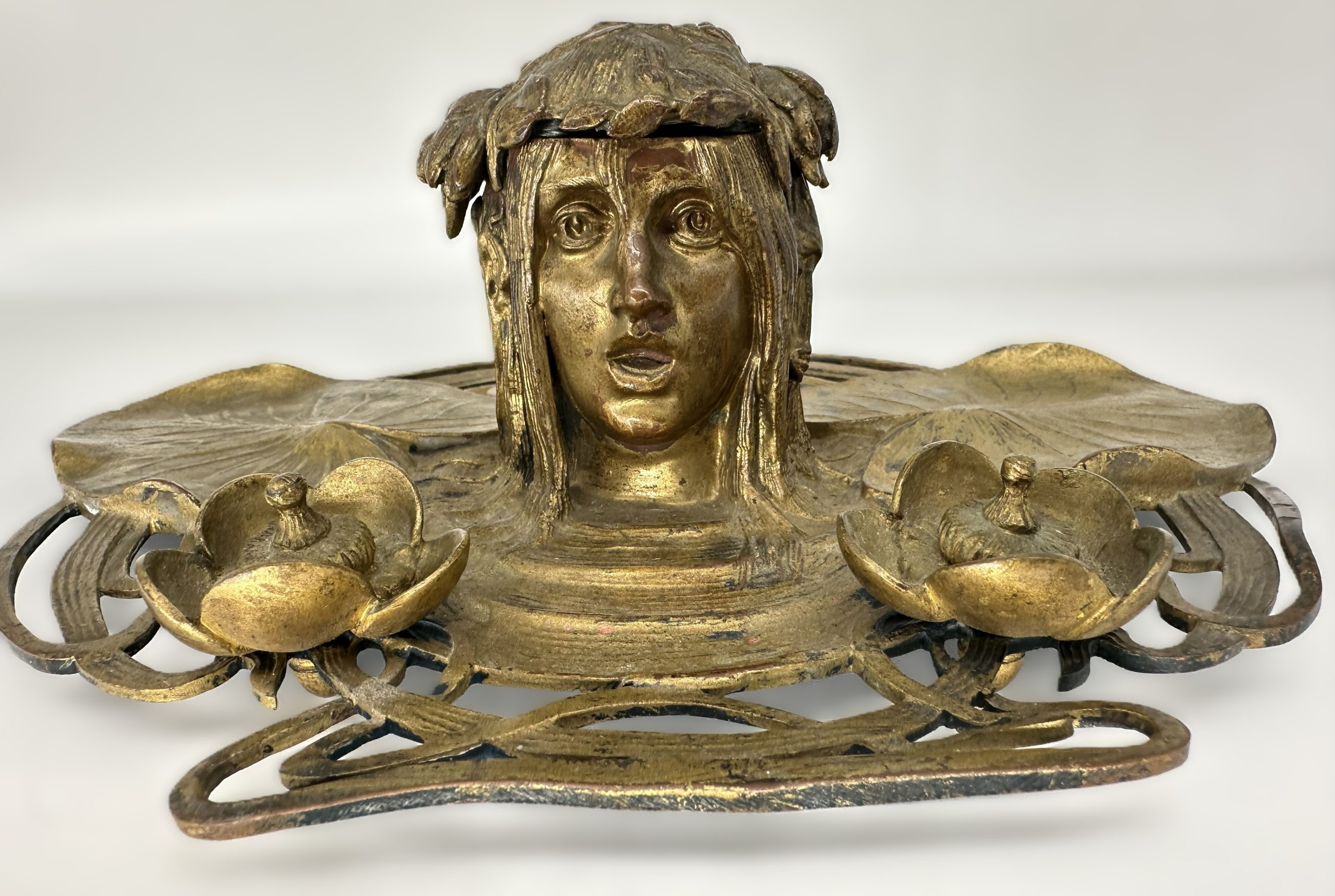


Water Nymph Emerging
| Categories | Art Nouveau |
| Type | Mythology |
| Material | Bronze |
| Markings | Unmarked |
| Manufacturer | Undetermined |
| Origin | Undetermined |
| Date or Era | circa 1900 |
| Measuring | 8 ½” x 6 ¼” x 3 ¼” high |
This is a nice example of Continental Art Nouveau metalwork, dating to approximately 1900–1910.
Description
The inkstand is cast in a high-relief, organic style, and made of bronze.
- The Central Figure: The focus is the head of a Water Nymph (Naiad) or “Spirit of the Pond.” Her expression is one of dramatic surprise, with an open mouth and wide, staring eyes. Her “drenched” hair flows downward in heavy, undulating strands that merge into the base.
- Symbolism in the Hair: She wears a crown of seaweed or aquatic flora (potentially marsh marigolds or budding lilies), which cements her identity as a creature of the water.
- The Base: The base is a “whiplash” openwork (pierced) design, a signature of the Art Nouveau movement. It features two large, expansive lily pads that flank the nymph, designed to serve as shallow pen rests.
- Functional Detail: The top of the nymph’s head is hinged at the crown, opening to reveal a glass ink insert. Three-dimensional water lily buds are nestled among the flowing lines of the base, helping to keep a resting pen in place and adding to the sculptural depth.
Origins and Context
- Age: Circa 1900. This era was obsessed with the “femme-nature” (woman-nature) motif, where female figures were blended with botanical or elemental themes.
- Subject: Specifically, this is a Naiad emerging from a pond. The “drenched” effect of the hair and the open-mouthed expression were often used by French and Austrian sculptors to convey a sense of “becoming”—the moment a spirit materializes from the natural world.
- Provenance: While unsigned, the style and casting technique are highly characteristic of French foundries (Paris) or the Vienna Secession (Austria). Many such pieces were produced by well-known foundries like E.G. Zimmermann or marked “Geschützt” (protected/copyrighted) in Austria/Germany, though many retail versions remained unsigned to keep prices accessible for the burgeoning middle-class decorative market.
The dark, matte finish on the underside is typical for period castings of this type, providing a stable, non-slip surface for a desktop.
Sold for $333 in March 2026
Content disclaimer. The information posted is the owner’s best knowledge and may not have been vetted by the SOIC. We welcome comments, corrections, and additions, working to make our website information comprehensive and accurate.
Join the Society of Inkwell Collectors (SOIC) – it’s free!
Founded in 1981 as a non-profit organization,
we are documenting inkwells (and accessories).
We’re here to help and inform!