




Tiffany & Co. Sterling Silver Inkstand – “Wave Edge” Pattern
| Categories | Tiffany |
| Material | Silver |
| Markings | See Narrative |
| Manufacturer | Tiffany |
| Origin | United States |
| Date or Era | circa 1885 |
| Measuring | 7” x 7” x 3 ¾” high |
Description
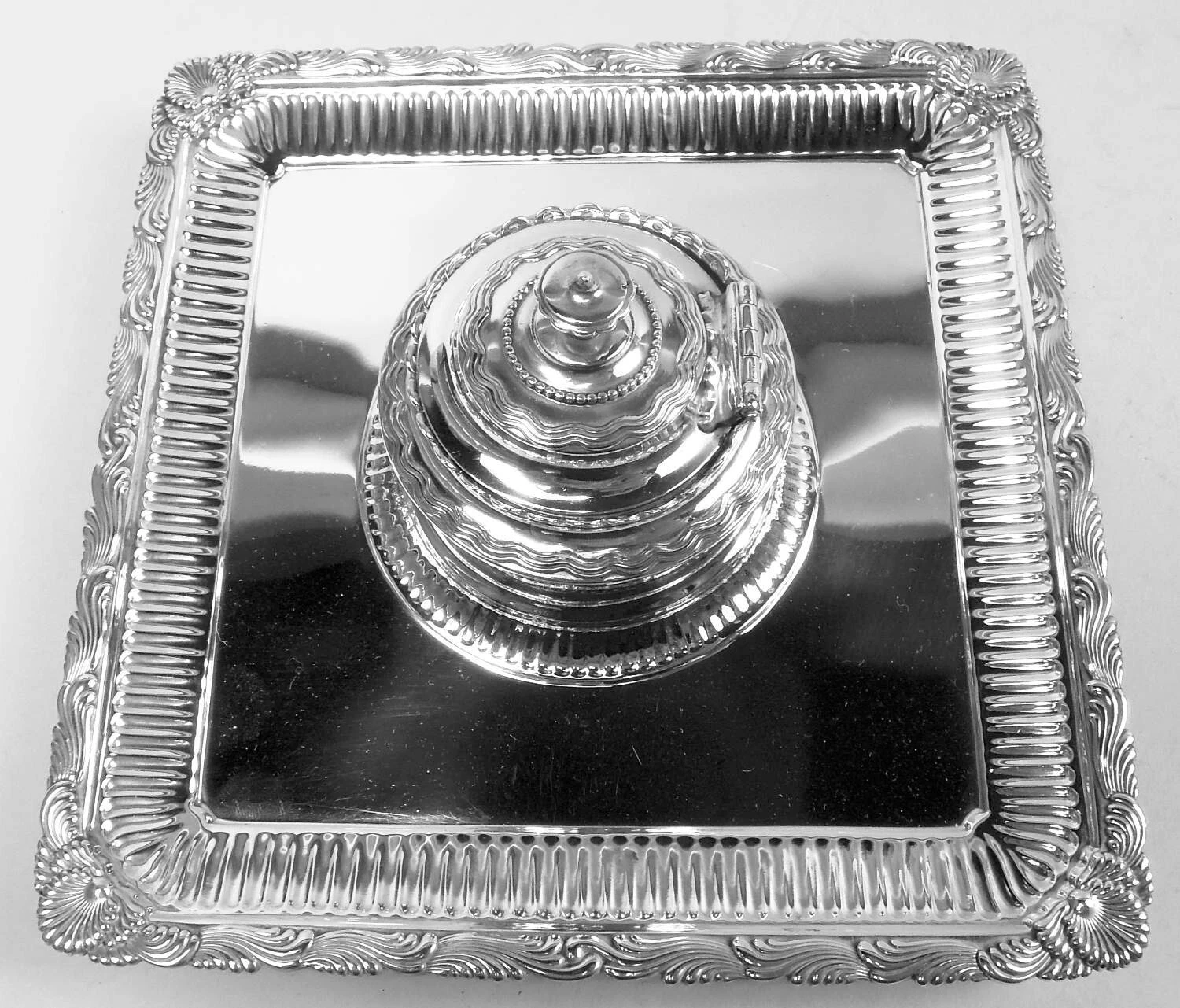
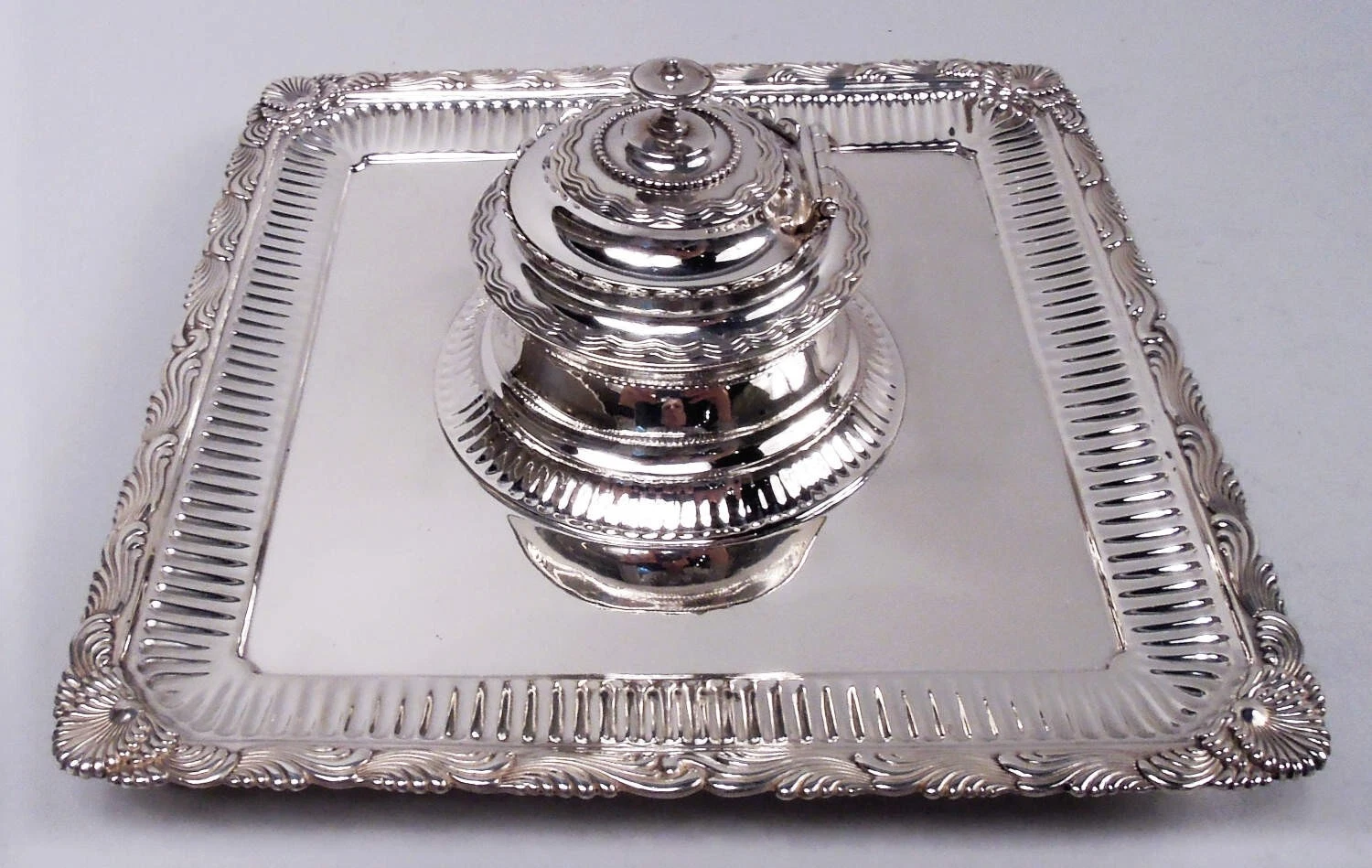
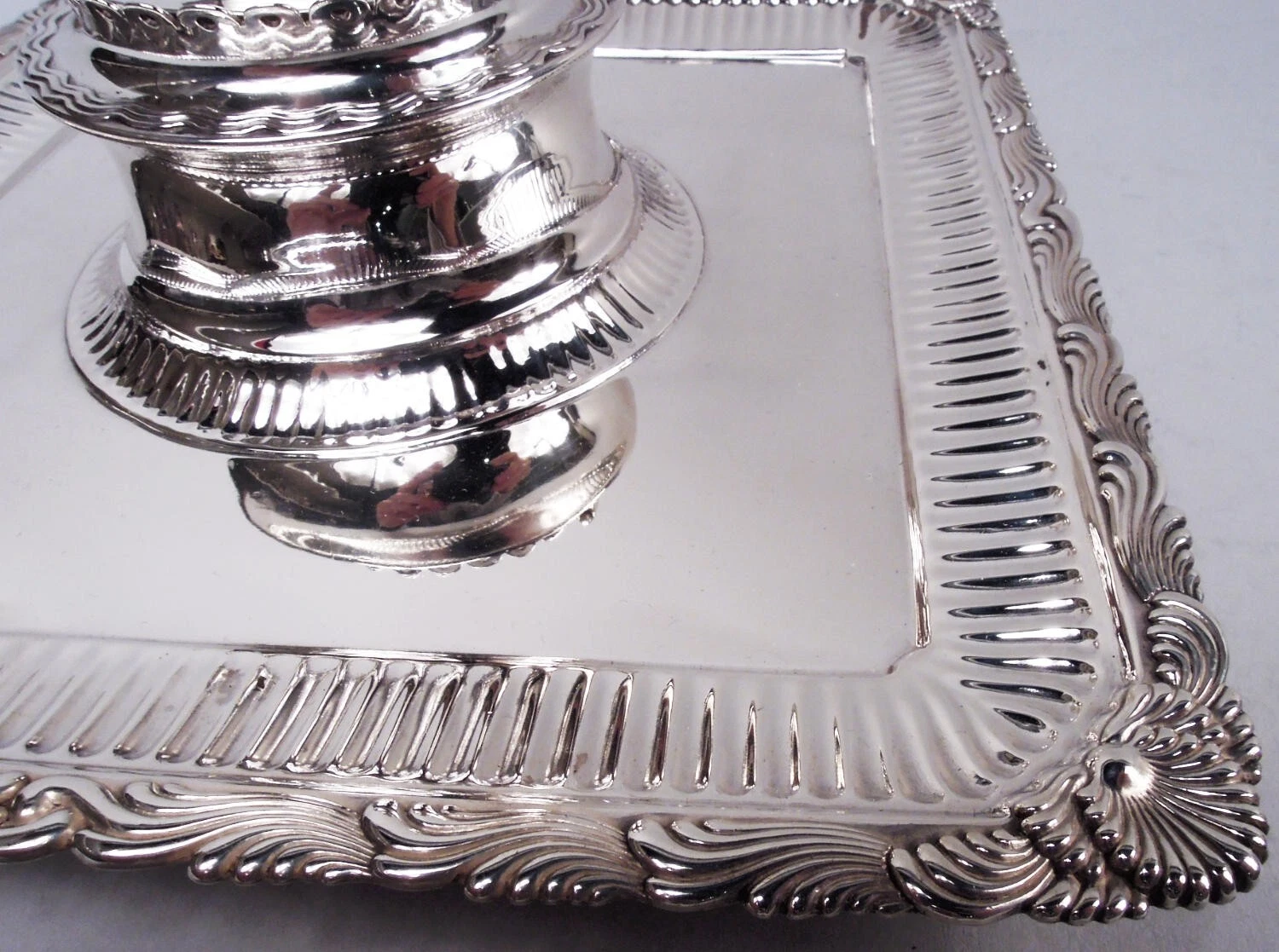
- Form & Structure: The inkstand features a wide, square, tray-style base with a polished mirror surface. It supports a single, prominent, centrally mounted inkwell bowl.
- The Borders & Edges: The tray features a “Wave Edge” design, consisting of an outer border of deeply chased, overlapping shell-and-scroll motifs that mimic churning waves. Just inside this wavy rim is a wide band of crisp, uniform vertical fluting (or gadrooning) that channels downward toward the flat surface. The four corners are anchored by stylized shell medallions.
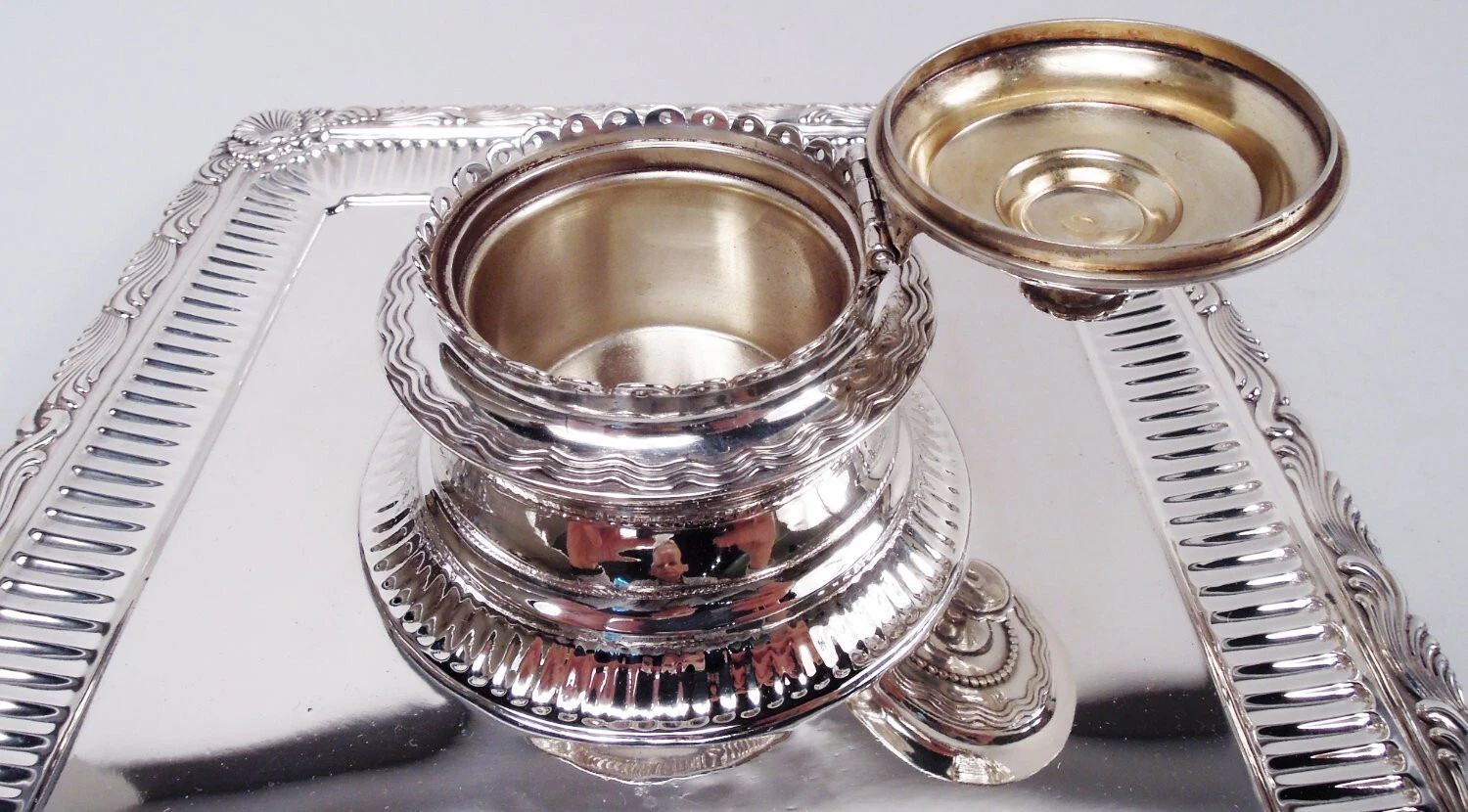
- The Central Inkwell: The circular inkwell structure mirrors the decorative language of the tray. It rises from a flared, fluted base into a multi-tiered dome. It features a heavy, pinned hinge and is topped by a turned, cap-shaped finial. The original removable glass insert is absent.
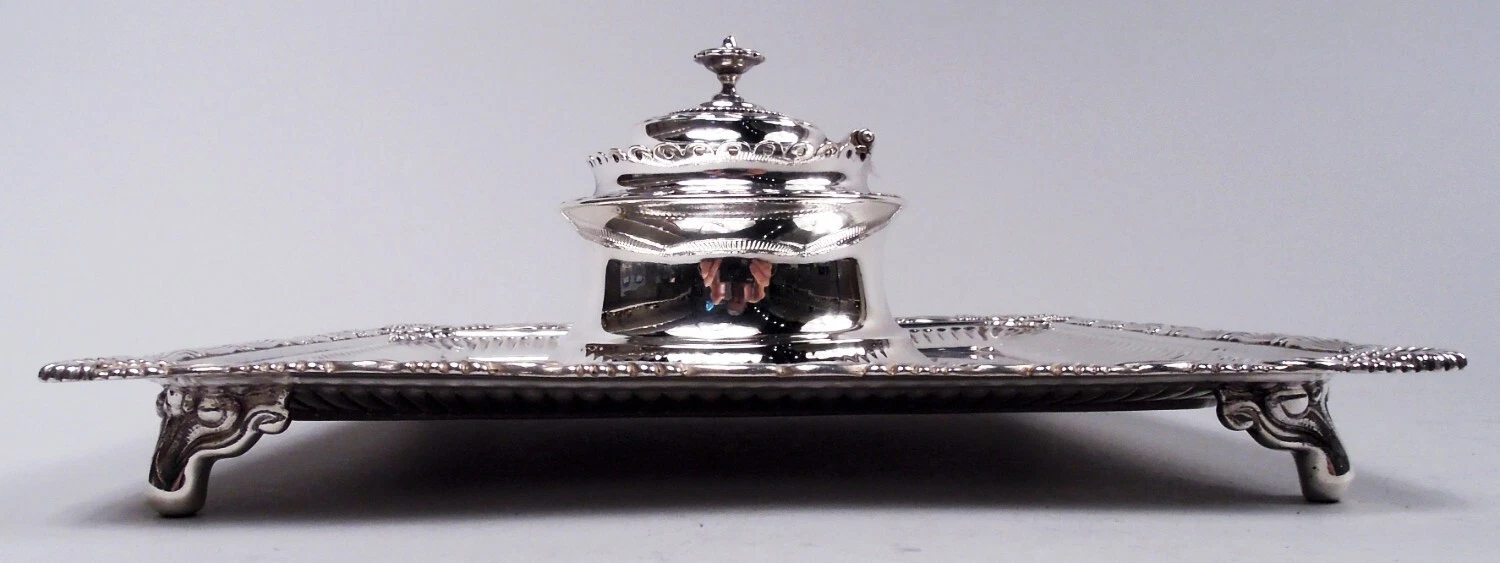
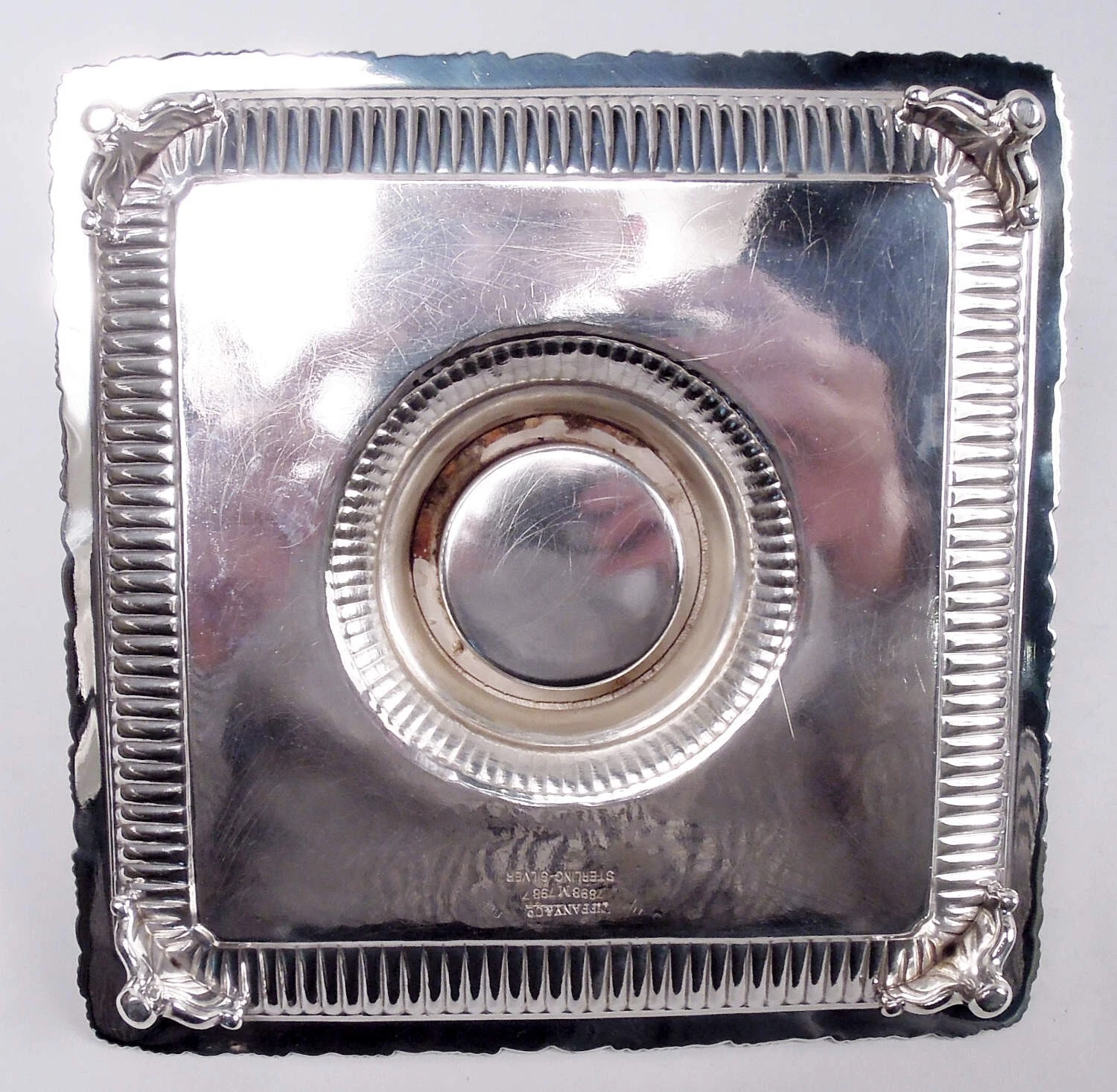
- Underside & Supports: The entire piece is elevated by four corner-mounted scroll feet. These feet are cast with shell and scroll details that flow into the underside framework.
Markings & Technical Verification
A close examination of the maker’s stamps on the underside provides precise details regarding the serial numbers.
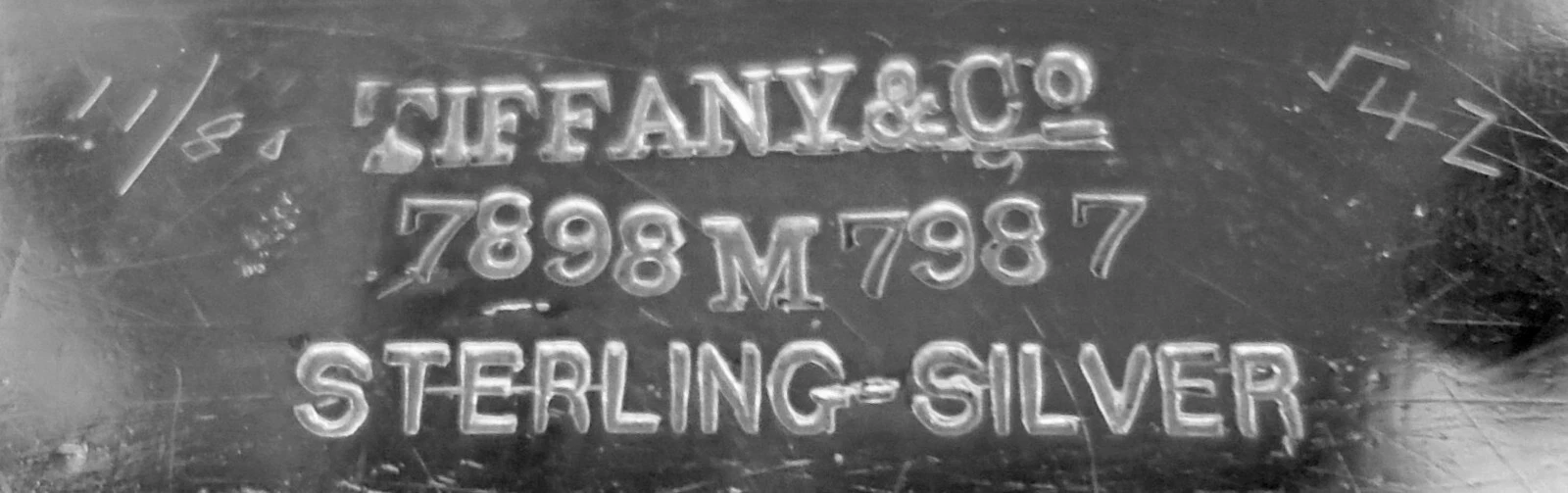
The main stamped inscription reads: TIFFANY & CO. 7898 M 7987 STERLING-SILVER
Verification:
- Maker: Verified. Definitely Tiffany & Co. of New York.
- The Director’s Letter: Verified. The capital letter “M” indicates the piece was manufactured under the artistic direction of Edward Moore. His tenure spanned from 1873 until his death in 1891, positioning this piece perfectly within the High Victorian era.
- Pattern Number: Clarified. The stamp contains two sequential four-digit numbers: 7898 and 7987.
- In Tiffany’s archival numbering system, when two numbers are paired like this around the director’s letter, one designates the pattern/shape of the primary body, and the other refers to the specific order, variant, or companion part (such as the central well assembly or specific casting elements).
- Pattern entry 7898 was first introduced into Tiffany’s design books in 1884.
Additional Markings Discovered:
- Scribbed Artisan/Inventory Marks: One can see two distinct hand-etched (scratched) marks flanking the main stamp.
- To the left, there is a fraction-like mark that appears to read 11 / 80 or 11 / 81, which likely notes a factory batch, a specific silversmith’s inventory number, or a finish date.
- To the right, there is a clear scratch mark reading √ 47 or √ 4 + Z. These types of professional graffiti were common to track workshop assembly or early point-of-sale retail inventories.
Design Context: The “Wave Edge” Pattern
While Tiffany & Co. is famous for its “Wave Edge” flatware line (originally designed by Charles T. Grosjean and introduced in 1884), finding this design language translated into hollowware/desk pieces like an inkstand is rarer.
The design brilliantly marries Neo-Rococo revival elements (the asymmetric, rolling wave scrolls) with classical symmetry (the rigid gadrooned fluting).
Sold for $2000 in May 2026
Content disclaimer. The information posted is the owner’s best knowledge and may not have been vetted by the SOIC. We welcome comments, corrections, and additions, working to make our website information comprehensive and accurate.
Join the Society of Inkwell Collectors (SOIC) – it’s free!
Founded in 1981 as a non-profit organization,
we are documenting inkwells (and accessories).
We’re here to help and inform!