


The Terry Penfiller
| Categories | Art Deco, Plastic - Bakelite - Gutta Percha |
| Material | Bakelite, Glass |
| Markings | See Narrative |
| Origin | United States |
| Date or Era | circa 1932 |
| Measuring | 3” x 3” x 3 ¼” high |
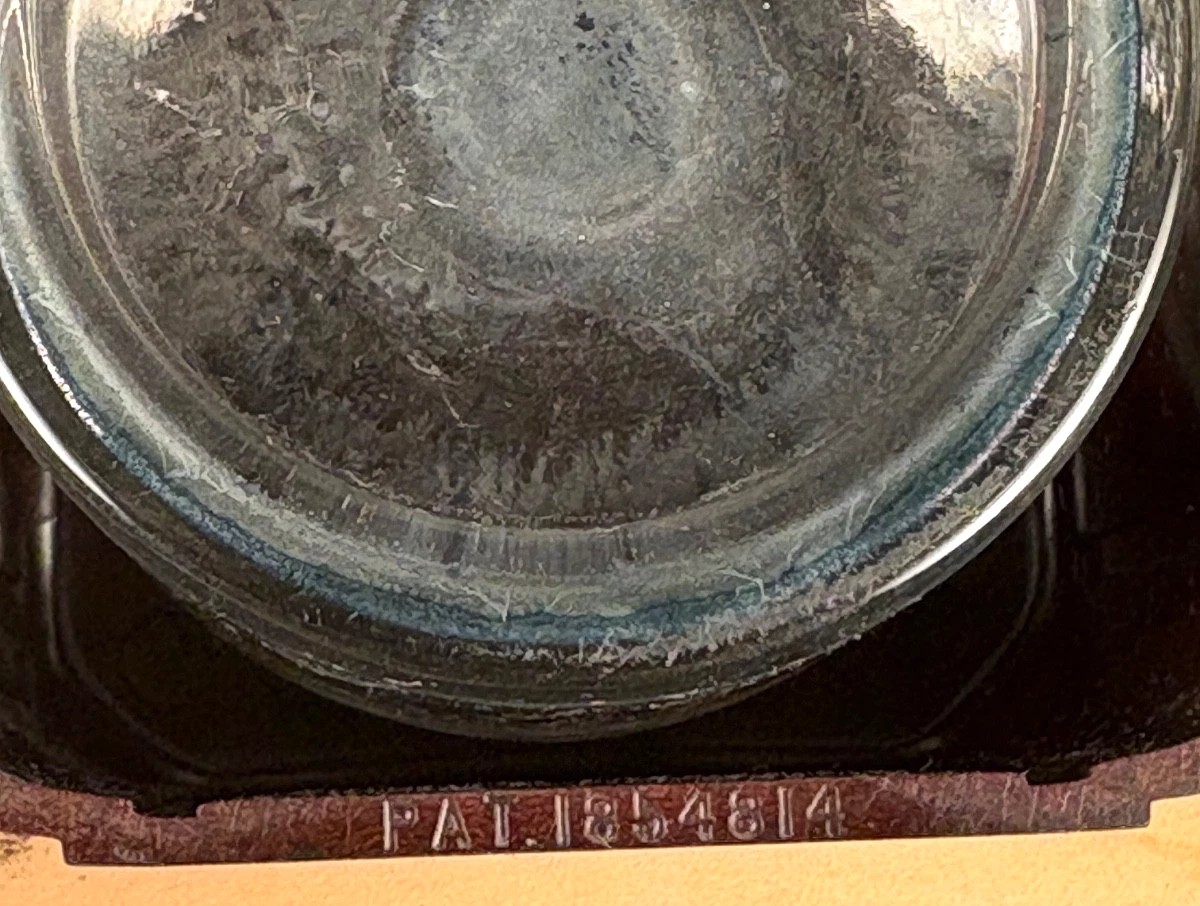
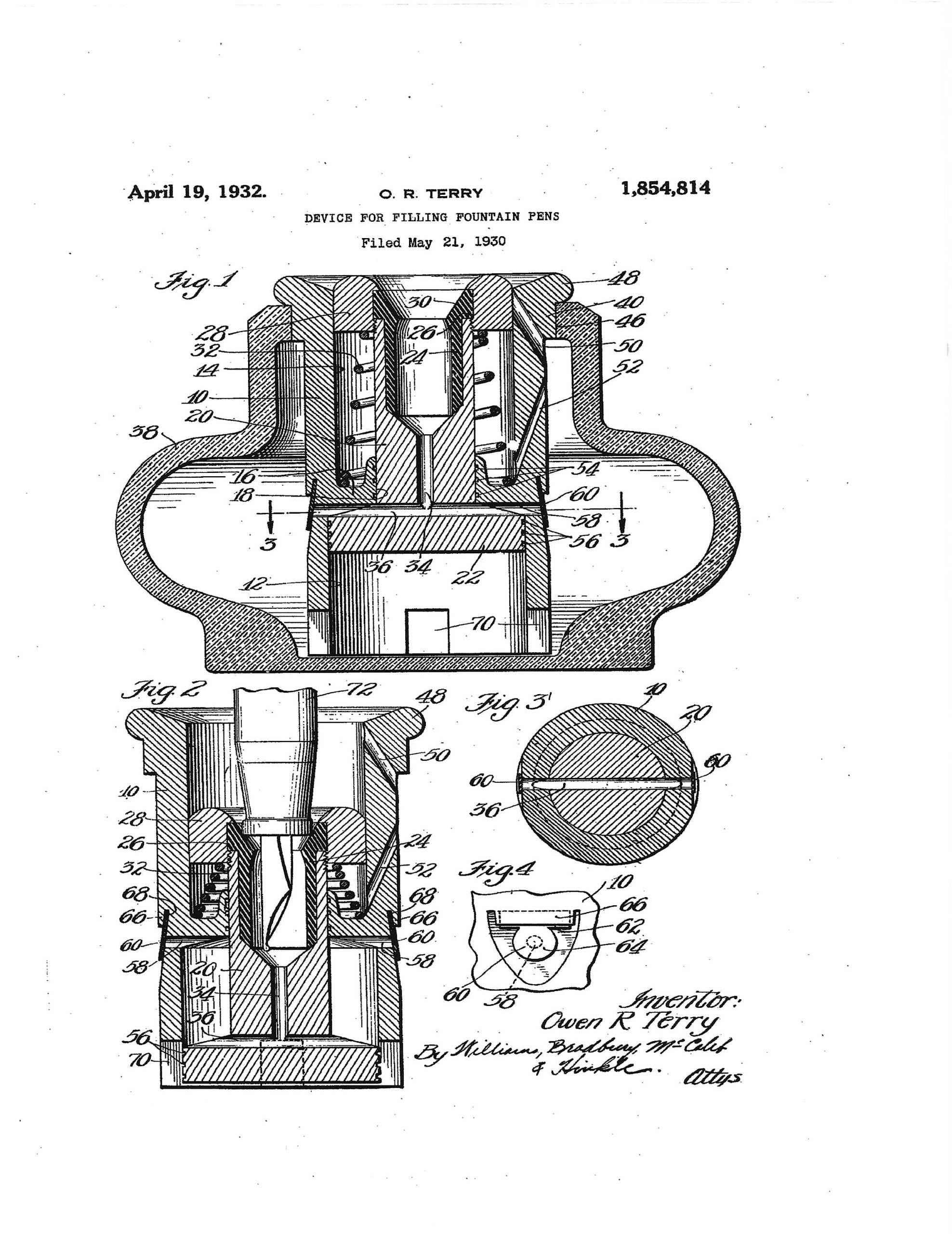
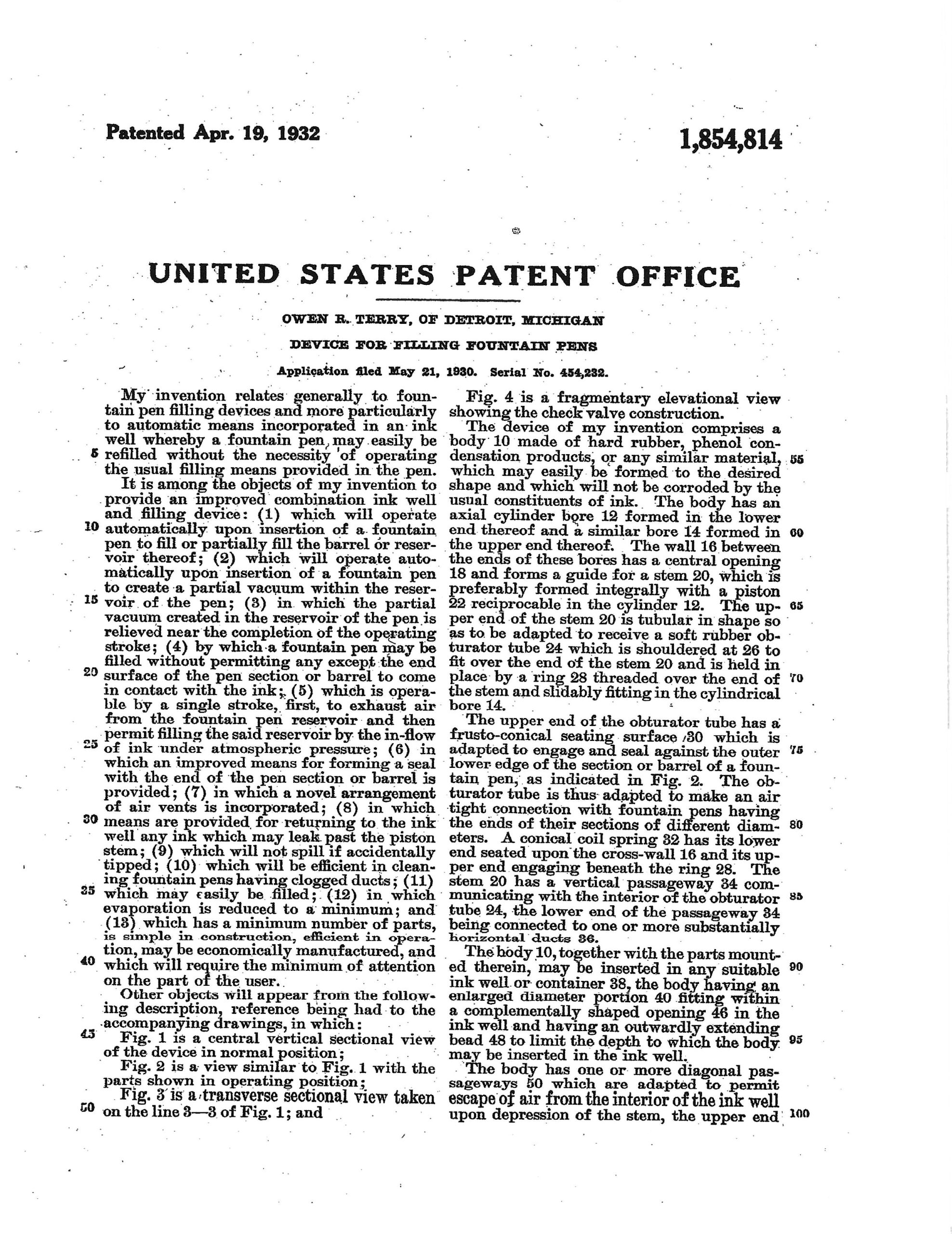
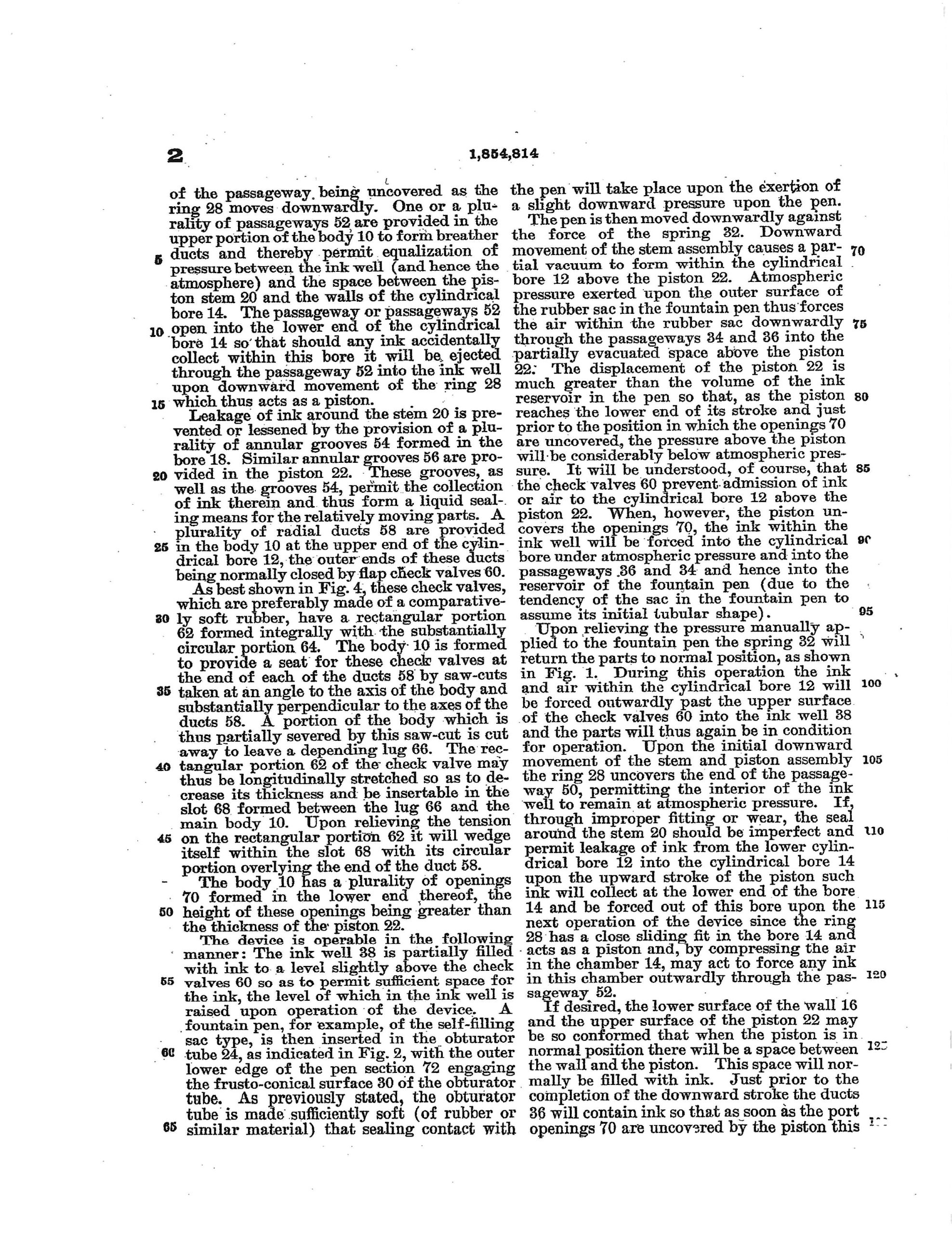
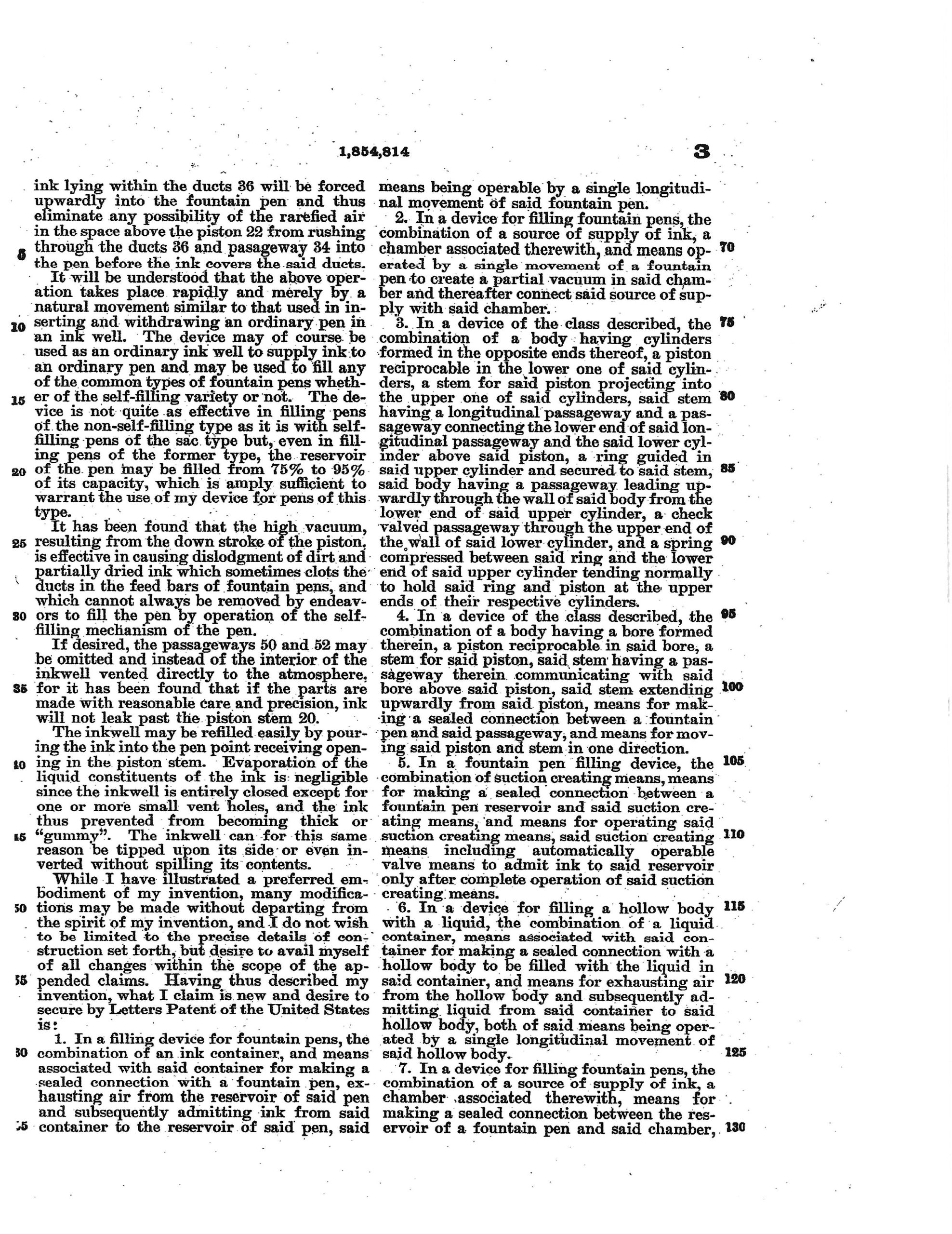
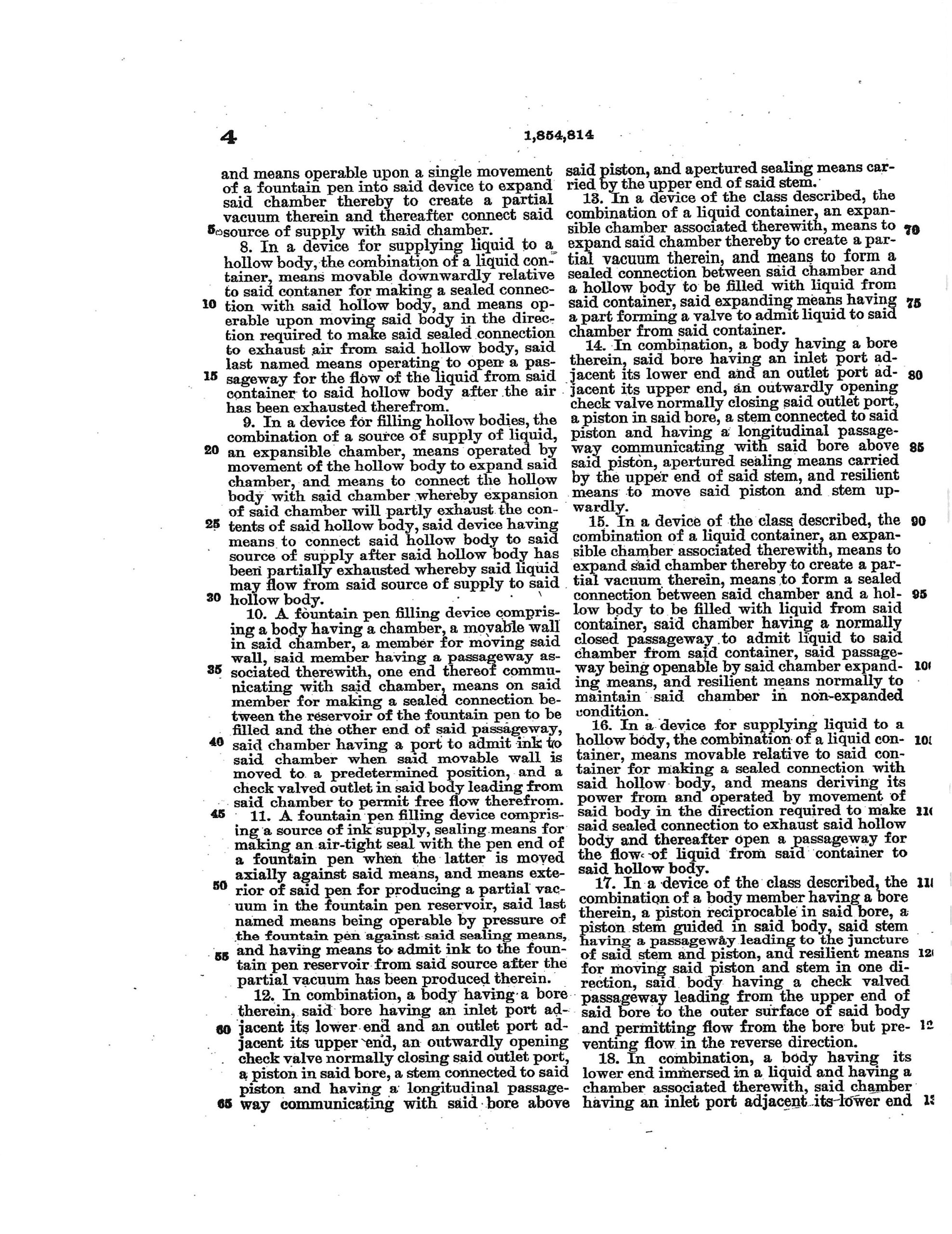
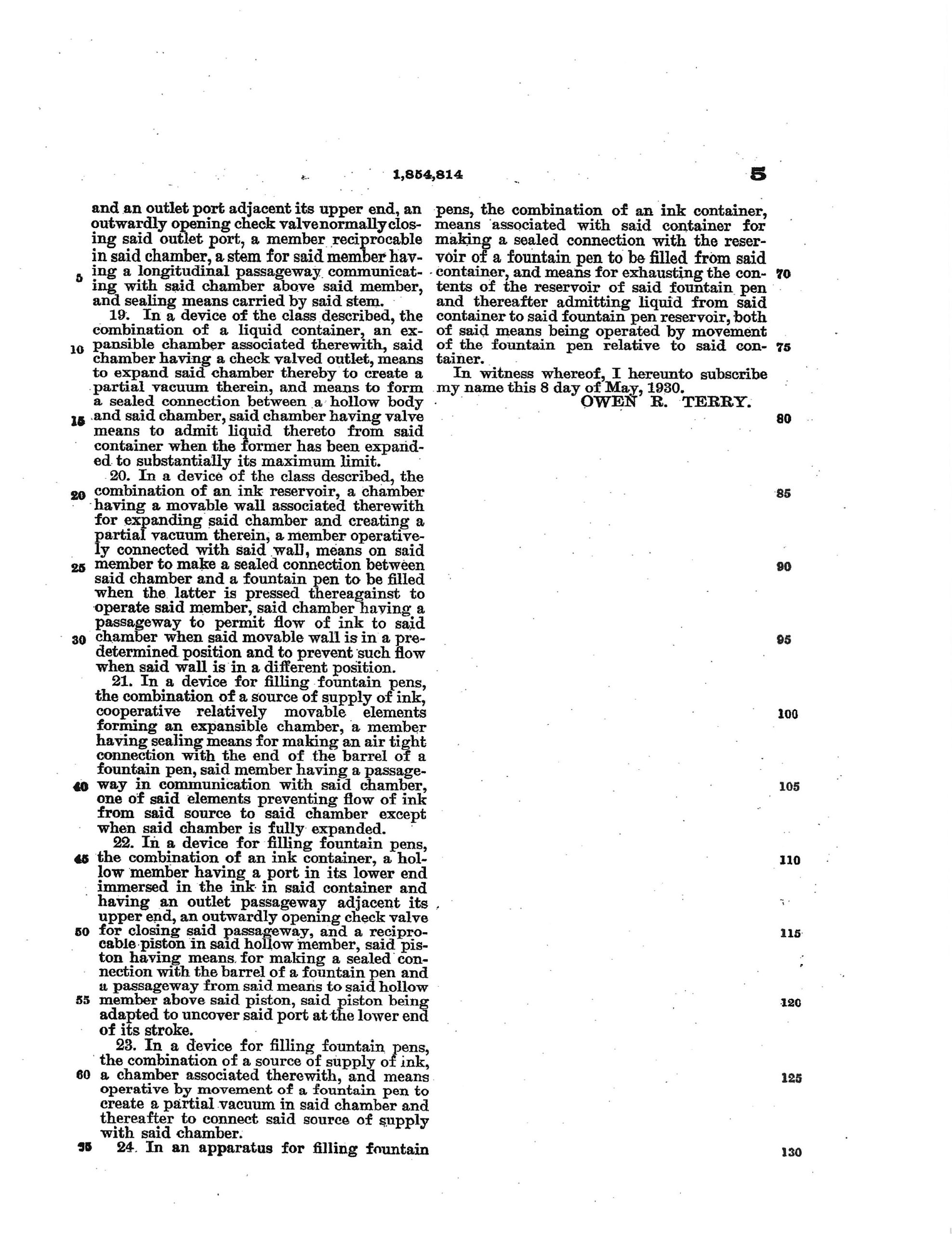
| Patent | U.S. Patent No. 1,854,814, granted April 19, 1932 |
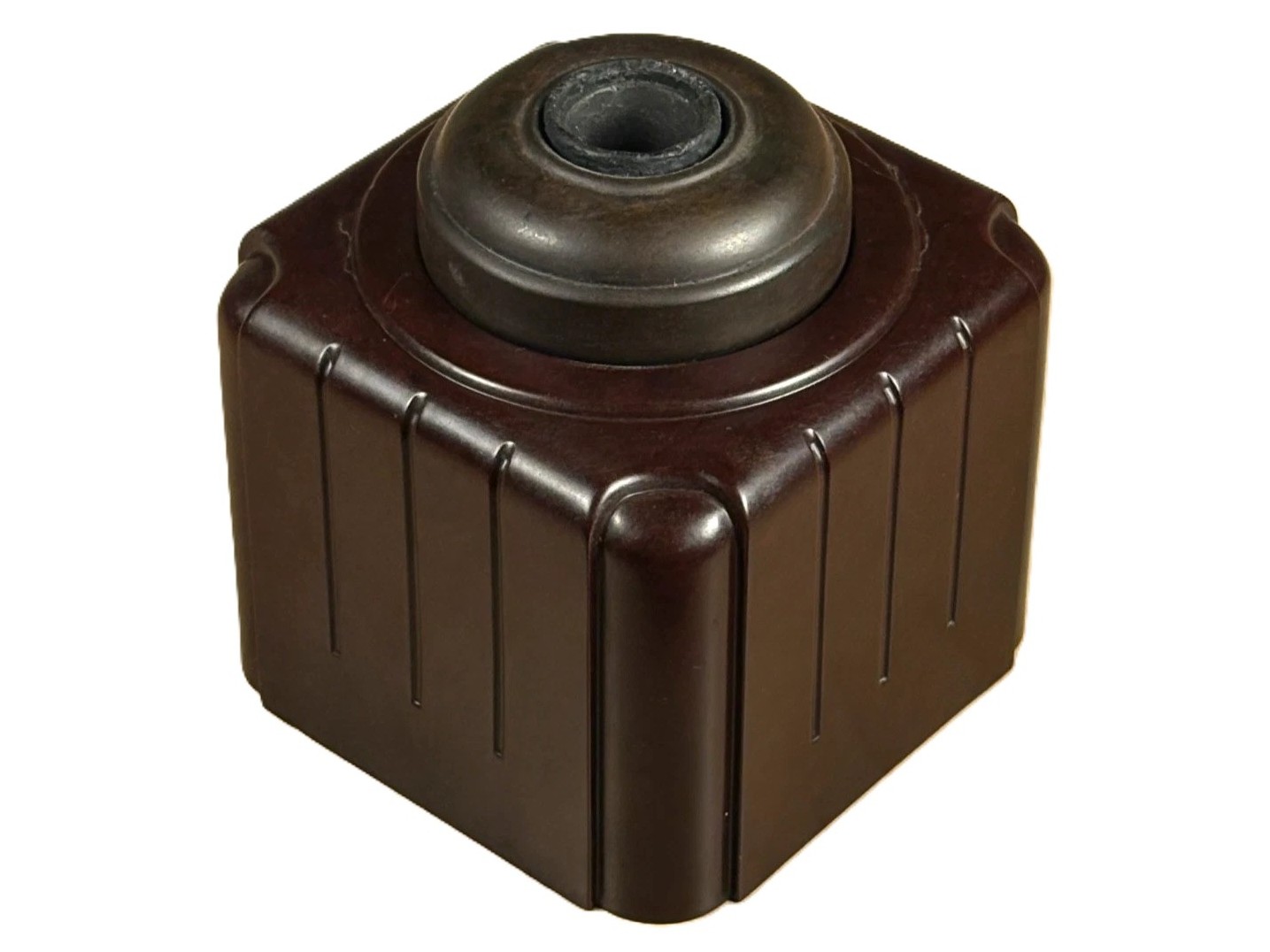
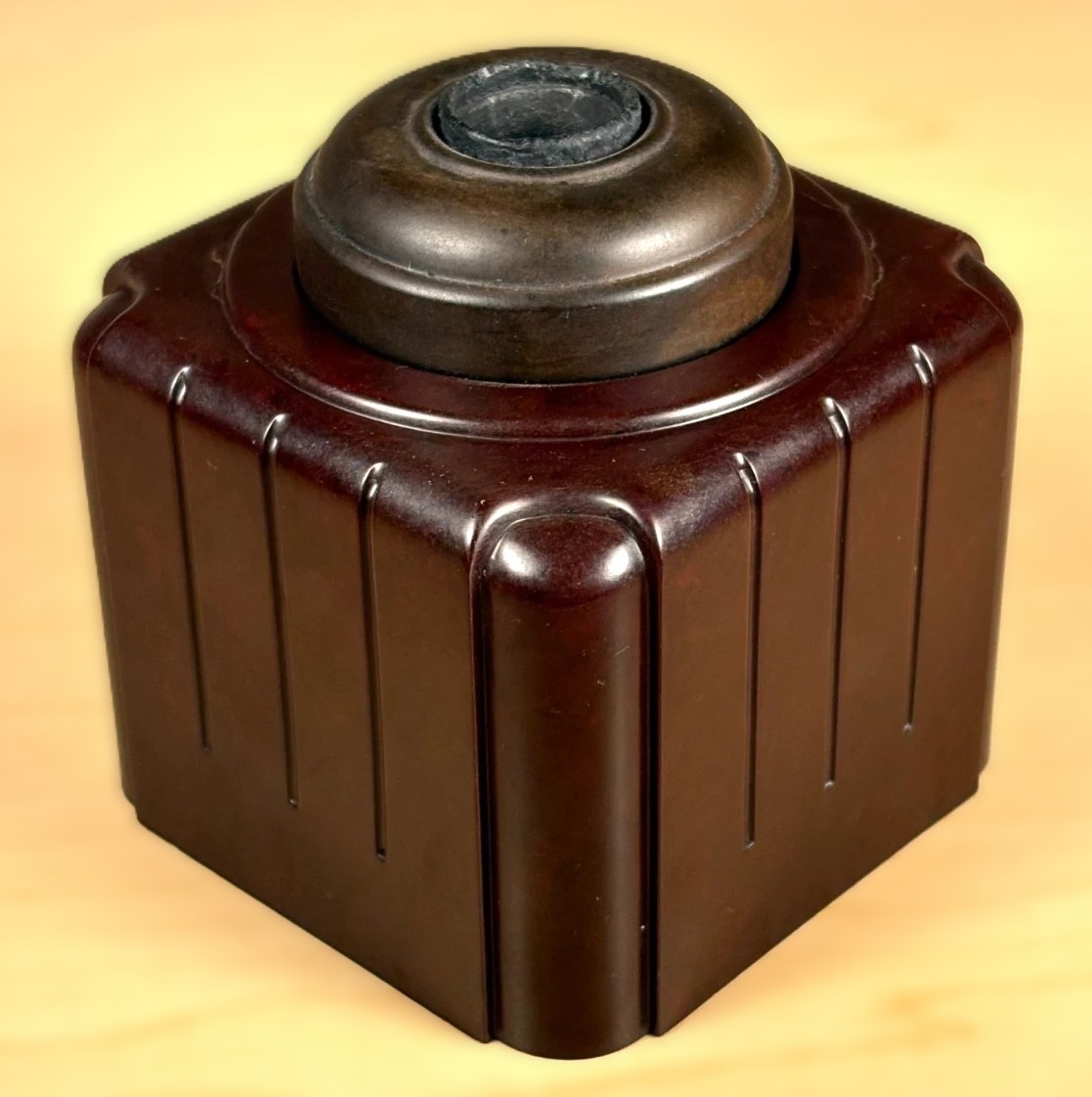
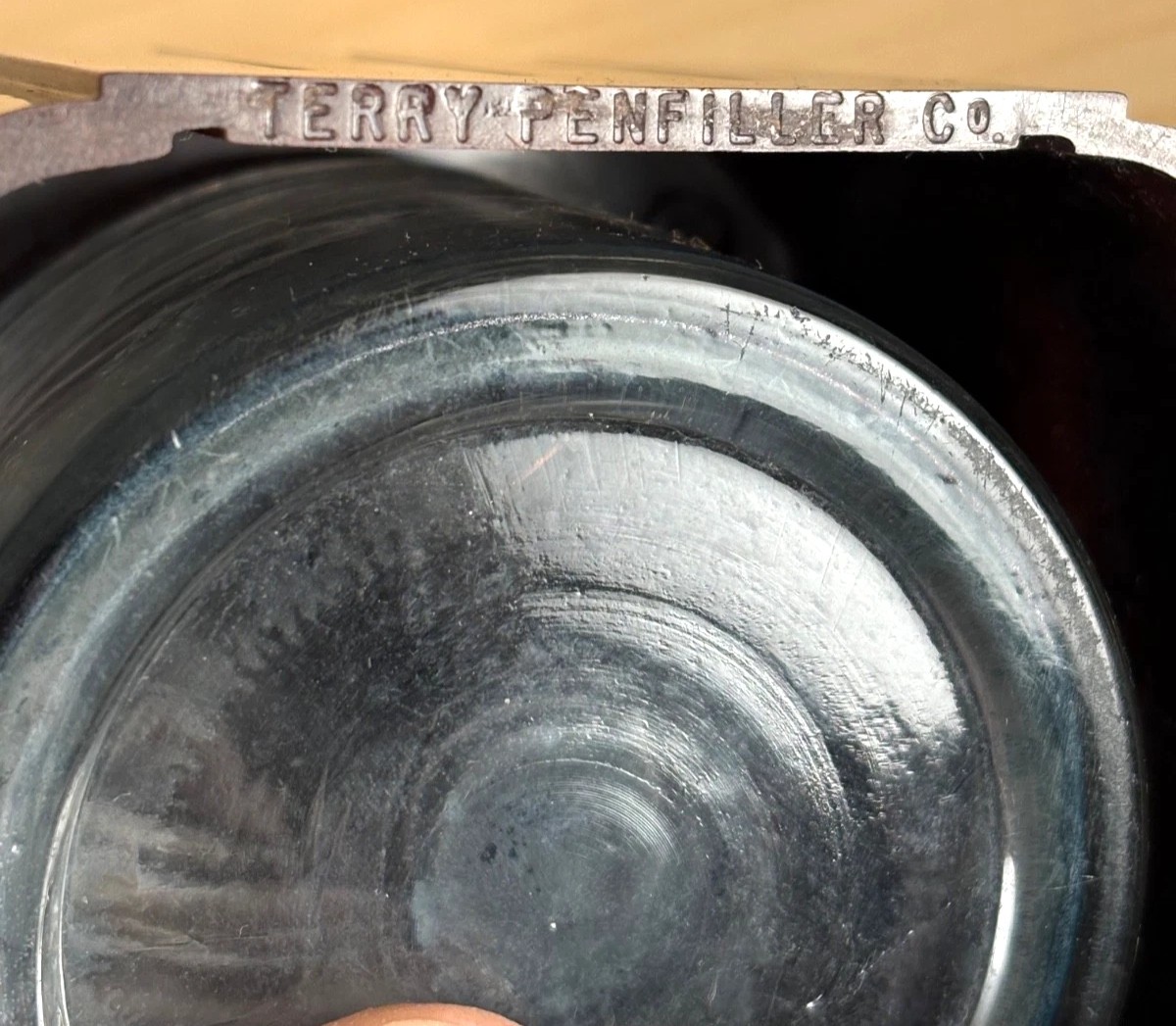
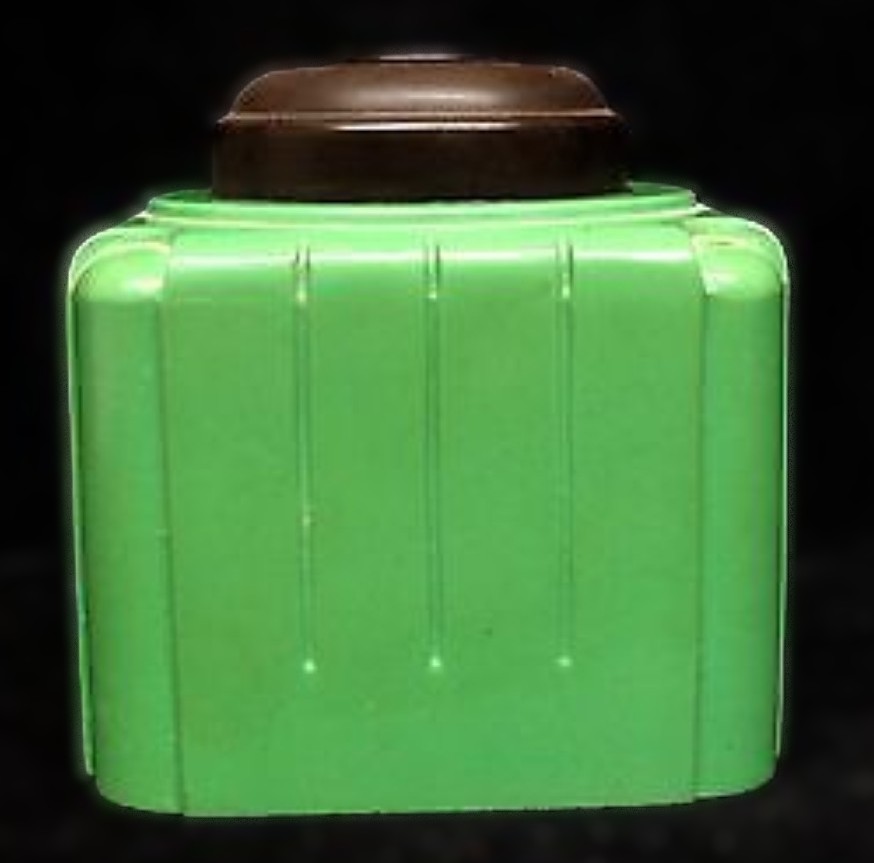
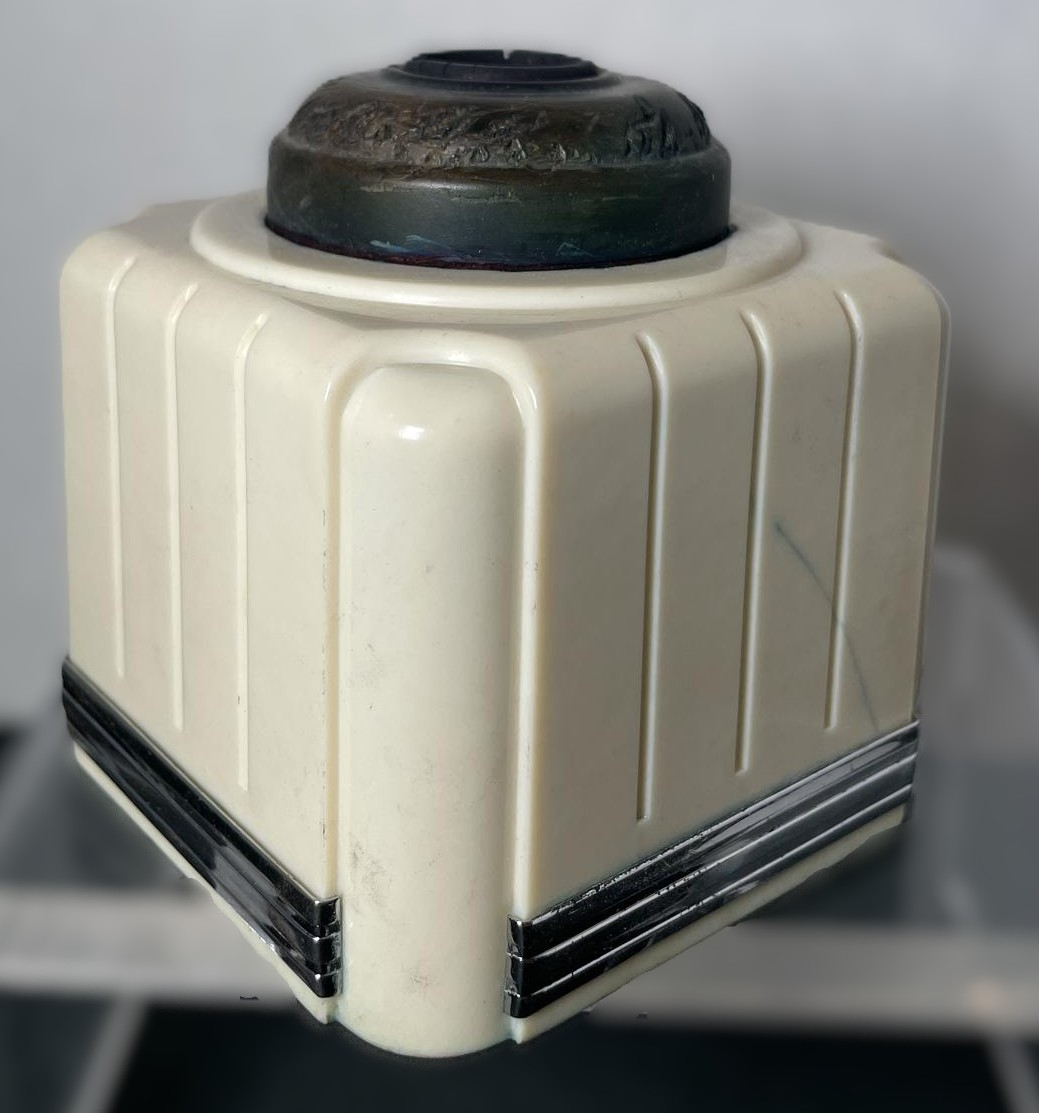
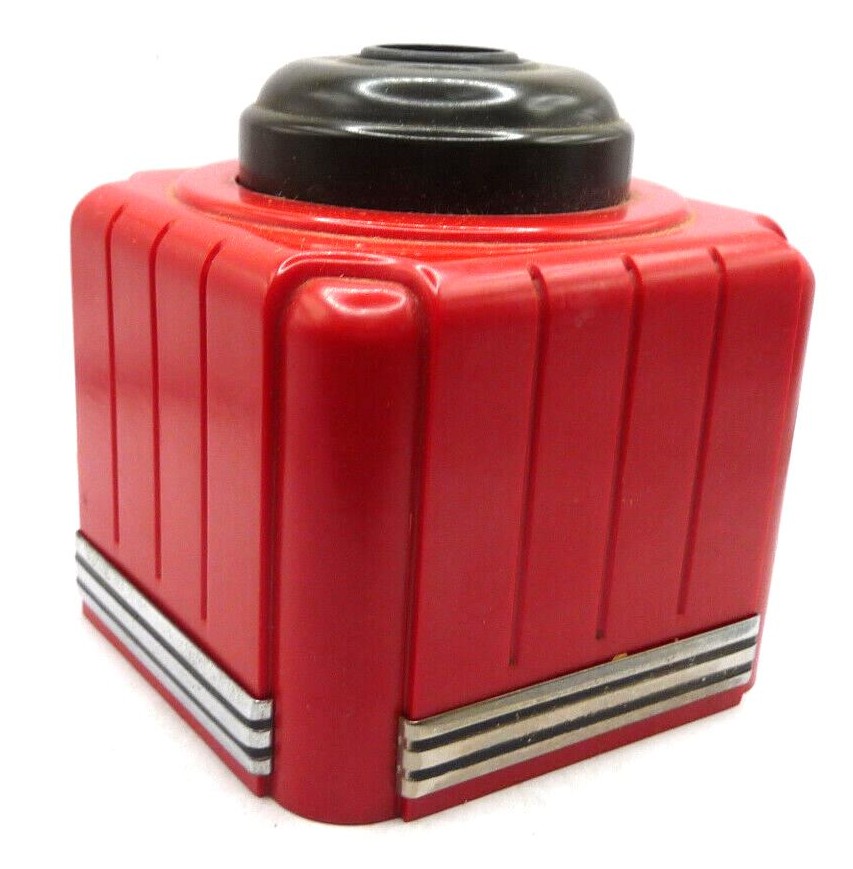
Manufactured by the Terry Penfiller Co. of Janesville, Wisconsin, this piece is an Art Deco desk accessory designed to automatically fill fountain pens.
Description
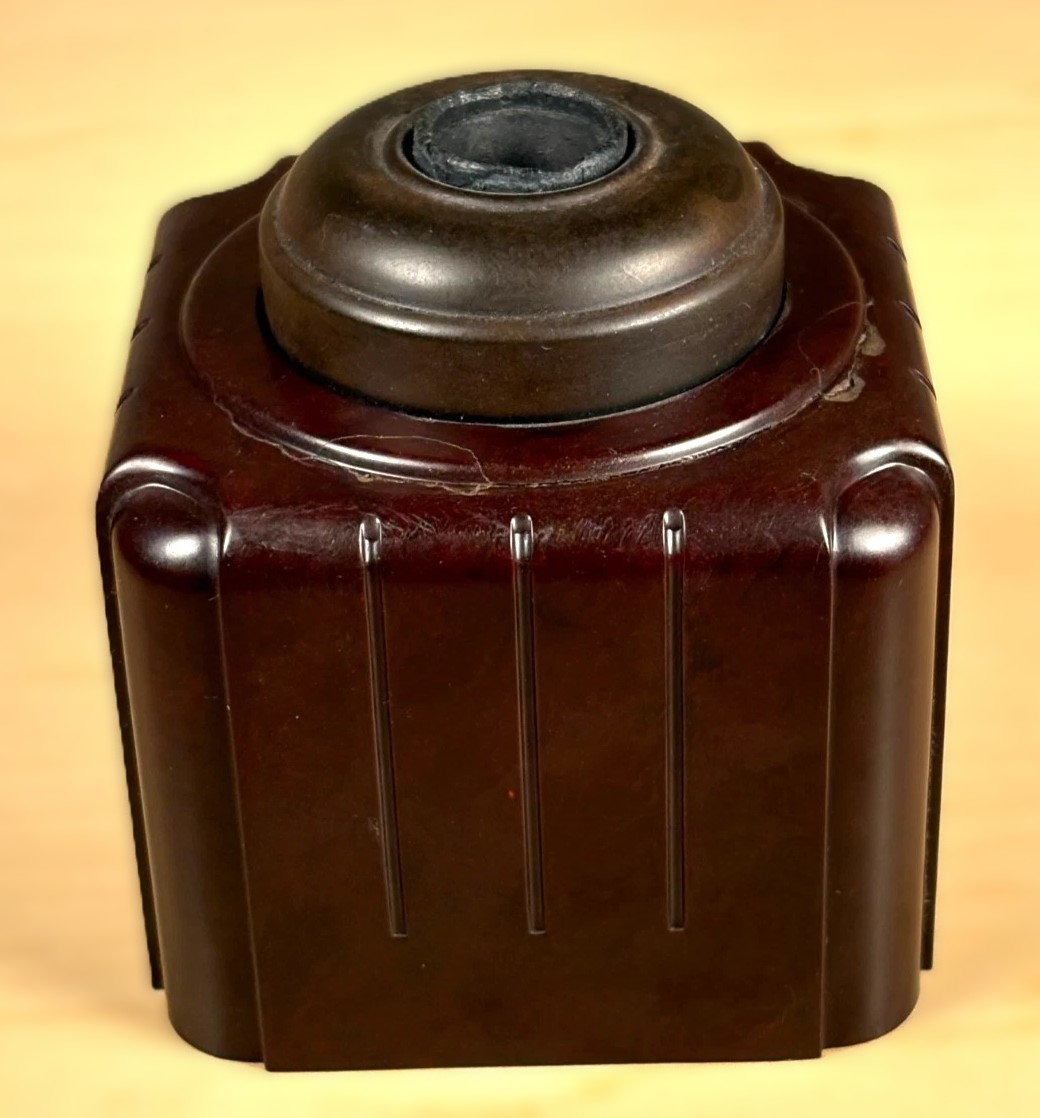
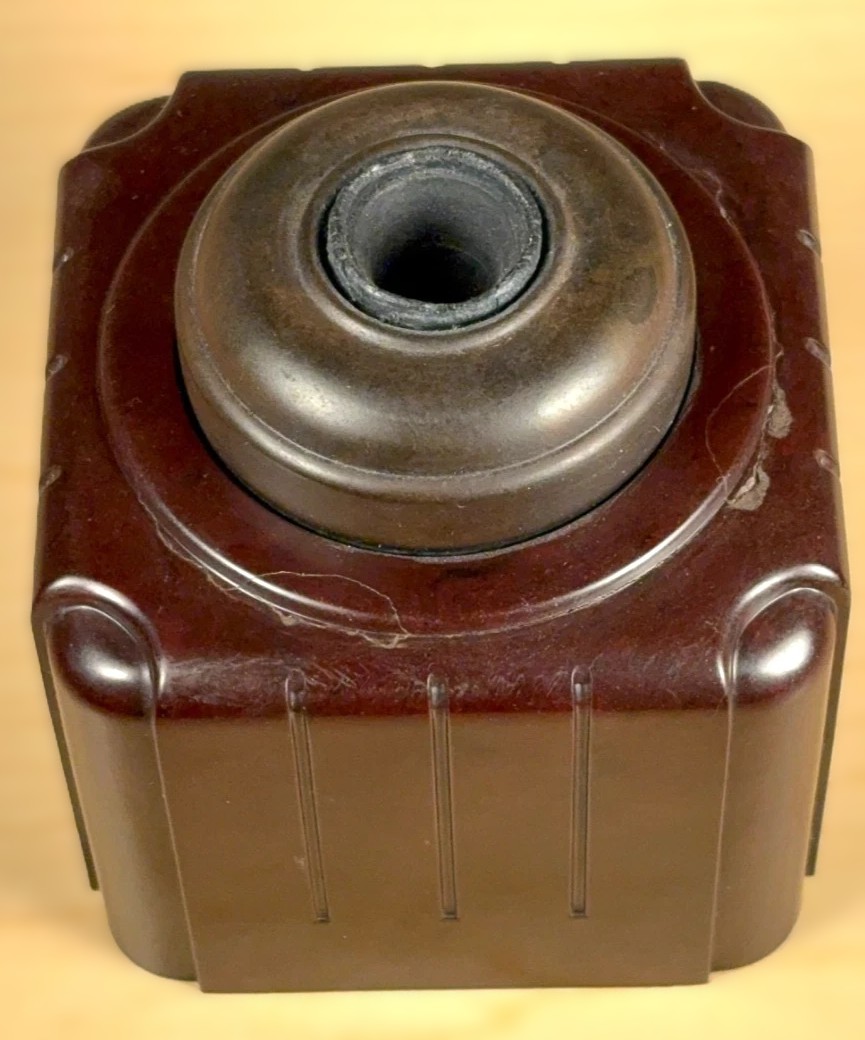
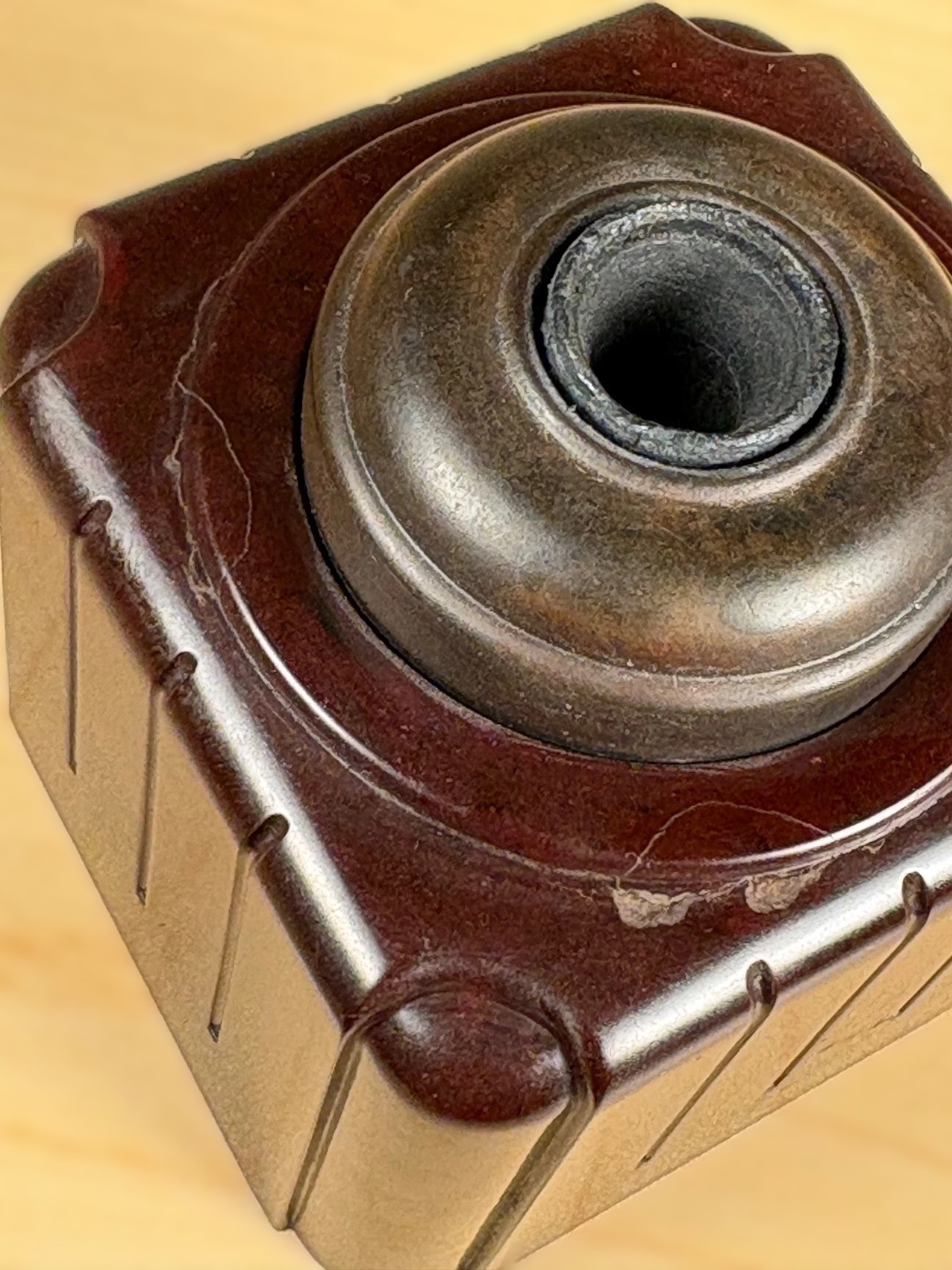
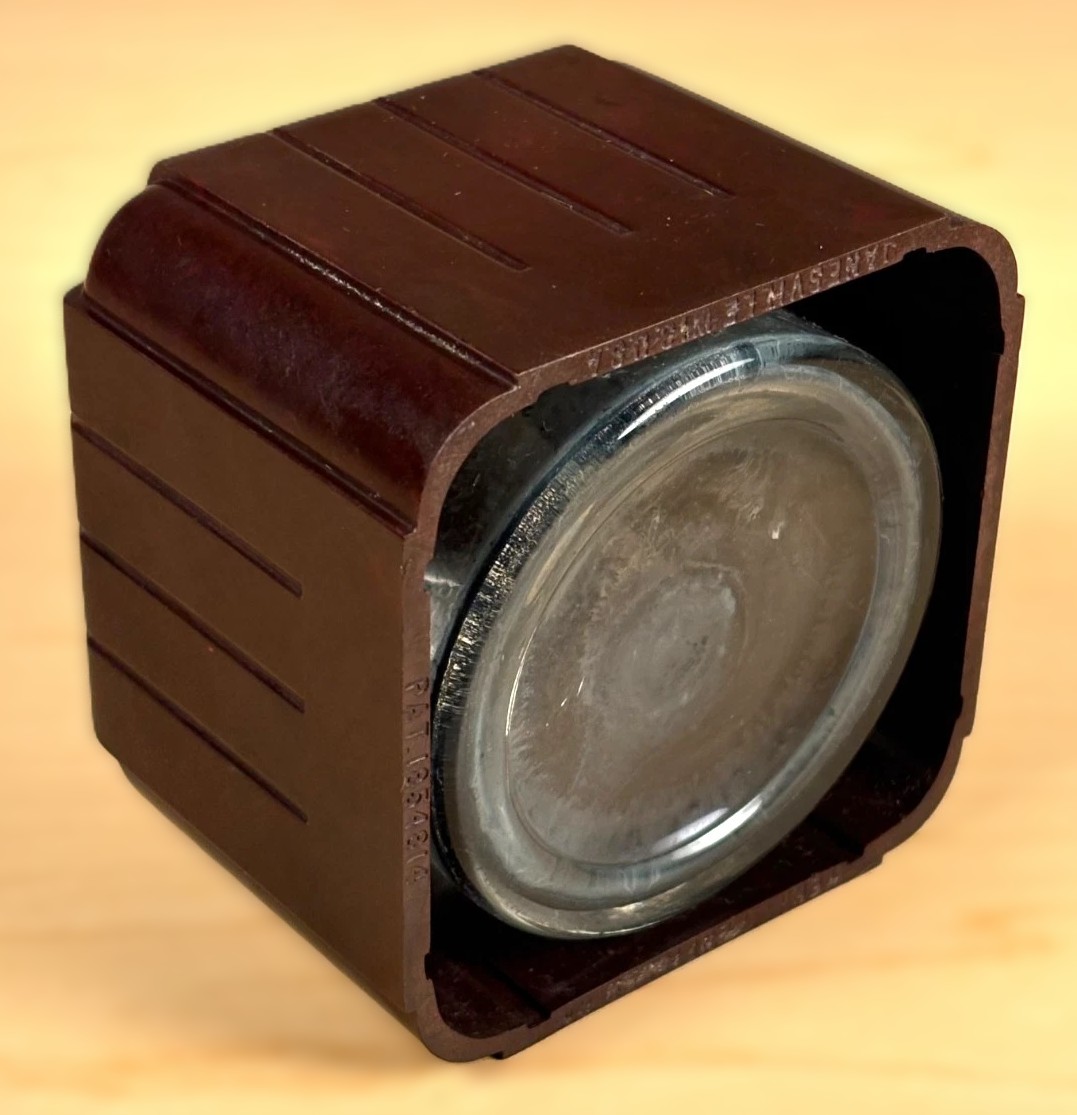
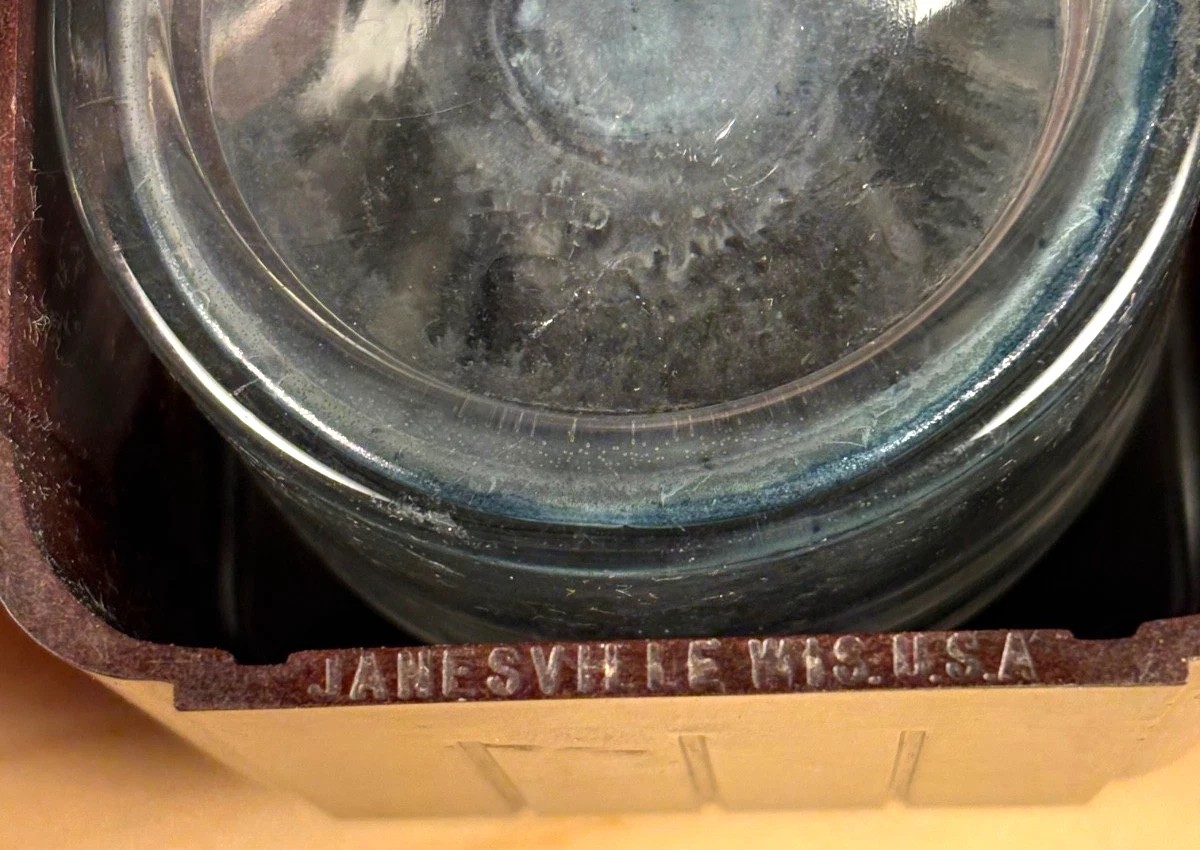
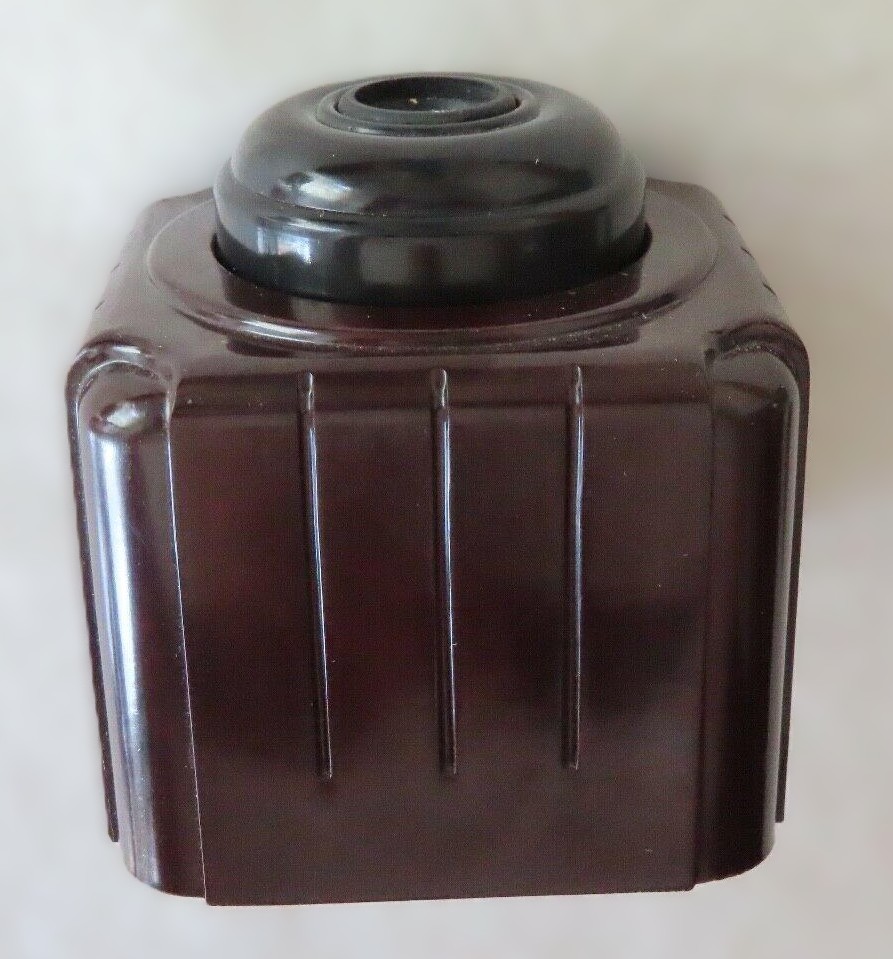
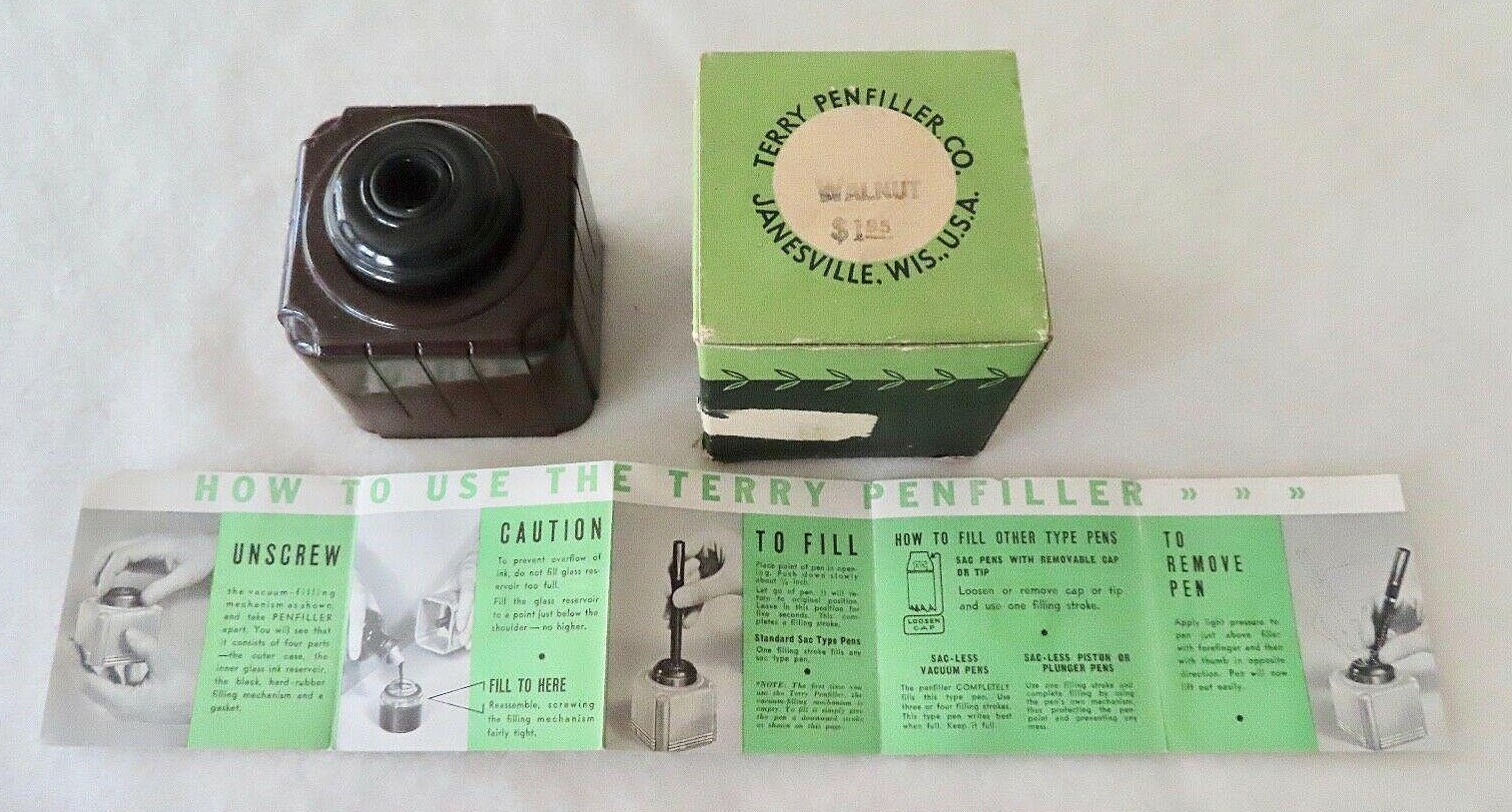
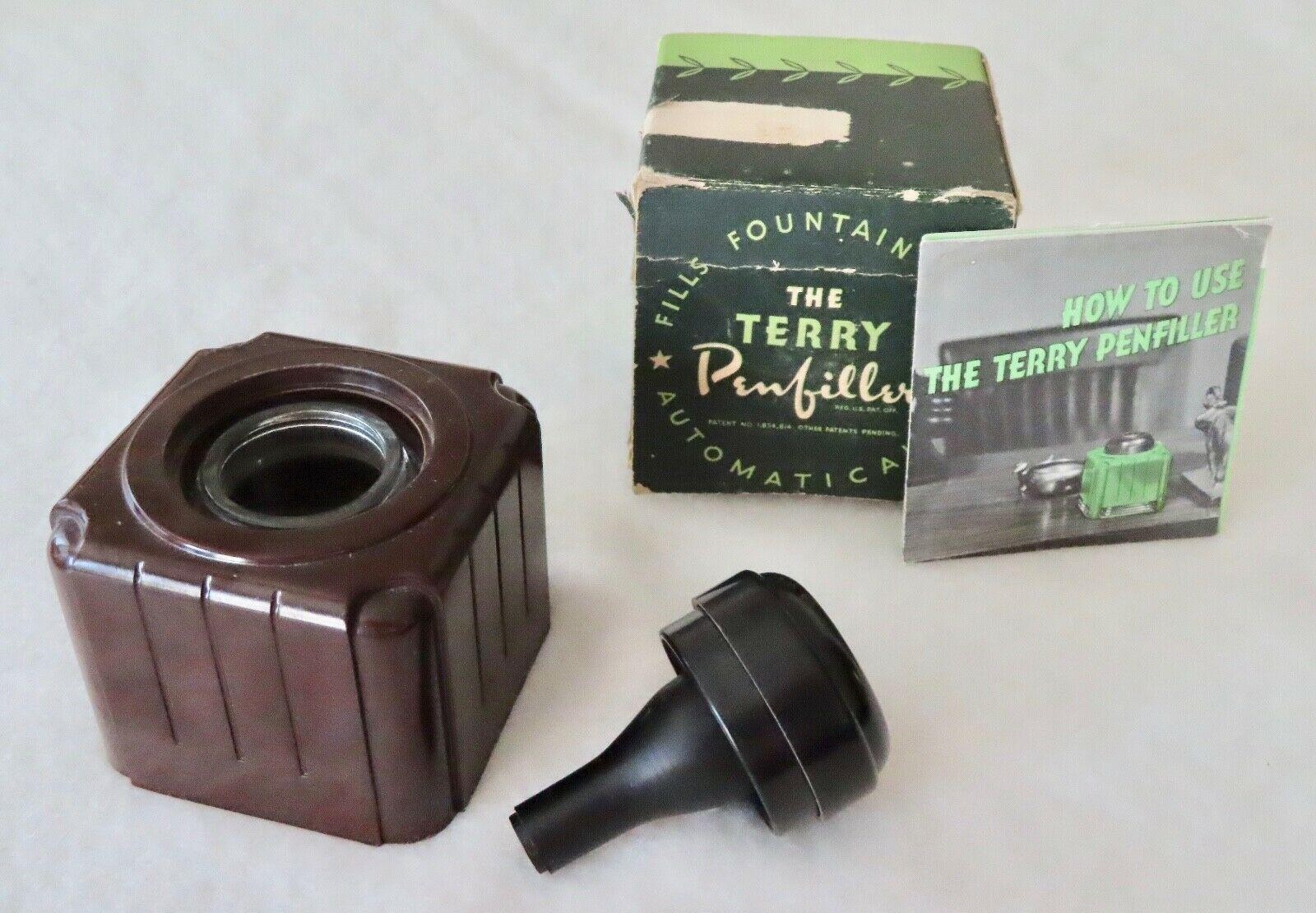
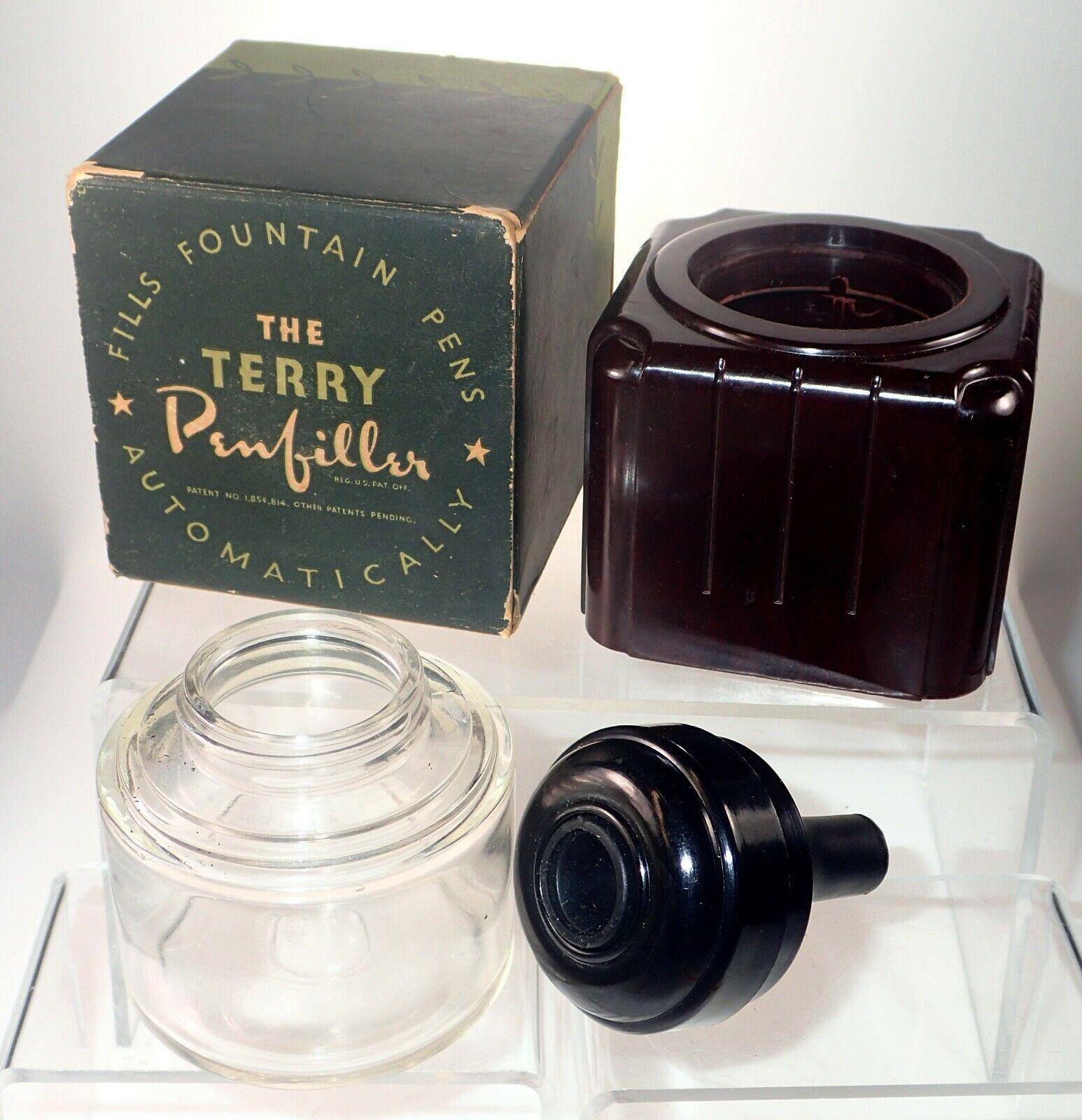
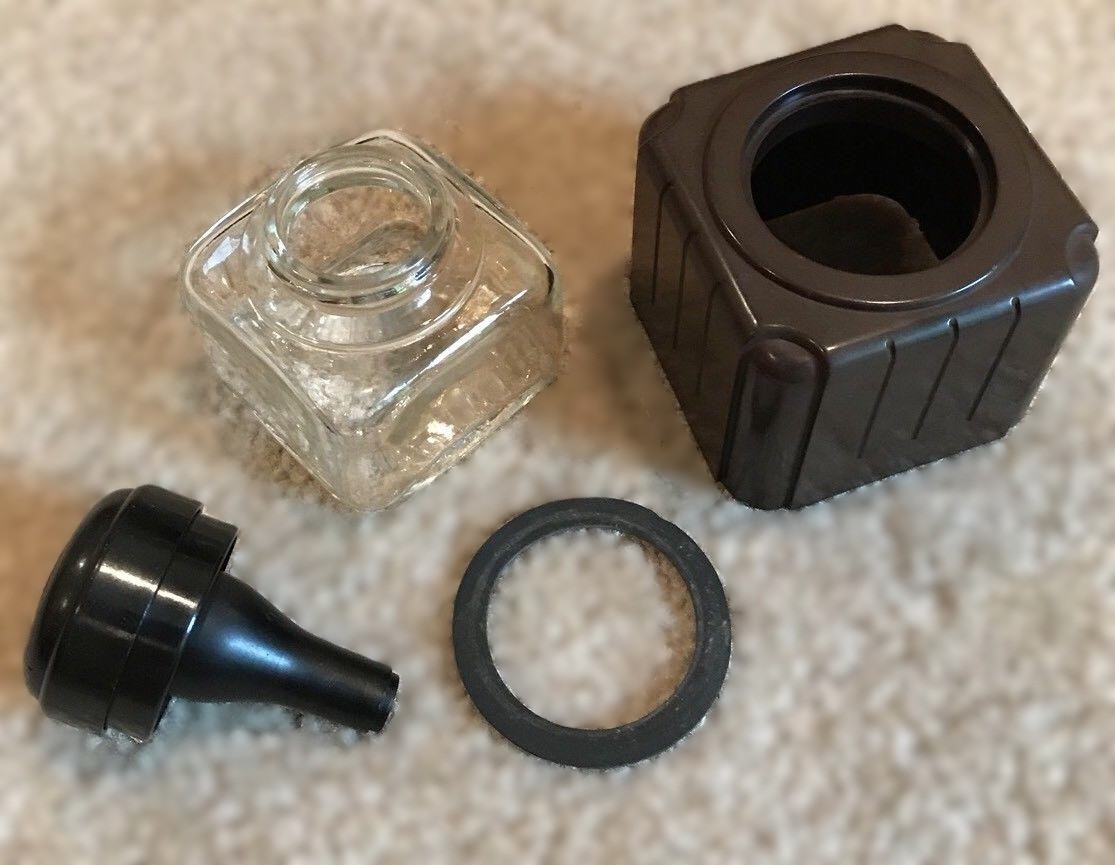
The device features a square, heavy-set outer housing accented with clean vertical fluting on its corners, styled in the streamlined architectural aesthetic typical of the 1930s. The bottom rim is embossed with the company name, location (“Janesville, Wis. U.S.A.”), and patent data (PAT. 1,854,814). Encased inside the outer housing is a heavy, clear glass ink reservoir/bottle fitted with a top collar assembly designed to seal and meter the ink flow.
Materials Used
- Bakelite (Early Plastic): The outer square housing is crafted from Bakelite, a popular thermosetting phenol formaldehyde resin prized during the early-to-mid 20th century for its durability and rich, glossy sheen. They came in a variety of colors, with walnut brown the most common.
- Glass: The internal ink container is made of thick, heavy molded clear glass.
- Metal and Rubber/Composition Elements: The top collar and filling mechanism utilize metal components (sometimes finished in patinated bronze or brass styles) along with resilient sealing gaskets or stoppers to create the pressure seal necessary for automated filling.
How It Works (Patent # 1,854,814)
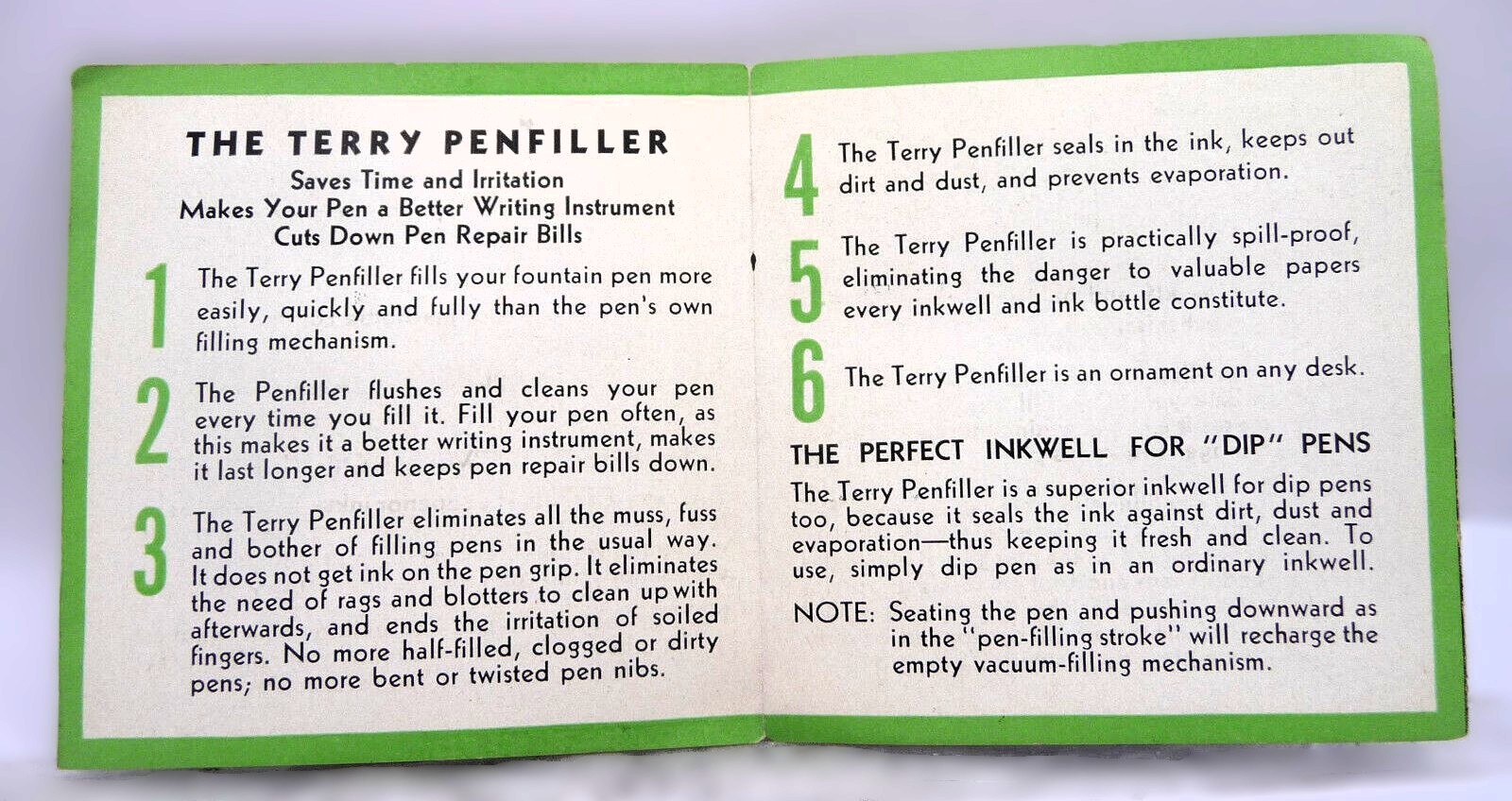
The device functions as an automatic pen filler meant to streamline the messy process of drawing ink into lever-, button-, or vacuum-filled fountain pens without getting ink all over the user’s fingers or section grip.
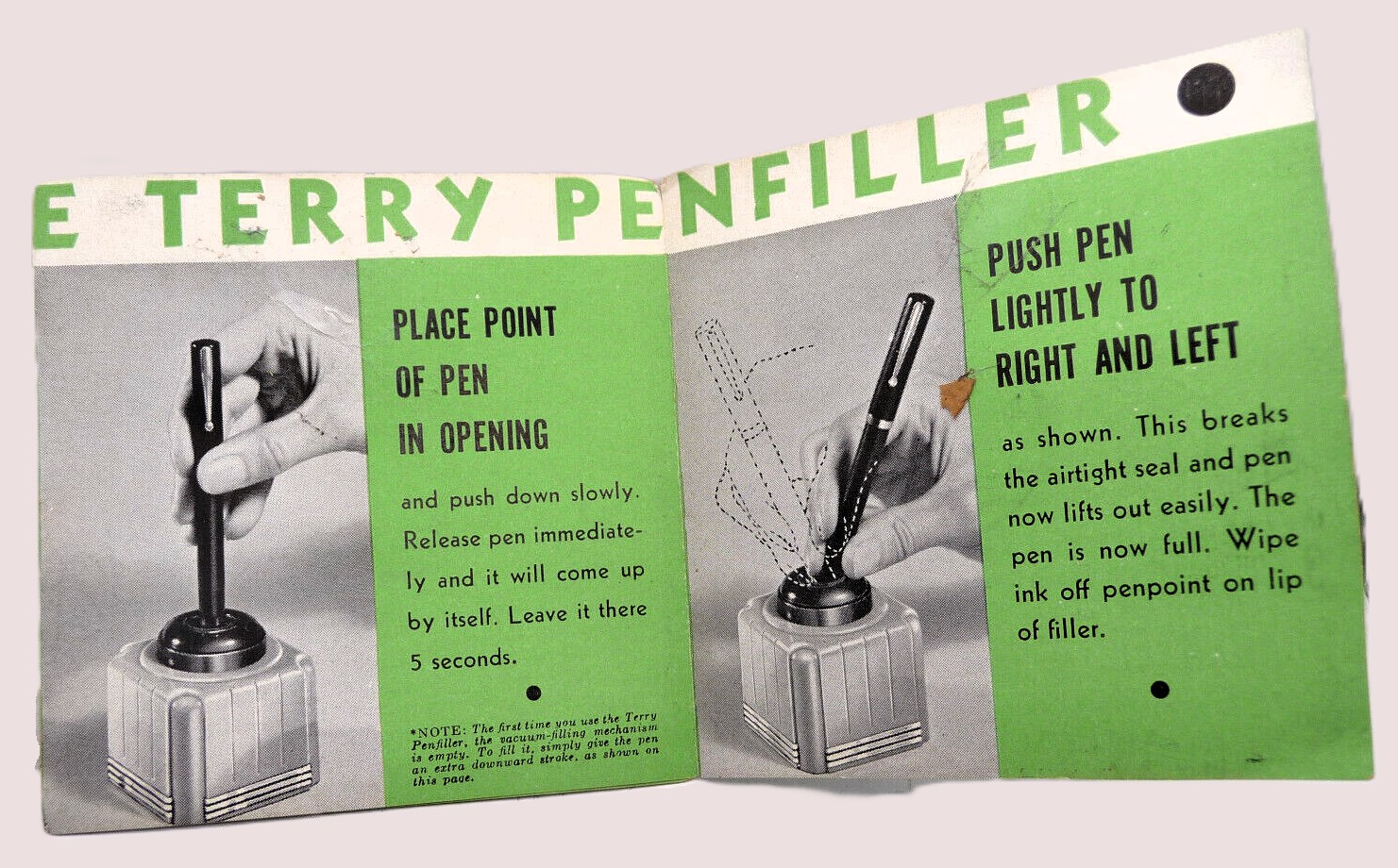
- By inserting the fountain pen nib downward into the central aperture and pressing down against the internal sealing collar, the pen creates an airtight chamber.
- Pushing the pen downward activates a displacement mechanism or air-pressure differential within the sealed ink reservoir.
- This action forces a measured amount of ink directly up into the feed and nib section at the exact depth required, allowing the user to operate their pen’s filling mechanism (such as depressing a bar or turning a filler) while the nib remains cleanly submerged in the sealing grommet.
- Upon releasing pressure, the valve seals back up, preventing evaporation, dust contamination, and accidental spills.
The Terry Penfiller was sold purely as an empty hardware accessory, meaning it was not supplied with ink in the box; users had to fill the internal glass container themselves using their preferred bottled writing ink.
Because it functioned as an open-reservoir dispensing mechanism rather than a closed cartridge system, you did not have to use a particular brand of ink. It was compatible with standard fountain pen inks of the era, such as Parker Quink, Waterman’s, or Sheaffer Skrip.
Filling the glass container was straightforward and simple:
- The heavy molded glass bottle lifted out from the bottom or dropped inside the square Bakelite housing.
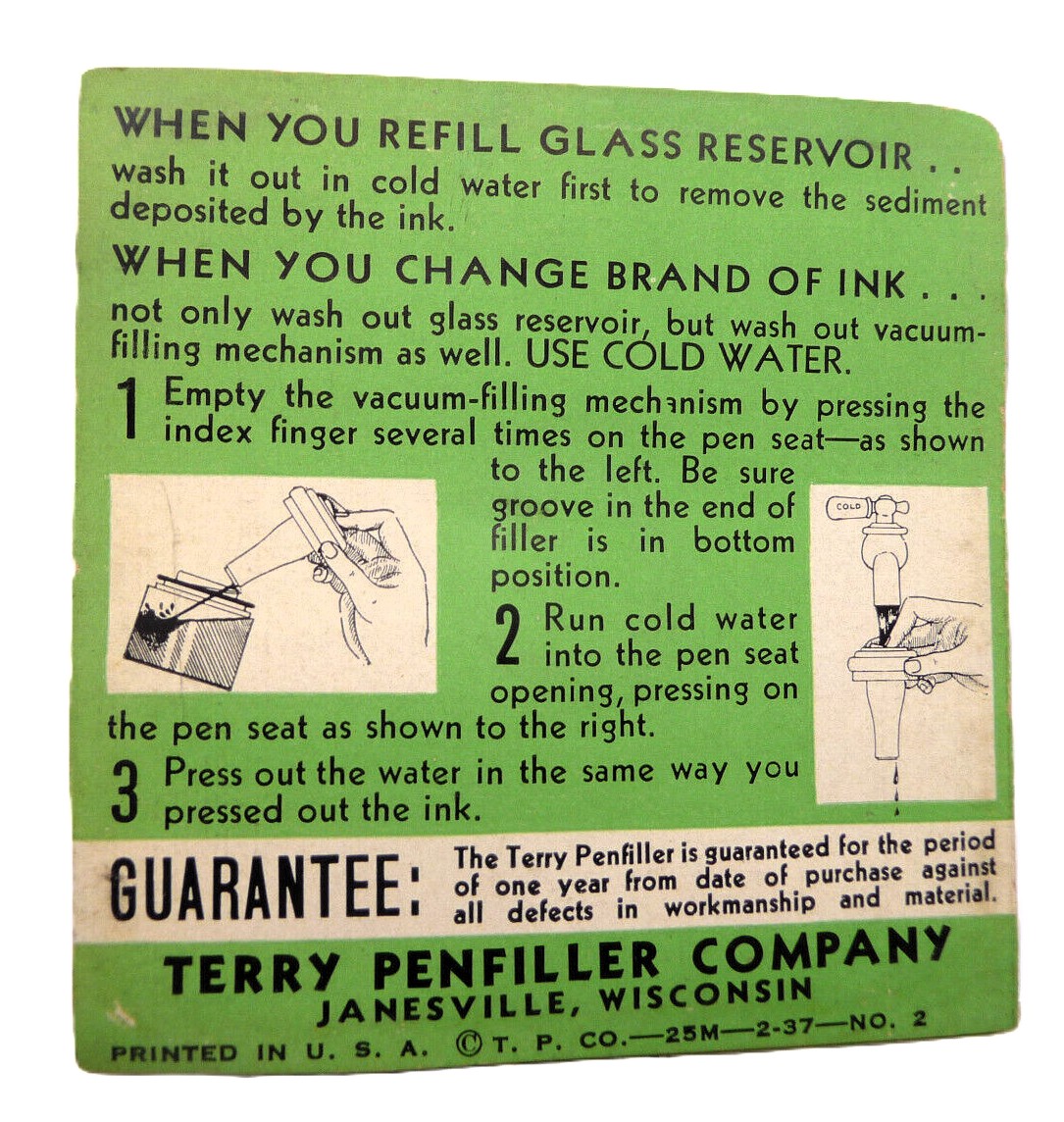
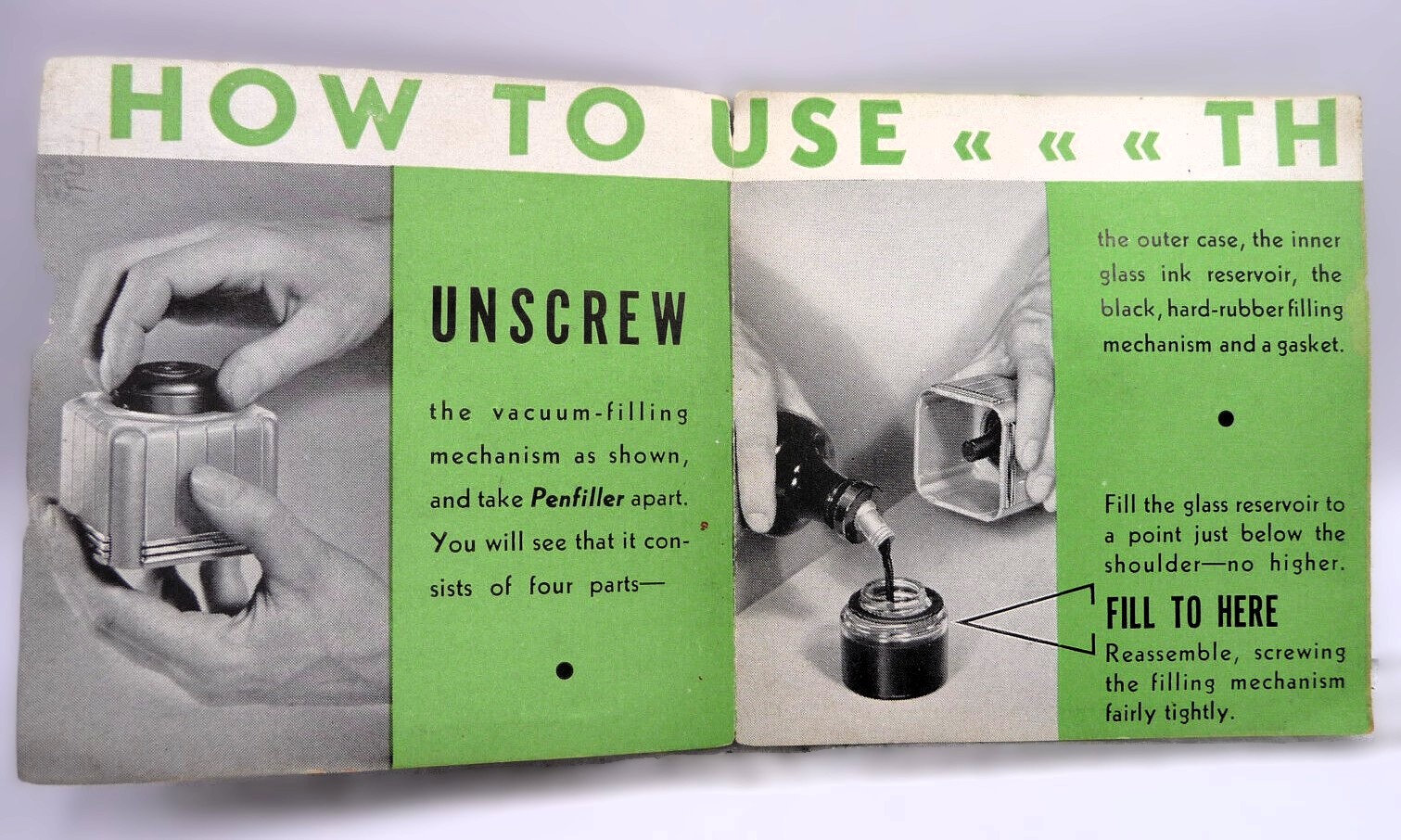
- To refill it, the user simply removed the inner glass bottle from the outer casing, unscrewed or removed the top collar/stopper assembly, and poured fresh ink directly from a standard ink bottle into the reservoir.
- Once filled, the collar assembly was placed back on, and the glass insert slid neatly back into the Bakelite base, keeping the desktop tidy and ready for automated pen filling.
History, Longevity, and Success of the Terry Penfiller Co.
- History & Location: The Terry Penfiller Co. operated out of Janesville, Wisconsin—notably the same midwestern city historically famous as the longtime home of the Parker Pen Company.
- Timeline and Market Success: Operating primarily during the 1930s (coinciding with the 1932 patent issuance), the company was a relatively small enterprise that specialized in desktop utility innovations during the height of the fountain pen era.
- Commercial Footprint: While they produced clever automated desk inkwells and occasional novelty items (such as figural knight’s helmet desk inkstands), the Terry Penfiller Co. was a short-lived or niche player rather than an industrial giant. They did not survive long-term as an independent manufacturer into the post-war era—largely because the convenience of specialized desk fillers diminished as fountain pen technology improved and ballpoint pens began sweeping the writing market in the late 1940s.
When the Terry Penfiller was introduced in the early 1930s, it occupied a middle-ground space: it was priced as a convenience gadget for everyday users (such as office workers, students, or professionals), rather than a luxury item, but it was slightly more expensive than a standard, disposable bottle of ink.
While exact original retail price figures from 1932 magazine catalogs are scarce today, desk accessories molded from Bakelite during this era were mass-produced consumer goods. Bakelite allowed for efficient factory molding, making functional desktop novelties affordable for middle-class households and offices, even if they cost more than a simple glass ink jar.
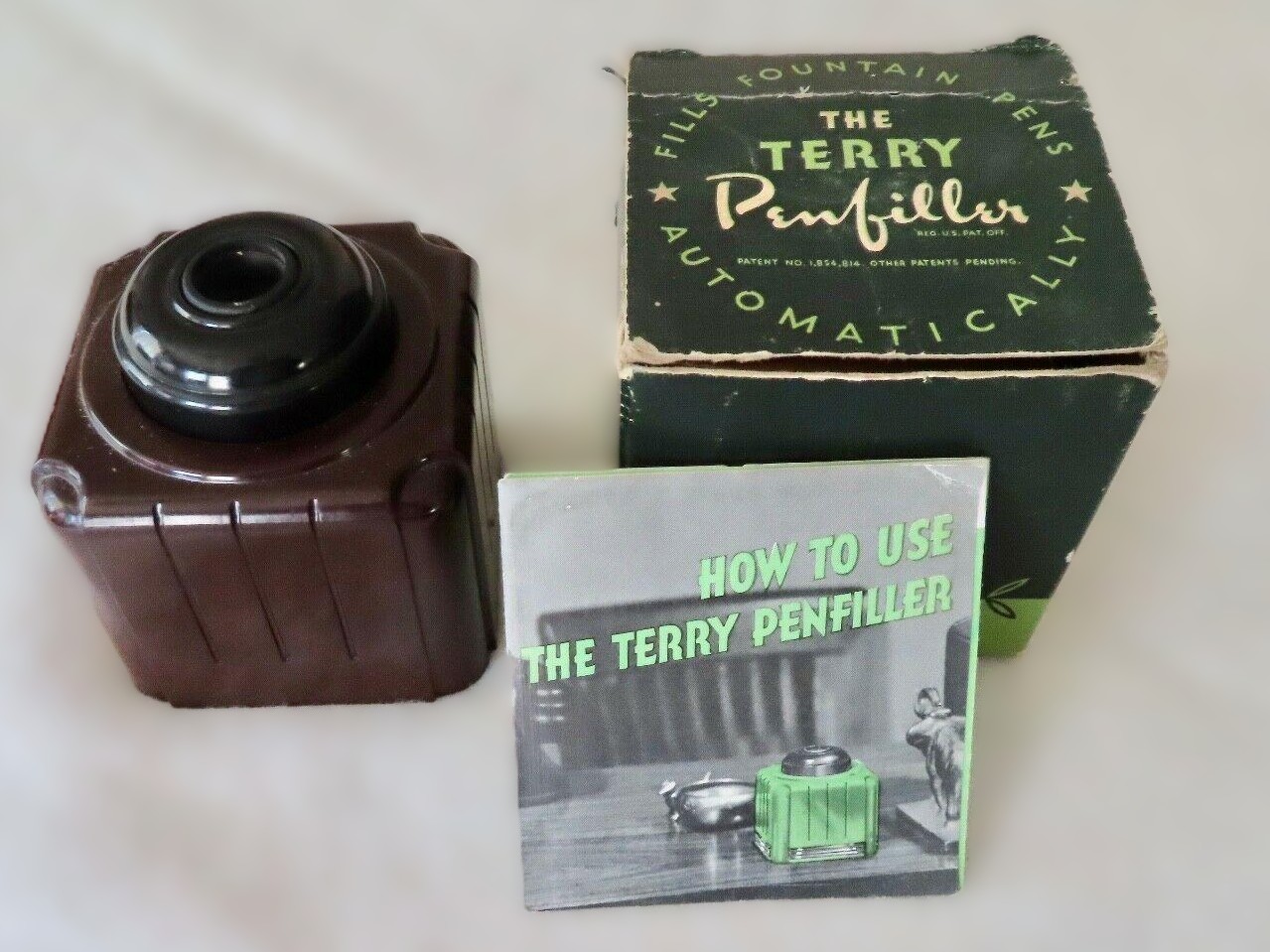
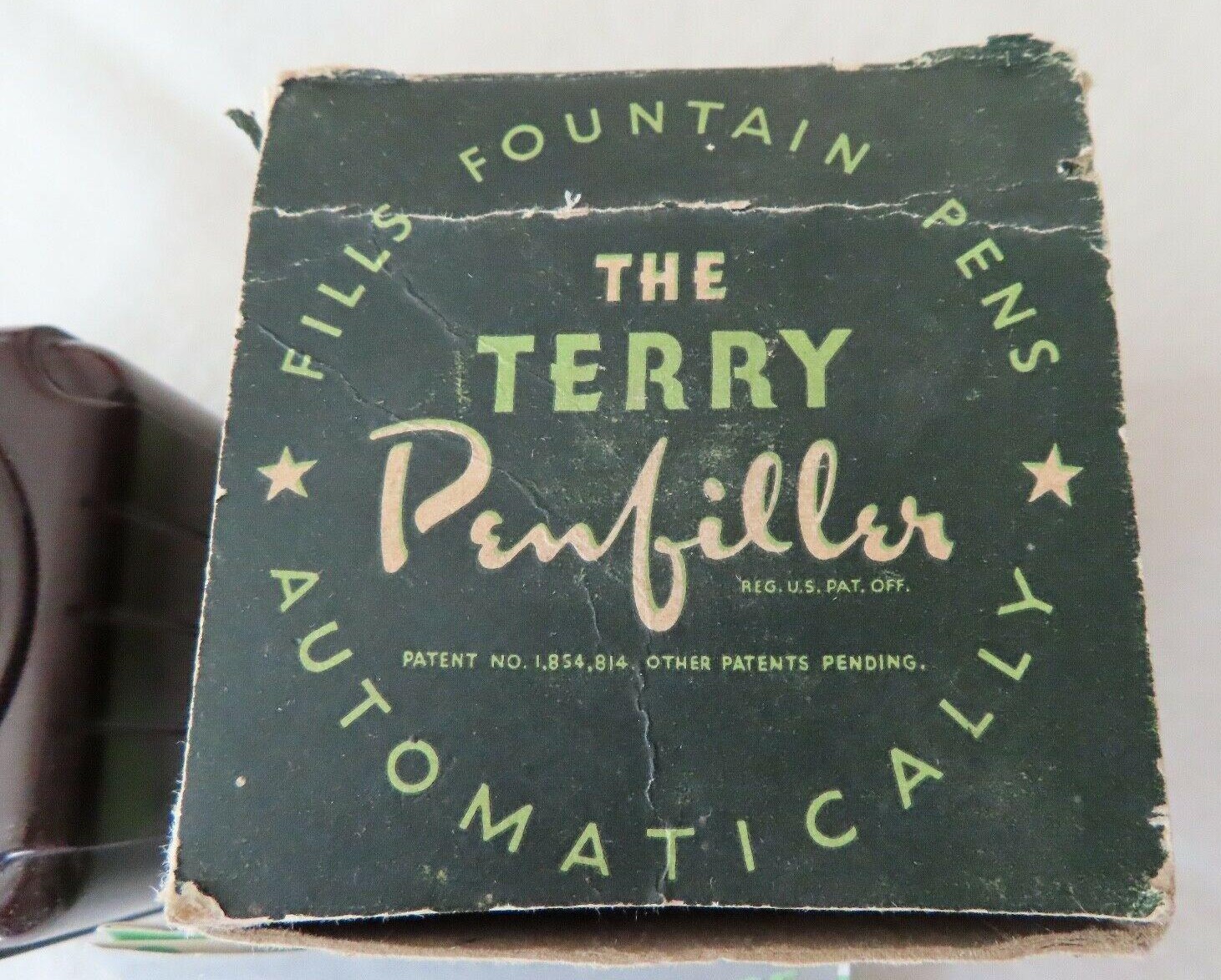
Also pictured here is an original product box with decorative green-and-black packaging, and a fold-out color instructional pamphlet. Paper inserts served as the primary marketing and point-of-sale advertising materials, featuring slogans like “The Terry Penfiller: Fills Fountain Pens Automatically” alongside step-by-step illustrations demonstrating how to insert a pen nib cleanly without getting ink on one’s fingers.
These sell in the $25 range. The pastel green model sold for $75 in December 2013.
Content disclaimer. The information posted is the owner’s best knowledge and may not have been vetted by the SOIC. We welcome comments, corrections, and additions, working to make our website information comprehensive and accurate.
Join the Society of Inkwell Collectors (SOIC) – it’s free!
Founded in 1981 as a non-profit organization,
we are documenting inkwells (and accessories).
We’re here to help and inform!