


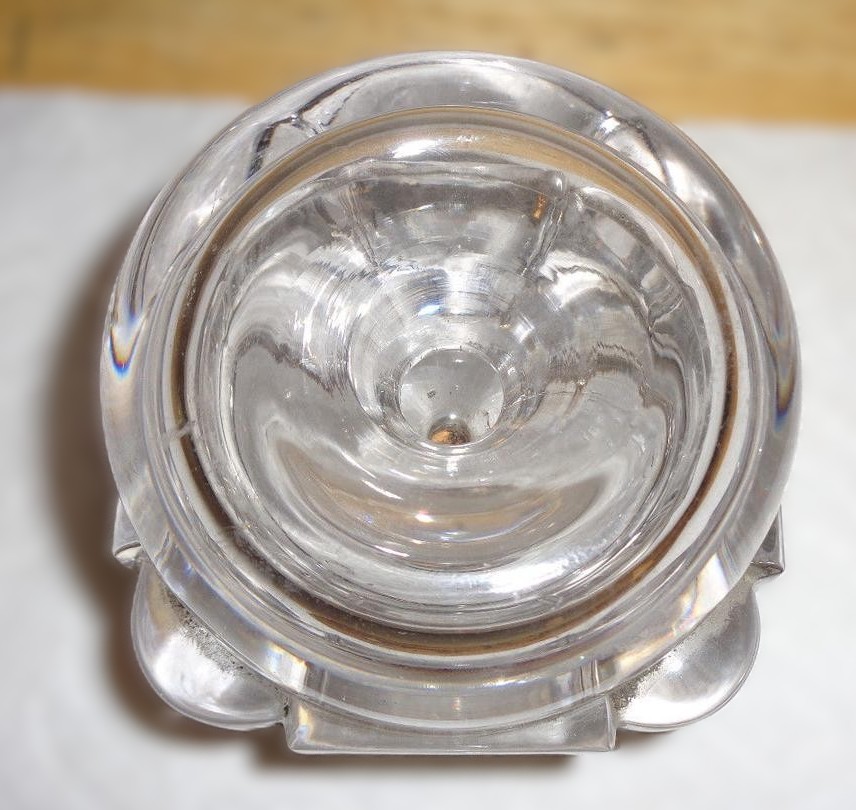


The “Safety” Inkstand
| Categories | Glass - Non-figural |
| Material | Glass |
| Markings | See narrative |
| Manufacturer | Undetermined |
| Origin | United States |
| Date or Era | circa 1876 |
| Measuring | 2 ¾” x 2 ¾” x 2 ½” high |
| Patent | multiple patents - see narrative |
This is a pressed glass “Safety” inkstand, a popular style of office equipment designed to prevent ink from spilling if tipped over and to reduce evaporation. The “Safety” name was a specific trade name used by several stationers, most notably associated with the designs of Samuel Darling and marketed by firms like Darling, Brown & Sharpe (of Providence, RI).
The Patents: Fitting the Puzzle Together
The patents marked on the inkstand belong to three different people. This is a common situation in 19th-century manufacturing where a company (the manufacturer) would buy or license multiple patents from different inventors to create a single “perfected” product.
Here is the breakdown of the three patents listed on this inkstand:
- Patent No. 53,729 (April 3, 1866):
- Inventor: Samuel Darling (of Bangor, Maine).
- The Invention: “Improvement in Inkstands.” This is the foundational patent. Darling invented a mechanism with a “dipping cup” and a “sediment trap” (a cavity below the cup to catch sludge so it wouldn’t get on the pen). It also described a way to regulate the ink level.
- Role: This patent provides the core “Safety” functionality – the internal shape that keeps ink fresh and clean.
- Patent No. 126,348 (April 30, 1872):
- Inventor: Thomas S. Hudson or George H. Mason. (Patents for “Improvement in Inkstands” were issued to both around this time, often focusing on the glass casing or the specific hinge/lid mechanism).
- Role: This patent improved the construction—making it easier to manufacture out of pressed glass rather than the complex metal-and-glass of Darling’s original design.
- Patent Reissue No. 7,406 (November 28, 1876):
- Inventor: This is a Reissue Patent, meaning it corrected or expanded on an earlier patent. It was issued to Samuel Darling or Joseph N. B. Bond (who had related patents reissued in 1876).
- Role: Reissues were often used to strengthen the legal protection of a popular product. By 1876, the “Safety Inkstand” was a best-seller, and the manufacturer wanted to ensure no one could copy their specific funnel/trap design.
How They Fit Together
These three men (Darling and the subsequent improvers) likely assigned their rights to a single manufacturer, such as Darling, Brown & Sharpe (later Brown & Sharpe, famous for precision tools) or a large stationer like Carter, Dinsmore & Co. (who acted as agents for “Safety Inkstands” on the Pacific Coast).
The inkstand pictured is the result of this collaboration:
- Darling (1866) provided the internal science (the sediment trap).
- The 1872 Inventor provided the manufacturing method (pressed glass body).
- The 1876 Reissue protected the final design.
History of the “Safety Inkstand”
- The Problem: In the mid-19th century, ink evaporated quickly, turning into sludge. If you knocked over an inkwell, it ruined your documents (and your desk).
- The Solution: The “Safety” inkstand used a funnel-shaped dipping cup. You only dipped your pen into a small amount of ink. If the stand was knocked over, the ink would get trapped inside the wide shoulders of the glass block rather than spilling out.
- Success: These inkstands were massive sellers. Advertisements from 1878 boast “150,000 SOLD” and claim that “when you are not using, you turn it upside down” to keep the ink fresh. They became a standard fixture in schools, banks, and offices until the fountain pen took over in the early 20th century.
Sold for $60 in November 2025
Content disclaimer. The information posted is the owner’s best knowledge and may not have been vetted by the SOIC. We welcome comments, corrections, and additions, working to make our website information comprehensive and accurate.
Join the Society of Inkwell Collectors (SOIC) – it’s free!
Founded in 1981 as a non-profit organization,
we are documenting inkwells (and accessories).
We’re here to help and inform!