

The Paragon Inkstand
| Categories | Glass - Non-figural |
| Material | Glass, Rubber |
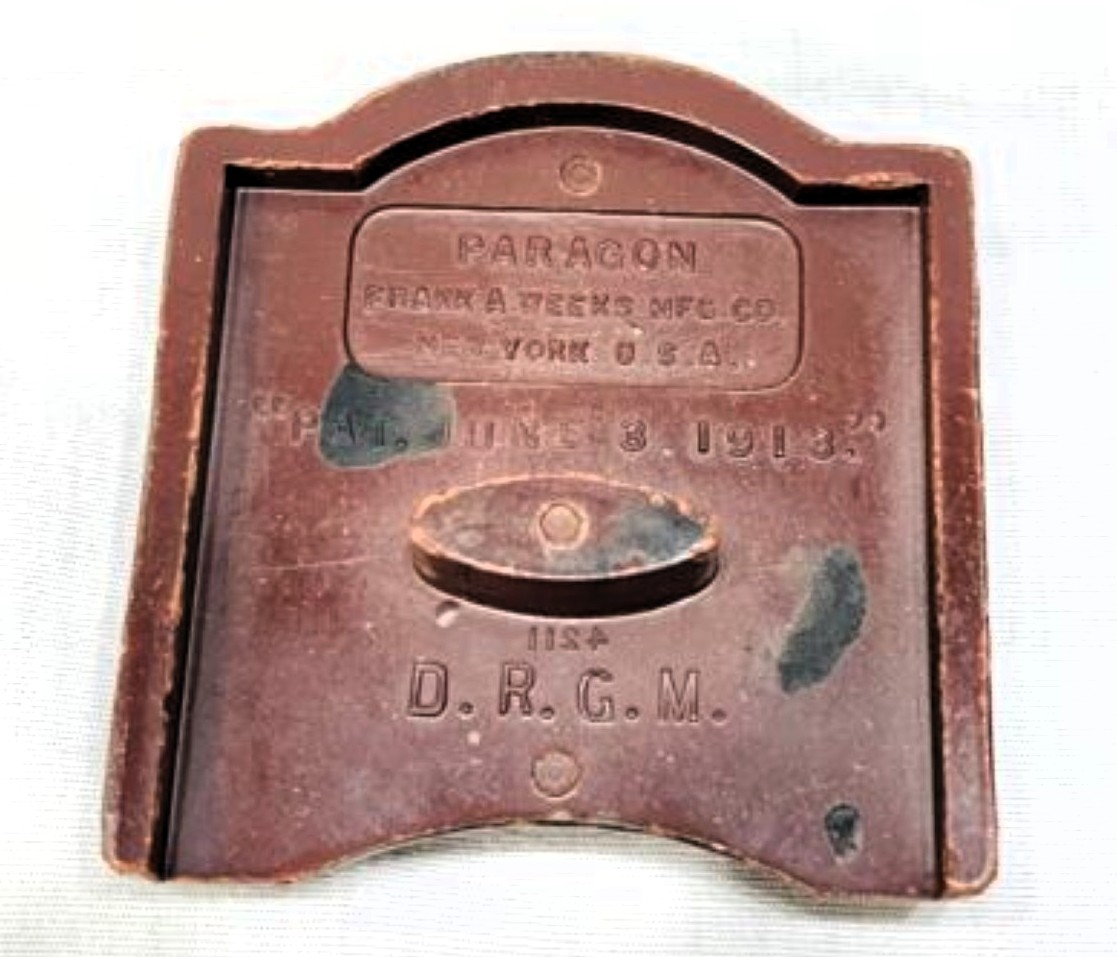
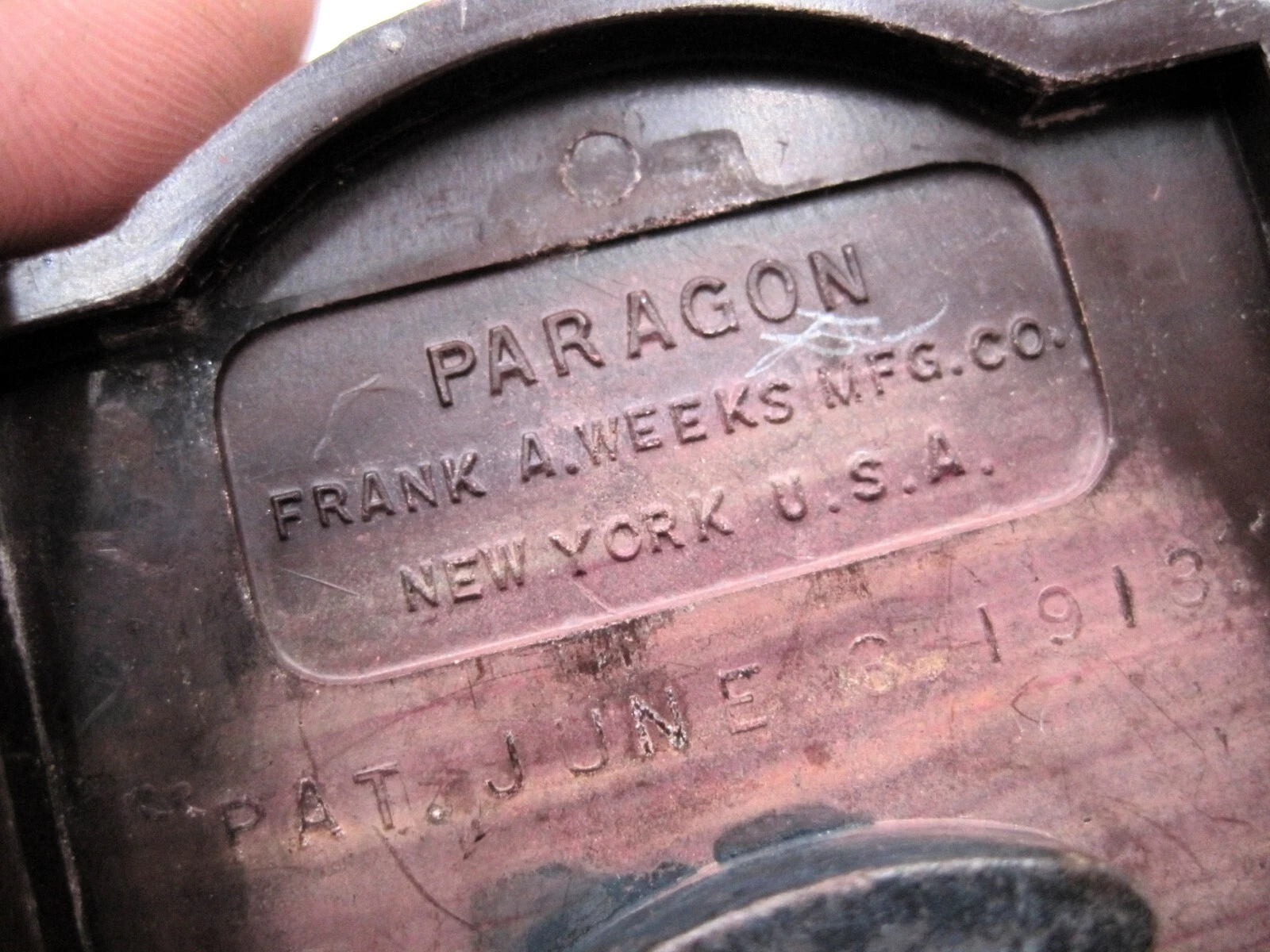
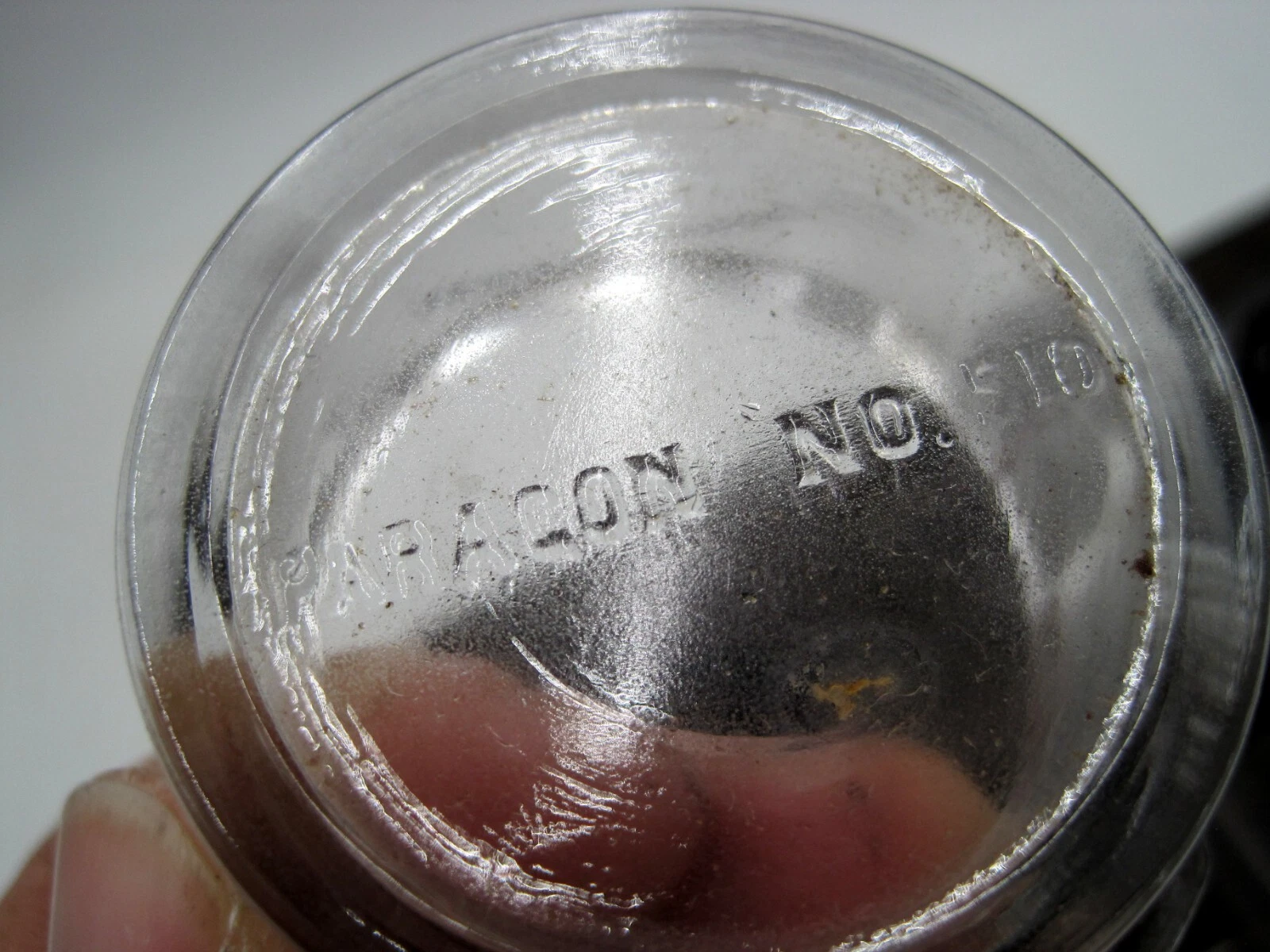
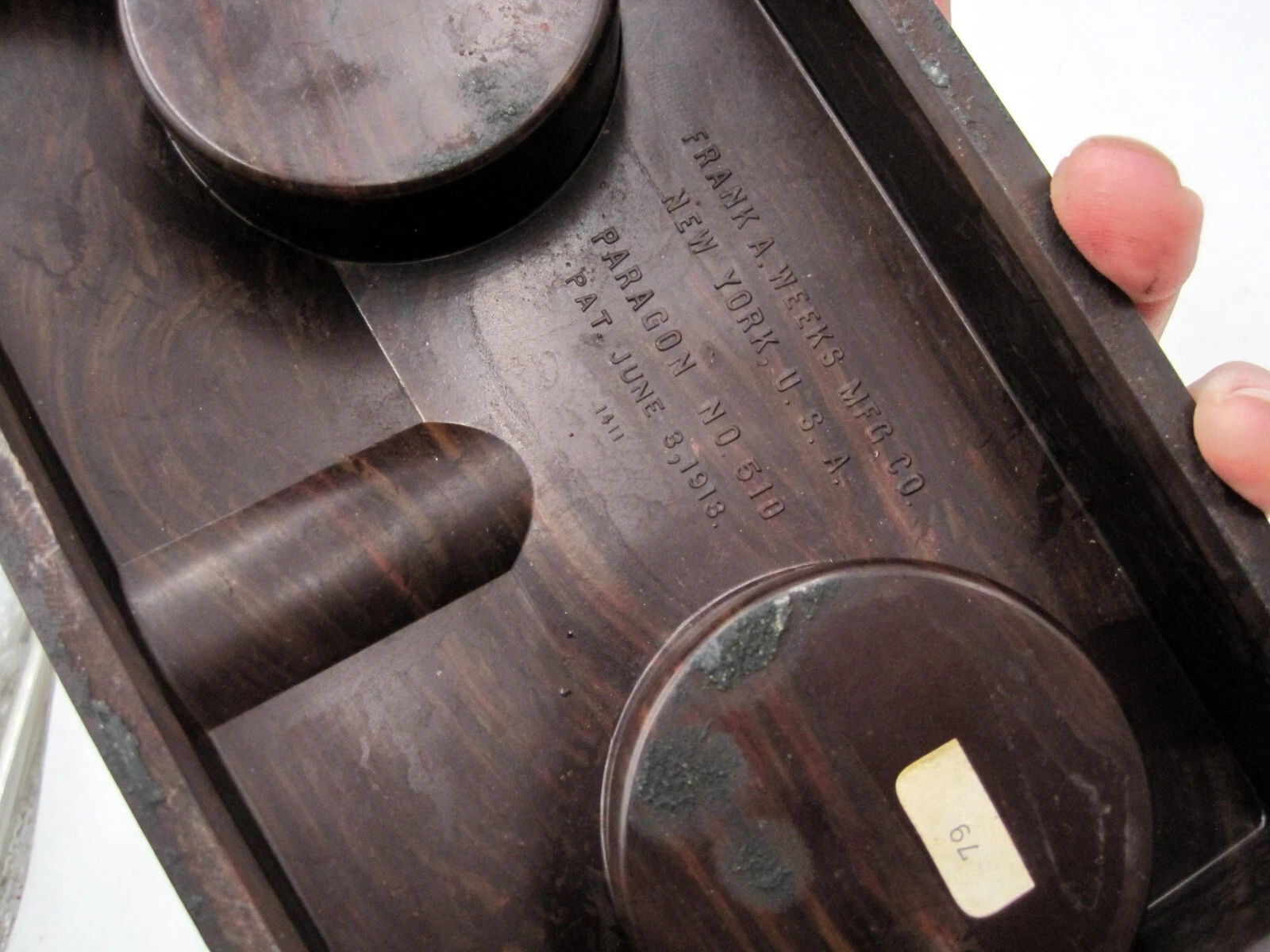
| Markings | See Narrative |
| Manufacturer | Frank A Weeks Mfg Co |
| Origin | United States |
| Date or Era | circa 1913 |
| Measuring | 7 ½” x 5” x 2” high |
| Patent | No. 1,063,630 Patented June 3, 1913 |
Description: The Paragon Inkstand
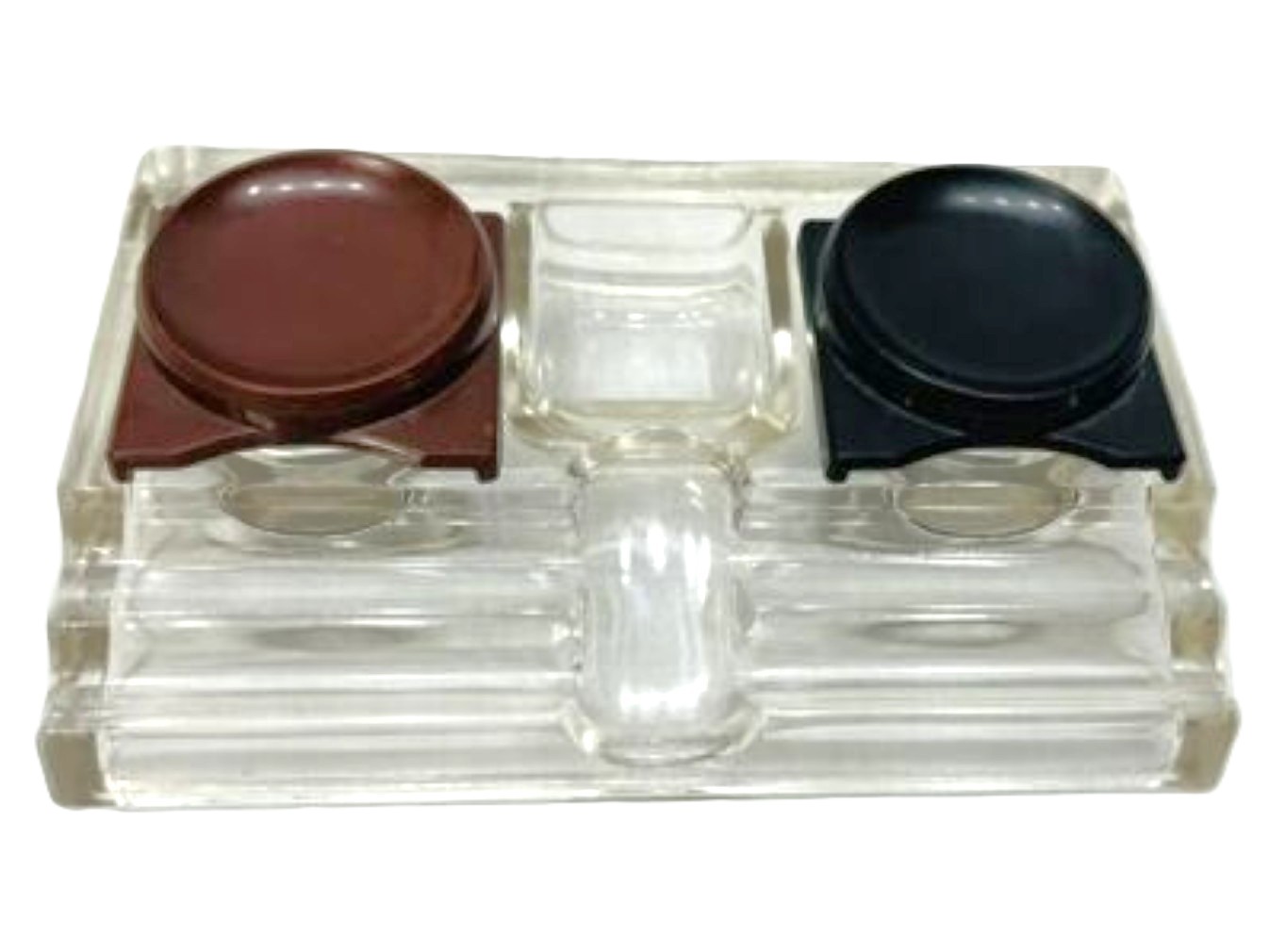
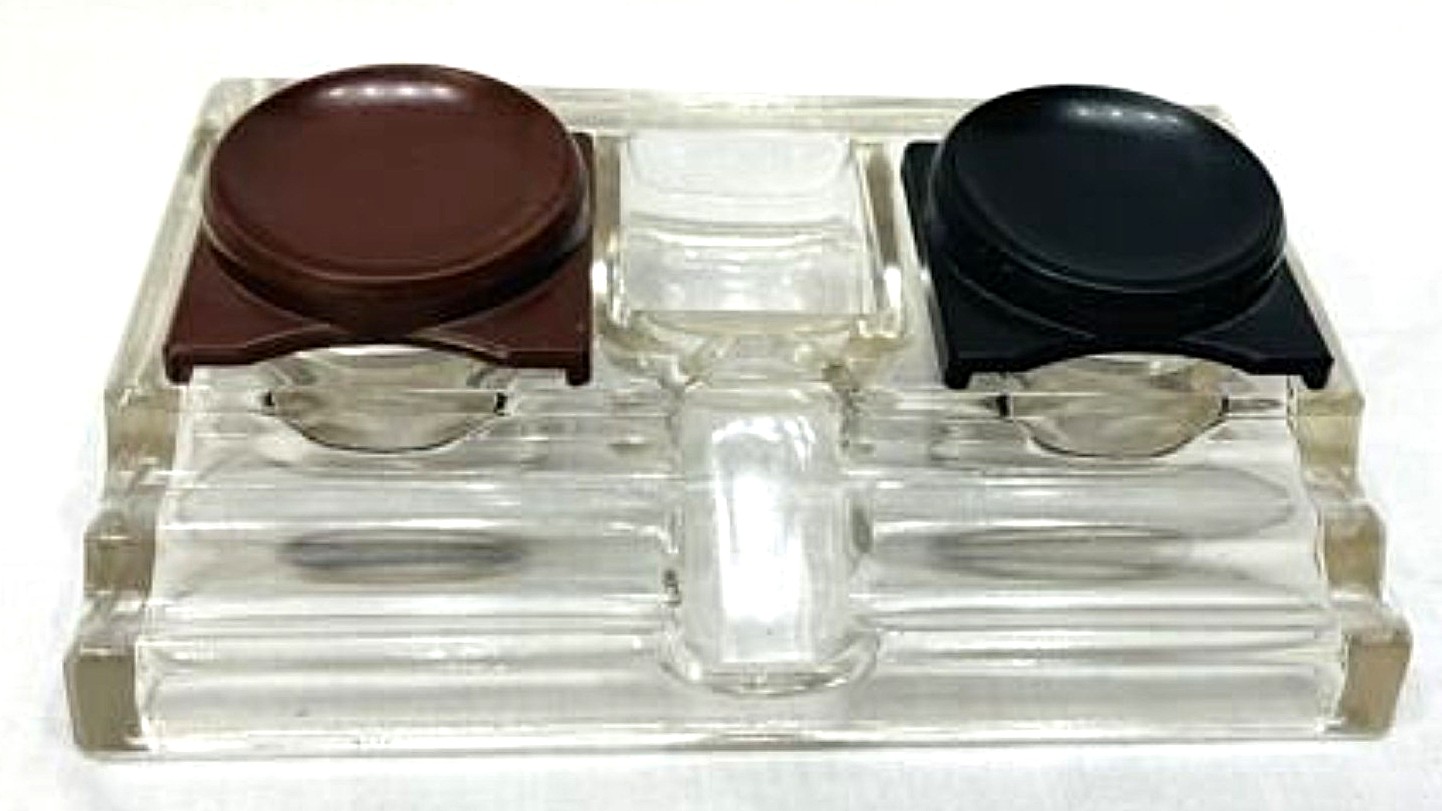
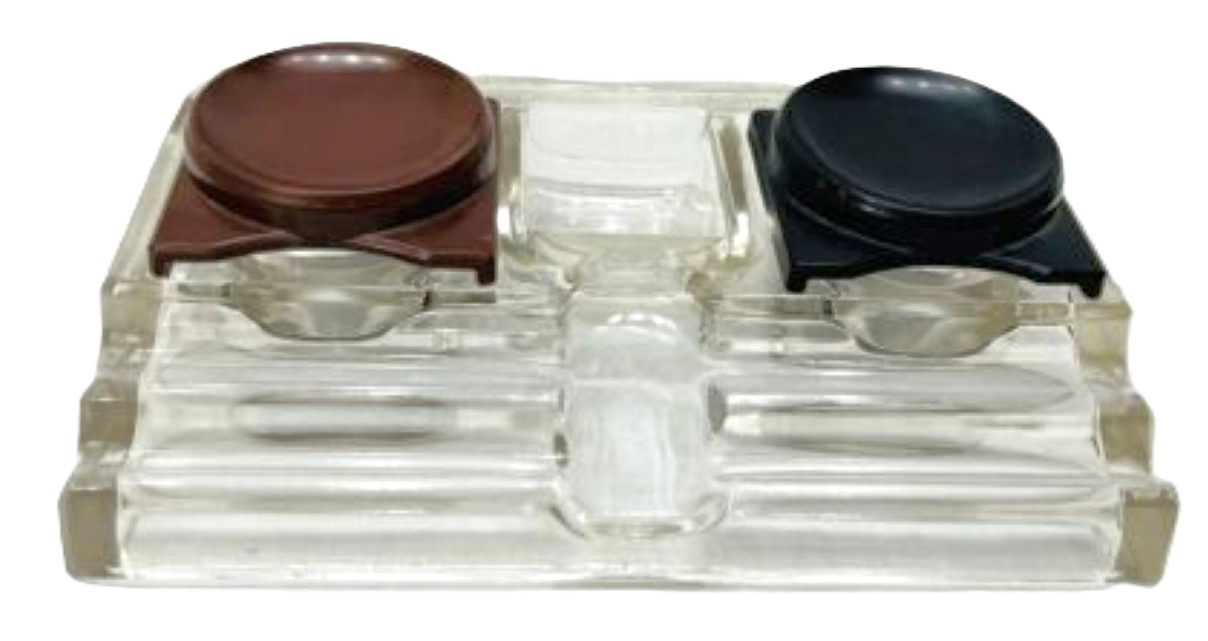
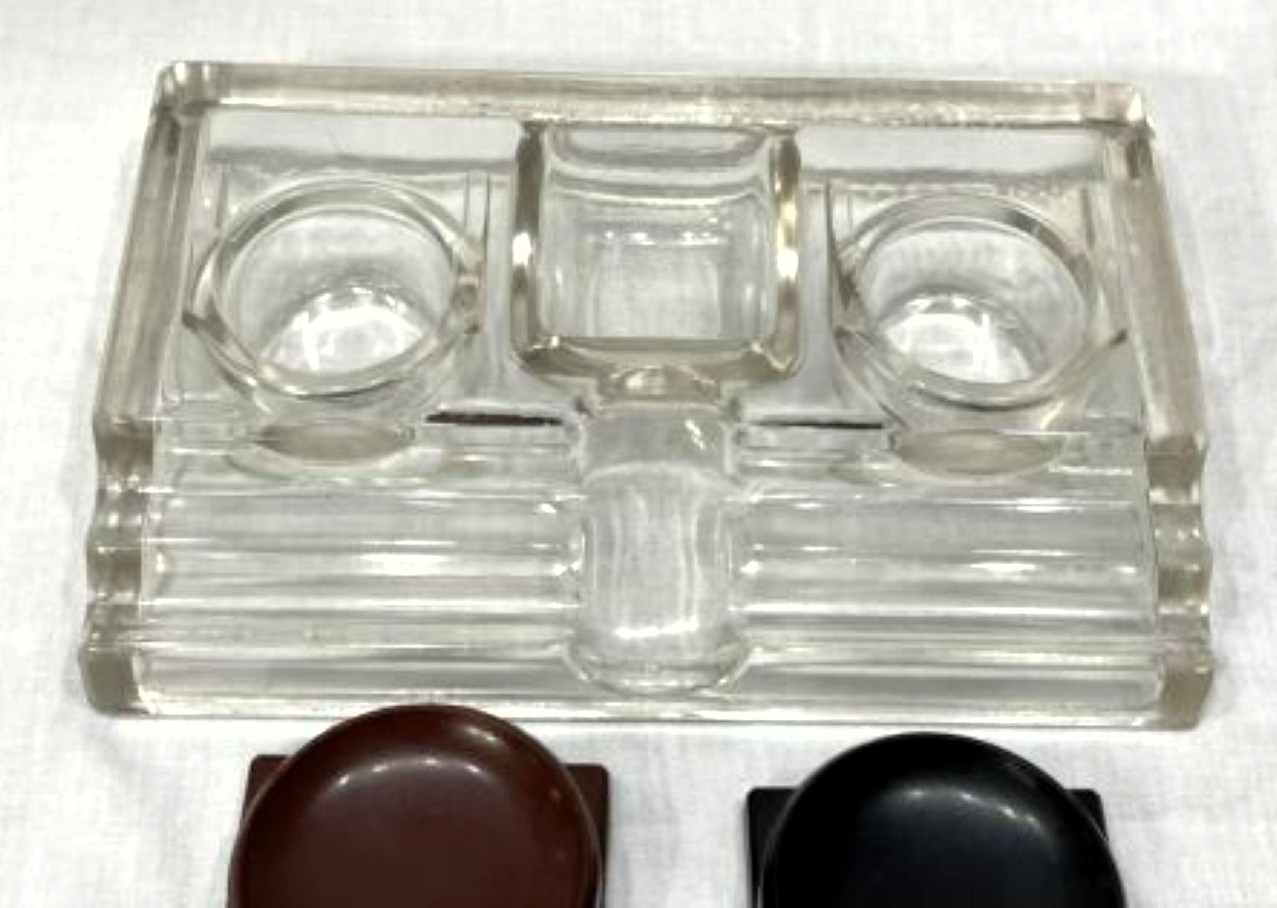
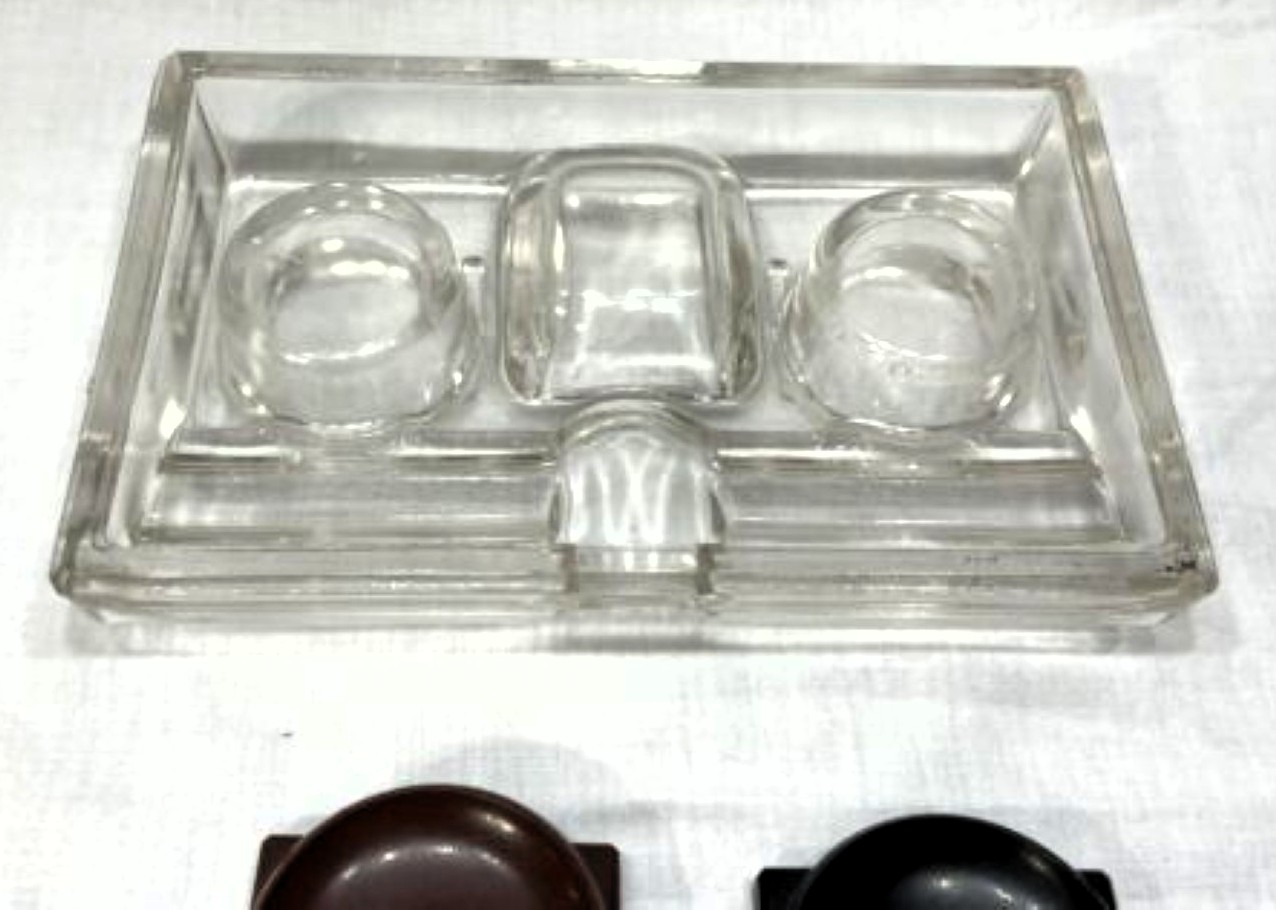
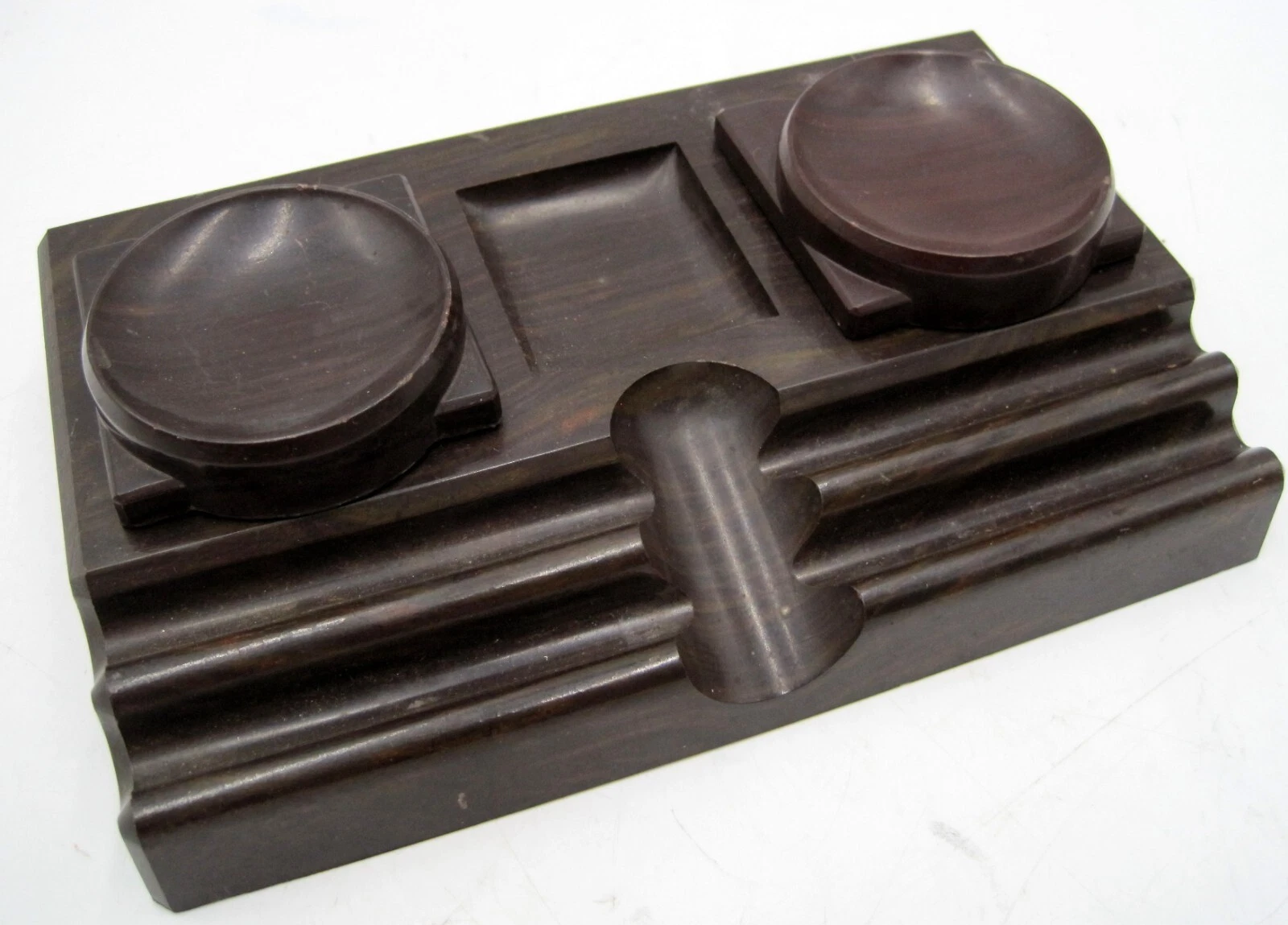
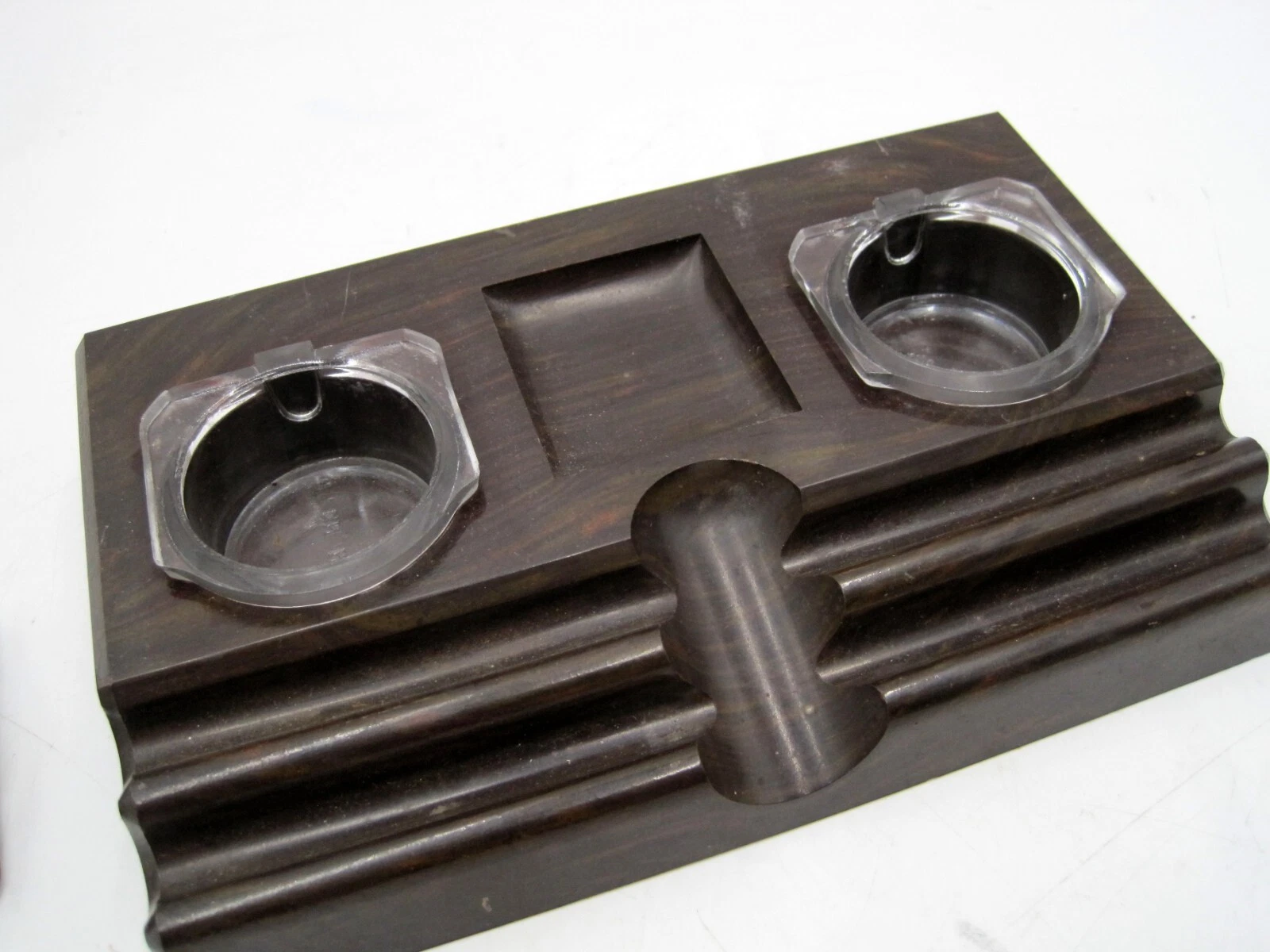
The Paragon Inkstand is a high-utility desk accessory crafted from heavy crystal glass. It features a “prism base” design, which refers to the decorative, light-refracting ridges along the sides and bottom that add elegance to an otherwise functional object.
Key Features:
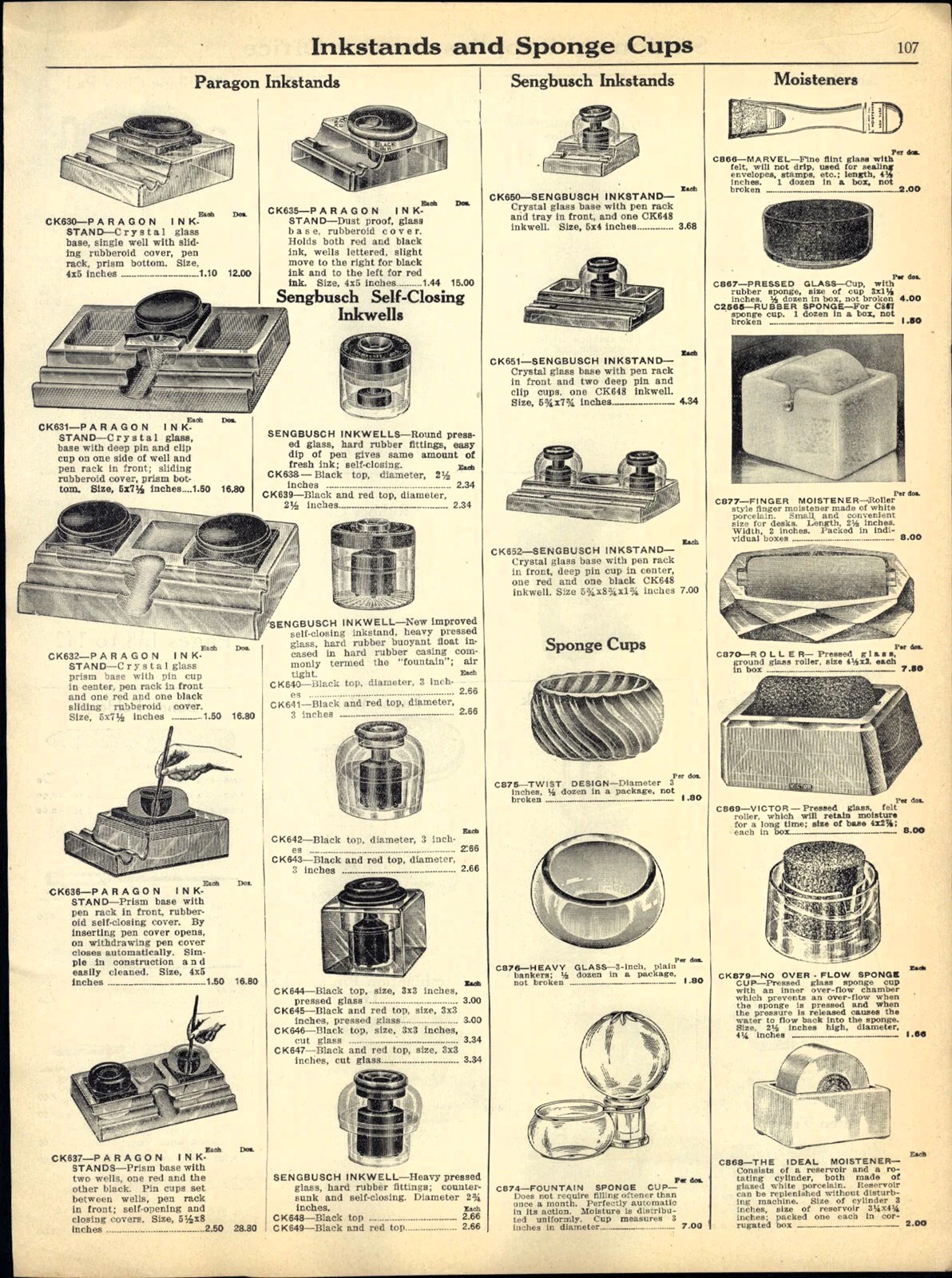
- Ink Wells: Two circular wells designed to hold different colors of ink (typically red and black).
- The Pin Cup: A central, rectangular depression used for holding metal nibs, pins, or paperclips.
- Pen Rack: A scalloped groove running along the front of the base, designed to cradle dip pens.
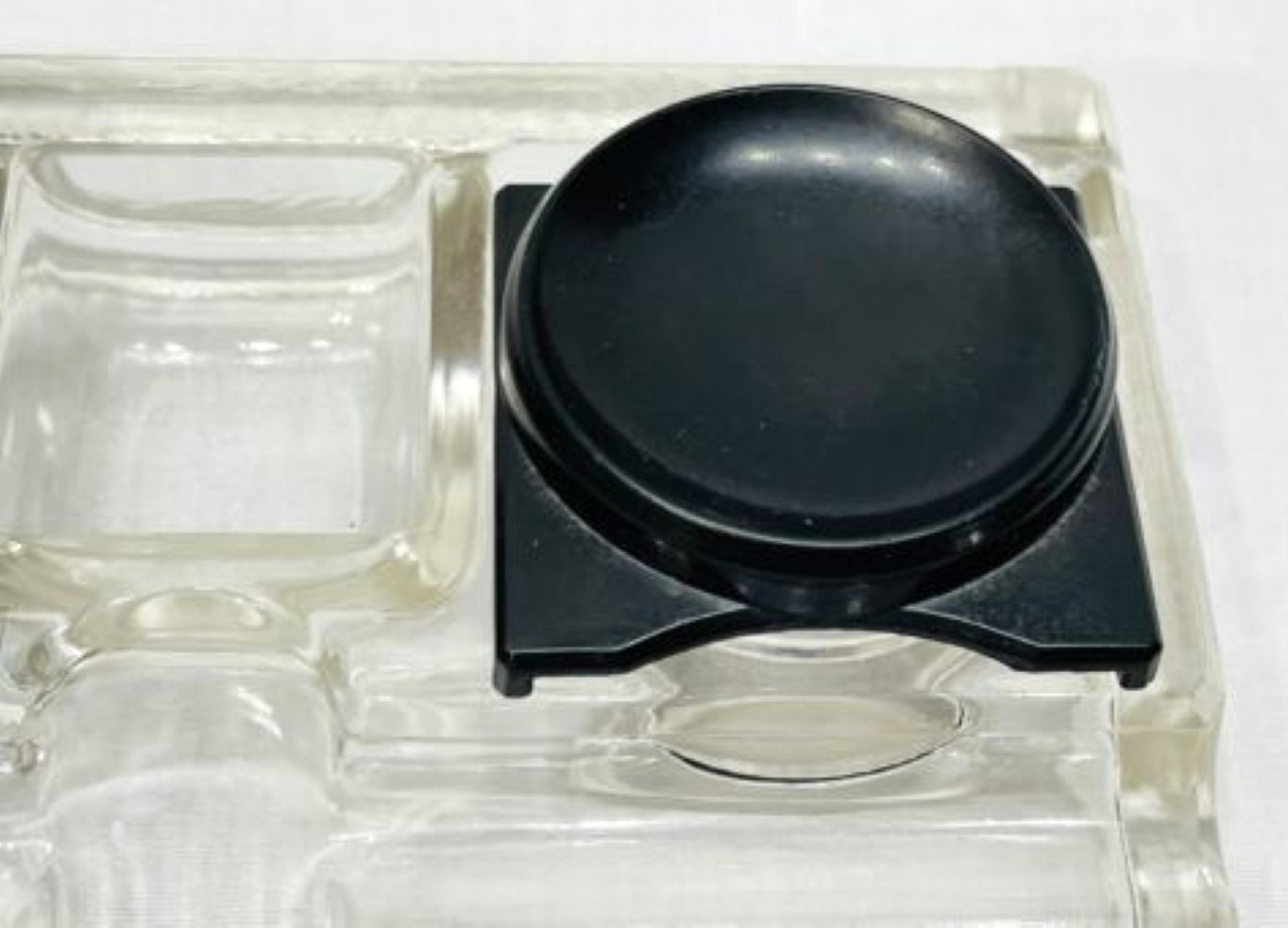
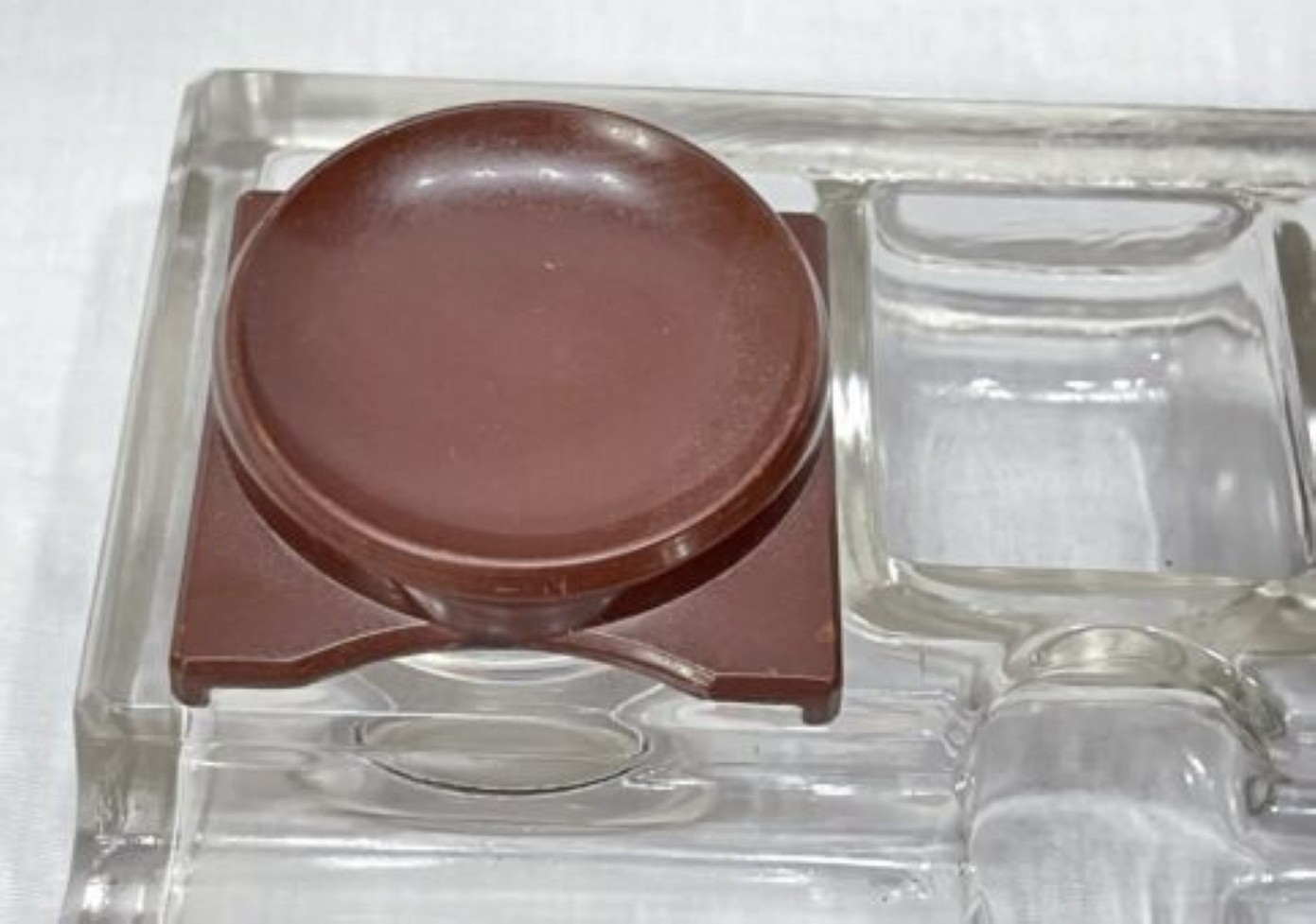
- Sliding Lids: Two “rubberoid” (hard vulcanized rubber, often called Ebonite) covers in reddish-brown and black. These slide backward to reveal the ink and forward to seal the well from dust and evaporation.
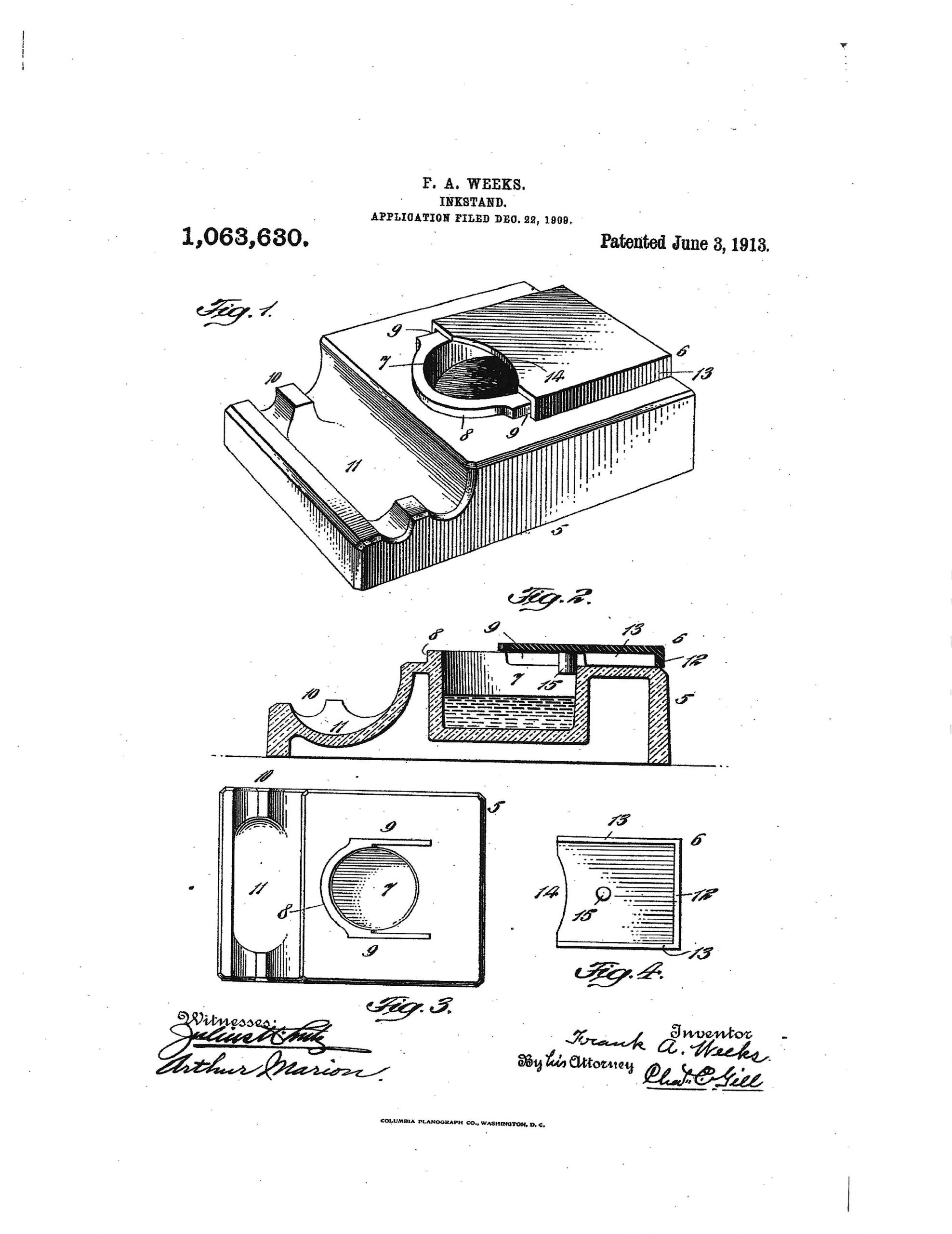
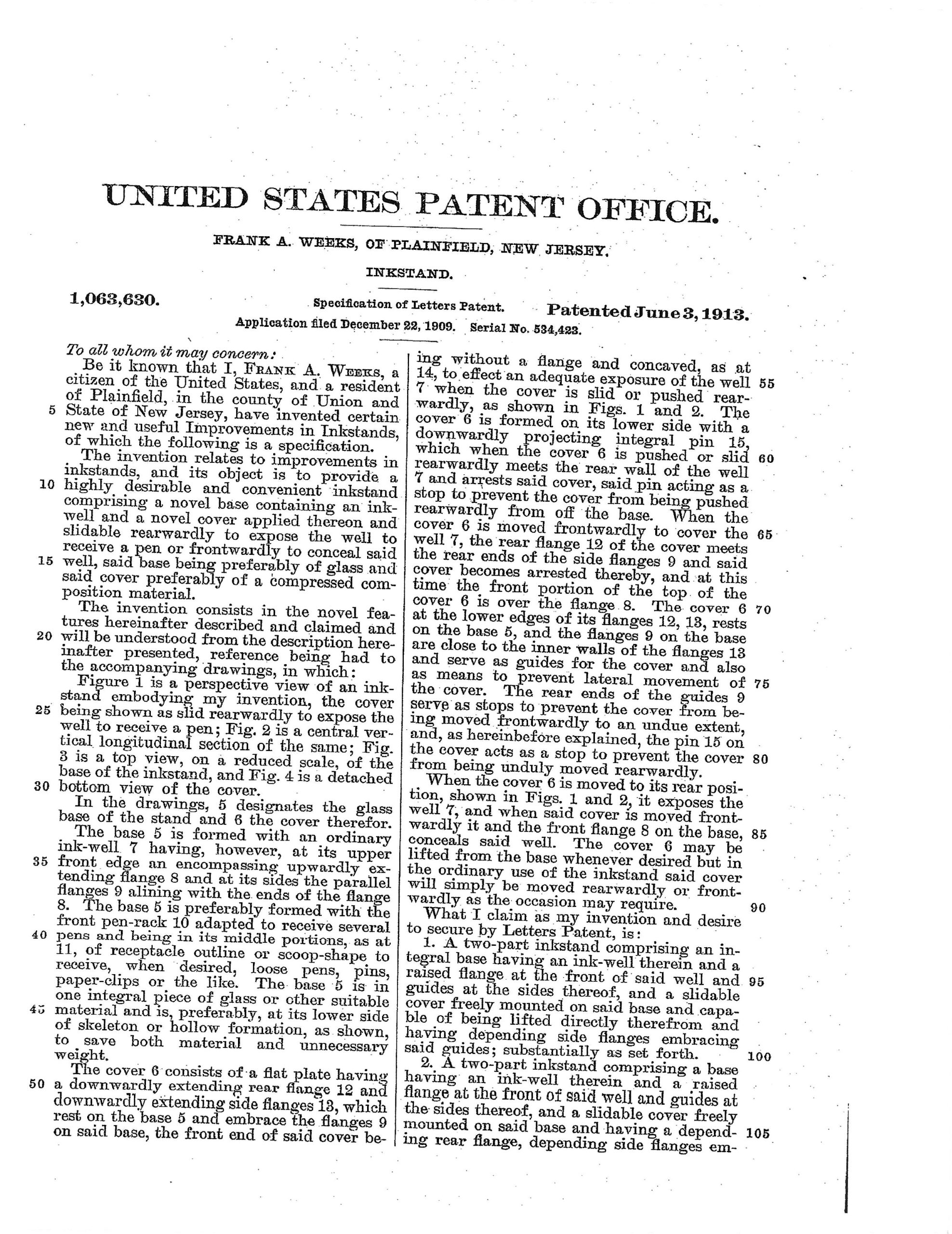
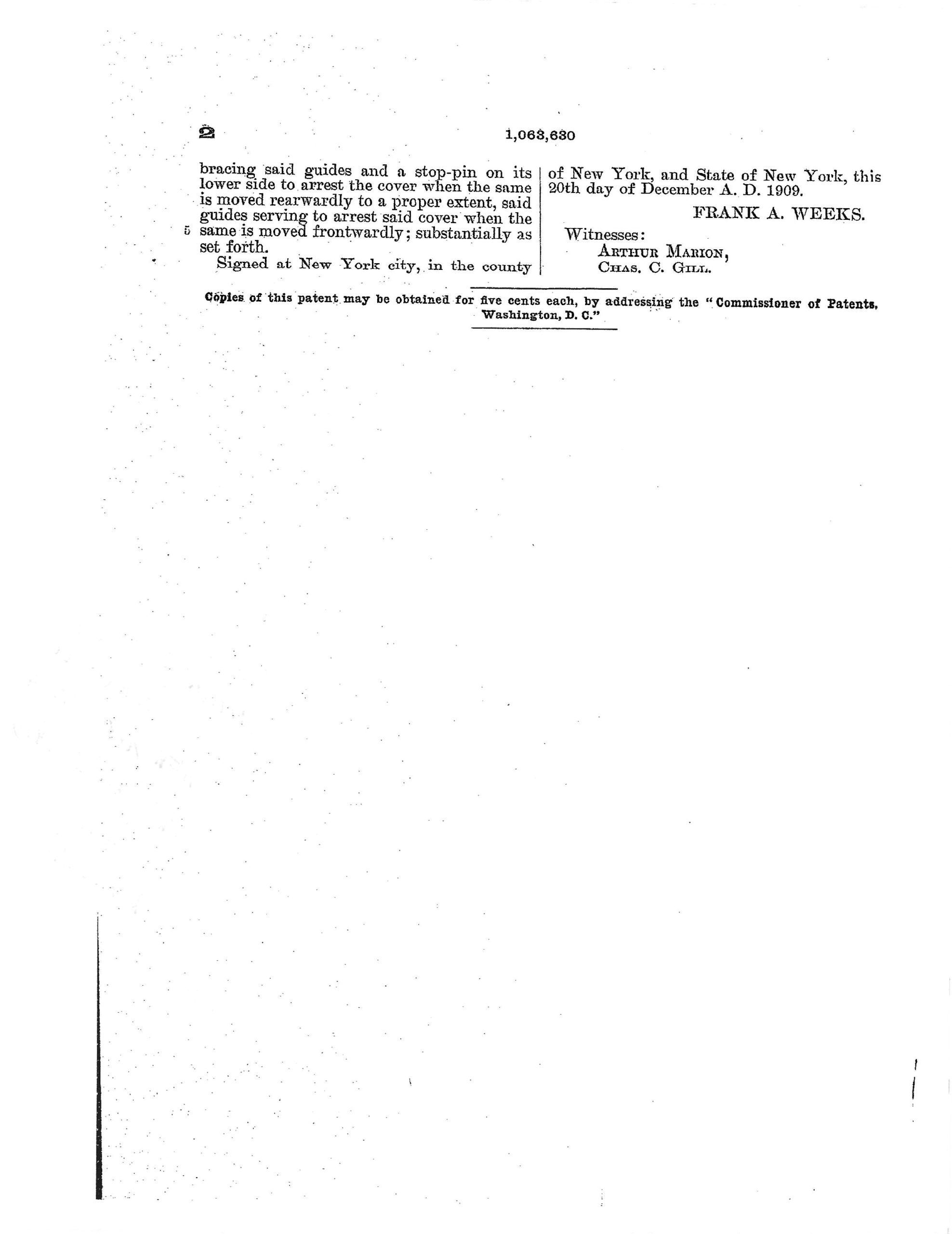
US Patent #1,063,630 (June 3, 1913)
The patent filed by Frank A. Weeks covers the specific mechanics of the sliding lid system. While inkstands existed for centuries, they often suffered from lids that fell off, got lost, or didn’t seal well.
The Patented Improvement
Weeks’ invention focused on a self-arresting sliding cover.
- Guided Movement: The glass base features raised “flanges” (guides) that the rubber lid grips. This ensures the lid moves in a straight line and cannot be easily knocked off sideways.
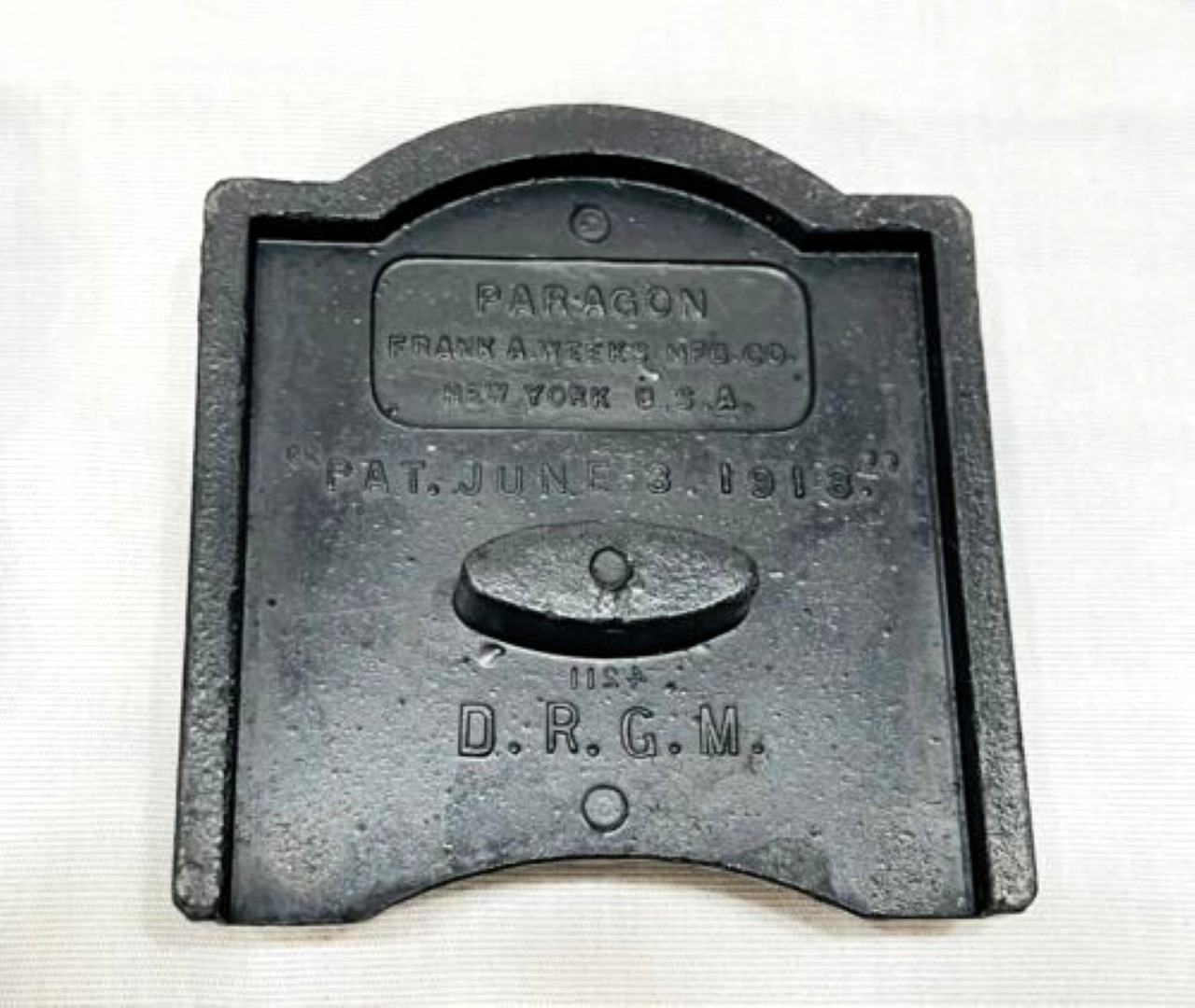
- The Stop-Pin: On the underside of the lid, there is a small projecting pin. This pin strikes the back of the glass well when you slide it open, preventing the lid from sliding completely off the back of the stand.
- The Goal: To create a “dust-proof” environment for the ink that could be operated with one hand while holding a pen in the other.
What does D.R.G.M. stand for?
The “D.R.G.M.” mark on the underside of the lids is significant. It stands for:
Deutsches Reichs-Gebrauchsmuster > (German Reich Registered Design)
This was a “petty patent” or design copyright used in Germany between 1891 and 1945. Its presence indicates that the Frank A. Weeks Mfg. Co. either exported these to Germany or, more likely, registered the design there to protect their intellectual property in the European market. It confirms the global reach of New York stationery manufacturers during this era.
Inventor & Manufacturer
The Inventor: Frank A. Weeks
Frank A. Weeks was a prominent figure in the New York stationery trade. Based in Plainfield, New Jersey, he was a prolific inventor of office “specialties.” Beyond inkstands, he held patents for various desk calendars, paper weights, and clips. He was known for merging aesthetic glasswork with practical mechanical improvements.
The Manufacturer: Frank A. Weeks Mfg. Co.
Located in New York City, this company was a powerhouse in the early 1900s office supply world. They produced a wide range of “Paragon” branded items. They didn’t just make inkstands; they were innovators in the “Stationery Specialty” niche, often featured in trade journals like American Stationer.
The history of the Paragon brand is a fascinating window into the “Golden Age” of American office supplies, particularly the era of the Frank A. Weeks Manufacturing Company of New York.
The Origins: A.A. Weeks to Frank A. Weeks
The brand’s roots lie in the late 19th century with the A.A. Weeks Manufacturing Company. Frank A. Weeks served as the president of this firm and was a well-known figure in the New York stationery trade, even serving as the treasurer for the Ring Paper Clip Company. By the early 1900s, the company transitioned to the Frank A. Weeks Mfg. Co., establishing its headquarters at 93 John Street in Manhattan. This location was part of New York’s “Stationery Row,” a hub for manufacturers of pens, paper, and desk accessories.
The “Paragon” Identity
The name “Paragon” was chosen to signify the “highest model of excellence.” It was the company’s premier trademark for its line of “Stationery Specialties.” While this inkstand is a primary example, the brand encompassed a wide range of high-end desk products:
- Inkstands: Their most famous products, including the 1913 patented sliding-cover models and “prism base” crystal stands.
- “Rubberoid” Specialties: They were pioneers in using vulcanized rubber (often called rubberoid or ebonite) for inkwell covers and pen racks because of its durability and resistance to ink corrosion.
- Marbleized Goods: Later in the 1920s and 30s, the Paragon brand expanded into “marbleized” desk sets made from early plastics and marble-effect glass, often marked as “Paragon No. 110” or “No. 410.”
Market Dominance and Innovation
Frank A. Weeks was a prolific inventor who held dozens of patents. The company thrived by solving small but persistent office problems—like ink drying out or lids getting lost. Their catalogs, such as the widely cited 1912 “Inkstands, Stationers’ Supplies and Specialties” volume, featured hundreds of items that were considered essential for a modern, efficient office.
The brand’s international presence is evidenced by the D.R.G.M. registration marks on many items. This shows that the company actively registered its designs in Germany to protect its intellectual property in the European market, a sign of its significant commercial reach.
The Decline and Legacy
The Frank A. Weeks Mfg. Co. remained a staple of the industry for decades, with records and catalogs appearing as late as the mid-1950s. However, the decline of the brand mirrored the decline of the dip pen. As fountain pens with internal reservoirs and later ballpoint pens became the standard, the large, ornate glass inkstands that defined the Paragon name became obsolete for daily use.
Sold for $68 in January 2026
Paragon #510 (pictured) sold for $100 in June 2026
Content disclaimer. The information posted is the owner’s best knowledge and may not have been vetted by the SOIC. We welcome comments, corrections, and additions, working to make our website information comprehensive and accurate.
Join the Society of Inkwell Collectors (SOIC) – it’s free!
Founded in 1981 as a non-profit organization,
we are documenting inkwells (and accessories).
We’re here to help and inform!