

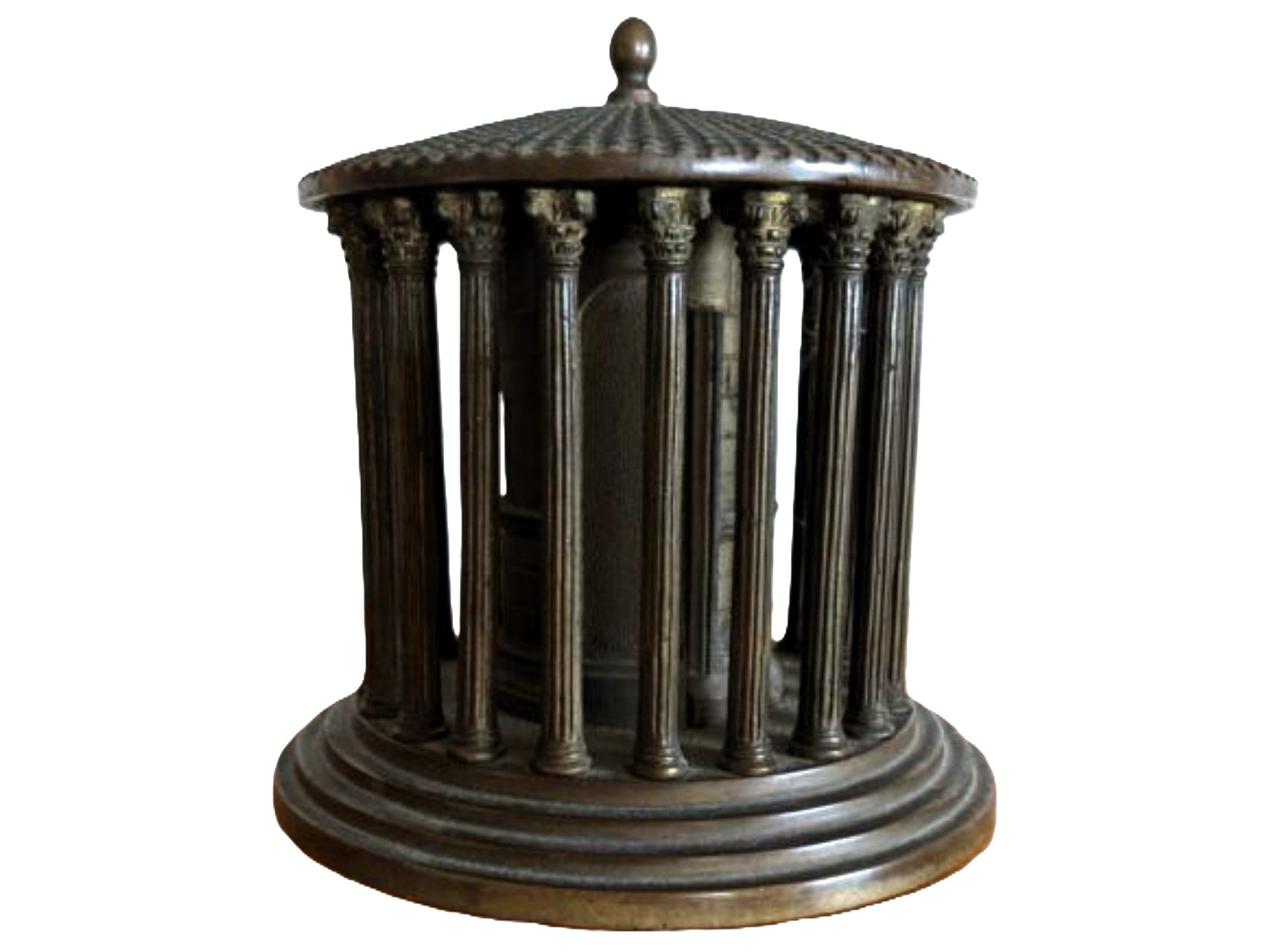

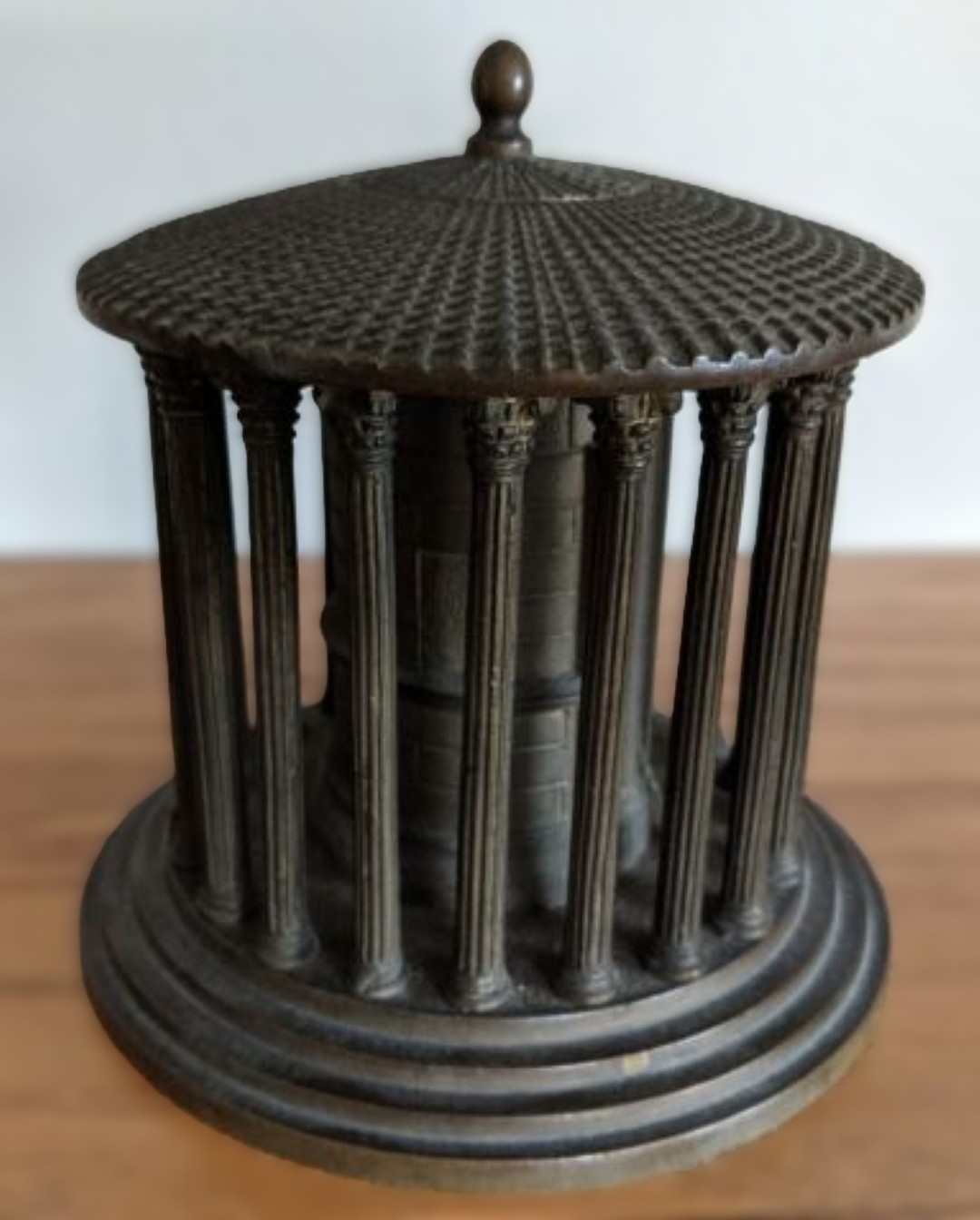
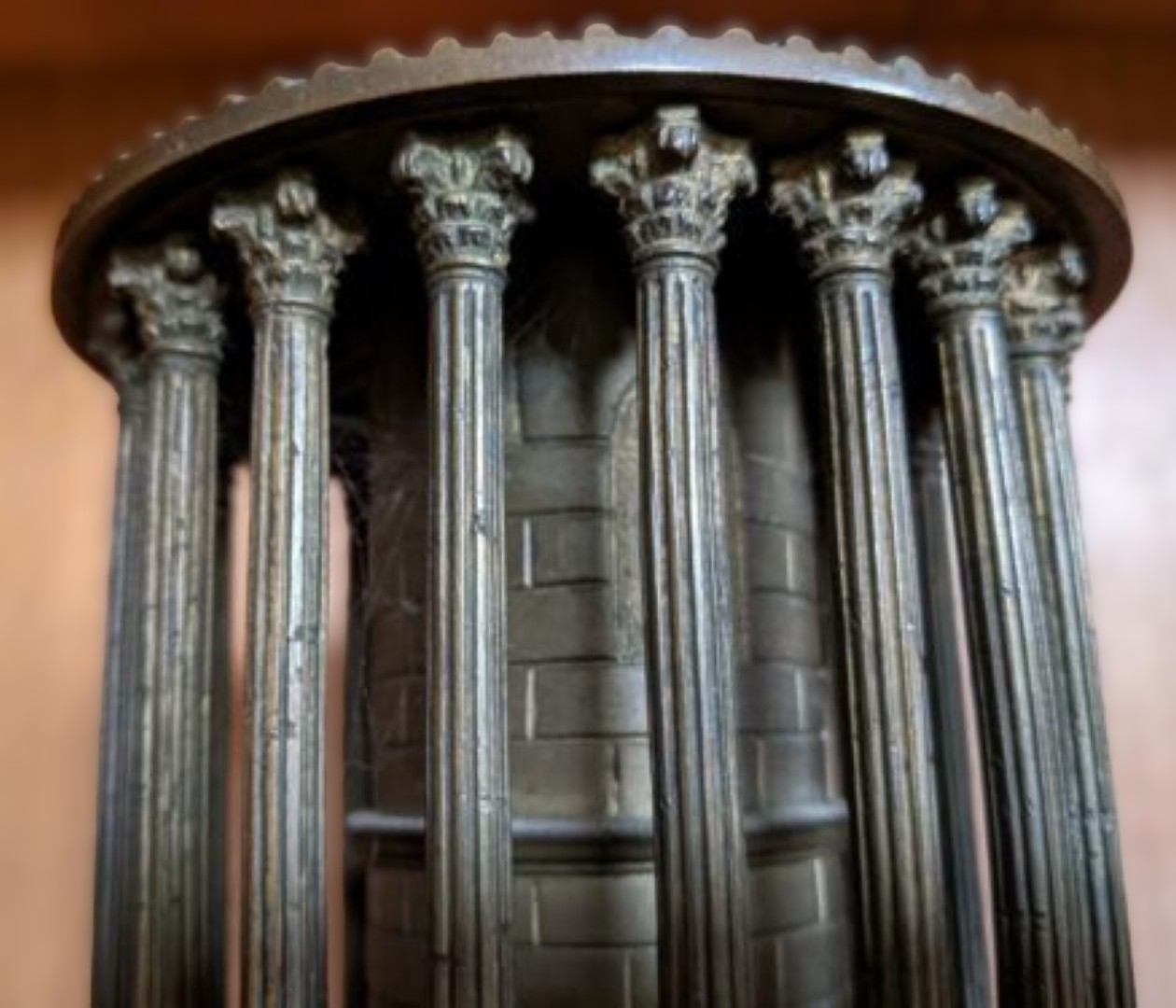

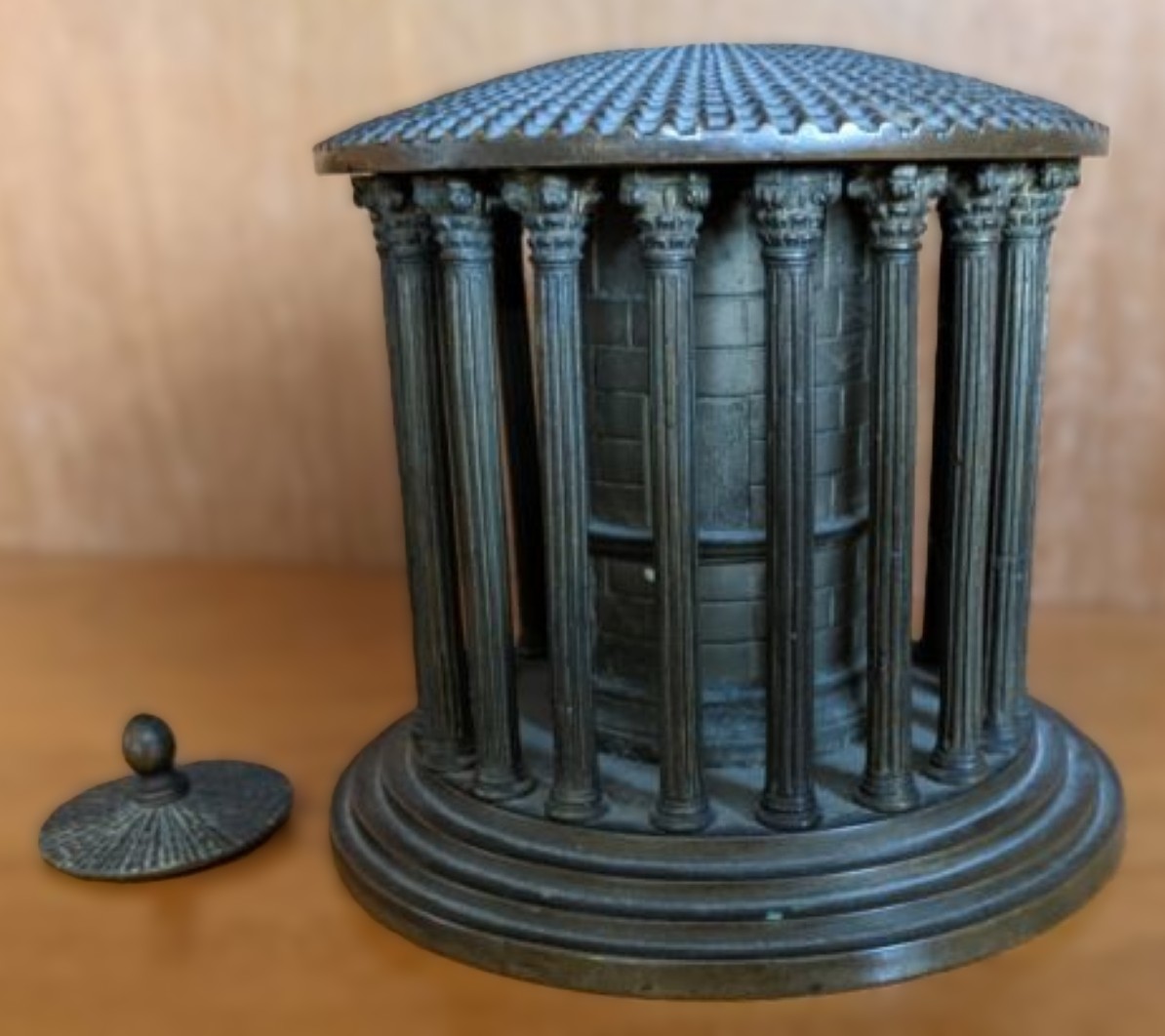


Temple of Vesta – A Grand Tour Souvenir
| Categories | Figural - Inanimate, Souvenir |
| Material | Bronze |
| Markings | Unmarked |
| Manufacturer | Undetermined |
| Origin | Italy |
| Date or Era | circa 1870 |
| Measuring | 5” diameter; 5” high |
This model is of the Temple of Vesta, one of the most recognizable ruins of ancient Rome.
Description of the Inkwell
- Form: The inkwell is a detailed miniature of a classical Roman tholos (circular temple). The bronze structure faithfully reproduces the cylindrical cella (inner chamber) surrounded by a ring of columns.
- Material: It is made of bronze.
- Inkwell Function: The center of the roof of the miniature temple is designed to lift off, revealing a cavity that holds the ink.
- Style: This piece embodies the Neoclassical taste that flourished from the mid-18th century through the 19th century, reflecting a reverence for classical antiquity.
The Grand Tour (c. 1660–1840s)
The inkwell is a product of the Grand Tour, a cultural phenomenon that defined the education of wealthy young men (primarily British, but also European and American) from the 17th to the early 19th century.
| Feature | Description |
| Purpose | To complete a young man’s education by exposing him to the art, culture, architecture, and language of continental Europe, solidifying his classical knowledge. |
| Route | The journey typically began in England, traveled through France (stopping in Paris), crossed the Alps, and culminated in Italy (Florence, Venice, and most importantly, Rome). |
| Souvenirs | Travelers were expected to return with objects that demonstrated their newfound sophistication. These ranged from large crates of antiquities and commissioned paintings (like portraits by Batoni) to more accessible souvenirs like: |
| * Architectural Models: Miniatures in bronze, marble, alabaster, or cork of famous ruins (Colosseum, Pantheon, Temple of Vesta). | |
| * Paintings/Prints: Vedute (views) of Roman ruins by artists like Piranesi or Canaletto. | |
| Decline | The Grand Tour declined in the mid-19th century with the rise of reliable rail travel (making it faster and cheaper and thus losing its aristocratic exclusivity) and political unrest in Europe. |
The Temple of Vesta
The subject of this inkwell is one of the most iconic structures in Rome.
| Aspect | Detail |
| Location | Roman Forum, near the House of the Vestal Virgins and the Regia. (A similar, well-preserved circular temple in the Forum Boarium was long mistaken for the Temple of Vesta but is now identified as the Temple of Hercules Victor—both circular temples were popular Grand Tour models). |
| Deity | Dedicated to Vesta, the Roman goddess of the hearth, home, and family. |
| Architecture | Unique among Roman temples, it has a circular footprint (tholos), believed to honor the design of early Roman huts. The surviving structure consisted of a round podium supporting Corinthian columns. |
| Significance | It housed the Sacred Fire of Vesta, which was tended by the Vestal Virgins. The fire was never allowed to go out, as its extinction was believed to foreshadow disaster for the Roman Empire. The temple also housed the Palladium, a sacred statue believed to have been brought from Troy by Aeneas. |
| Status | It was an important religious site. The circular ruins were easily recognizable and highly evocative of ancient history, making them an ideal subject for a Grand Tour souvenir. |
Sold for $1200 in March 2023
Content disclaimer. The information posted is the owner’s best knowledge and may not have been vetted by the SOIC. We welcome comments, corrections, and additions, working to make our website information comprehensive and accurate.
Join the Society of Inkwell Collectors (SOIC) – it’s free!
Founded in 1981 as a non-profit organization,
we are documenting inkwells (and accessories).
We’re here to help and inform!