

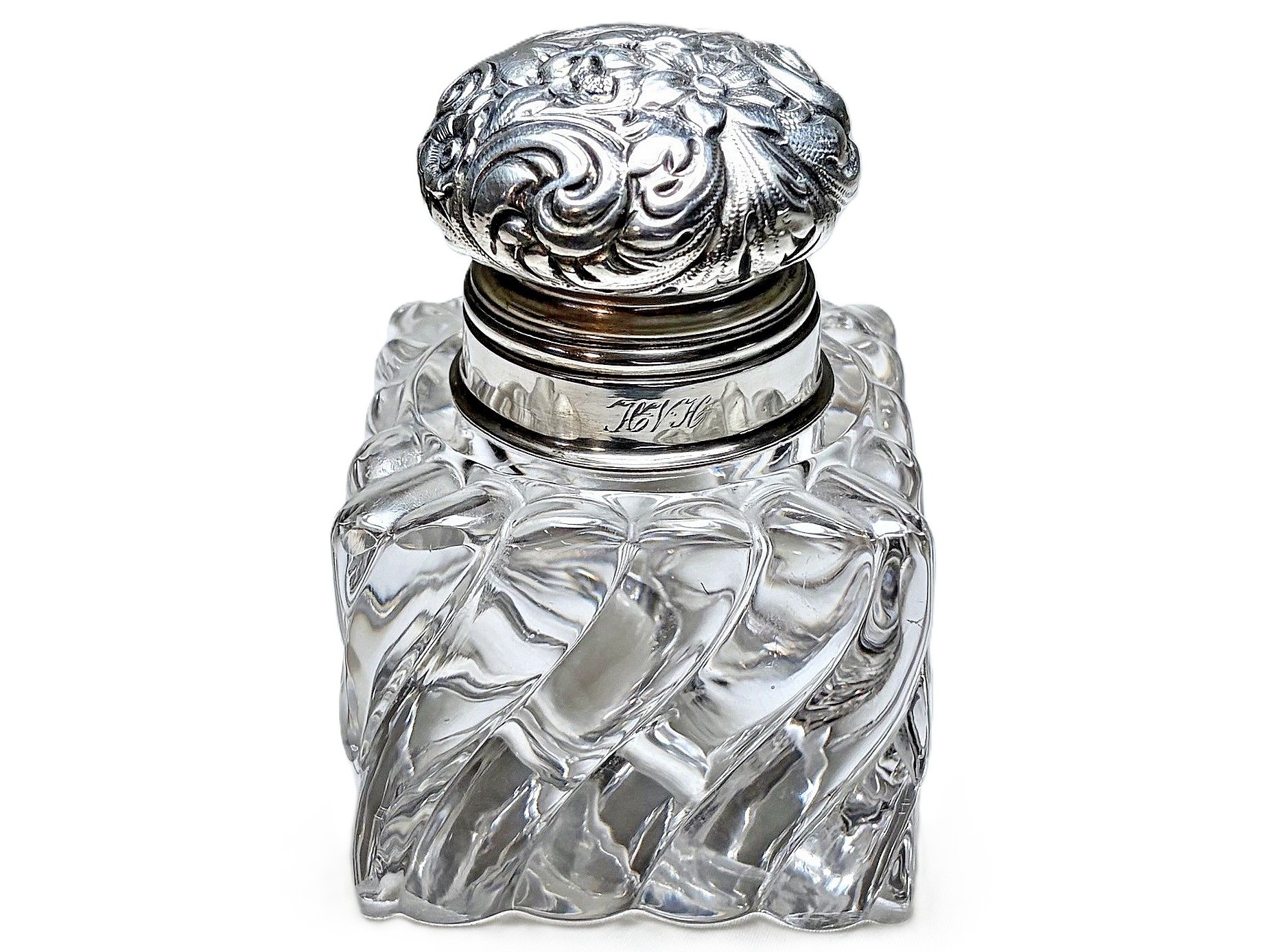


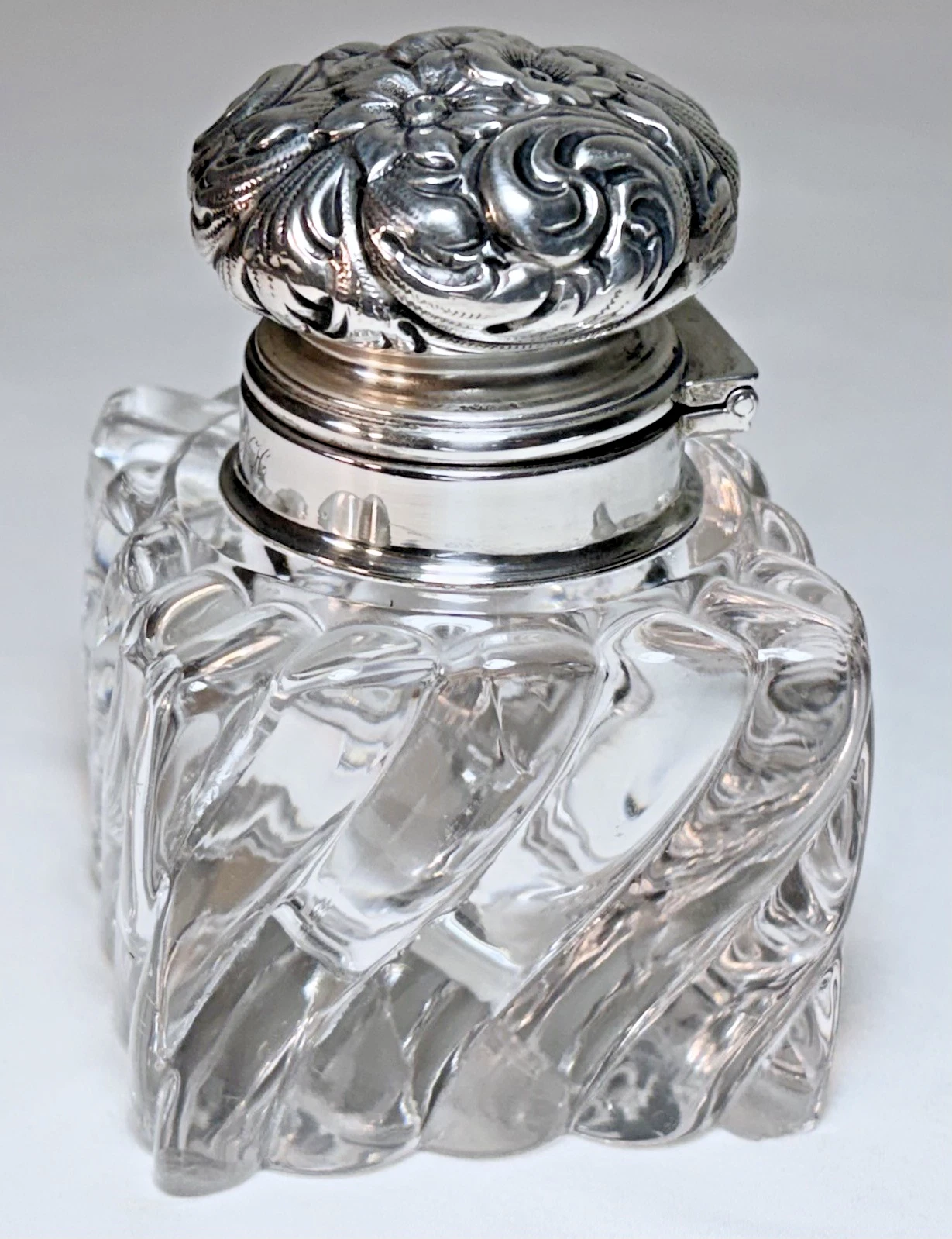
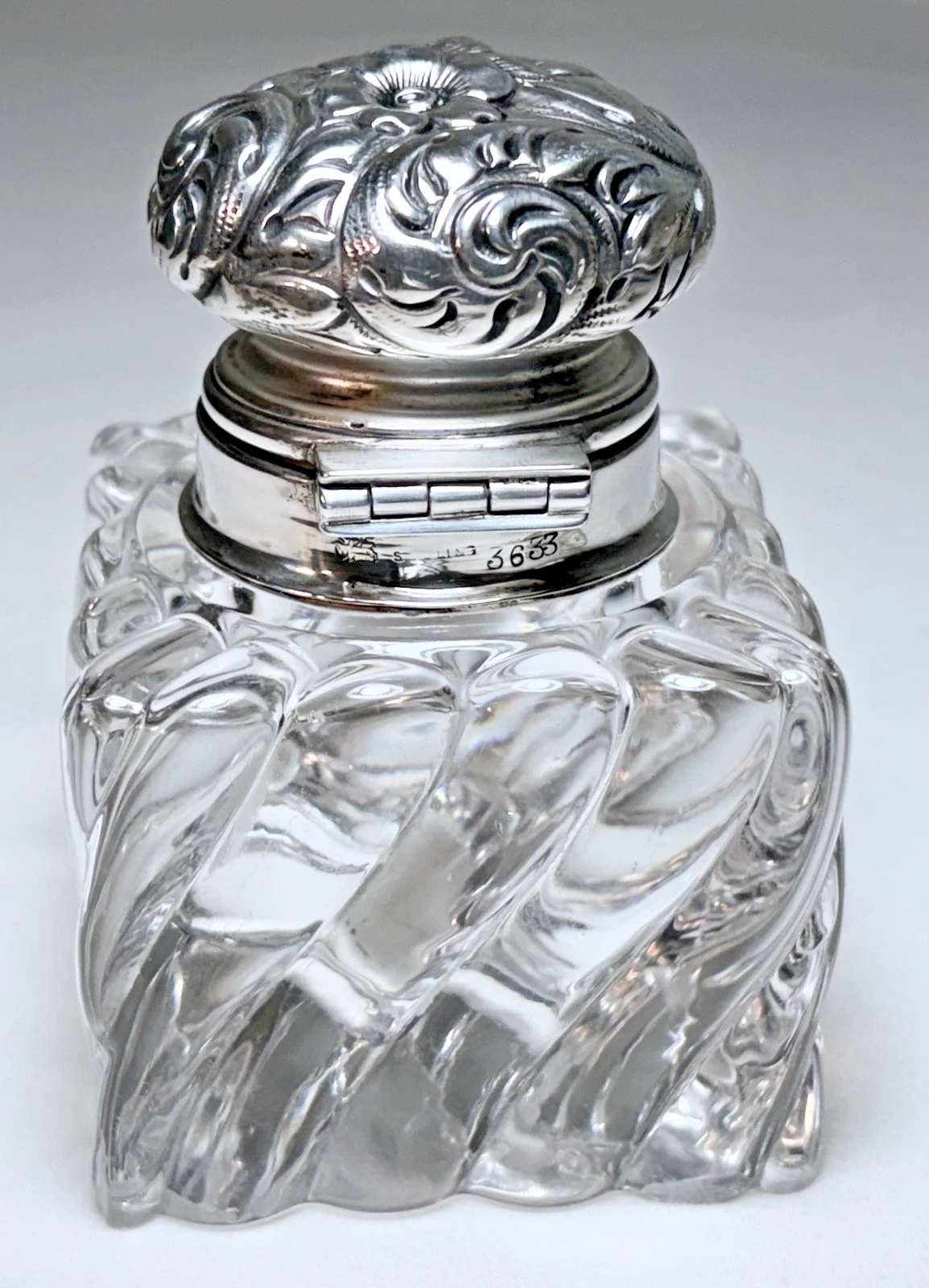


Swirl Molded Inkwell with Sterling Lid – Whiting Manufacturing Co.
| Categories | Glass - Non-figural |
| Material | Glass, Silver |
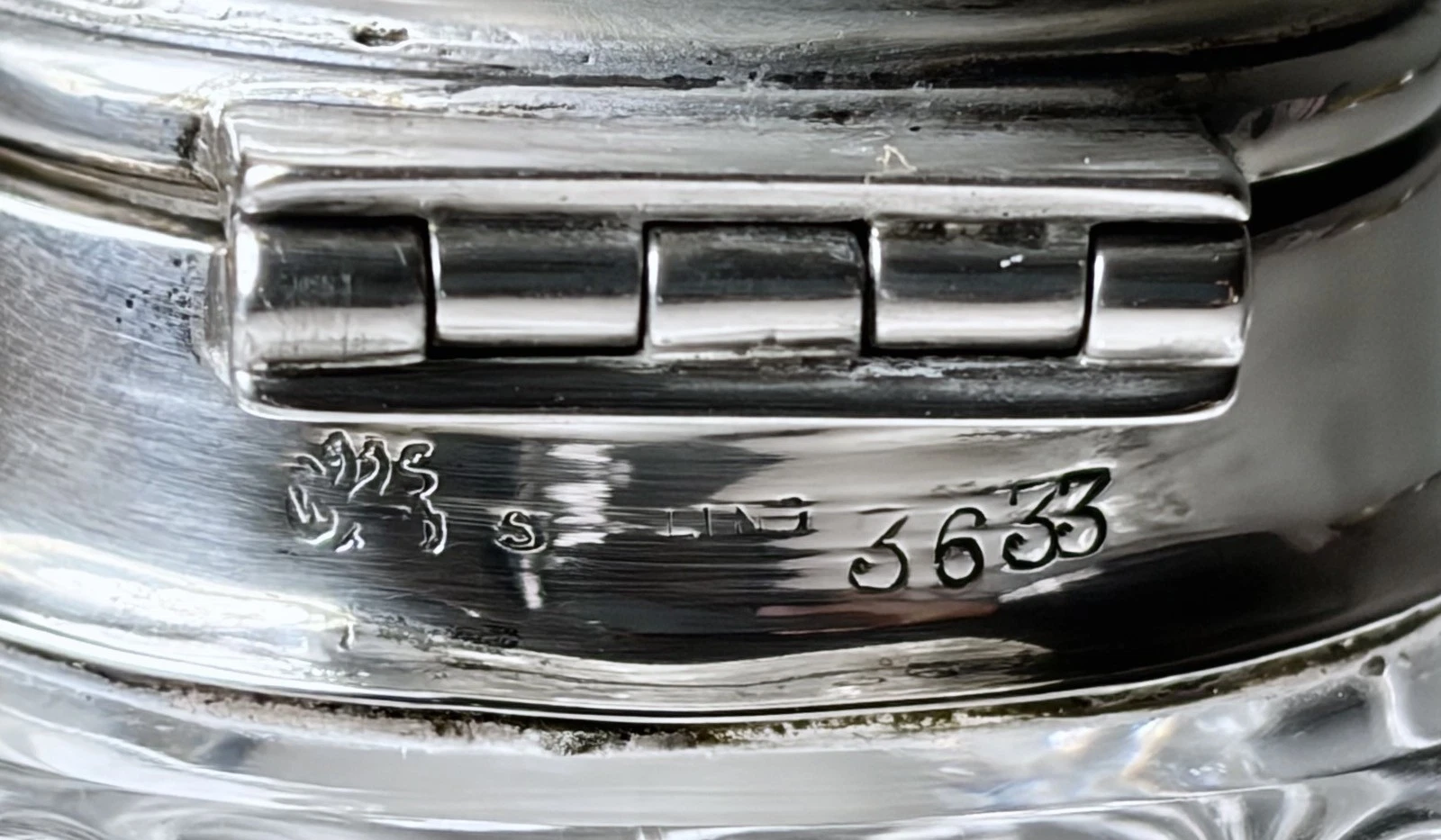
| Markings | See Narrative |
| Manufacturer | Whiting Manufacturing Co. |
| Origin | United States |
| Date or Era | circa 1900 |
Description
- The Vessel: A heavy, clear glass inkwell featuring a swirl-molded (torsade) pattern. The deep, diagonal ribs are designed to catch and play with light, giving the piece a shimmering, liquid appearance. The base is square with rounded, scalloped edges, and the interior reservoir is a cylindrical “well” visible through the thick glass walls.
- The Lid: A hinged, sterling silver dome executed in high-relief repoussé. The design is a classic Rococo Revival floral motif, featuring blooming flowers (likely chrysanthemums or poppies) nestled among scrolling acanthus leaves and “C-scrolls.” The background of the silver is finely chased with a stippled texture to provide contrast against the polished highlights.
- The Hardware: The lid is attached via a sturdy five-part barrel hinge. The collar of the inkwell is engraved with the elegant, interlaced script initials “HVH.”
- The Marks: The silver collar bears the hallmark of Whiting Manufacturing Co. (a stylized winged lion or griffin holding a ‘W’), followed by the word “STERLING” and the pattern/production number “3633.”
About Whiting Manufacturing Co.
Whiting Manufacturing Co. was one of the premier American silver manufacturers of the 19th and early 20th centuries.
- Origins: Founded by William D. Whiting in 1866 (originally Tifft & Whiting), the company was based in North Attleboro, Massachusetts, before moving to Newark, New Jersey, and later New York.
- Reputation: They were renowned for their high-quality craftsmanship, particularly their repoussé work and “Mixed Metals” pieces. They were a major competitor to Tiffany & Co. and Gorham.
- The Gorham Connection: In 1905, the company was acquired by the Gorham Manufacturing Company, though they continued to produce pieces under the Whiting name and hallmark for several decades afterward.
- Legacy: Whiting is perhaps most famous for its “Lily” pattern (introduced in 1902), which remains one of the most sought-after Art Nouveau flatware patterns today.
Dating the Inkwell
Based on the style, the hallmark, and the production number, this inkwell dates to approximately 1890–1910.
The heavy, swirling glass and the dense, floral repoussé are hallmarks of the late 19th century – early 20th century. During this period, desks were the centerpiece of the home, and “desk furniture” like this was often given as a high-end wedding or commemorative gift (hence the personalized monogram).
Sold for $179 in January 2026
Content disclaimer. The information posted is the owner’s best knowledge and may not have been vetted by the SOIC. We welcome comments, corrections, and additions, working to make our website information comprehensive and accurate.
Join the Society of Inkwell Collectors (SOIC) – it’s free!
Founded in 1981 as a non-profit organization,
we are documenting inkwells (and accessories).
We’re here to help and inform!