






Swan Pen Wipe
| Categories | Accessories |
| Type | Swan |
| Material | Silver |
| Markings | See Narrative |
| Manufacturer | Levi & Salaman |
| Origin | England |
| Date or Era | circa 1896 |
| Measuring | 3 ⅛” long; 2 ¾” high |
Description
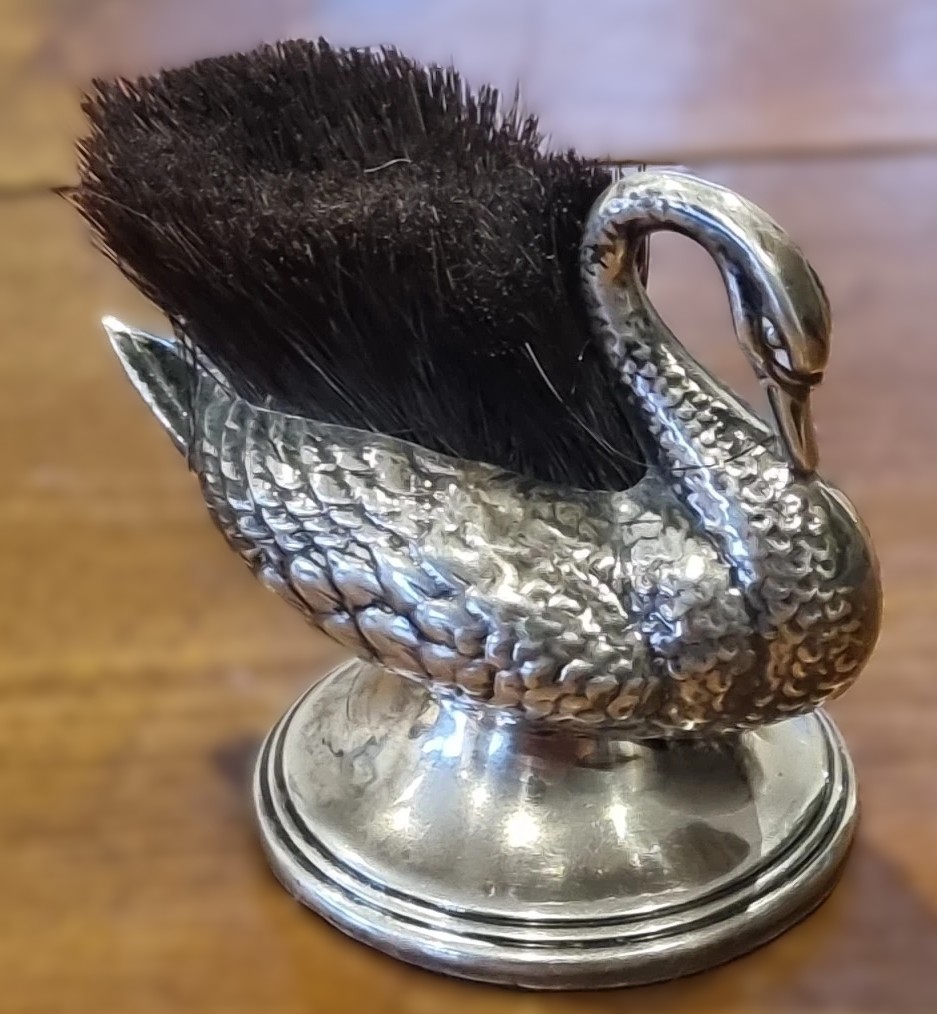
The piece is made in the form of a swan, a popular motif in the 19th century symbolizing grace and elegance.
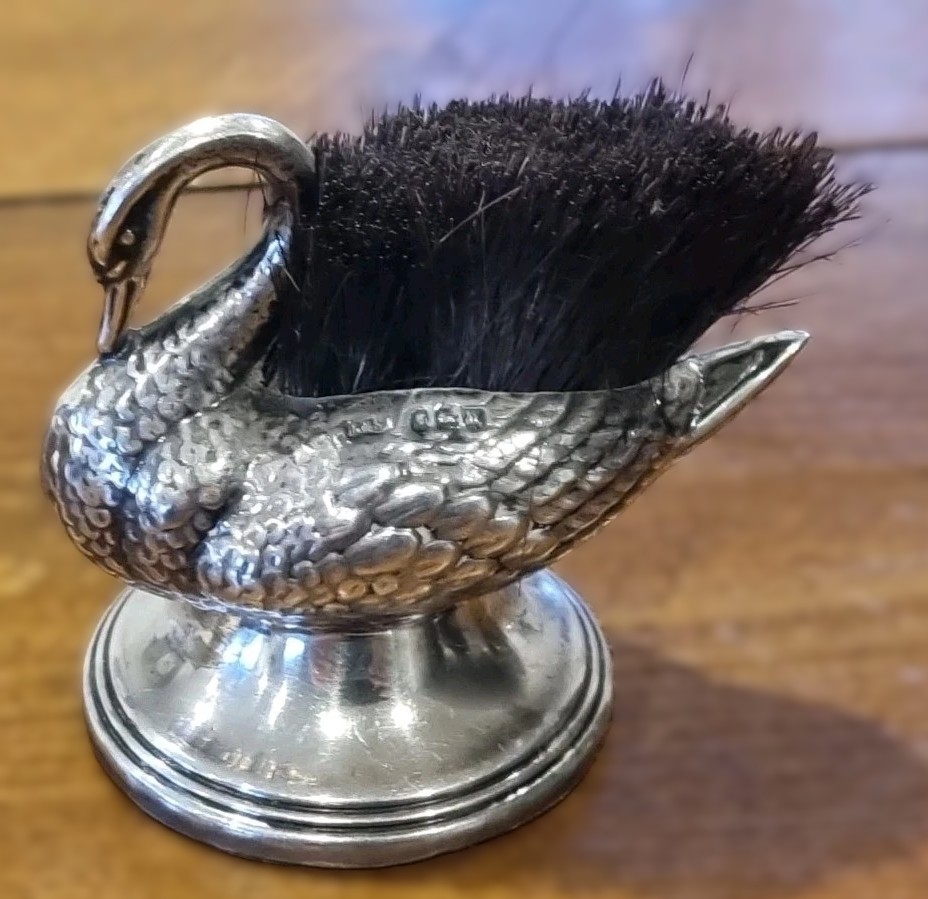
- The Body: The swan features highly detailed, repoussé-worked feathers that cover the entirety of its breast and wings. Its neck is gracefully arched in a characteristic “S” curve, with its beak tucked toward its chest.
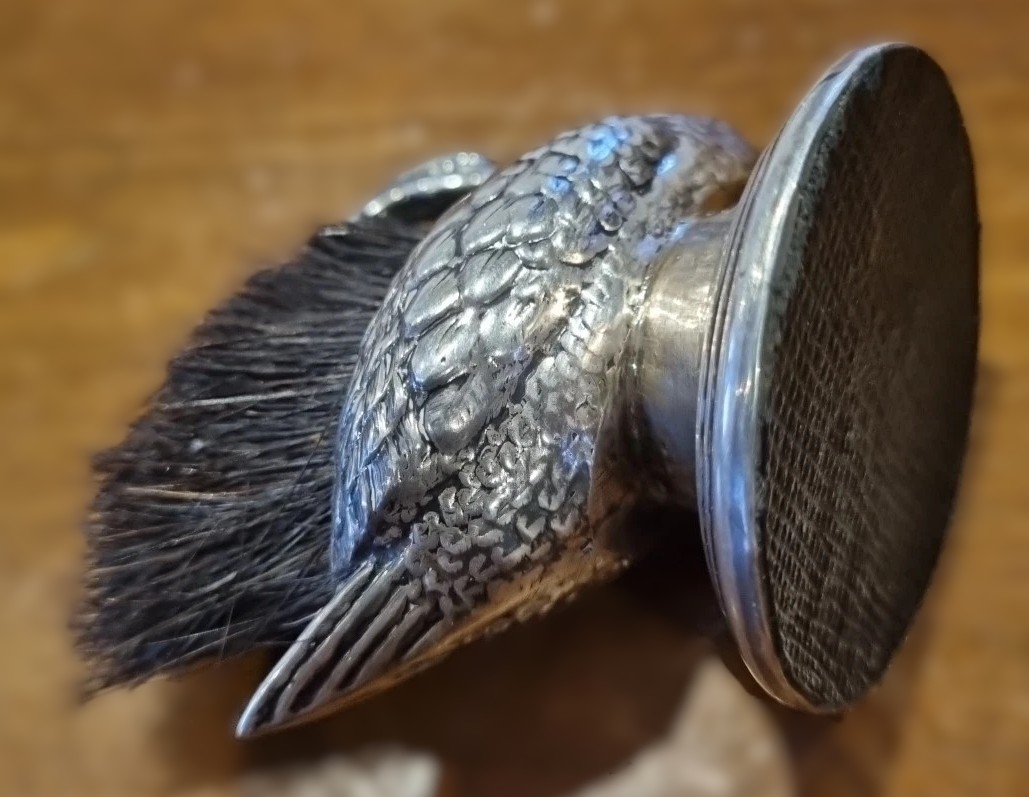
- The Base: The swan sits atop a weighted, circular pedestal base with concentric stepped molding.
- The Brush: Emerging from the swan’s back is a dense, stiff-bristled brush. This was intended for the writer to dip their ink-stained nib into, effectively cleaning it between uses or before storage.
Hallmark Analysis
The hallmarks are visible on the upper flank of the swan’s body and can be decoded as follows:
| Mark | Identification | Significance |
| L&S | Levi & Salaman | The maker’s mark for one of Birmingham’s most prolific silversmiths. |
| Anchor | Birmingham | The town mark for the Birmingham Assay Office. Notably, the anchor is sideways, which was a practice used specifically between 1860 and 1899. |
| Lion Passant | Sterling Silver | Confirms the metal is 92.5% pure silver. |
| w | 1896 | The lowercase Roman “w” in a shield corresponds exactly to the year 1896 in the Birmingham date letter cycle. |
Bristle Material
The bristles are made of hog hair (boar’s bristle). This was the standard material for antique pen wipes and desk brushes because hog hair is naturally stiff and resilient. Unlike softer horsehair, hog bristles could withstand the repeated friction of cleaning metal nibs and were excellent at trapping and holding dried ink without fraying or shedding excessively.
History of Levi & Salaman
The firm was one of the most successful manufacturers of “small silver goods” and “novelties” in Britain during the Victorian and Edwardian eras.
- Founding: Established in 1870 by Phineas Harris Levi and Joseph Wolff Salaman in Birmingham.
- The “Novelty” Specialist: While they made everything from tableware to jewelry, they were most famous for their “novelties” – small, whimsical items like this swan, animal-shaped pin cushions (especially their famous silver elephants), and souvenir spoons.
- Expansion: In 1878, they acquired the Potosi Silver Co., allowing them to expand into high-quality silverplate as well. By the late 19th century, they operated out of the massive “Potosi Works” on Newhall Street.
- Legacy: After Phineas Levi died in 1910, the company became Levi & Salaman Ltd. It was eventually amalgamated with Barker Brothers in 1921.
Sold for $410 in February 2026
Content disclaimer. The information posted is the owner’s best knowledge and may not have been vetted by the SOIC. We welcome comments, corrections, and additions, working to make our website information comprehensive and accurate.
Join the Society of Inkwell Collectors (SOIC) – it’s free!
Founded in 1981 as a non-profit organization,
we are documenting inkwells (and accessories).
We’re here to help and inform!