


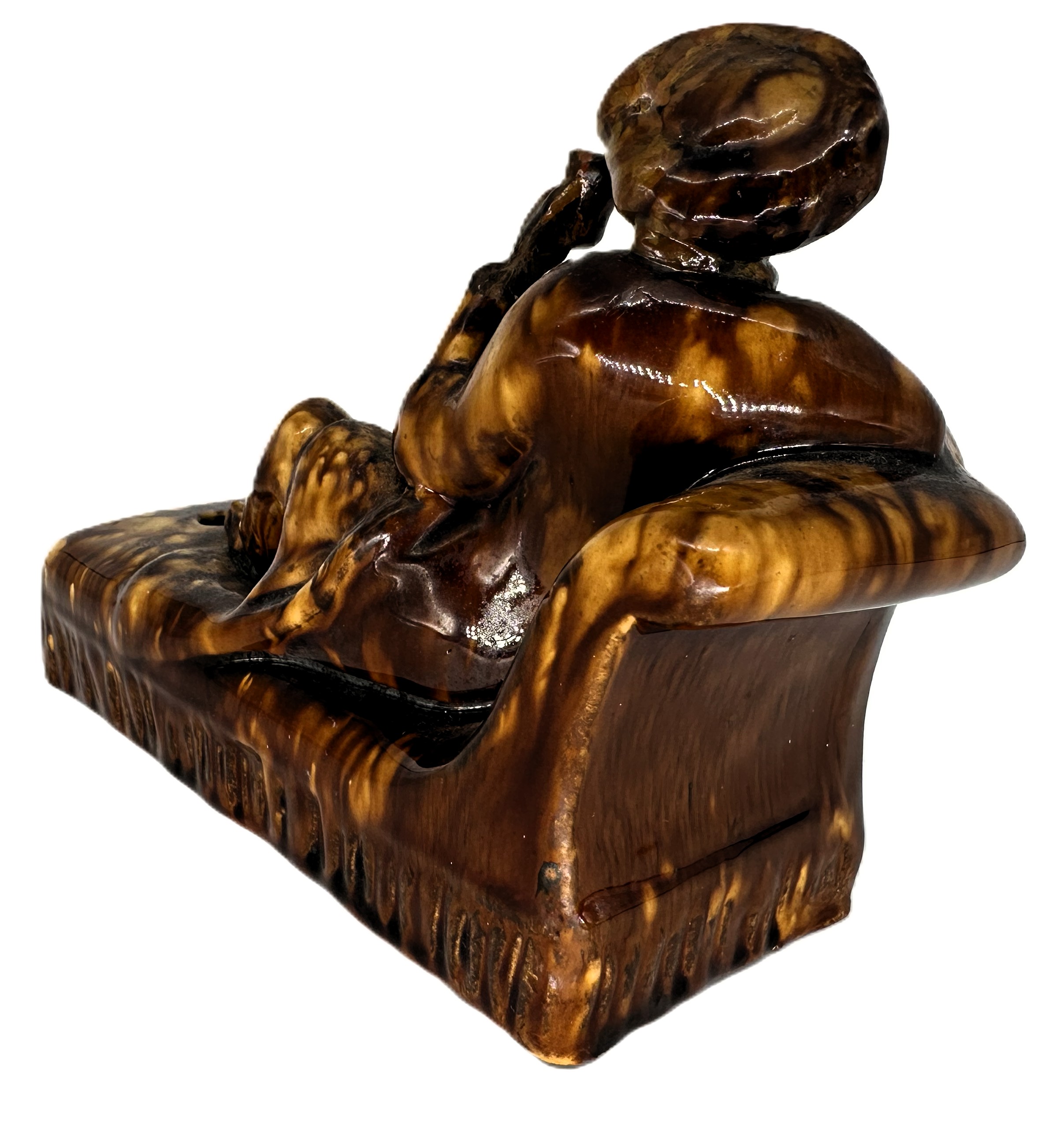
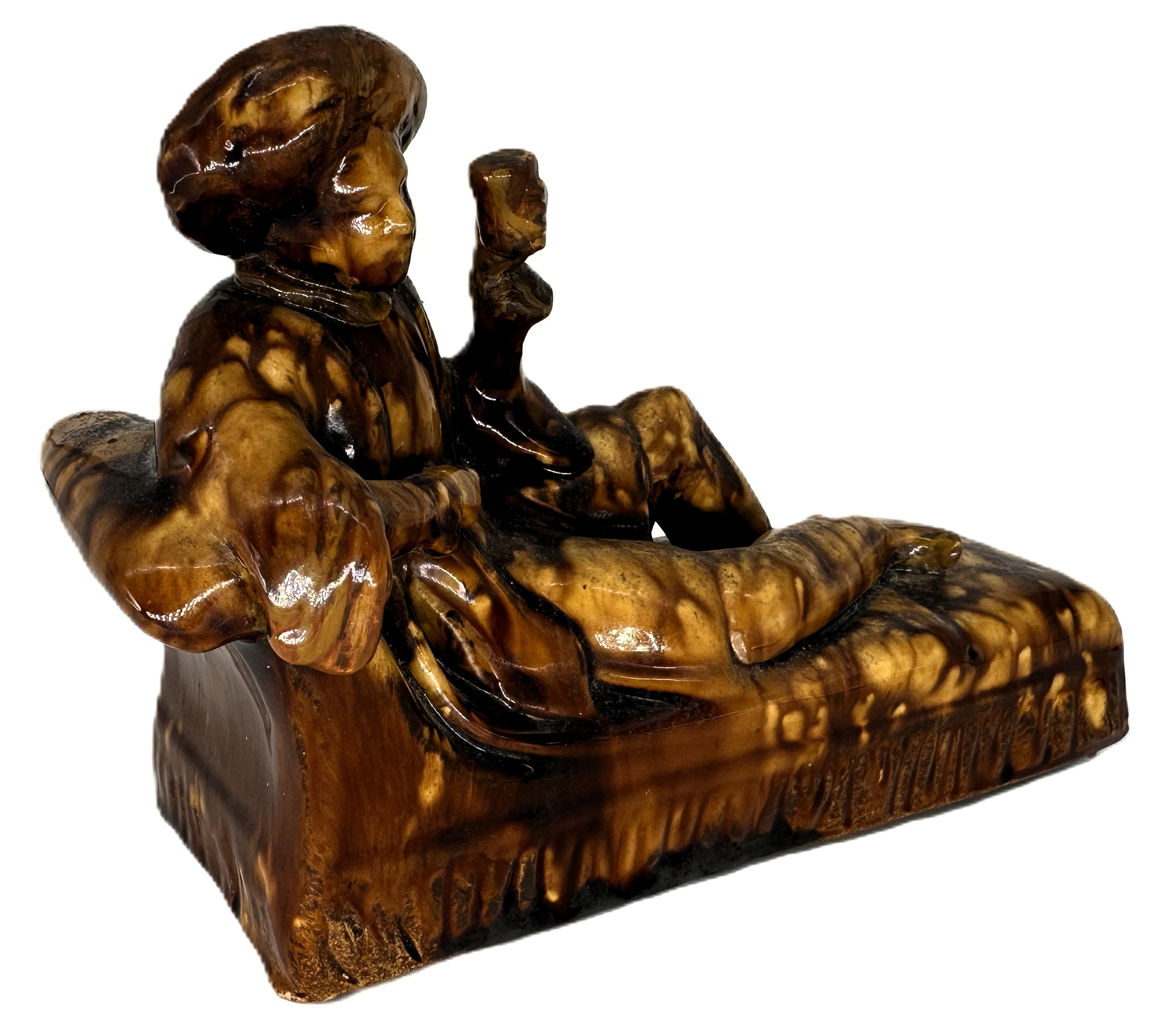


Sulton Reclining on a Chaise
| Categories | Middle East / Africa |
| Material | Earthenware |
| Markings | Unmarked |
| Manufacturer | Undetermined |
| Origin | England |
| Date or Era | circa 1850 |
| Measuring | 6 ¾” x 2 ⅝” x 5 ¼” high |
Description: Figural Treacleware Inkwell
Overview
- Classification: Figural Desk Accessory
- Material: Cream-colored molded earthenware
- Glaze: Treacle glaze (Mottled brown manganese oxide)
- Origin: England (likely the Staffordshire region)
- Period: Mid-Victorian, circa 1850–1870
- Subject: A Recumbent Sultan or Pasha on a Sofa
Analysis
This unusual figural piece depicts a lounging male figure in 19th-century European “Orientalist” attire, resting in a recumbent position on a luxurious, draped daybed or sofa. The bottom edge of the sofa features a molded, tufted fringe or paneled skirt border.
The figure is styled with a voluminous, wrapped turban, loose-fitting robes or a tunic, and traditional baggy trousers. He rests his right arm along the back of the sofa, while his left hand holds a small object close to his chin—likely representing a traditional Middle Eastern tobacco pipe bowl or a ceremonial cup.
The Inkwell Component:
A clean, molded circular aperture is positioned on the flat end of the sofa base near the figure’s feet. The piece is hollow cast, but the underside reveals that the factory specifically engineered an isolated, self-contained internal pocket directly beneath this hole. This internal well is completely coated in a thick, protective layer of brown glaze, meaning liquid ink poured into the top was safely contained within a sealed cylinder and prevented from flooding the rest of the hollow figurine.
Attribution Logic: Why This Piece is English
While American potteries in Ohio and Vermont produced vast quantities of similar brown-mottled “Rockingham” pottery, a diagnostic assessment confirms this piece is of British origin, hailing from the historic Staffordshire pottery district:
- The Clay Composition (Paste)
The telltale sign is visible along the unglazed, exposed bottom rim of the base. American yellow ware clay fires to a distinct, deep pumpkin-buff or warm yellow color. In contrast, this piece features a very light, chalky, off-white to pale cream-colored earthenware body. This pale clay body is characteristic of the refined earthenwares utilized by mid-Victorian Staffordshire factories for everyday molded press-ware novelties.
- The Decorative Technique (“Treacleware”)
While Americans use the term Rockingham to describe manganese oxide glazes that streak and pool over a lighter clay body, the British historically refer to this specific aesthetic as a Treacle glaze or Treacleware (evoking the deep, rich color of dark British molasses). The high-gloss, mirror-like finish and the heavy pooling of dark brown glaze in the deep crevices of the turban, costume folds, and sofa fringe are quintessential examples of British industrial treacleware execution.
- Cultural and Historical Subject Matter
The subject matter aligns perfectly with Victorian England’s obsession with “Orientalism” and the exoticism of the Ottoman Empire, which reached a fever pitch around the time of the Crimean War (1853–1856). Staffordshire potters were famous for capturing contemporary news, theater, and international politics in clay. They produced thousands of inexpensive chimney ornaments and flatbacks depicting the Sultan of Turkey and various Ottoman commanders.
While American factories stuck primarily to local, rustic, or animal themes (stags, hounds, log cabins), the British specialized heavily in these whimsical, narrative, and exotic figures.
Condition and Rarity Note
Molded earthenware items of this grade were inexpensive parlor utilities in the 19th century. Because they were subjected to daily wear on writing desks, exposed to caustic inks, and eventually discarded upon the invention of the fountain pen, their survival rate is incredibly low. Finding a highly complex, multi-part molded figural scene like this reclining sultan—completely intact with no major structural loss—makes it a scarce example of Victorian Staffordshire pottery.
Estimated value: $400
Content disclaimer. The information posted is the owner’s best knowledge and may not have been vetted by the SOIC. We welcome comments, corrections, and additions, working to make our website information comprehensive and accurate.
Join the Society of Inkwell Collectors (SOIC) – it’s free!
Founded in 1981 as a non-profit organization,
we are documenting inkwells (and accessories).
We’re here to help and inform!