


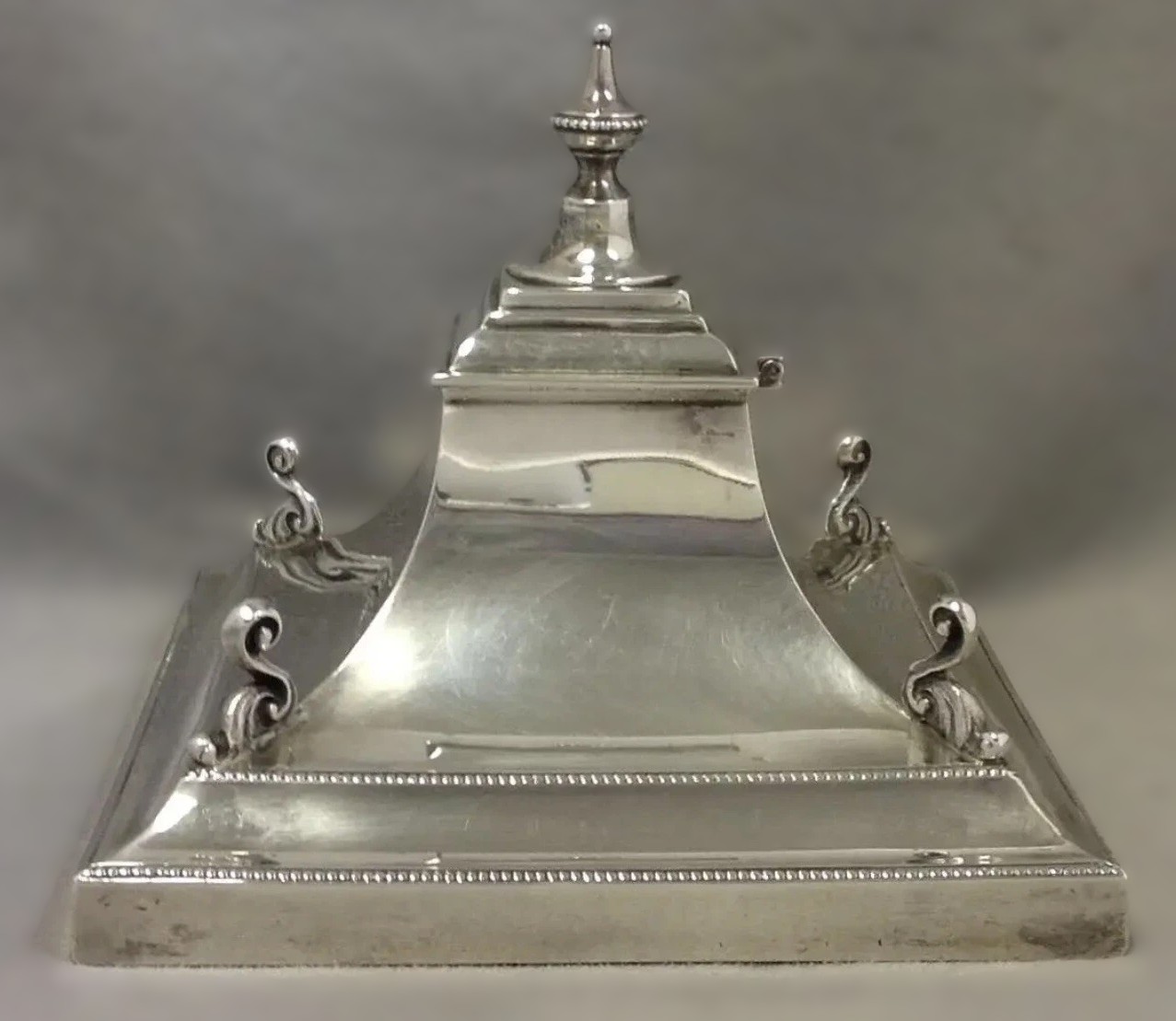
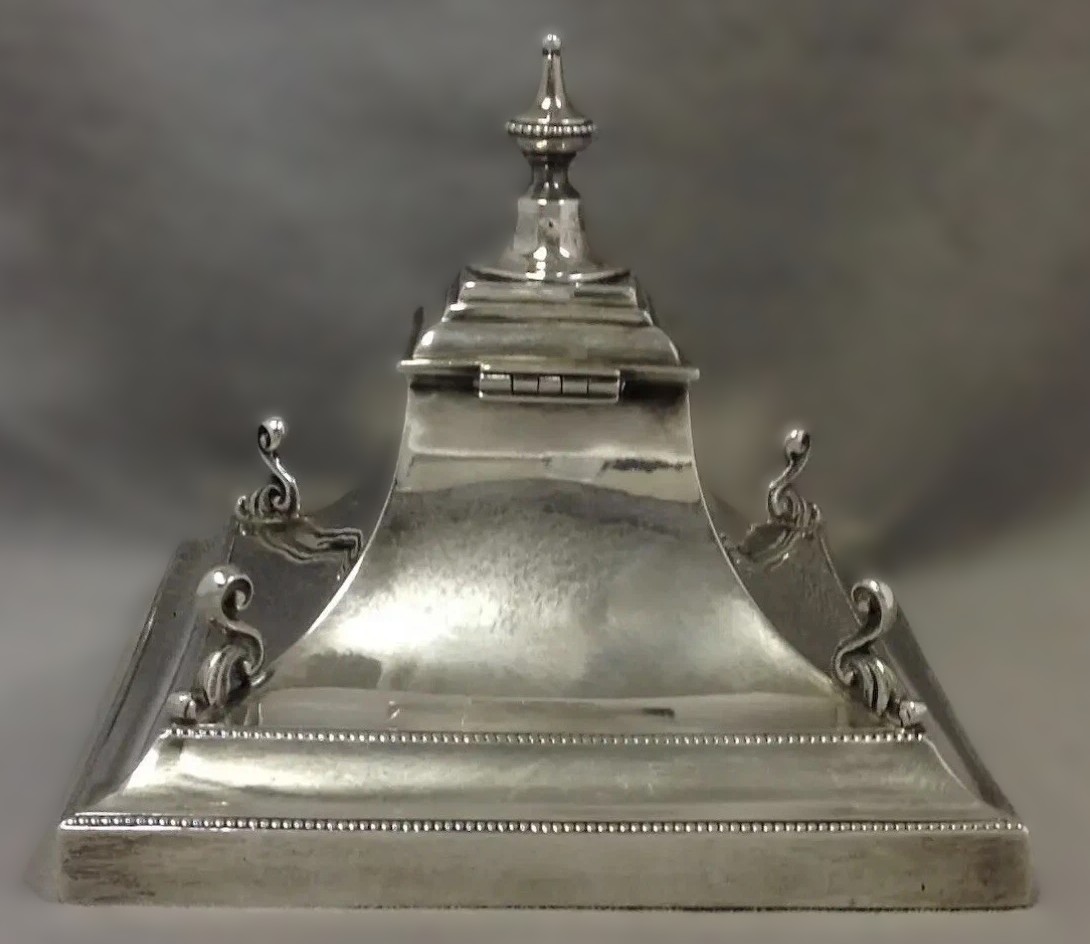

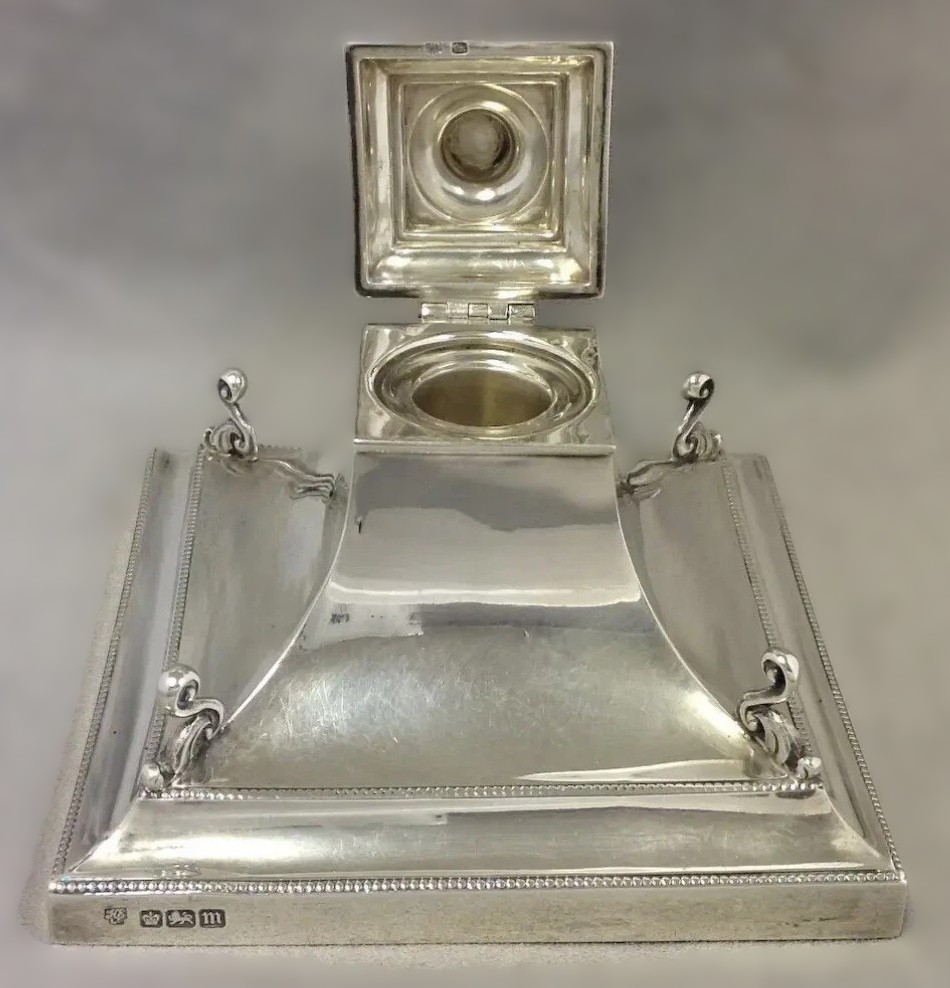


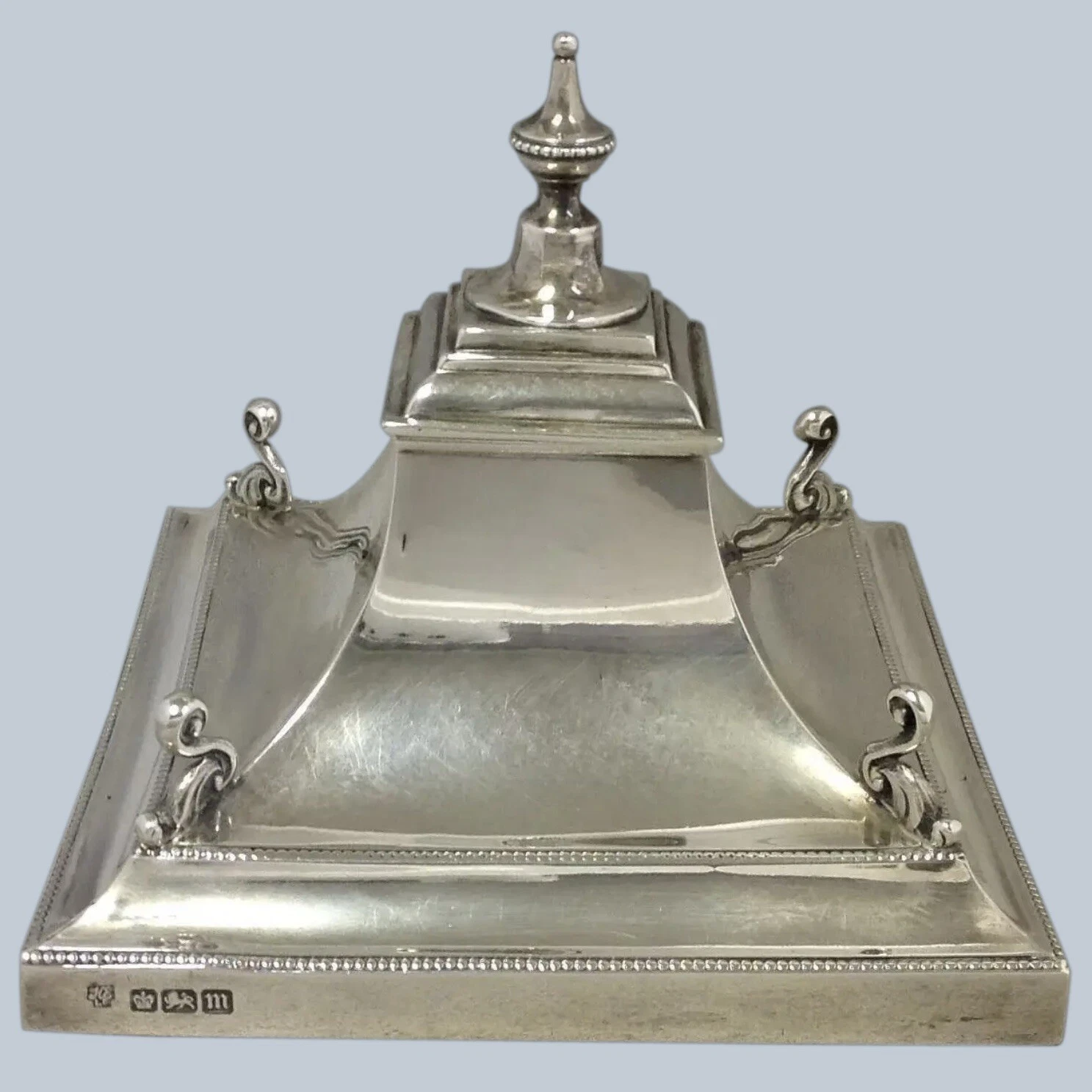
Sterling Silver Inkstand with Corner Cradles
| Categories | Silver |
| Material | Silver |
| Markings | See Narrative |
| Manufacturer | Hawksworth Eyre & Co Ltd |
| Origin | England |
| Date or Era | circa 1904 |
| Measuring | 5 ⅛” x 5 ⅛” x 4 ½” high |
This hallmarked sterling silver inkstand was produced by one of Sheffield’s most respected silversmithing firms.
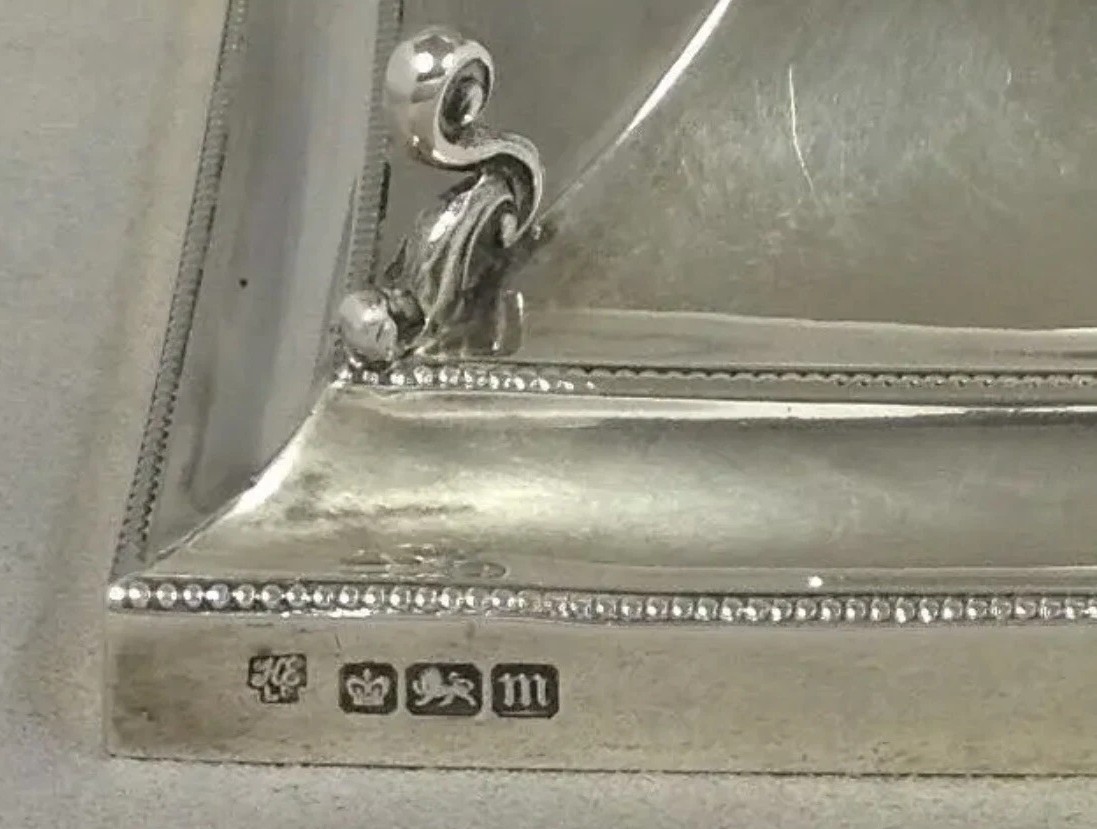
The Hallmark & Date Identification
Based on the specific sequence of marks, this inkstand was assayed in Sheffield in the year 1904.
- HE L D: The maker’s mark for Hawksworth, Eyre & Co Ltd. The “L D” signifies they were a Limited company at the time.
- Crown: The town mark for the Sheffield Assay Office.
- Lion Passant: The standard mark for Sterling Silver (.925 purity).
- M: The date letter. For the Sheffield Assay Office, a capital Roman “M” in a shield corresponds to the year 1904.
- 12156: This is a pattern number or design registration number used by the factory to track the specific mold and style for reordering or inventory purposes.
The “Pattern 12156” Design
This model was part of the firm’s “Modern Desk Series” introduced for the 1904 season. It was designed to provide maximum stability on a busy desk, which is why it features a “weighted” base (filled with a mixture of resin and lead) to prevent it from sliding or tipping.
- Form: A square, tapering body (5 ⅛” x 5 ⅛” x 4 ½”high).
- The Pen Rests: In catalog terminology, these are called “Scroll Pen Rests” or “Corner Cradles.” They are specifically flared at the corners to allow a dip pen to sit securely horizontally or slightly angled across the top of the well.
The design is Edwardian Neoclassical, characterized by its “plain and polished” surfaces and the heavy, slightly stepped base. This style was marketed as a “masculine” desk accessory, often intended for use in a library or a bank manager’s office. Because this is a “weighted” inkstand, the base is filled with a dense material (usually a mixture of resin and lead or plaster) and covered with a leather or baize pad. This gives it the stability needed. The original glass liner is intact.
The Manufacturer: Hawksworth, Eyre & Co Ltd
Hawksworth, Eyre & Co was a prominent firm of silversmiths and electroplaters based in Sheffield, England.
- Origins: The company was founded in 1833 by Charles Hawksworth and John Eyre as the successors to Blagden, Hodgson & Co.
- Reputation: They were renowned for the quality of their “finely chiseled” work. While they were early pioneers in Old Sheffield Plate, they successfully transitioned into high-end sterling silver and electroplating during the Victorian era.
- Global Reach: By the time this inkstand was made in 1904, the firm had prestigious showrooms in London (Devereux Court) and was a regular exhibitor at major international exhibitions, including the Great Exhibition of 1851.
- Legacy: The firm continued to operate until 1932, when it was liquidated and its designs/dies were purchased by Ellis & Co of Birmingham.
Historical Significance: Hawksworth, Eyre & Co Ltd
The choice of this specific piece says much about the owner’s status in 1904. Hawksworth, Eyre & Co. was not a high-volume manufacturer like some Birmingham firms; they were known for “chased and hand-finished” luxury items.
- Sheffield Craftsmanship: Because it was assayed in Sheffield (the Crown mark), it represents the pinnacle of English tool-and-die making. Sheffield silversmiths were world-renowned for their ability to create heavy, perfectly symmetrical hollowware.
- The “M” Hallmark: This confirms the date of 1904. During this specific year, the firm was aggressively expanding its London showrooms to compete with companies like Mappin & Webb, and pattern 12156 was one of their flagship “new era” designs that departed from the fussy, floral patterns of the late Victorian years.
Sold for $411 in December 2025
Content disclaimer. The information posted is the owner’s best knowledge and may not have been vetted by the SOIC. We welcome comments, corrections, and additions, working to make our website information comprehensive and accurate.
Join the Society of Inkwell Collectors (SOIC) – it’s free!
Founded in 1981 as a non-profit organization,
we are documenting inkwells (and accessories).
We’re here to help and inform!