




Sterling Silver Inkstand – circa 1807
| Categories | Silver |
| Type | Standish |
| Material | Glass, Silver |
| Markings | See Narrative |
| Manufacturer | John Emes |
| Origin | England |
| Date or Era | circa 1808 |
| Measuring | Base: 7” x 4 ⅛” |
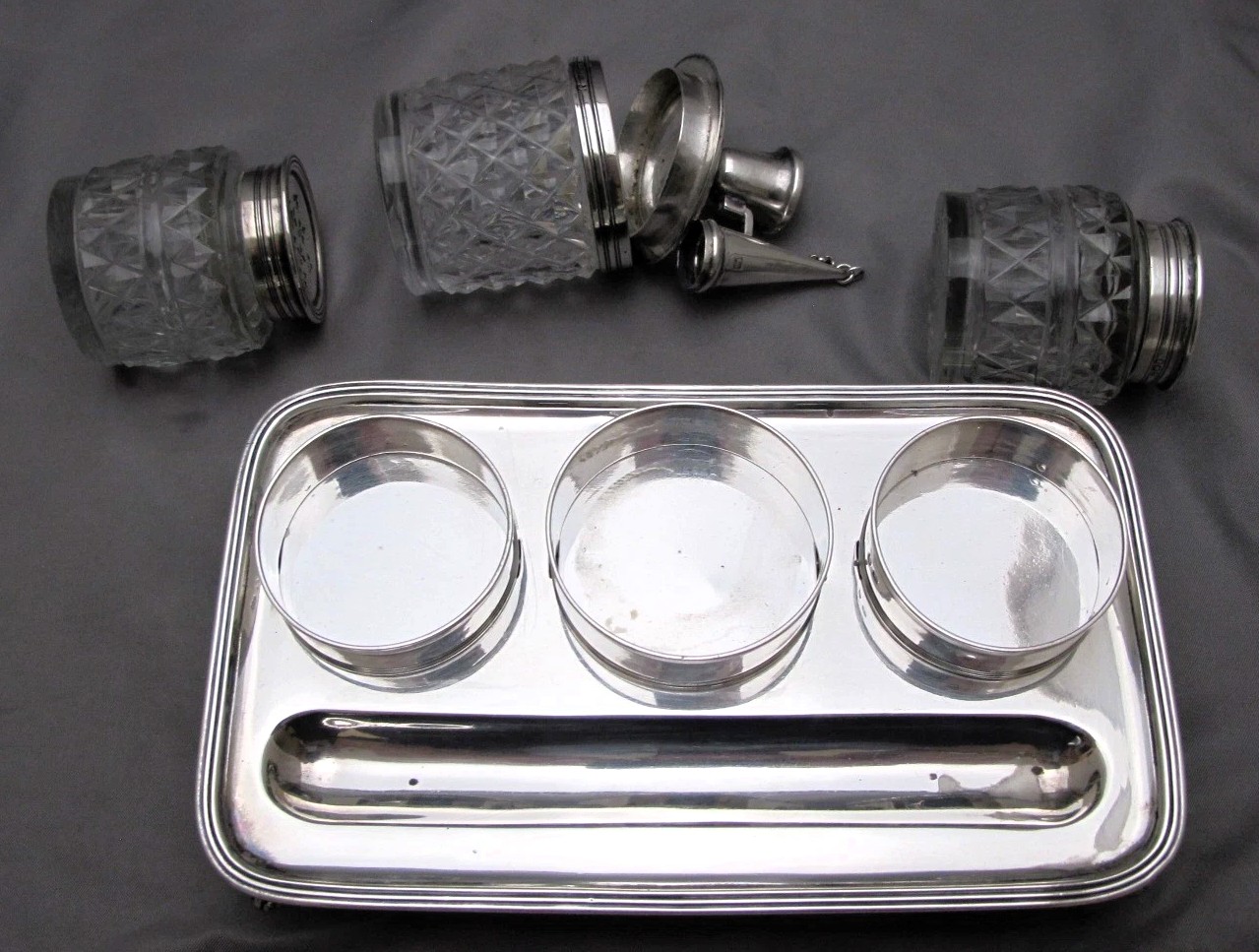
This George III sterling silver and glass inkstand is a refined example of early 19th-century English silversmithing, hallmarked for London, 1807–08, and crafted by the celebrated silversmith John Emes.
Description
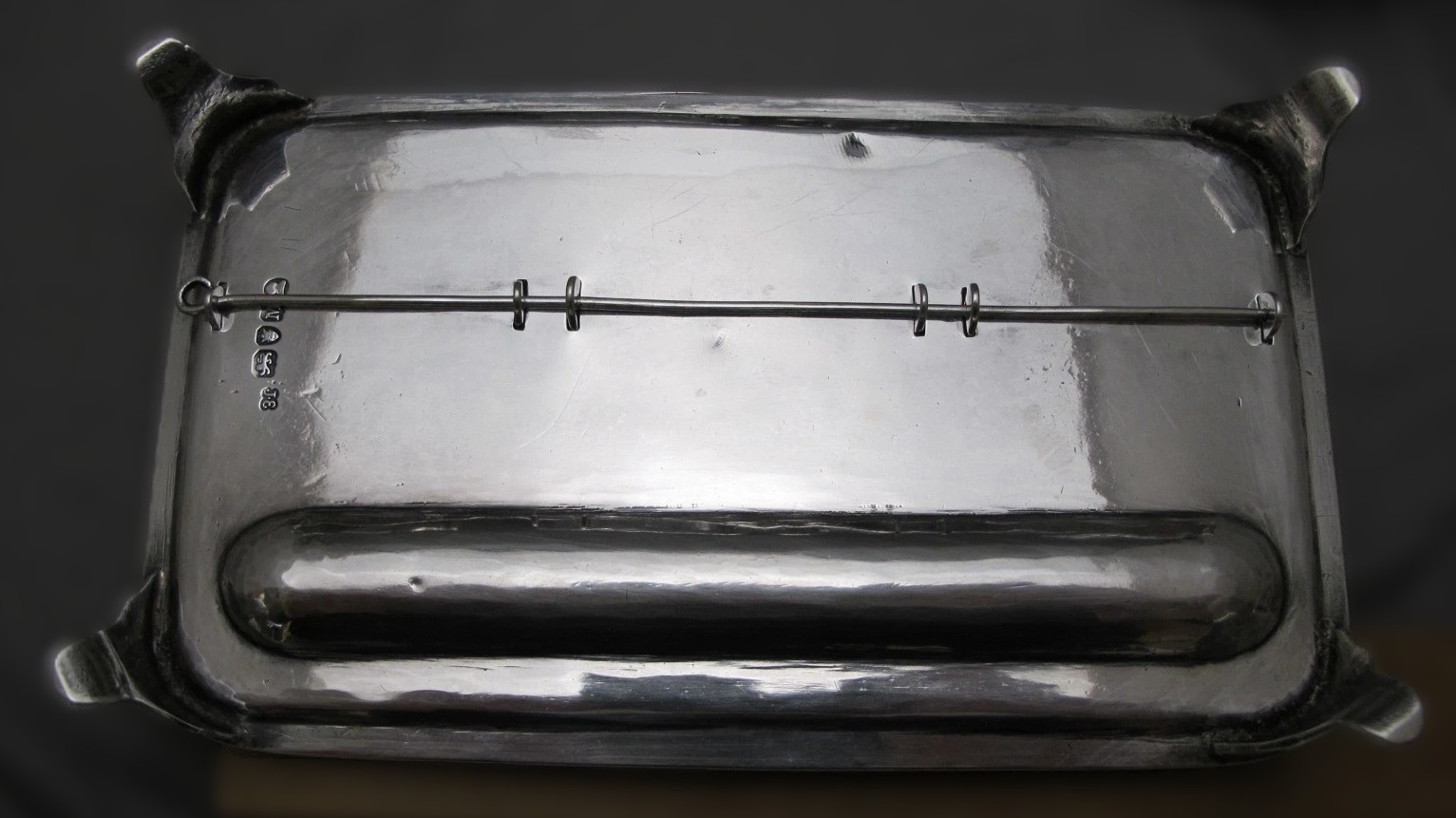
- The Stand: The rectangular sterling silver tray features a molded reeded edge and is supported by four matching tab feet. The tray is designed with a long, integrated pen groove at the front and three circular rings to secure the bottles.
- The Glassware: The set contains three heavy, molded glass bottles with a sharp diamond-cut pattern and star-cut bases. Each bottle is fitted with a fixed silver rim.
- The Desk Accessories:
- Inkwell: Topped with a silver lid featuring a central aperture for a dip pen.
- Sander (Pounce Pot): Features a silver lid with a decorative pierced star-pattern grill, used for shaking “pounce” (fine powder) onto wet ink to dry it.
- Candle Holder and Snuffer: The central well acts as a taper stick (small candle holder) and comes equipped with its original conical silver snuffer attached by a delicate silver chain.
Hallmark Interpretation
The underside of the tray and the various silver components bear a set of clear British hallmarks:
- Maker’s Mark [JE]: The initials of John Emes.
- Lion Passant: Confirms the purity as .925 sterling silver.
- Leopard’s Head (Crowned): The city mark for the London Assay Office.
- Date Letter “M”: Represents the London assay year of 1807–08.
- Duty Mark (King George III): A profile head of the reigning monarch, indicating the excise tax on silver had been paid.
About the Maker: John Emes
John Emes (active c. 1796–1808) was one of the most prominent London silversmiths of the late Georgian period.
- Legacy: He worked out of Amen Corner, London, and was highly regarded for his Neoclassical designs, which favored elegant, restrained ornamentation like the reeded borders seen on this set.
- Partnerships: He was a former partner of Stephen Adams and later worked independently after 1796. Following his death in 1808 (the same year this piece was hallmarked), his widow Rebecca Emes took over the business, forming the famous partnership of Emes & Barnard.
- Significance: Because Emes died in 1808, this inkstand represents one of the final pieces produced under his personal mark.
Sold for $552 in December 2025
Content disclaimer. The information posted is the owner’s best knowledge and may not have been vetted by the SOIC. We welcome comments, corrections, and additions, working to make our website information comprehensive and accurate.
Join the Society of Inkwell Collectors (SOIC) – it’s free!
Founded in 1981 as a non-profit organization,
we are documenting inkwells (and accessories).
We’re here to help and inform!