

Sterling Silver English Arts & Crafts Inkwell
| Categories | Arts & Crafts |
| Material | Silver |
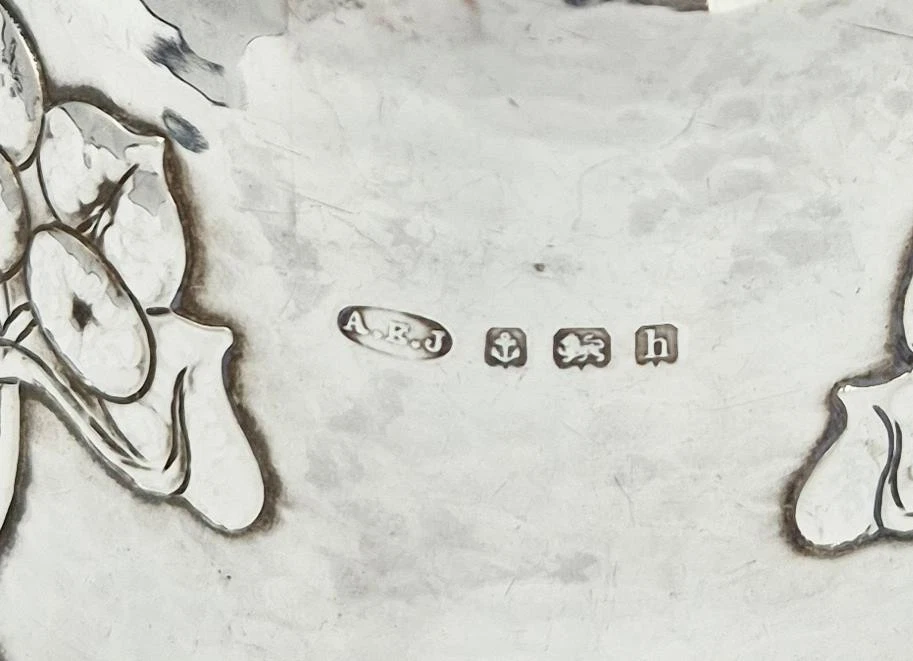
| Markings | See Narrative |
| Manufacturer | Albert Edward Jones |
| Origin | England |
| Date or Era | circa 1907 |
| Measuring | 4 ¼” diameter |
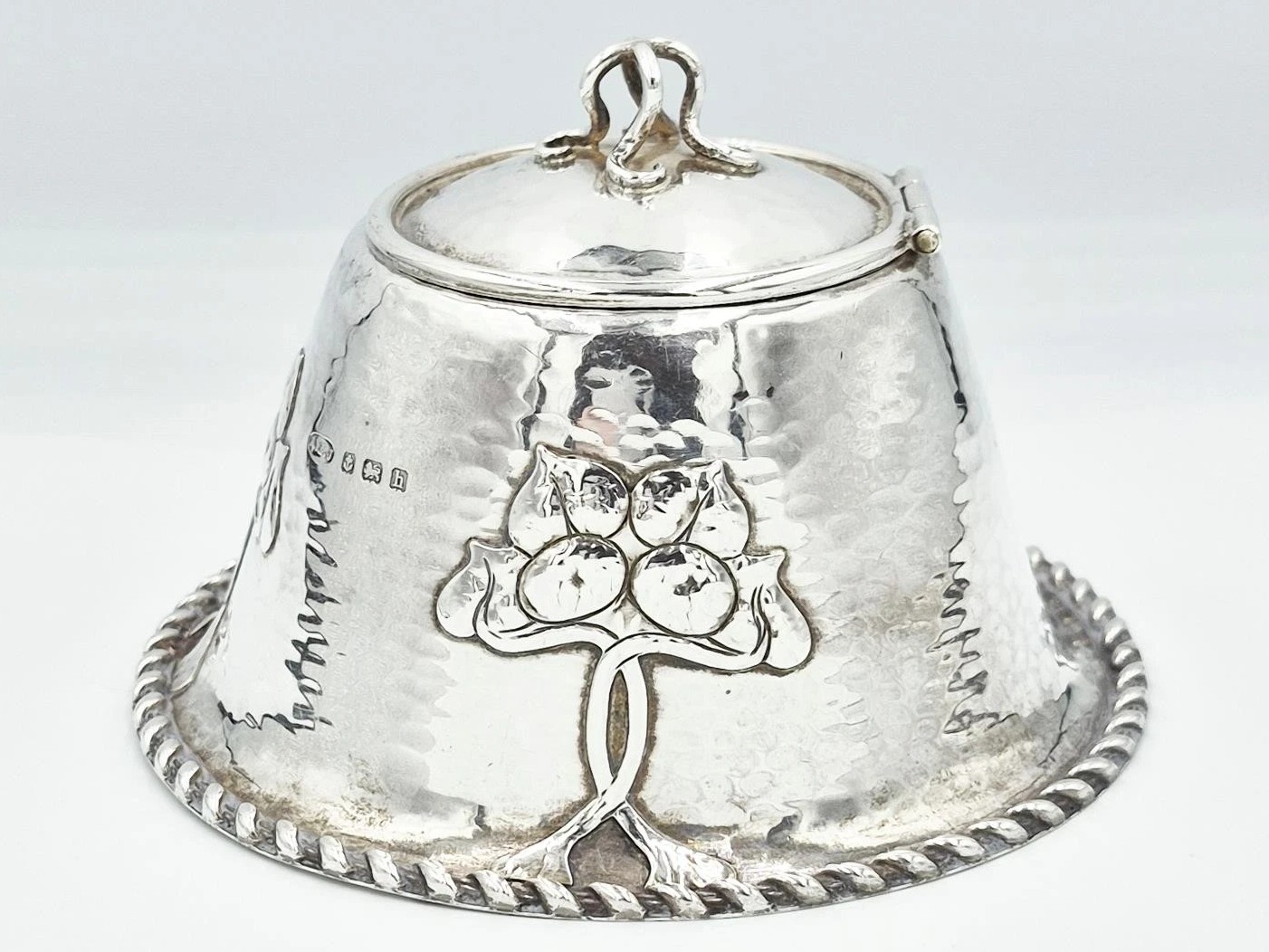
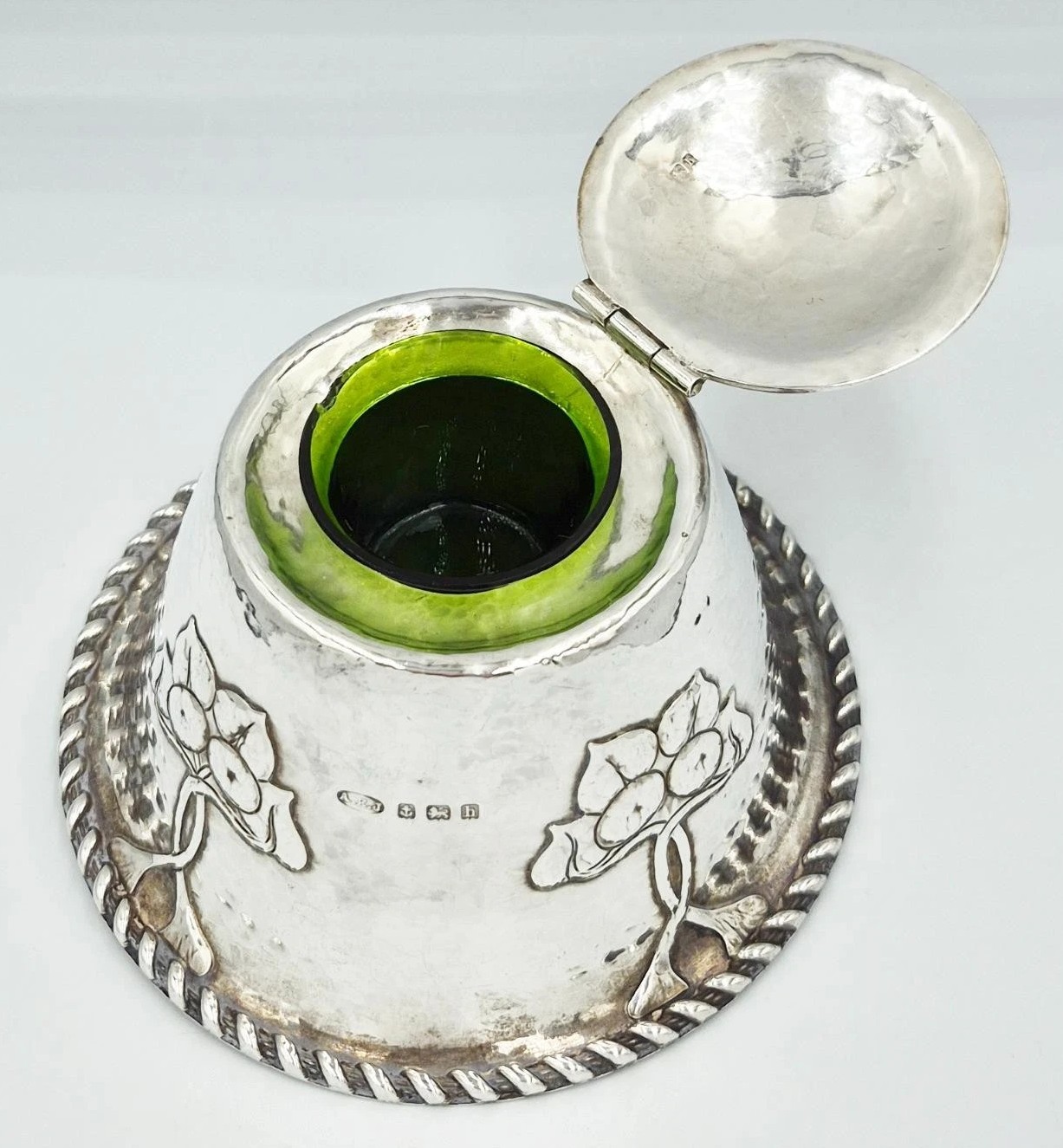
This is a superb example of an Arts and Crafts sterling silver inkwell by the renowned Birmingham silversmith Albert Edward Jones (A.E. Jones). Dated 1907, it represents the height of the English Arts and Crafts movement, showcasing the “Spirit of Art” that Jones famously advocated for in his work.
Description
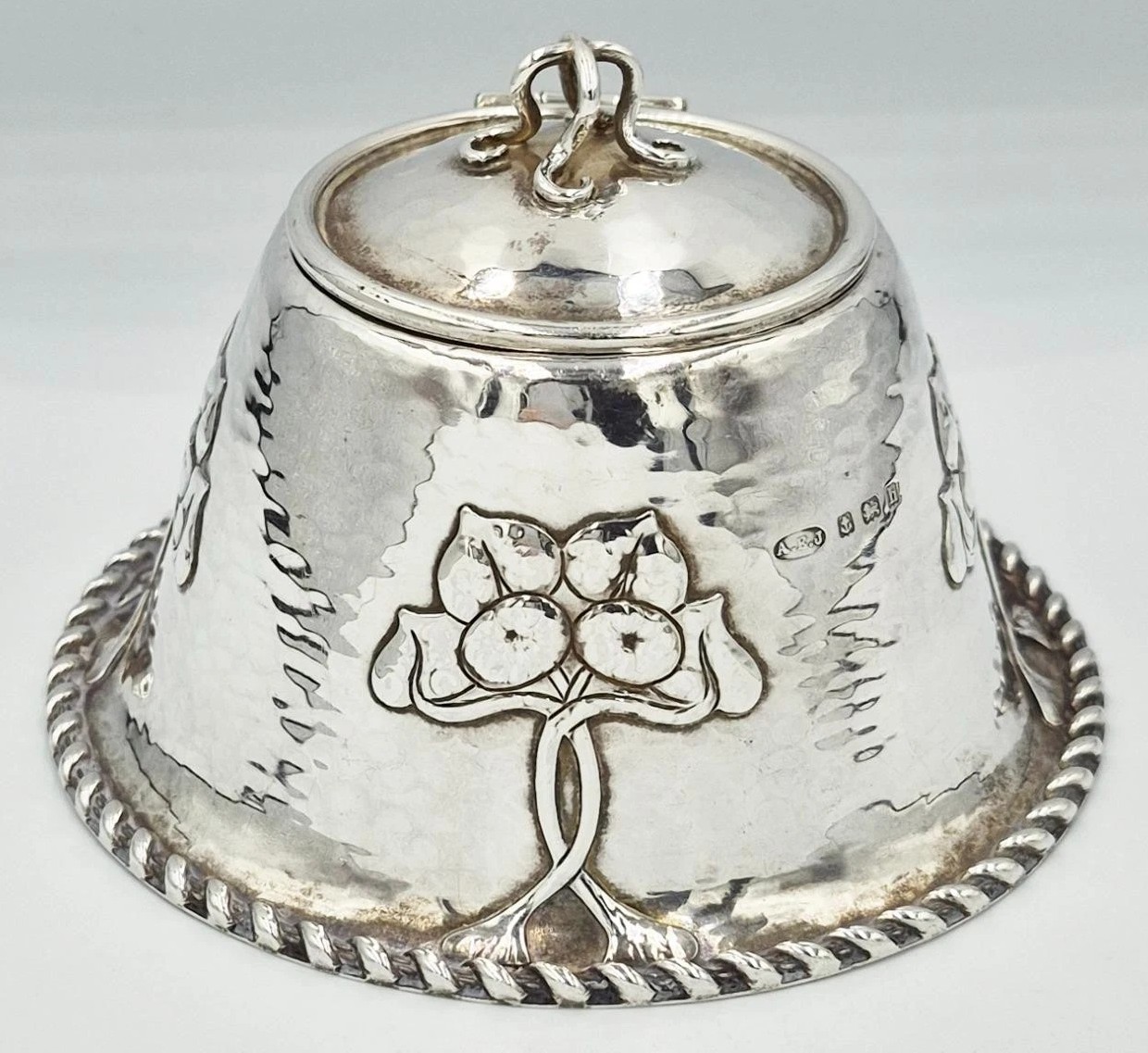
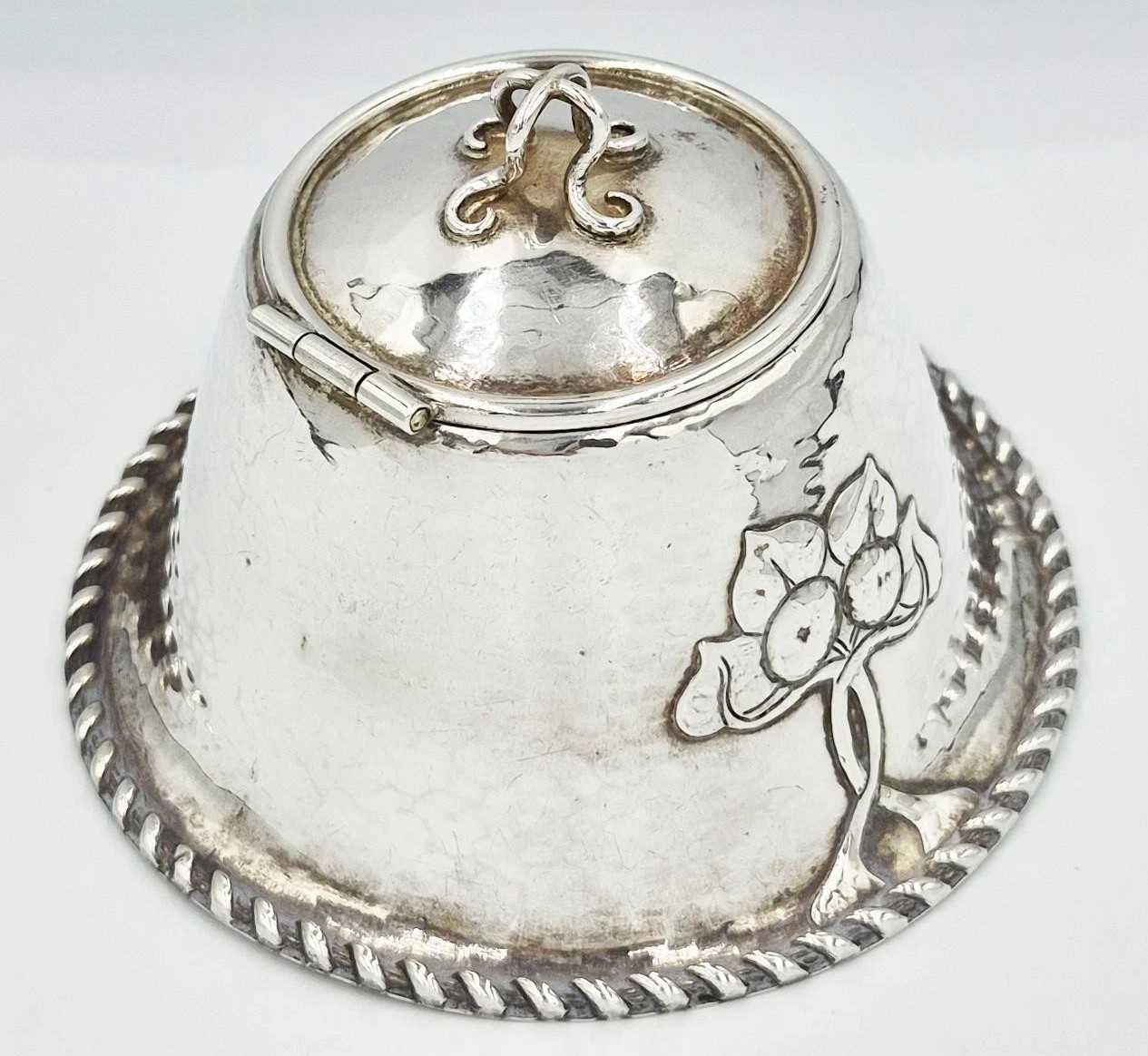
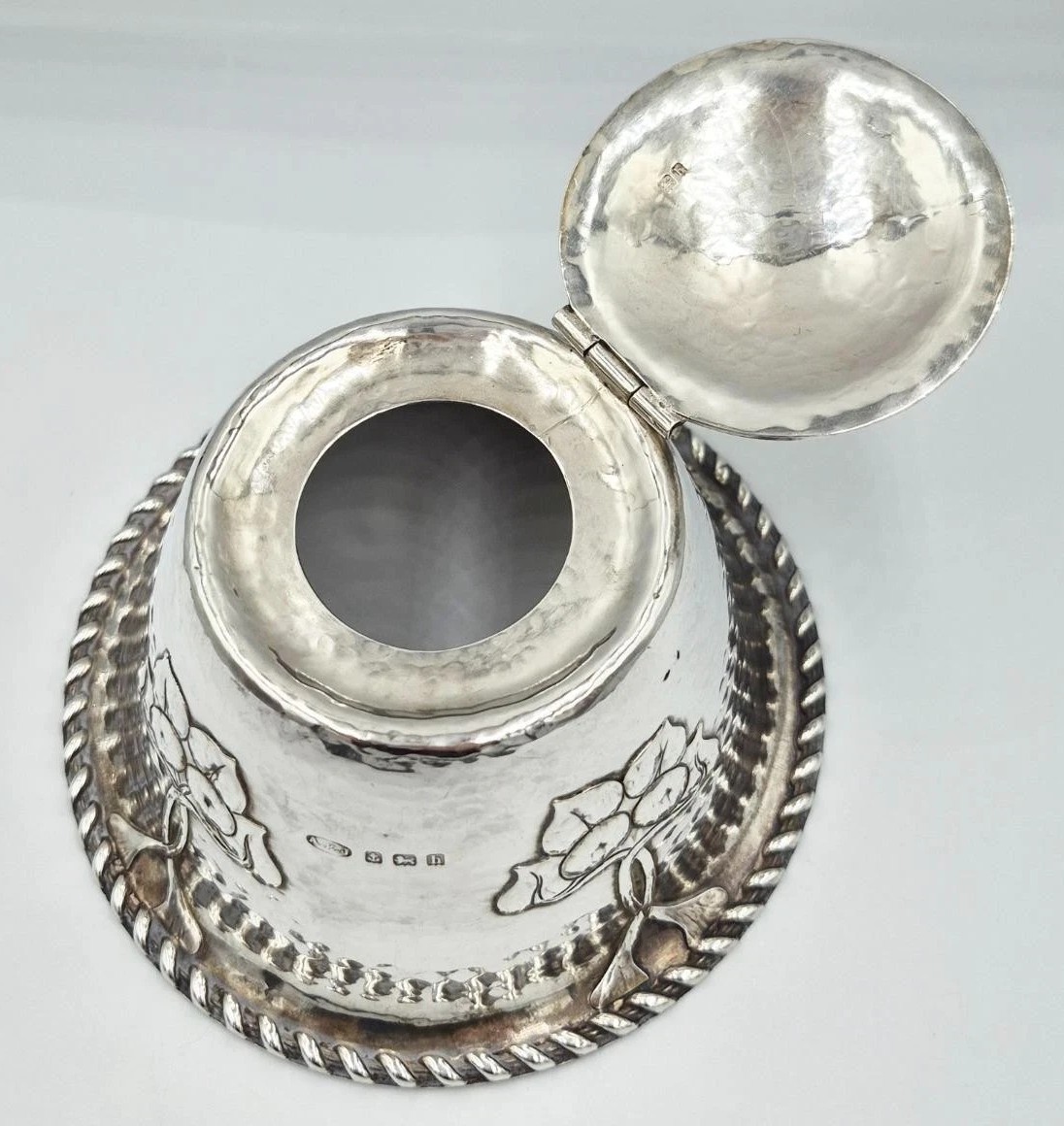
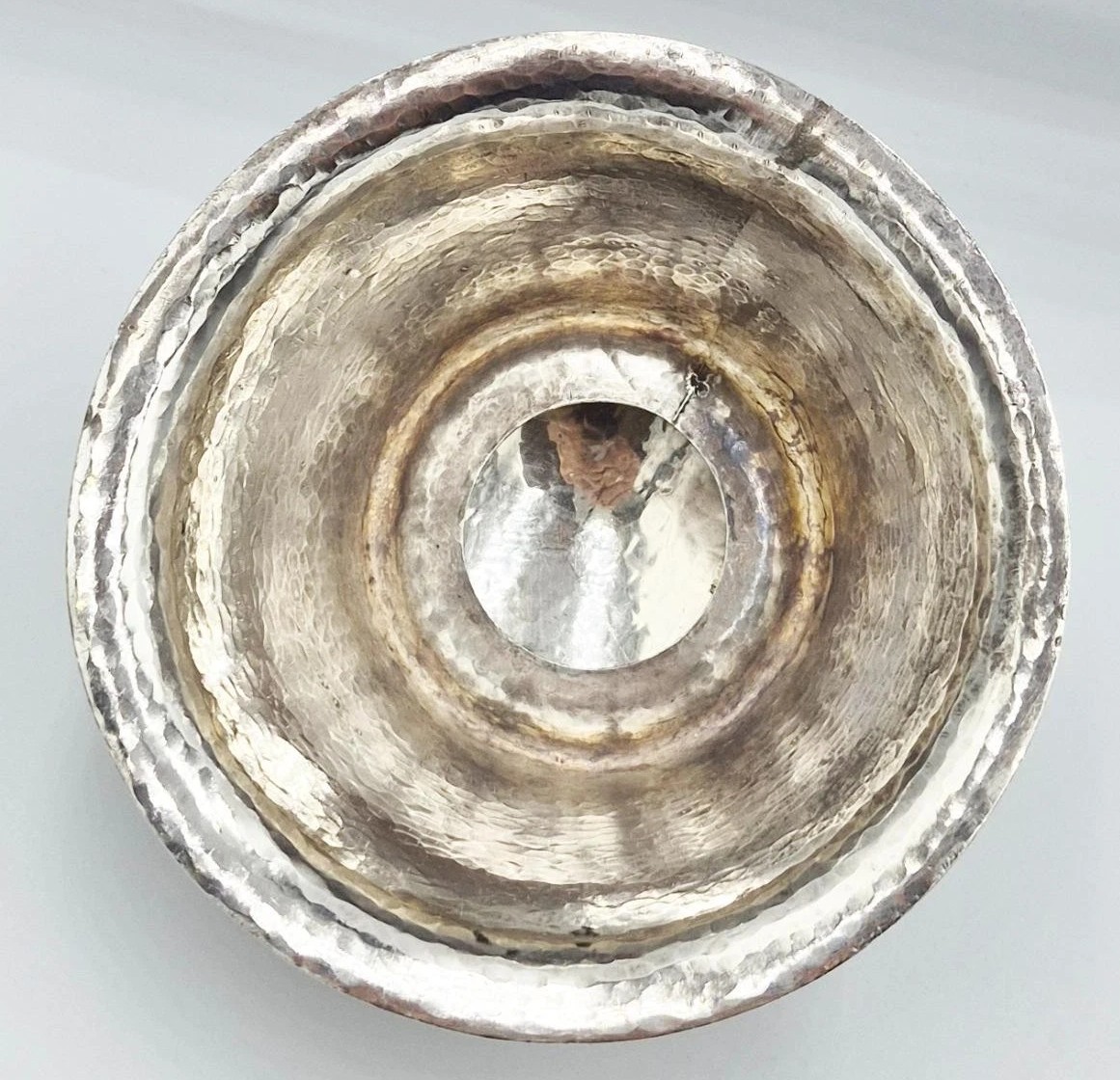
Form & Decoration The inkwell features a classic capstan or bell-shaped form, resting on a broad, slightly flared base. The entire exterior surface is finished with a fine hammered (planished or martelé) texture, a hallmark of hand-wrought Arts and Crafts metalwork designed to catch and soften the light.
The body is ornamented with three repoussé (embossed) stylized floral motifs. These motifs feature two circular flower heads – stylized poppies or anemones – with long, elegant stems that intertwine at the base in a manner typical of the transition between Art Nouveau and Arts and Crafts. The bottom edge of the inkwell is finished with a crisp rope-twist (corded) border, providing a sturdy visual weight to the piece.
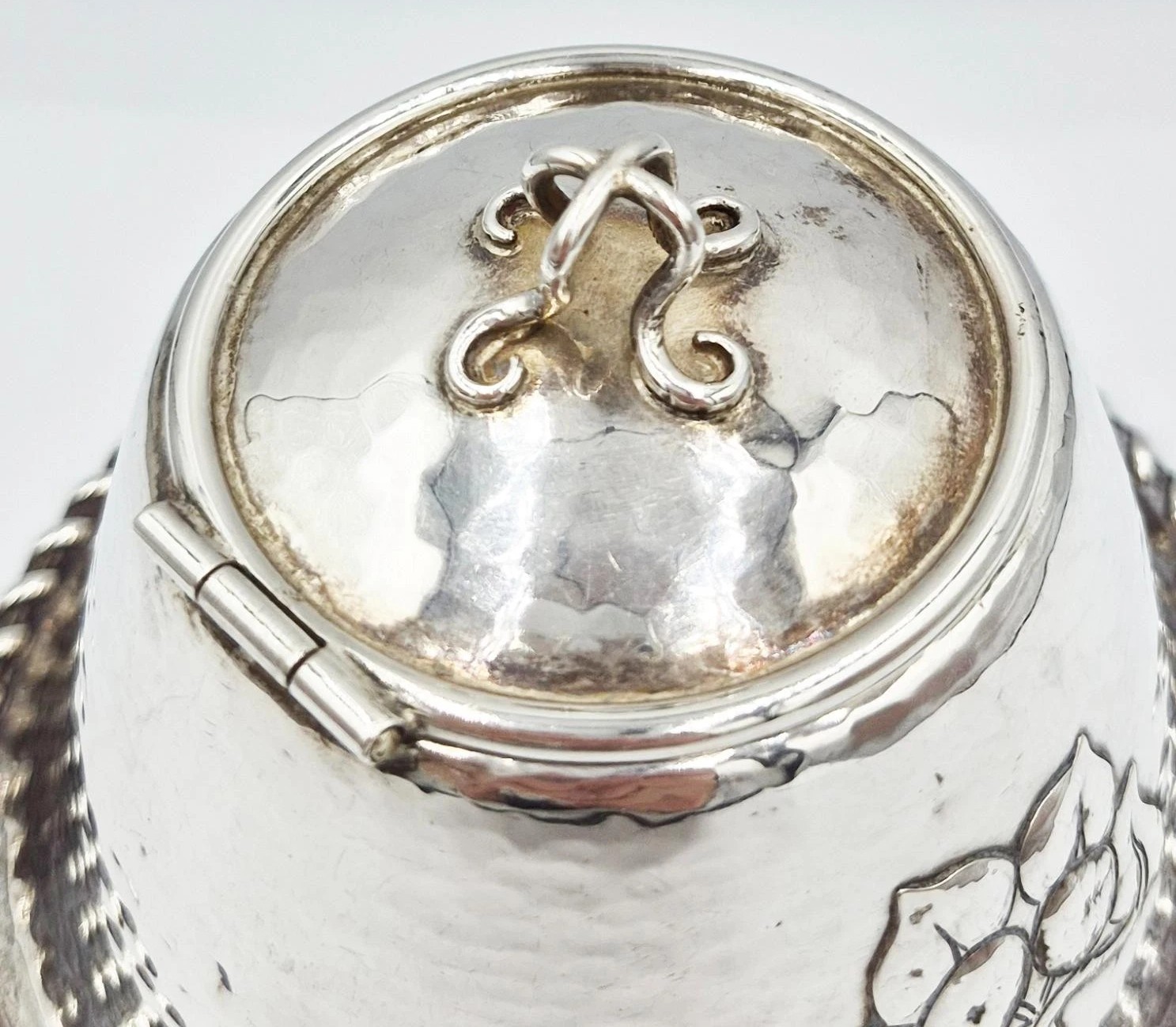
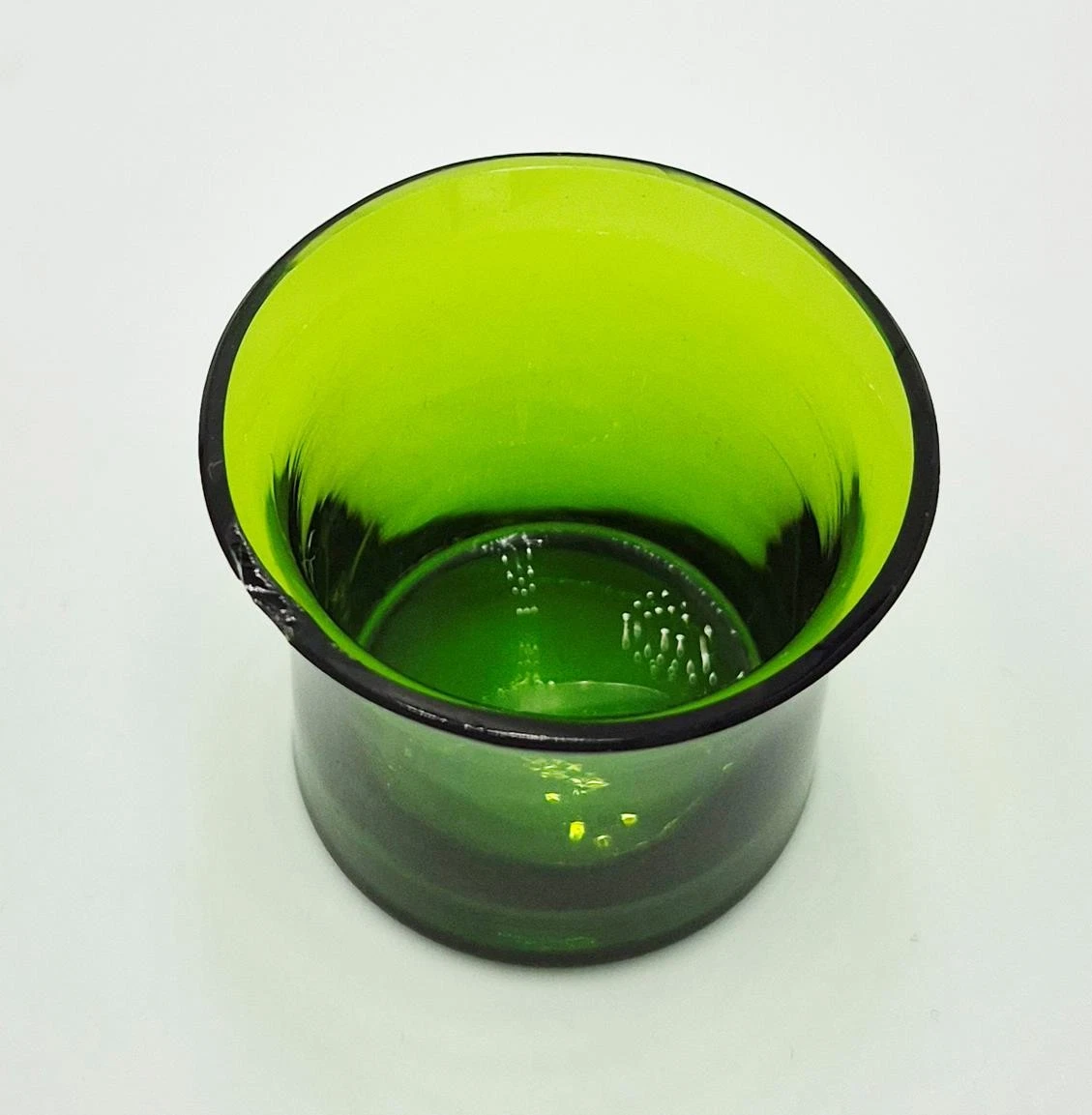
Lid & Interior The inkwell is fitted with a domed, hinged lid that continues the hammered texture. It is topped with a decorative scroll-wire finial, which serves as a delicate handle. Inside, the inkwell contains its original (or period-correct) vivid green glass liner. This specific shade of green is often associated with the glass produced by James Powell & Sons (Whitefriars), who frequently supplied glass components for high-end Birmingham silver firms during this era.
Hallmarks The hallmarks are crisp and clear:
- A.E.J in an oval: The maker’s mark for Albert Edward Jones.
- Anchor: The assay office mark for Birmingham.
- Lion Passant: The sterling silver standard mark.
- Lowercase ‘h’: The date letter for 1907.
About the Silversmith: Albert Edward Jones (1878–1954)
Albert Edward Jones was a pivotal figure in the Birmingham Arts and Crafts scene. Born into a family of craftsmen, he trained at the Birmingham Central School of Art under Edward Taylor and later worked as a Guildsman at the Birmingham Guild of Handicraft.
In 1902, he established his own firm, A.E. Jones & Co., with the mission of creating functional objects that were also works of art. He is celebrated for:
- Collaborative Design: He frequently collaborated with other artists and firms, most notably using Ruskin Pottery or Whitefriars glass for liners and mounts.
- Hand-Raised Quality: Unlike mass-produced silver of the Edwardian era, Jones’s pieces retained the visible marks of the craftsman’s hammer, emphasizing the human element in production.
- Stylized Motifs: His use of intertwined stems and organic, yet restrained, floral patterns became a signature of the firm’s early 20th-century output.
Historical Significance
By 1907, A.E. Jones had fully hit his stride. This piece is particularly desirable for collectors because it combines the three most sought-after elements of his work: the planished finish, the stylized organic repoussé, and a vibrant glass liner. It perfectly embodies the movement’s philosophy of bringing beauty to utilitarian objects—a “Spirit of Art” for the writer’s desk.
Sold for $1225 in March 2026
Content disclaimer. The information posted is the owner’s best knowledge and may not have been vetted by the SOIC. We welcome comments, corrections, and additions, working to make our website information comprehensive and accurate.
Join the Society of Inkwell Collectors (SOIC) – it’s free!
Founded in 1981 as a non-profit organization,
we are documenting inkwells (and accessories).
We’re here to help and inform!