

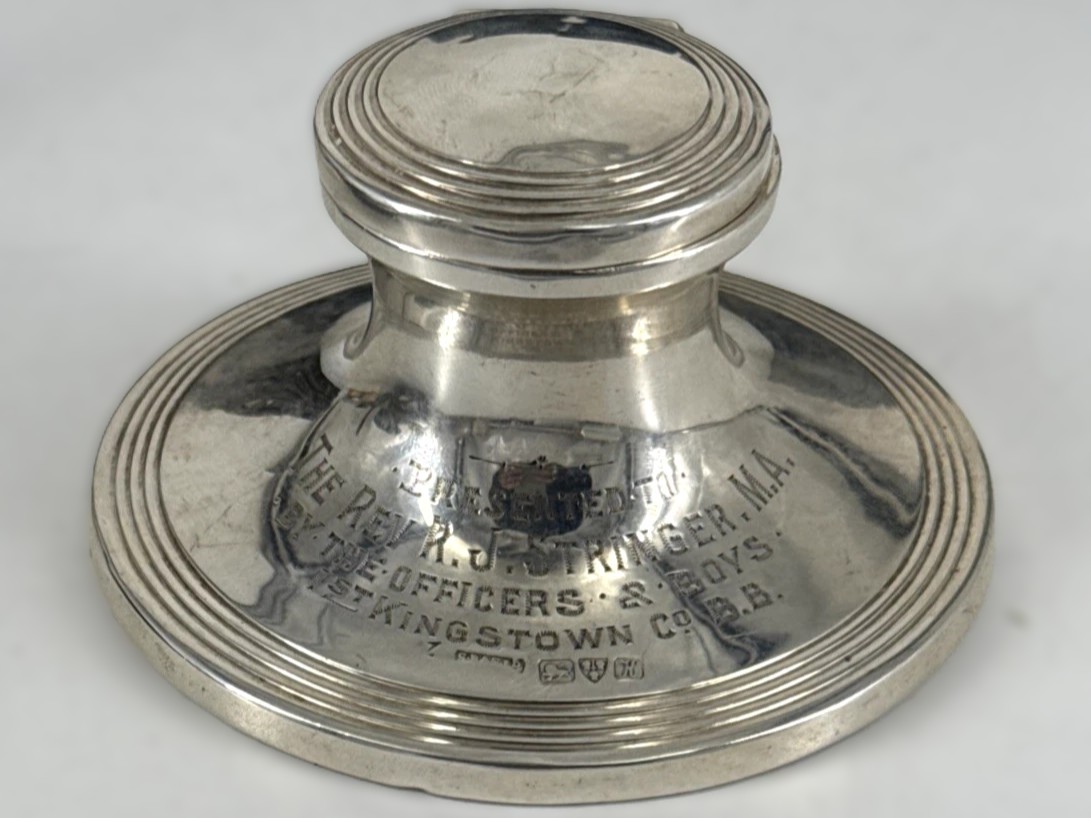
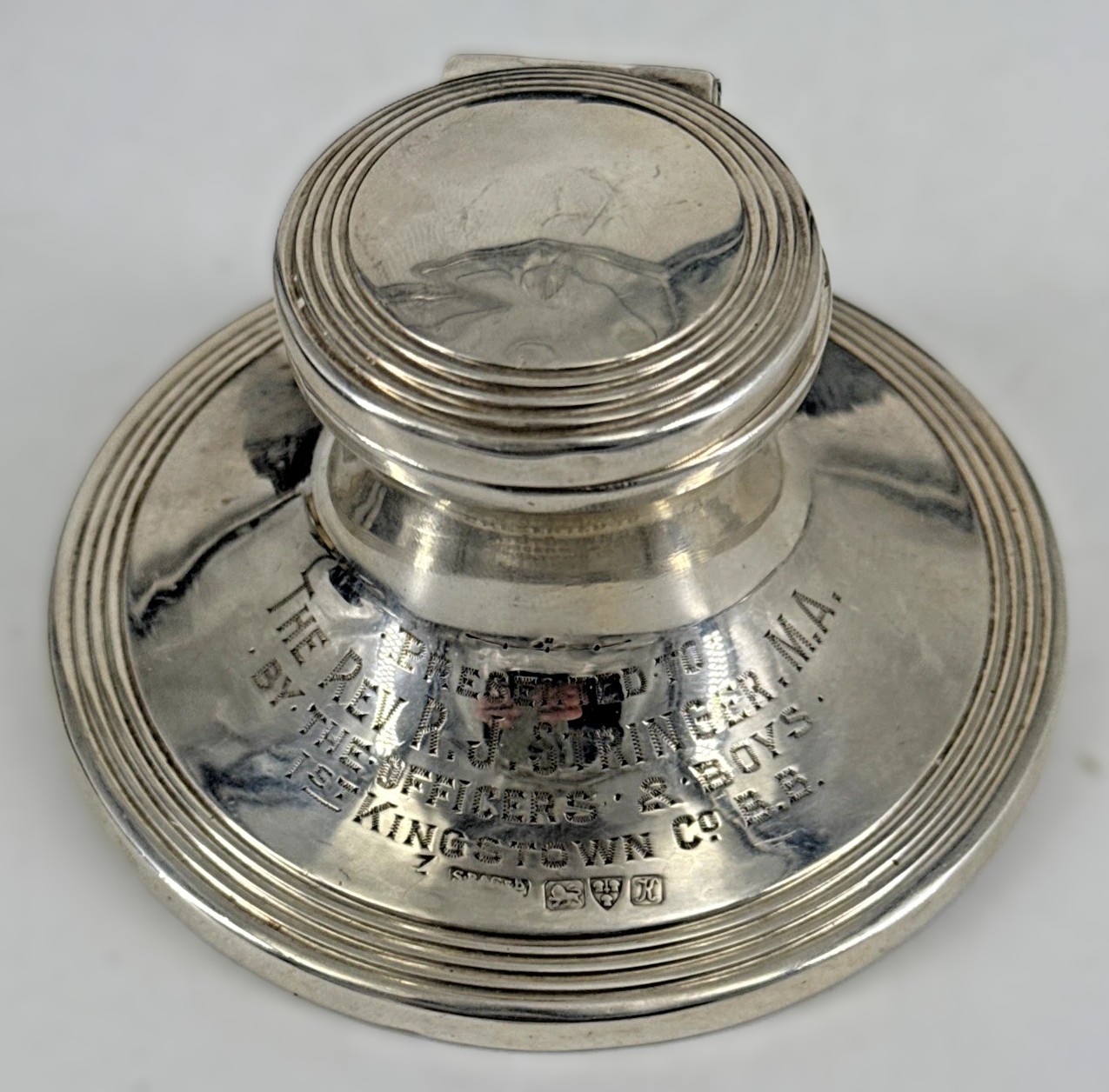


Sterling Silver Capstan Inkwell – Presentation Piece
| Categories | Presentation Piece |
| Type | Maritime |
| Material | Silver |
| Markings | See Narrative |
| Manufacturer | S. Blanckensee & Son Ltd. |
| Origin | England |
| Date or Era | circa 1910 |
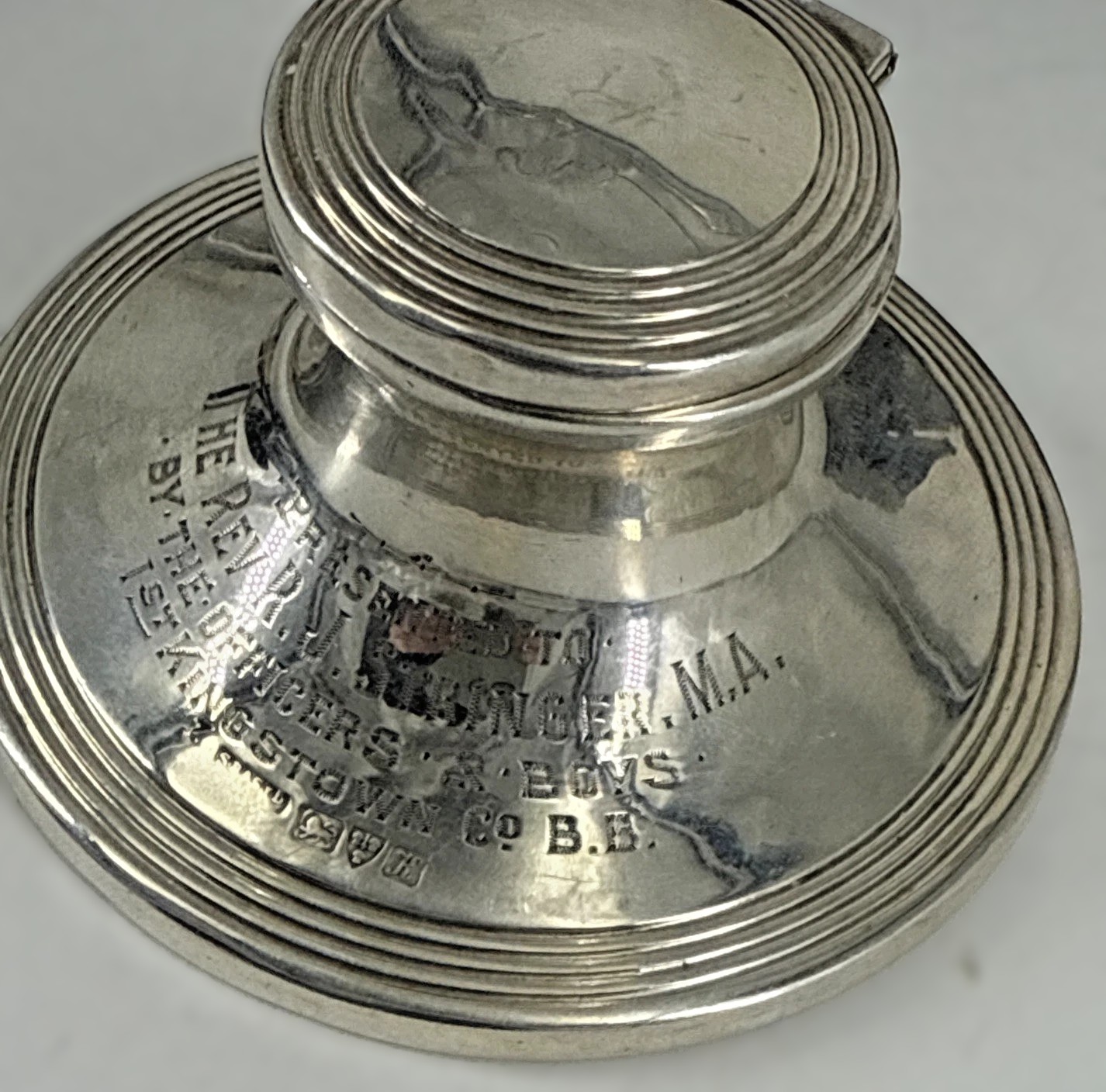
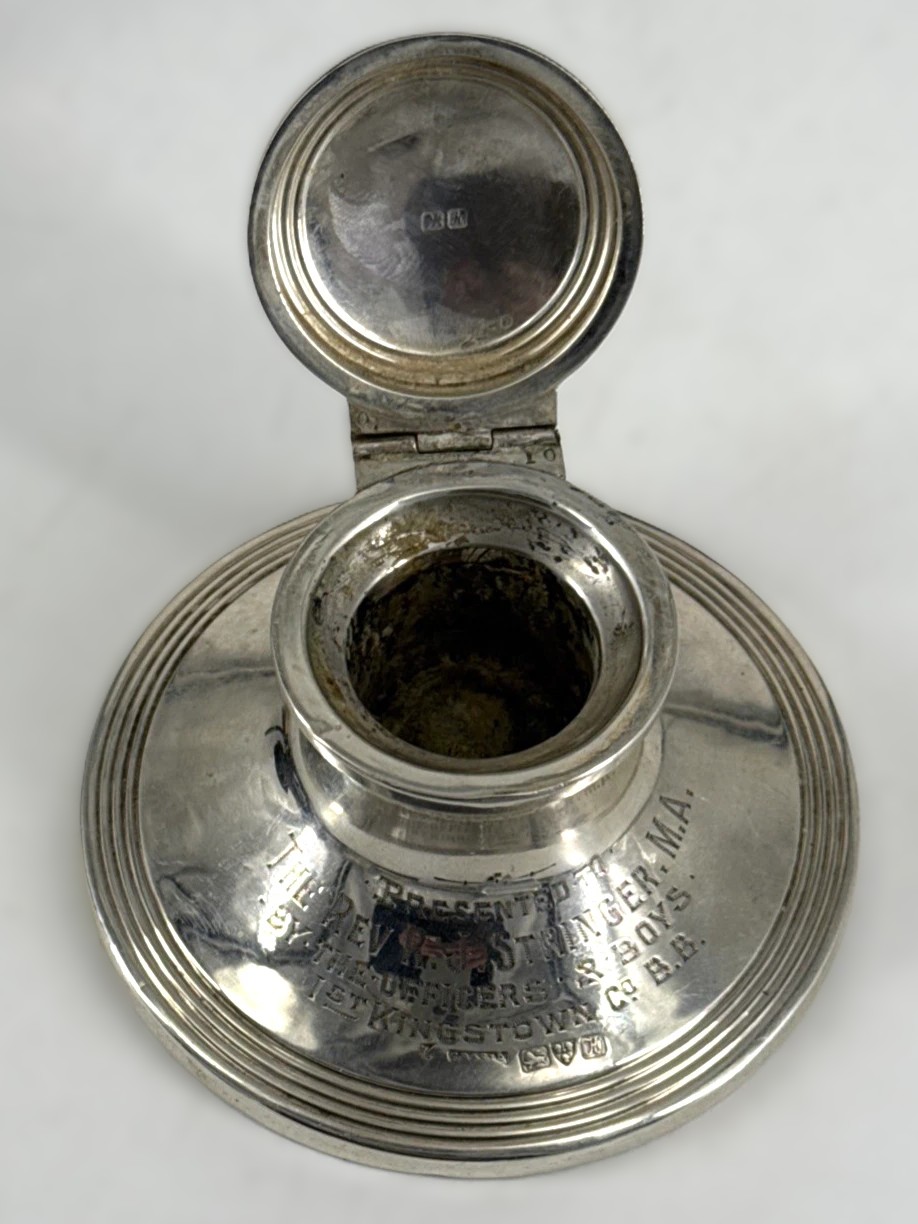
This inkwell is made in the classic “Capstan” style—so named because its flared, circular form mimics the nautical winches used on ships to wind in ropes or anchors. It features a weighted base (filled with wood or plaster to provide stability on a desk) and a hinged lid that opens to reveal the well (originally fitted with a glass liner – missing here). The nautical theme is appropriate for the maritime connection of the recipient.
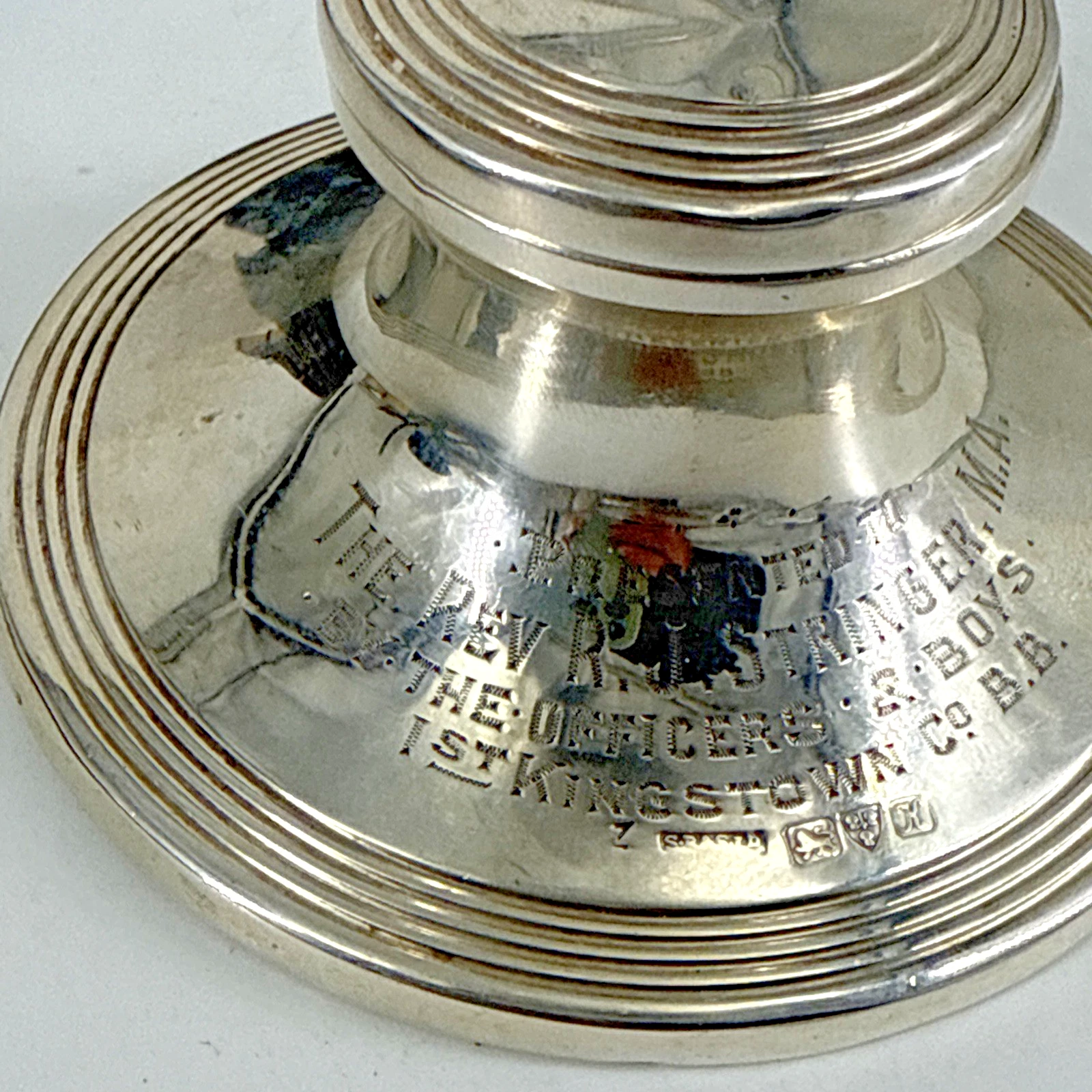
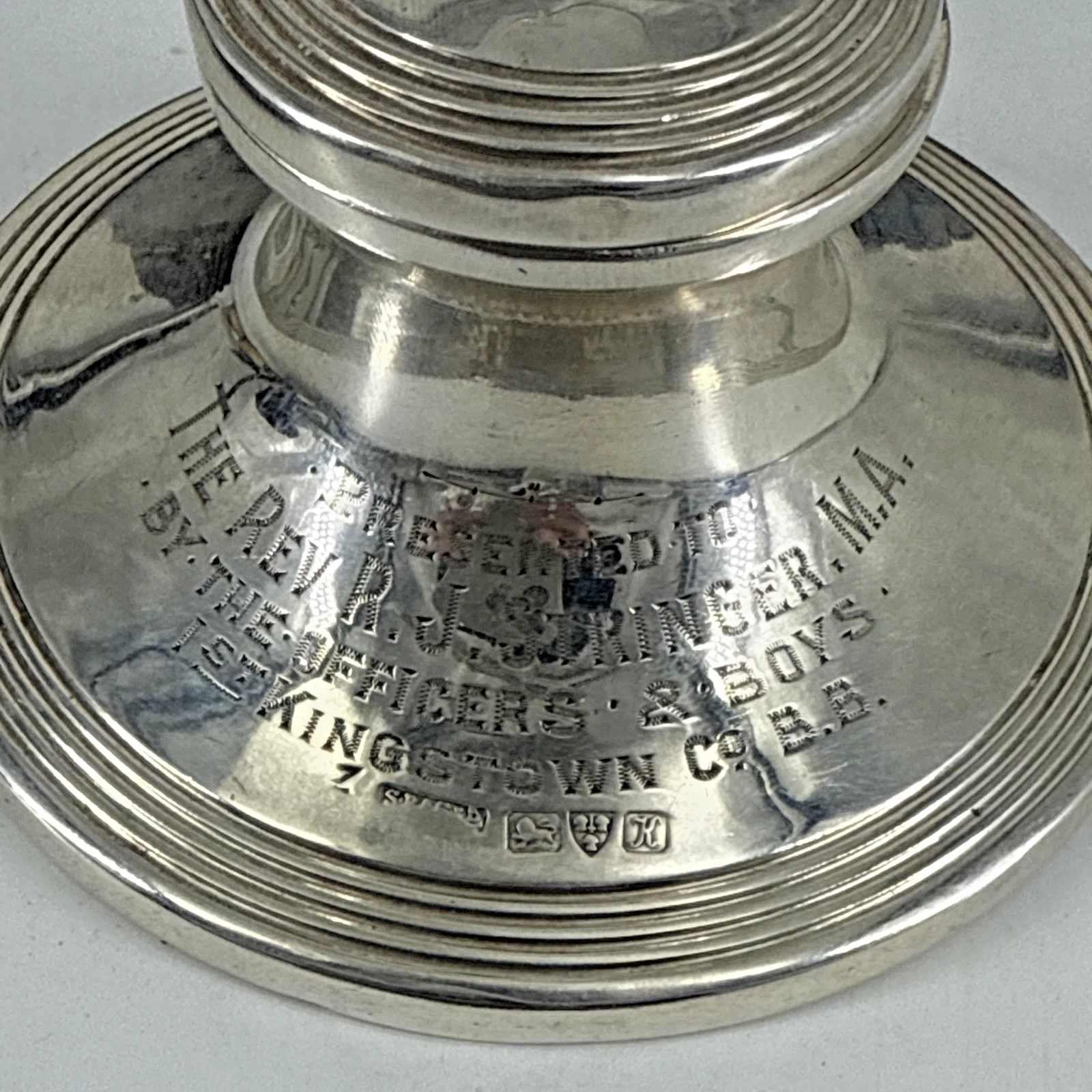
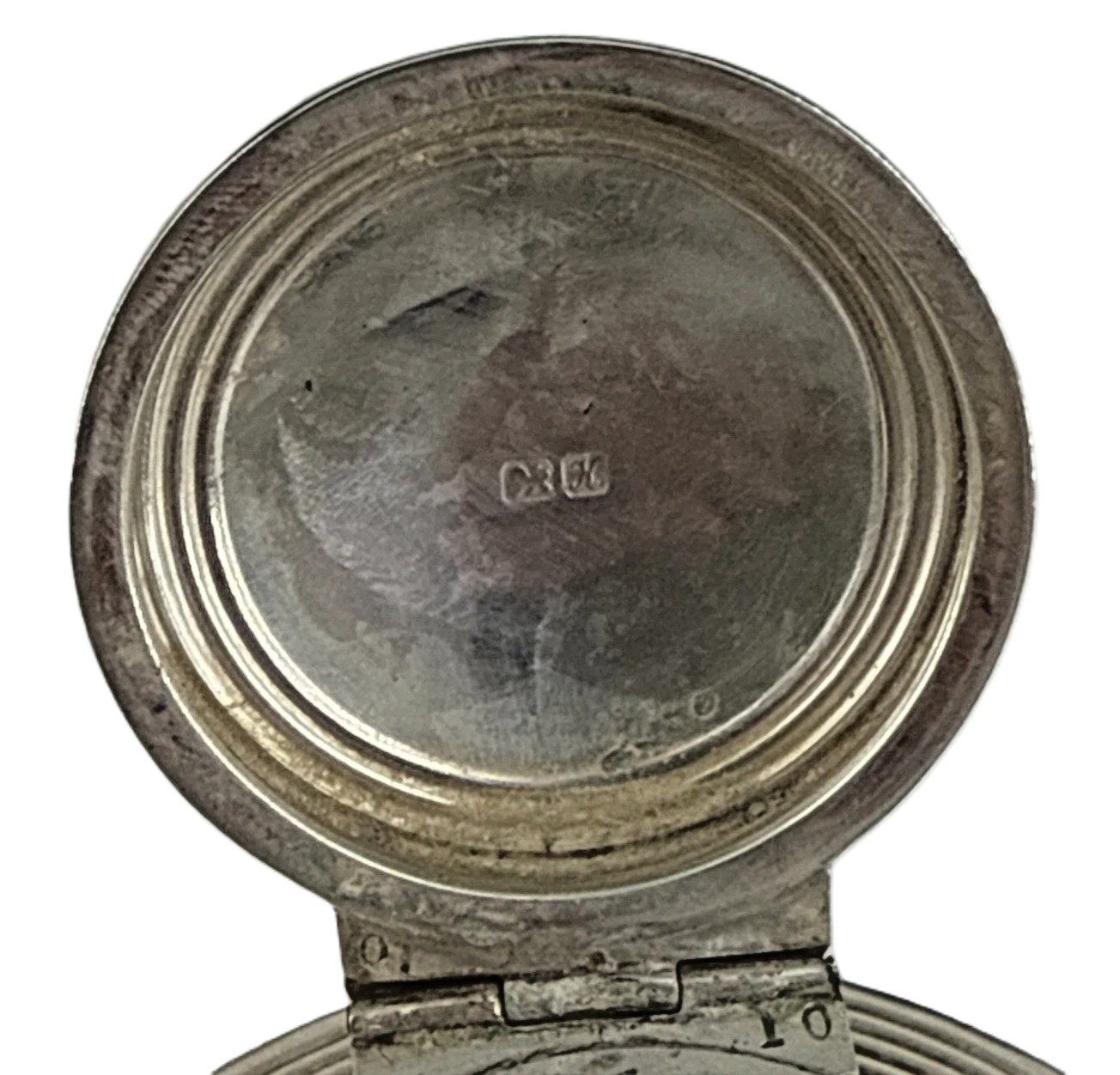
Hallmark Identification
Based on the markings, the piece was assayed in Birmingham in 1910:
- Anchor: The office mark for Birmingham.
- Lion Passant: The British mark for Sterling silver (.925 fineness).
- Date Letter ‘l’: The specific font and shield shape for the year 1910.
- Maker’s Mark (S.B&S LD): Confirms the maker as S. Blanckensee & Son Ltd.
The Maker: S. Blanckensee & Son Ltd.
Founded in 1826 by Solomon Blanckensee, an immigrant from Prussia, this firm became one of Birmingham’s most formidable and successful manufacturing jewelers and silversmiths.
- History: Initially based in Bristol, Solomon moved the family to Birmingham’s “Jewelry Quarter” to take advantage of the industrial boom. By the time of this inkwell’s manufacture, the firm was headquartered at Sovereign Hall (14/15 Frederick Street), a grand Italianate building that still stands today as a Grade II listed landmark.
- Reputation: They were known for combining cutting-edge technology with fashionable designs. They were large enough to absorb other famous makers like Stokes & Ireland and A & J Zimmerman, cementing their status as a premier supplier to high-end London retailers.
The Provenance: Reverend R. J. Stringer & The Boys’ Brigade
The inscription on the base provides a fascinating window into the religious and social history of early 20th-century Ireland:
“Presented to Reverend R.J. Stringer M.A. By The Officers & Boys 1st Kingstown Company Boys Brigade.”
Reverend Robert James Stringer, M.A.
Records from 1910 show that Rev. R. J. Stringer was a curate at the Mariners’ Church in Kingstown. The “M.A.” indicates he received his Master of Arts from Trinity College Dublin, the standard path for Church of Ireland clergy at the time.
The Mariners’ Church (built in 1837) was designed to serve the sailors and residents of Kingstown, then a vital royal port for the British Empire. Today, that church building houses the National Maritime Museum of Ireland.
The 1st Kingstown Company, Boys’ Brigade
The Boys’ Brigade (BB) was the world’s first uniformed youth organization, founded in 1883 with the goal of “the advancement of Christ’s Kingdom among Boys.”
- The 1st Kingstown Company was officially associated with the Mariners’ Church.
- The Gift: This inkwell was a presentation piece given to Rev. Stringer as a token of appreciation from the boys and officers he led. It was common for a congregation or youth group to gift a silver item to a departing or particularly beloved leader.
- The Thematic Connection: Gifting a capstan-shaped inkwell to a clergyman at the Mariners’ Church was a clever and thoughtful nod to the nautical character of his parish and the port city they called home.
Summary:
Edwardian Sterling Silver Capstan Inkwell (1910) Maker: S. Blanckensee & Son Ltd., Birmingham. Provenance: A presentation gift to Rev. R. J. Stringer, M.A., from the 1st Kingstown (Dún Laoghaire) Boys’ Brigade. Historical Note: Rev. Stringer served at the famous Mariners’ Church in Kingstown, Ireland. The inkwell’s “capstan” shape—mimicking a ship’s winch—was a deliberate tribute to the nautical heritage of the Mariners’ parish. A fine piece of Irish ecclesiastical and maritime-linked social history.
Sold for $175 in March 2026
Content disclaimer. The information posted is the owner’s best knowledge and may not have been vetted by the SOIC. We welcome comments, corrections, and additions, working to make our website information comprehensive and accurate.
Join the Society of Inkwell Collectors (SOIC) – it’s free!
Founded in 1981 as a non-profit organization,
we are documenting inkwells (and accessories).
We’re here to help and inform!