

Standish with Taper Stick
| Categories | Silver |
| Type | Standish |
| Material | Silverplate |
| Markings | Unmarked |
| Manufacturer | Undetermined |
| Origin | England |
| Date or Era | circa 1850 |
| Measuring | 9” long |
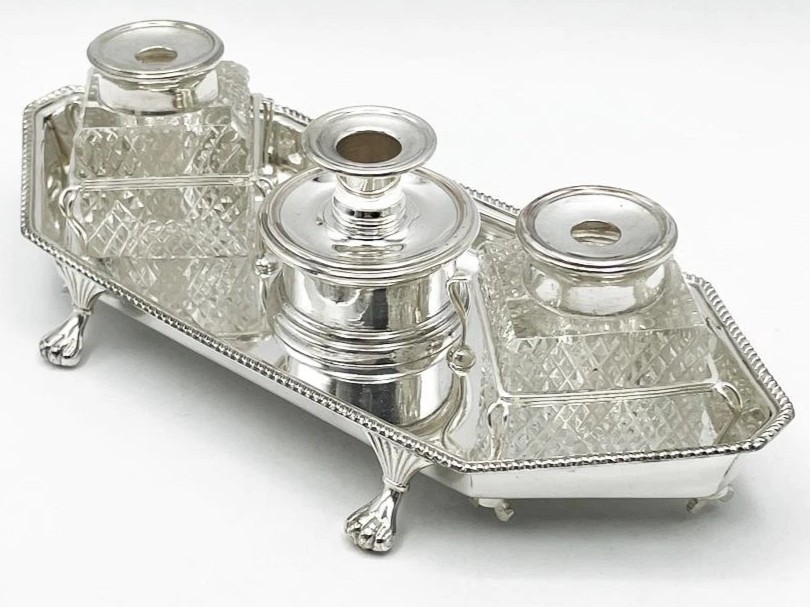
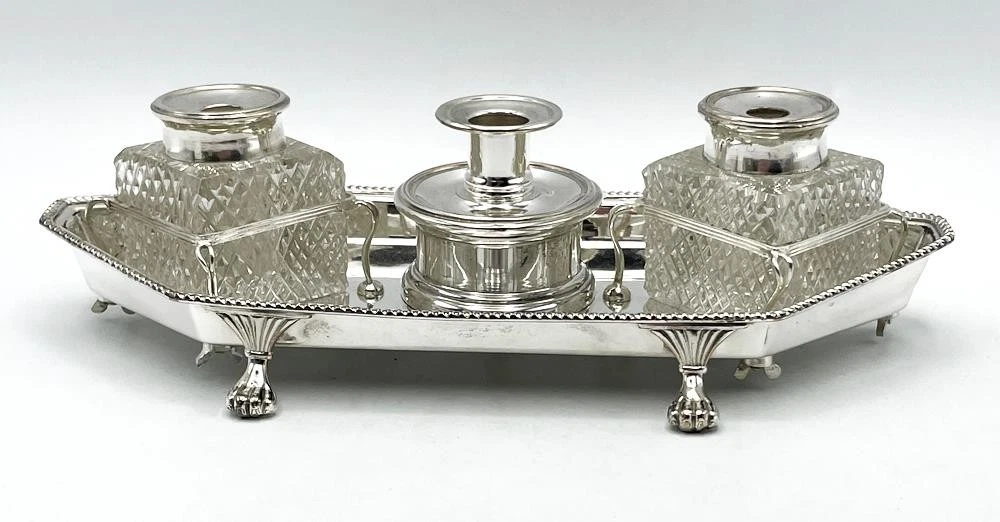
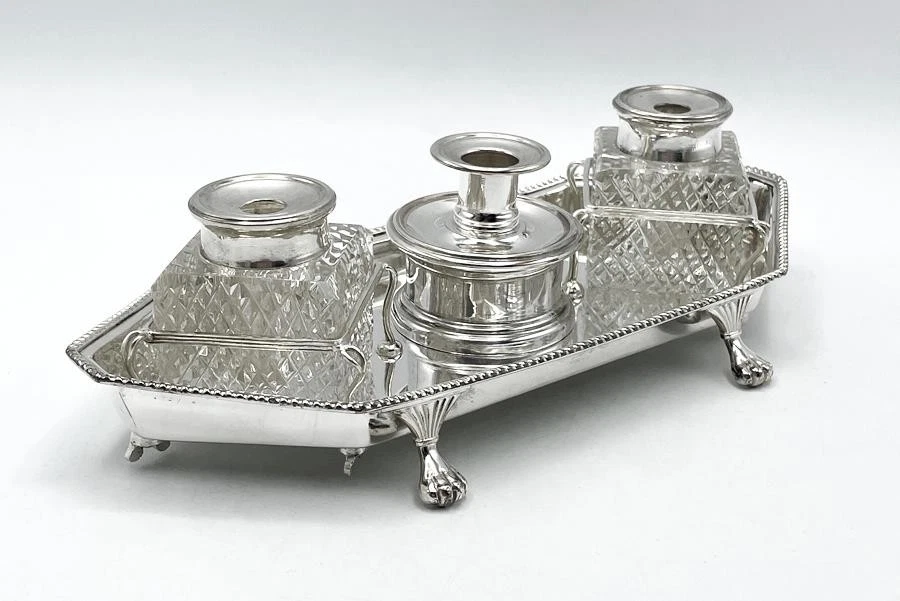
This is a classic, high-quality English silverplated inkstand (historically referred to as a standish). It features a refined neoclassical design that balances utility with elegant symmetry.
Detailed Description
The Tray and Feet
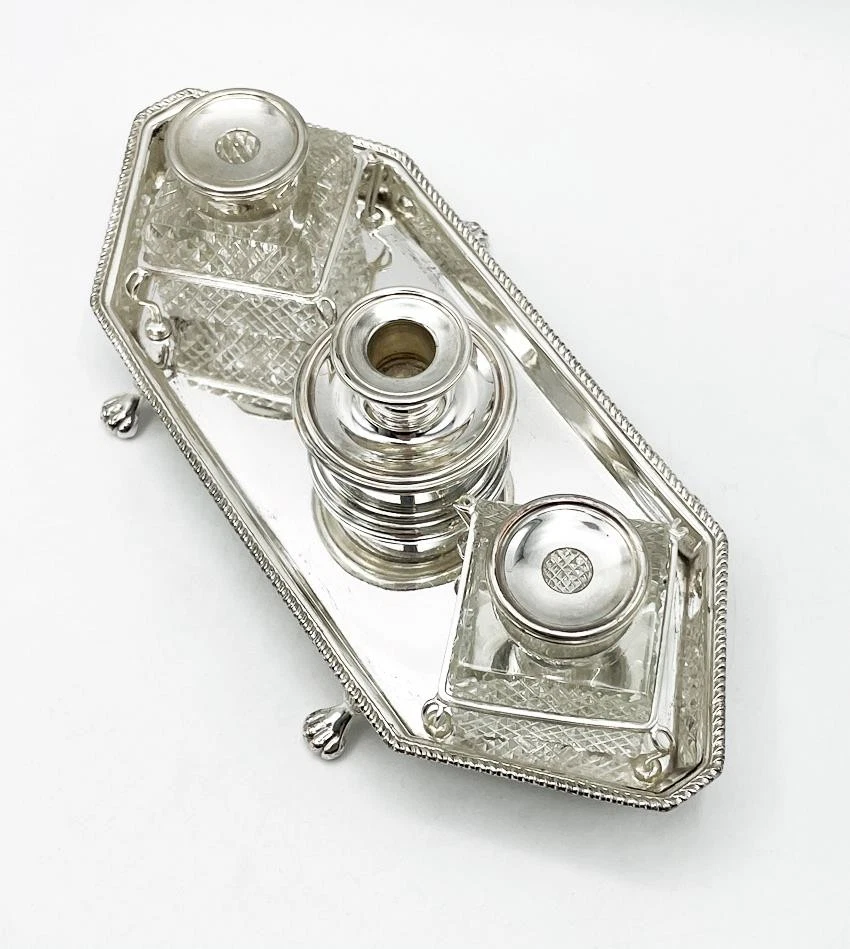
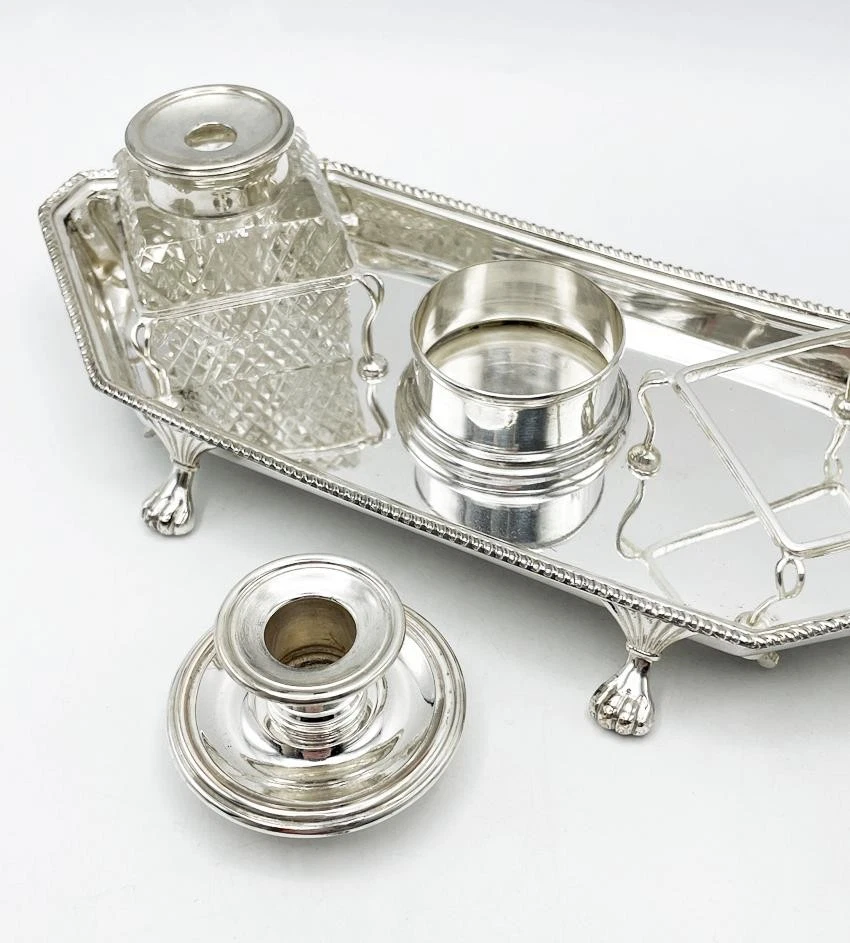
- Shape & Border: The tray has an elongated octagonal (or elongated hexagonal) form with a raised, flared rim. The edge is finished with a crisp, classic beaded border (sometimes called a perlé rim), a quintessential neoclassical motif.
- The Feet: The standish is supported by four cast silverplated claw-and-ball feet. The upper portions of the feet feature stylized shell or acanthus leaf knees where they join the body of the tray.
The Inkwells
- Glassware: The two matching inkwells are made of square, heavy, clear glass and decorated with a sharp, deep diamond-point (hobnail) cut pattern.
- Mounts: Each inkwell is fitted with a silverplated collar and a matching circular, flat-topped lid.
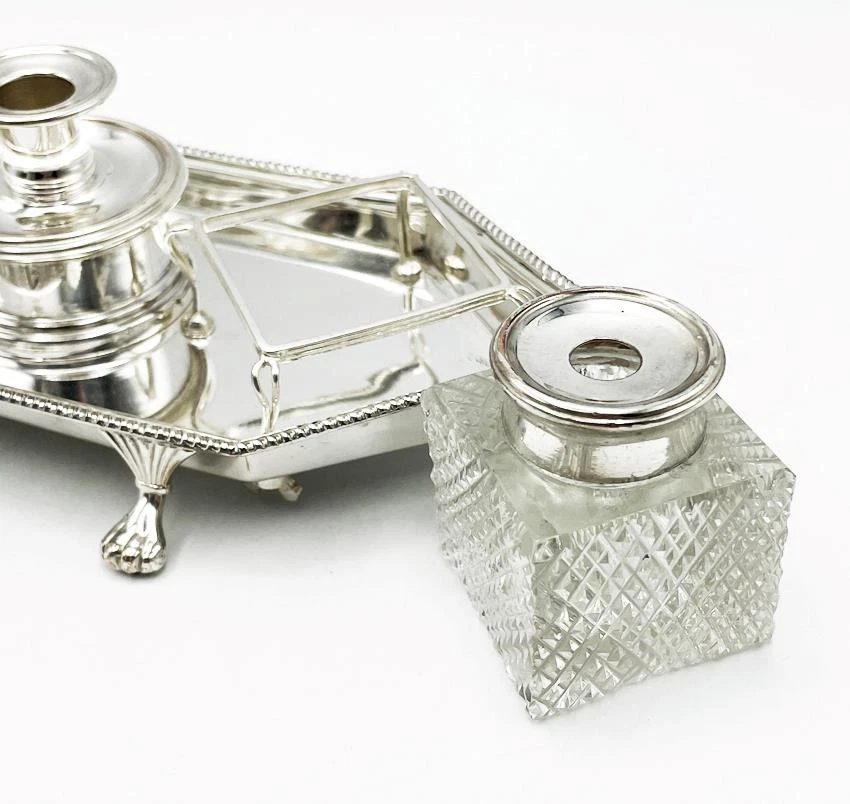
- Retaining Frames: To prevent the glass from sliding, the tray features two integrated, square wirework retaining cages that hold the inkwells securely in place.
Central Sealing Wax Box & Candle Sconce
- The Sconce: The center of the inkstand is dominated by a cylindrical taper stick (candle sconce) with a turned, flared nozzle designed to hold a small taper candle.
- The Box: The candle sconce serves as the removable lid for a cylindrical container underneath. Historically, this central box was used to store sealing wax, wafer seals, or matches. The candle was lit to melt the wax when sealing letters.
Underside Construction
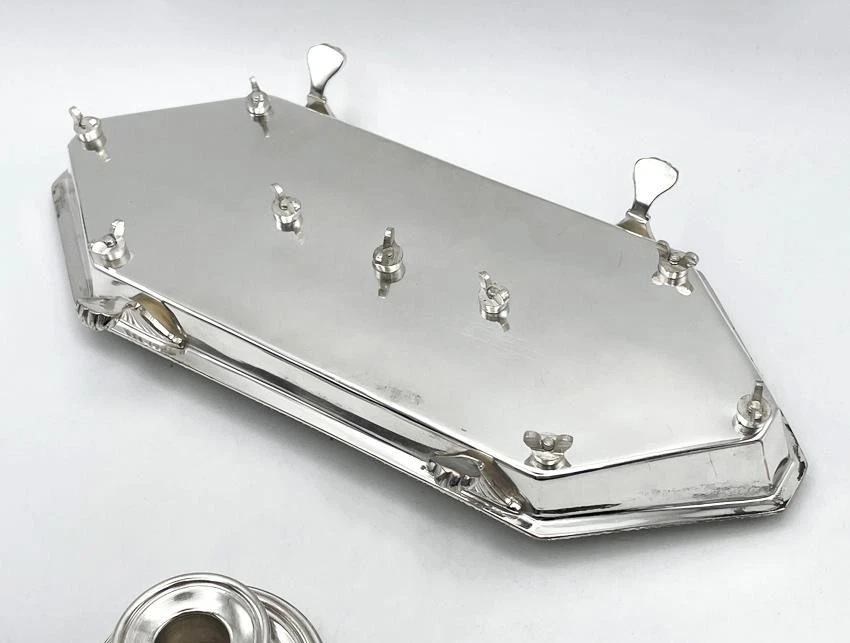
- One of the most telling features of this piece is visible on the underside. It features a series of hand-turned wing nuts and threaded bolts sticking through the bottom of the tray. This mechanical assembly allowed the user to completely unscrew the wire cages and the central wax box from the tray so the silver could be safely polished, and the glass bottles washed without trapping water in the joints.
Date of Manufacture and Origin
Estimated Date: Circa 1820–1850 (Late Georgian / Regency to Early Victorian)
Origin: England
This specific layout—two diamond-cut bottles flanking a central wafer box/taper stick on an octagonal beaded tray—is a quintessentially British design that gained immense popularity during the Regency period (George IV) and carried over into the early years of Queen Victoria’s reign.
Why this date range fits:
- Design Vocabulary: The combination of the beaded rim, geometric tray shape, and claw-and-ball feet strongly points to the neoclassical revival of the 1810s–1830s.
- The Underside Bolts: The use of prominent wing-nut fasteners on the underside is standard practice for high-quality English bench-made metalwork from the first half of the 19th century. By the late Victorian era (1880s and onward), manufacturing shifted toward integrated stamping, soldering, and standardized machine screws.
- Metalwork Type: It is likely an early piece of EPNS (Electroplated Nickel Silver) from the 1840s or 1850s.
Sold for $150 in April 2026
Content disclaimer. The information posted is the owner’s best knowledge and may not have been vetted by the SOIC. We welcome comments, corrections, and additions, working to make our website information comprehensive and accurate.
Join the Society of Inkwell Collectors (SOIC) – it’s free!
Founded in 1981 as a non-profit organization,
we are documenting inkwells (and accessories).
We’re here to help and inform!