

Inkipedia

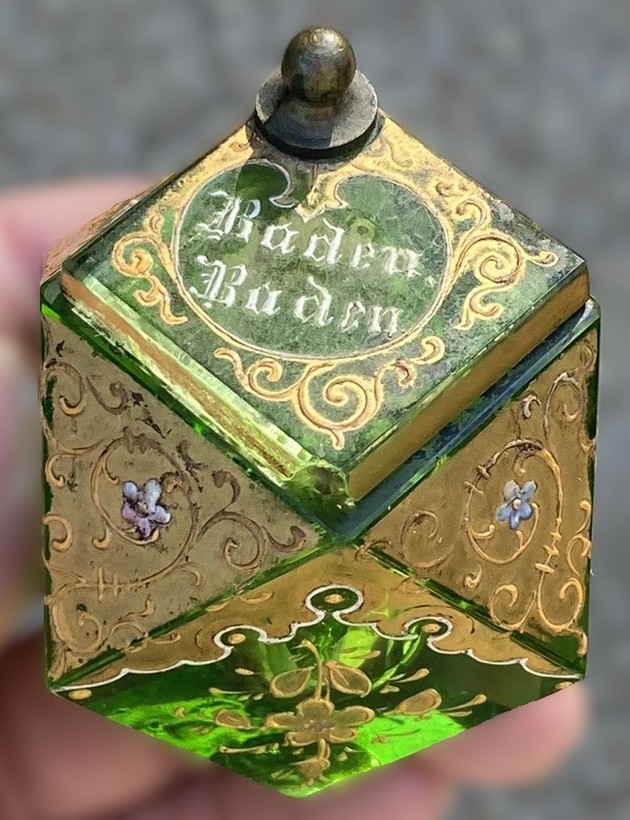


Souvenir Inkwell – Baden-Baden Germany
| Categories | Souvenir |
| Material | Glass |
| Markings | Baden Baden |
| Manufacturer | Undetermined |
| Origin | Germany |
| Date or Era | circa 1880 |
| Measuring | 2 ⅛” high |
This is a souvenir inkwell from the famous German spa town of Baden-Baden.
- Description of the Inkwell
- Form: The inkwell is a heavy cube of emerald green glass. It is cut with chamfered (beveled) corners to create a faceted, jewel-like appearance.
- The Lid: The top features a flat glass lid that is engraved and gilded with the text “Baden Baden” in a traditional German Fraktur (Gothic) script.
- Mechanism: The lid swivels horizontally on a pin rather than flipping up on a hinge.
- Decoration: The sides are heavily decorated with Rococo-style scrollwork in gold, framing hand-painted enamel flowers (Forget-me-nots and white violets).
- The Gilded Overlay Technique
- Technique: This is Raised Paste Gilding (or Relief Enamel).
- Process:
- The artist first painted the scroll design using a thick, putty-like paste (often a mix of glass powder and oil).
- This raised design was fired in a kiln to harden it.
- Gold Leaf or high-quality gold paint was applied over the raised paste and fired again.
- Finally, the gold was burnished (polished) to a high shine. This creates a 3D texture that looks like solid metal but is actually painted glass.
- Origin and History: Baden-Baden
- Origin: The glass was almost certainly made in Bohemia (modern-day Czech Republic) or a German glass center (like the Bavarian Forest) specifically for the tourist market in Baden-Baden.
- Baden-Baden History: Located in the Black Forest, Baden-Baden was the “Summer Capital of Europe” in the 19th century.
- The Clientele: It was the playground of royalty and the ultra-wealthy. Queen Victoria, Kaiser Wilhelm I, Napoleon III, and Russian aristocrats (like Dostoevsky and Turgenev) frequented its thermal baths and famous casino.
- The Souvenir: Because the visitors were wealthy, the souvenirs sold in the promenade shops were of high quality—like this heavy, hand-gilded crystal inkwell—rather than cheap trinkets.
- Age
- Date: Circa 1870–1900 (Late Victorian / Gründerzeit).
- The specific “Emerald Green” glass was incredibly popular in the 1880s.
- The use of the Gothic script and the raised gold scrollwork is typical of Central European decorative arts from the late 19th century.
Sold for $176 in November 2025
Content disclaimer. The information posted is the owner’s best knowledge and may not have been vetted by the SOIC. We welcome comments, corrections, and additions, working to make our website information comprehensive and accurate.
Join the Society of Inkwell Collectors (SOIC) – it’s free!
Founded in 1981 as a non-profit organization,
we are documenting inkwells (and accessories).
We’re here to help and inform!