

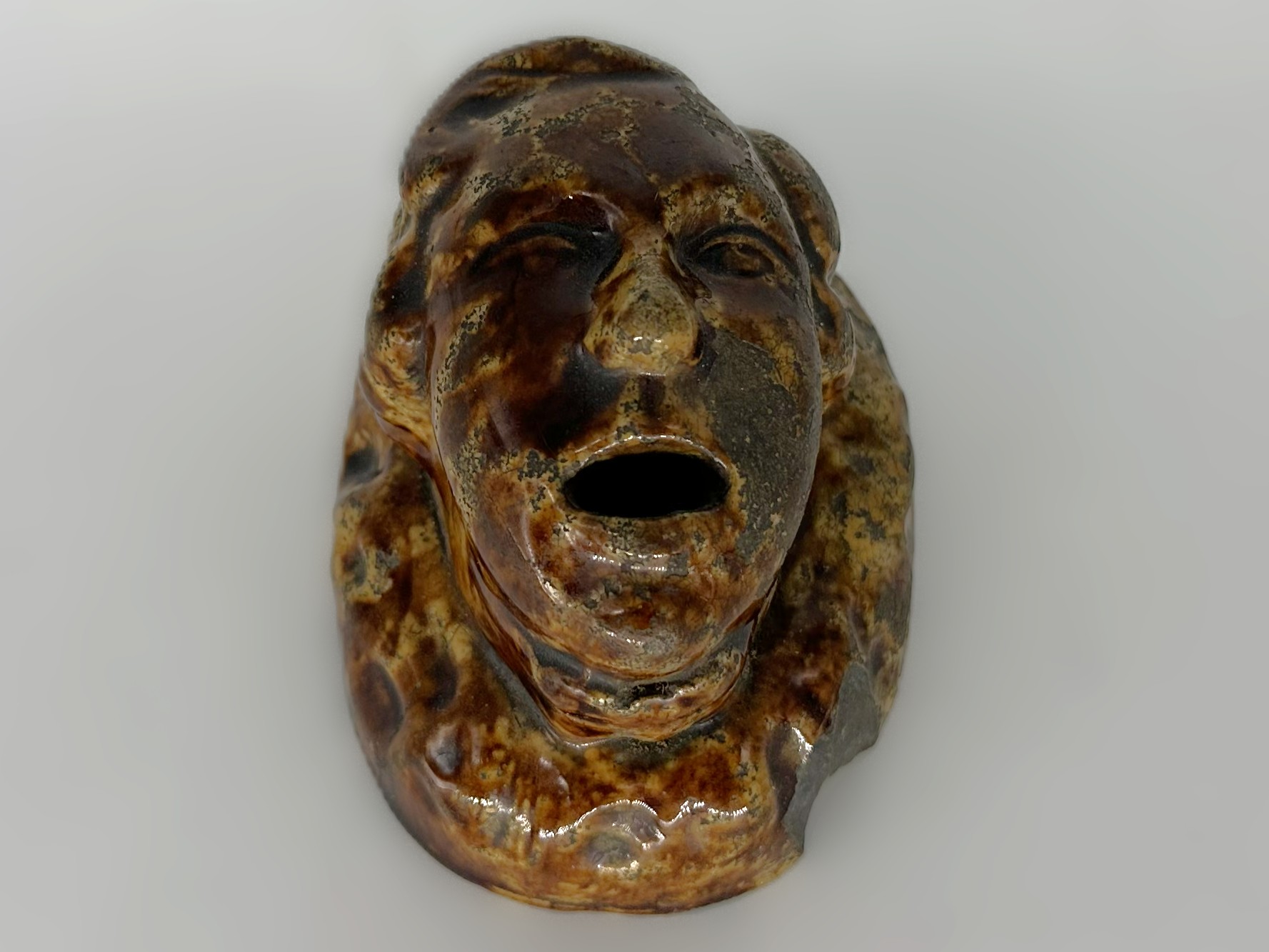


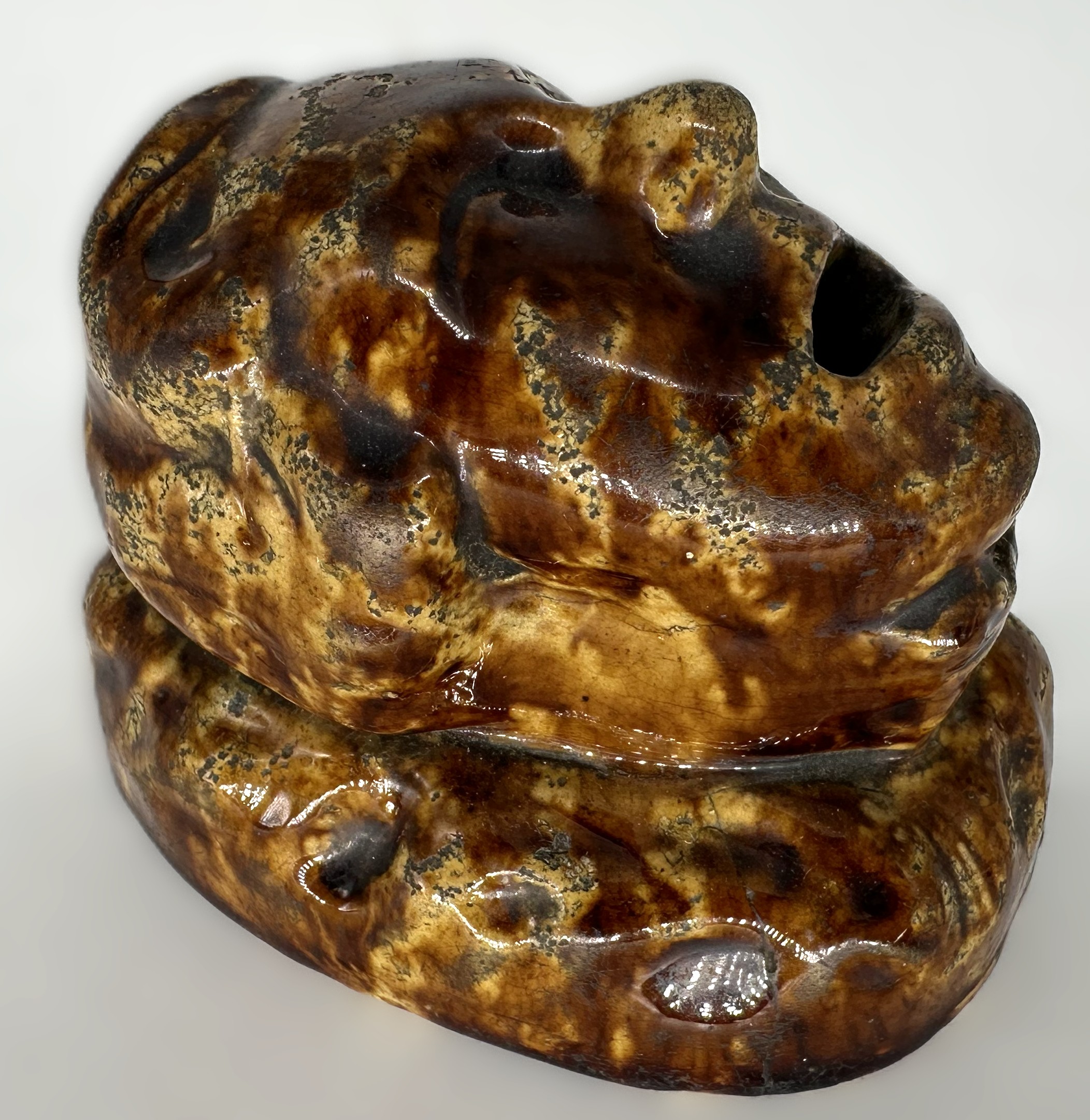
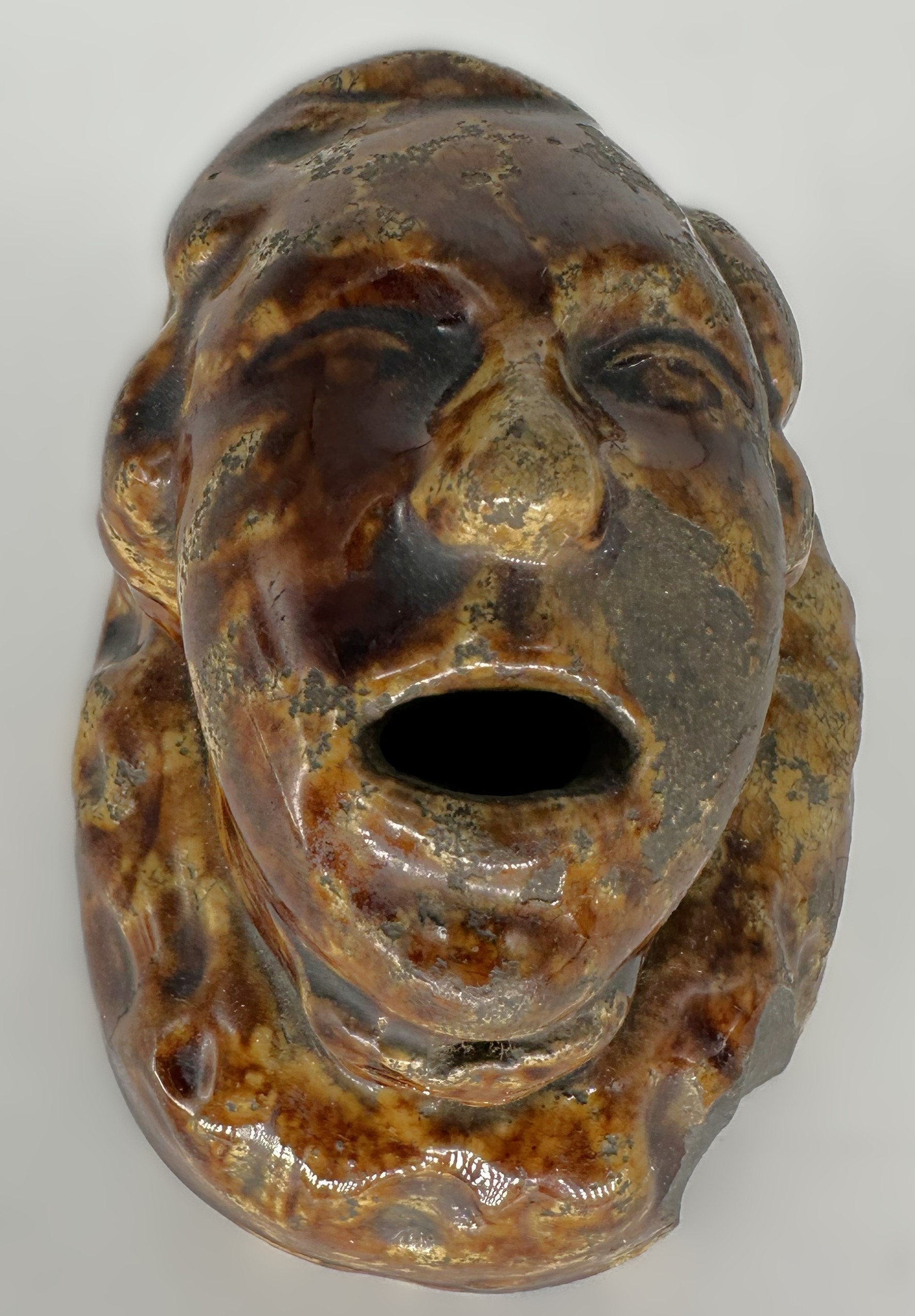

Sir Walter Scott Inkwell with Rockingham Glaze
| Categories | Figural - Mythology; Literature; Religion; Fictional |
| Type | Literature |
| Material | Pottery |
| Markings | Unmarked |
| Manufacturer | Undetermined |
| Origin | England |
| Date or Era | circa 1840 |
| Measuring | 4” x 3” x 3 ¼” high |
- Description and Assessment
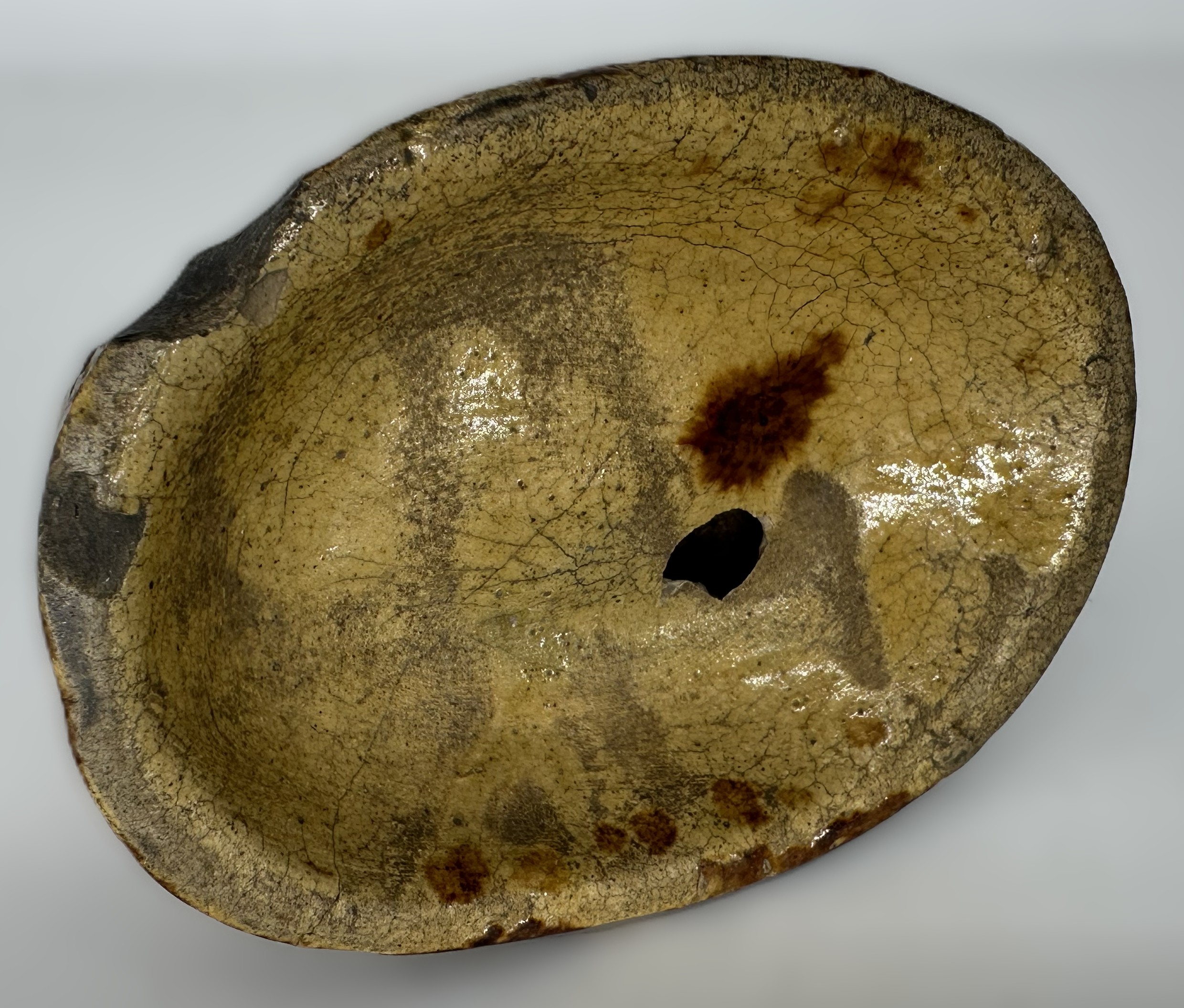
- Material and Glaze: The inkwell is made of earthenware or a buff-colored stoneware (similar to yellowware). It is covered in a Rockingham glaze, characterized by its mottled, streaky brown, and dark ochre coloration. The worn glaze reveals the lighter clay body beneath, consistent with age and use.
- Form: The inkwell is a bust of a gentleman wearing a ruffled collar (a cravat or jabot). The figure is finely molded, resting on a round or tiered base.
- Functionality:
- Ink Dipping Hole: The ink is accessed through the figure’s mouth.
- Age: Based on the glaze and the general style of figural pottery, this piece dates to the Mid-Victorian Period, likely 1840–1870.
- Identity of the Figure: Sir Walter Scott
- The figure depicted in this Rockingham-glazed bust inkwell is most likely Sir Walter Scott (1771–1832), one of the most famous literary figures of the 19th century. This identification is based on the specific style of bust, which was commonly produced by English potteries to commemorate popular figures.
- The figure’s features closely match those of busts and portraits of the Scottish historical novelist and poet, Sir Walter Scott:
- Receding Hairline/Forehead: Scott is often depicted with a high or receding forehead.
- Facial Features: The slightly heavy, but kind and intellectual features match the common ceramic renderings of Scott.
- In the mid-19th century (when this inkwell was made), figures from literature and poetry, especially those who embodied sentimentality and historical romance, were extremely popular subjects for pottery manufacturers. Scott’s fame ensured a massive market for his likeness, and numerous potteries made busts, figurines, and pitchers bearing his image.
Sir Walter Scott (1771–1832)
Sir Walter Scott was a Scottish historical novelist, poet, playwright, and short story writer. He is considered the inventor of the modern historical novel and, during his lifetime, was the most popular author in the world.
- Early Life and Legal Career
- Birth: Born August 15, 1771, in Edinburgh, Scotland.
- Childhood: Scott was afflicted with polio in childhood, which left him lame in his right leg for life. He was sent to his paternal grandparents’ farm in the Scottish Borders, where he developed a deep lifelong love for Scottish border history, folklore, and ballad tradition.
- Education and Law: He studied law at the University of Edinburgh and was called to the bar in 1792. He spent several years working in the legal profession, serving as a Sheriff-Depute and later as a Principal Clerk of Session.
- Literary Career: Poetry and Ballads
Scott began his literary career by collecting and publishing old Scottish ballads.
- Initial Fame: His first major success came with the long narrative poem, The Lay of the Last Minstrel (1805), which romanticized Scottish history and folklore. This was followed by highly popular poems like Marmion (1808) and The Lady of the Lake (1810).
- Poetic Influence: Scott established himself as Britain’s most popular poet until he was eventually eclipsed by Lord Byron.
III. The Invention of the Historical Novel
In 1814, Scott anonymously published his first novel, Waverley, which is widely regarded as the first true historical novel in the Western tradition.
- The Waverley Novels: He went on to write dozens of historical novels, often set in Scotland’s past, but also in medieval Europe. These were published anonymously for many years, collectively known as the “Waverley Novels.”
- Key Works:
- Ivanhoe (1819): Set in 12th-century England, focusing on the return of Richard the Lionheart and the conflict between Normans and Saxons.
- Rob Roy (1817): A famous novel set during the Jacobite rising of 1715.
- The Heart of Midlothian (1818).
- Impact: Scott’s novels created a template for historical fiction, blending realistic dialogue with authentic historical settings and events. He profoundly influenced European and American literature, historical perception, and even popular culture, establishing an idealized image of Scotland.
- Later Life and Legacy
- Financial Troubles: Scott invested heavily in his printing firm and his country estate, Abbotsford. When his firm went bankrupt in 1826, he famously refused to declare bankruptcy and spent the last years of his life writing furiously to pay off enormous debts, which he largely succeeded in doing through his writing output.
- Death: Scott died on September 21, 1832, at Abbotsford.
- Legacy: Scott’s works were translated into virtually every European language. He was instrumental in establishing the modern tourist image of Scotland and inspired countless writers, including Alexandre Dumas and James Fenimore Cooper. He remains a national hero of Scotland, commemorated by the iconic Scott Monument in Edinburgh.
Scott’s likeness was a natural choice for 19th-century commemorative pottery like this inkwell, symbolizing wisdom, patriotism, and the height of literary achievement.
Estimated value: $75
Content disclaimer. The information posted is the owner’s best knowledge and may not have been vetted by the SOIC. We welcome comments, corrections, and additions, working to make our website information comprehensive and accurate.
Join the Society of Inkwell Collectors (SOIC) – it’s free!
Founded in 1981 as a non-profit organization,
we are documenting inkwells (and accessories).
We’re here to help and inform!