

Inkipedia


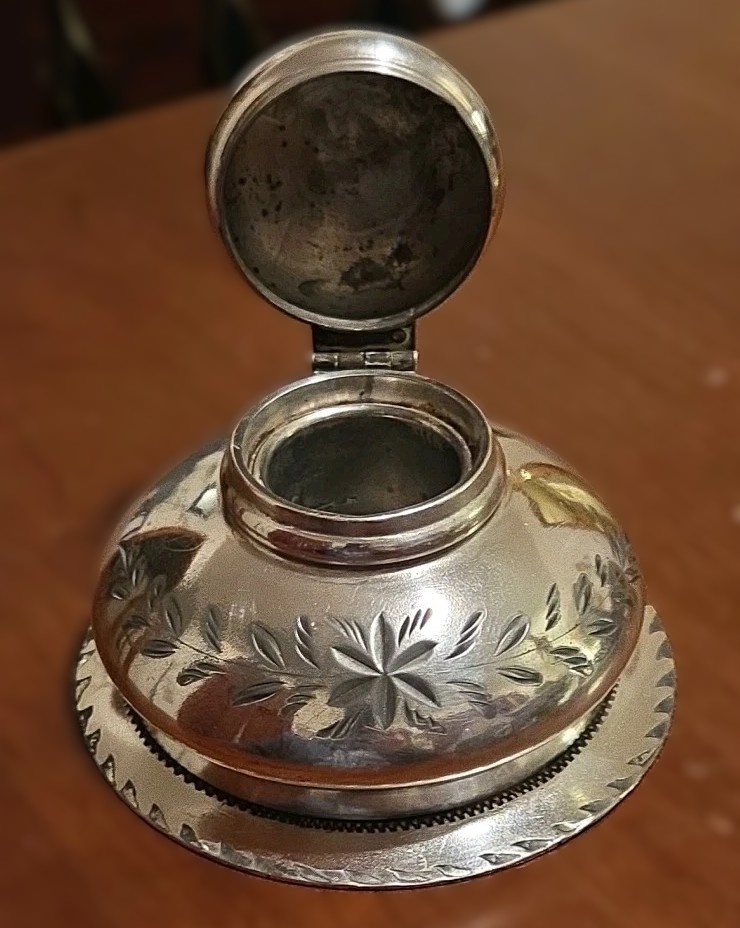


Silverplated Dome-Shaped Inkwell
| Categories | Silver |
| Material | Silverplate |
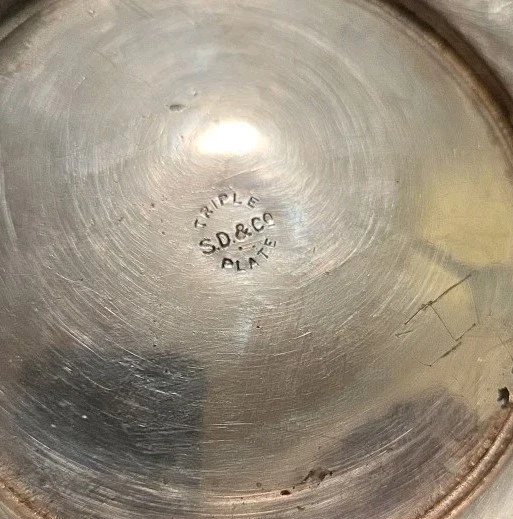
| Markings | See narrative |
| Manufacturer | S. Davis & Co. |
| Origin | Canada |
| Date or Era | circa 1890 |
| Measuring | 4 ¼” diameter |
- Identification: The Maker & Mark
- The Maker: The mark “S.D. & Co” combined with the designation “TRIPLE PLATE” is attributed to S. Davis & Co. of Montreal, Canada.
- History: Active during the late 19th century (c. 1880s–1900s), S. Davis & Co. was a prominent importer and wholesaler of watches, jewelry, and silverware. Like many large retailers of that era, they did not manufacture the items themselves. Instead, they commissioned silverplated wares from major factories (likely in Connecticut or Toronto) and had them stamped with their own retailer’s mark to sell under their brand.
- “Triple Plate”: This was a marketing term used in North America between 1880 and 1910. Standard silverplate was often just flashed with silver. “Triple Plate” indicated that the base metal was dipped or electroplated three times (or given a coating equivalent to three standard layers), theoretically ensuring the silver would not wear off for 20+ years.
- Visual Description & Style
- Form: This is a “Capstan” or “Dome” inkwell. The wide, low center of gravity was a practical design choice to prevent the inkwell from tipping over on a cluttered desk.
- Design: The decoration is classic Aesthetic Movement (c. 1875–1890). This style moved away from the heavy, cluttered Rococo designs of the mid-Victorian era and focused on nature-inspired motifs. The delicate fern fronds and floral sprays etched into the body are hallmark motifs of this period.
- Construction: The base features a distinctive sawtooth or “pinked” flange rim. The hinged lid has a matching floral engraving.
- Condition: One can see a warm, reddish/brassy tone coming through the silver. This is called “bleeding.” It indicates that the inkwell was polished over the last 130 years, eventually wearing through the silver plating to reveal the base metal (likely copper or brass) underneath.
- Age
- Date: Circa 1885–1900.
- The “Triple Plate” terminology, the Aesthetic fern engraving, and the S. Davis & Co. timeline all align perfectly with the last 15 years of the 19th century.
Sold for $52 in November 2025
Content disclaimer. The information posted is the owner’s best knowledge and may not have been vetted by the SOIC. We welcome comments, corrections, and additions, working to make our website information comprehensive and accurate.
Join the Society of Inkwell Collectors (SOIC) – it’s free!
Founded in 1981 as a non-profit organization,
we are documenting inkwells (and accessories).
We’re here to help and inform!