


Satsuma “Moriage” Inkwell
| Categories | Far East / Oriental |
| Material | Earthenware |
| Markings | Unmarked |
| Manufacturer | Undetermined |
| Origin | Japan |
| Date or Era | circa 1890 |
| Measuring | 4 ¾” high |
Description
Item: Japanese Satsuma Earthenware Inkwell Period: Meiji Period (Late 19th Century, approx. 1885–1895) Technique: Polychrome enamels, heavy gilding, and Moriage (raised relief)
This cuboid inkwell is crafted from fine earthenware, featuring the characteristic cream-colored (ivory) ground and a fine crackle glaze (known as kan-nyu). The piece is decorated in the “Golden” Satsuma style, which was prized by Western collectors during the Victorian era. It features four primary relief-molded panels and a matching bulbous lid, all connected by an original brass collar and hinge.
- Determining Date of Production
We can narrow this down to circa 1890.
- The Export Boom: After the 1873 Vienna World Expo, Satsuma production shifted heavily toward “Export Ware.” The style of this inkwell—specifically the heavy use of Moriage (the “puffy” or raised enamel work seen on the faces and clothing) and dense gilding—reached its peak popularity between 1885 and 1900.
- The Hardware: The brass hinge assembly is typical of late-Meiji desk accessories manufactured for the European and American markets.
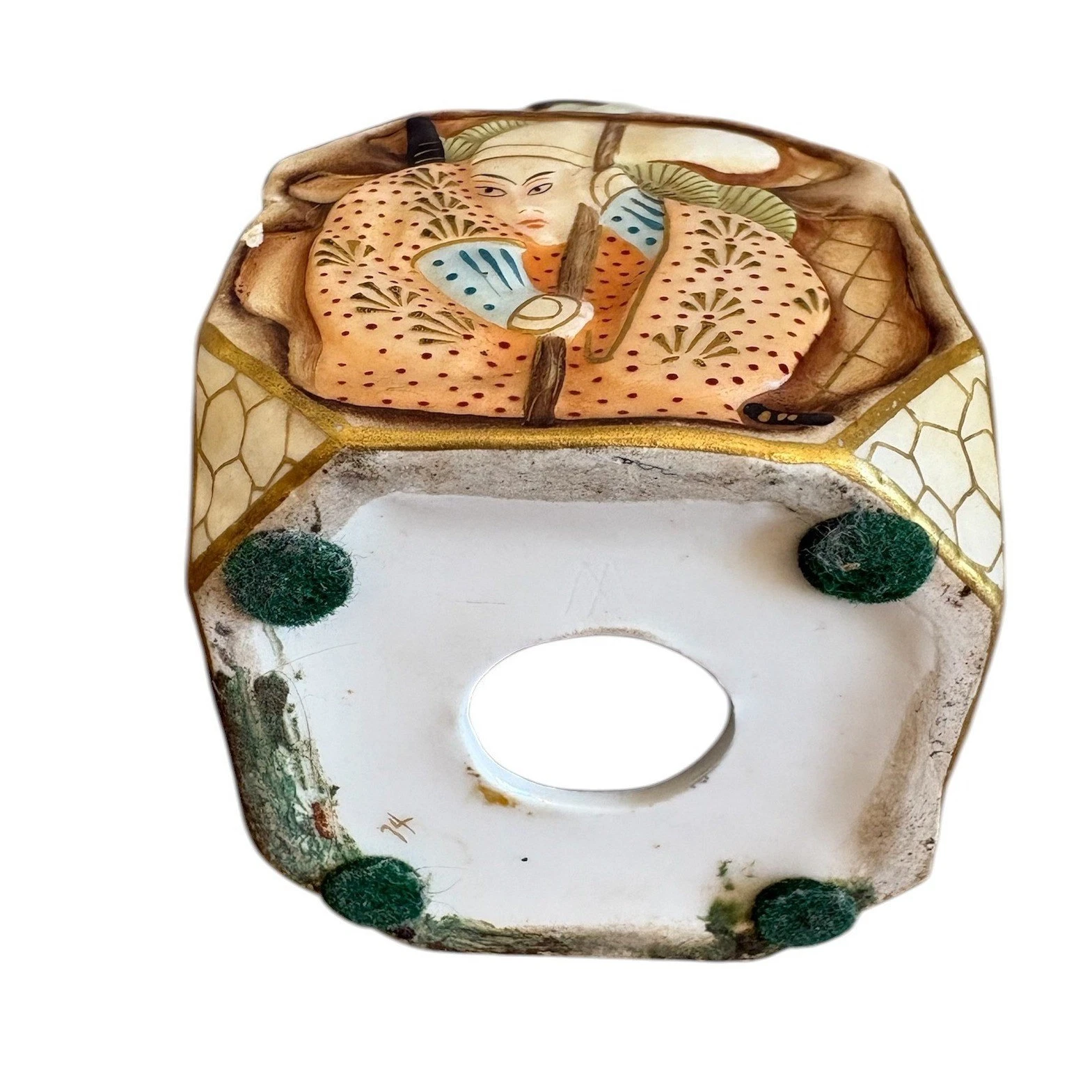
- The Base: There is a simple hand-painted mark (looks like “14”) on the base. This is likely a decorator’s mark or a pattern number rather than a famous kiln seal, which is common for pieces produced in larger workshops in Kyoto or Yokohama for export.
- Identifying the Figures
The figures on this inkwell are not just generic portraits; they represent a very specific and popular theme in Satsuma art:
- The Rakan (Arhats): The figures on the side panels and lid appear to be Rakan—the legendary disciples of the Buddha who achieved enlightenment. They are often depicted with exaggerated facial expressions, shaved heads (or wispy hair), and flowing robes. In Satsuma art, they were frequently used to appeal to the Western fascination with “exotic” Eastern mysticism.
- The Samurai/Warrior: One panel appears to show a figure in more traditional armor or formal kamishimo, suggesting a legendary hero or samurai, likely a scene from a popular Kabuki play or historical myth.
- The Crane (Tsuru): One panel depicts a crane in flight over waves. In Japanese culture, the crane is a profound symbol of longevity and immortality (said to live for 1,000 years).
- Observations
- Material: To be precise, this is earthenware, not porcelain. Earthenware is fired at a lower temperature and is porous; the “crackle” in the glaze occurs because the glaze and the clay body expand and contract at different rates.
- The “Missing” Insert: These originally came with a small, removable white ceramic well to hold the actual ink.
Sold for $150 in April 2026
Content disclaimer. The information posted is the owner’s best knowledge and may not have been vetted by the SOIC. We welcome comments, corrections, and additions, working to make our website information comprehensive and accurate.
Join the Society of Inkwell Collectors (SOIC) – it’s free!
Founded in 1981 as a non-profit organization,
we are documenting inkwells (and accessories).
We’re here to help and inform!