

Salter’s Patent Inkstand
| Categories | Mechanical - Levered or Rotating Lids |
| Material | Cast iron |
| Markings | See Narrative |
| Manufacturer | George Salter & Co. |
| Origin | England |
| Date or Era | circa 1890 |
| Measuring | See narrative |
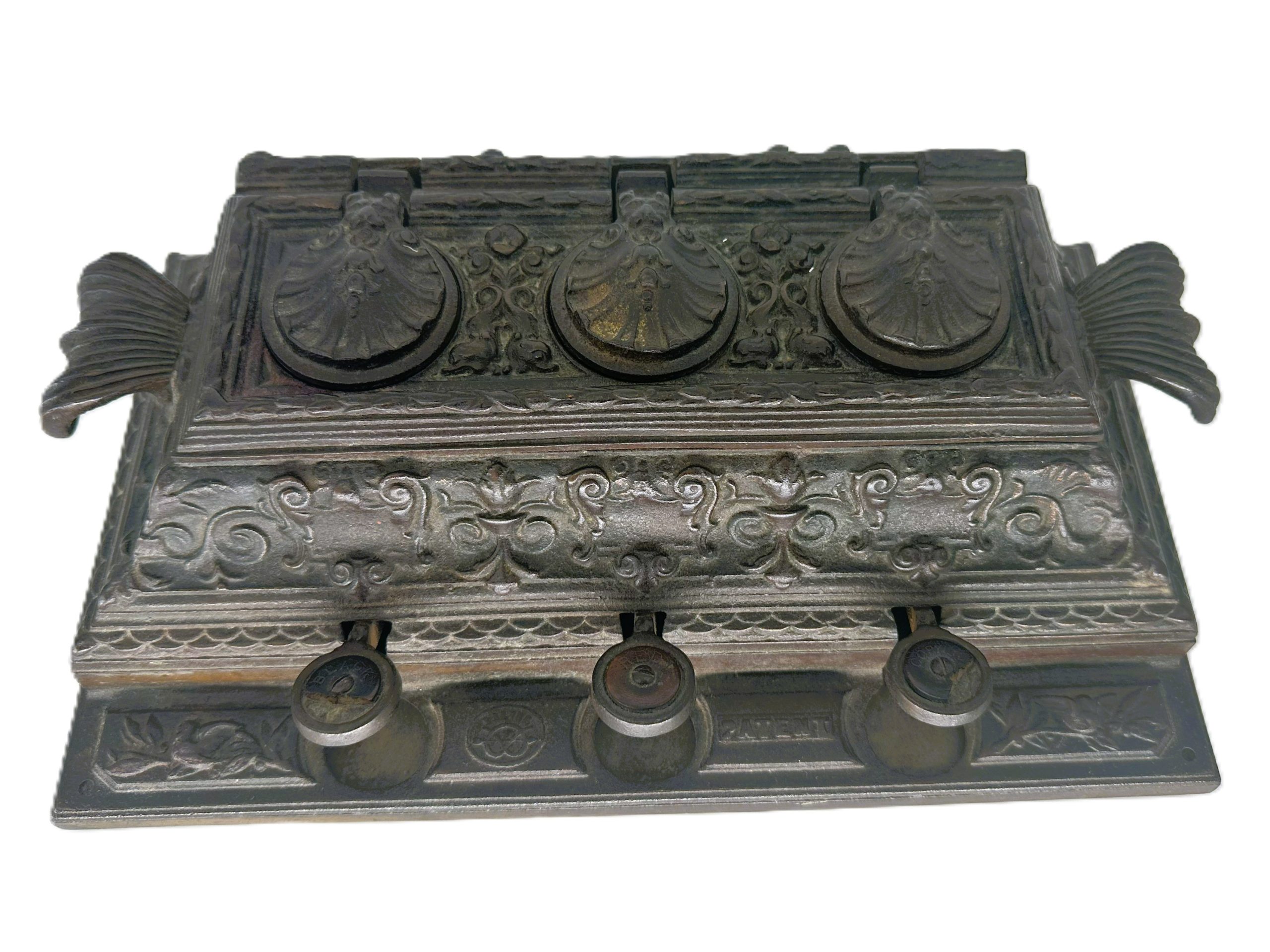
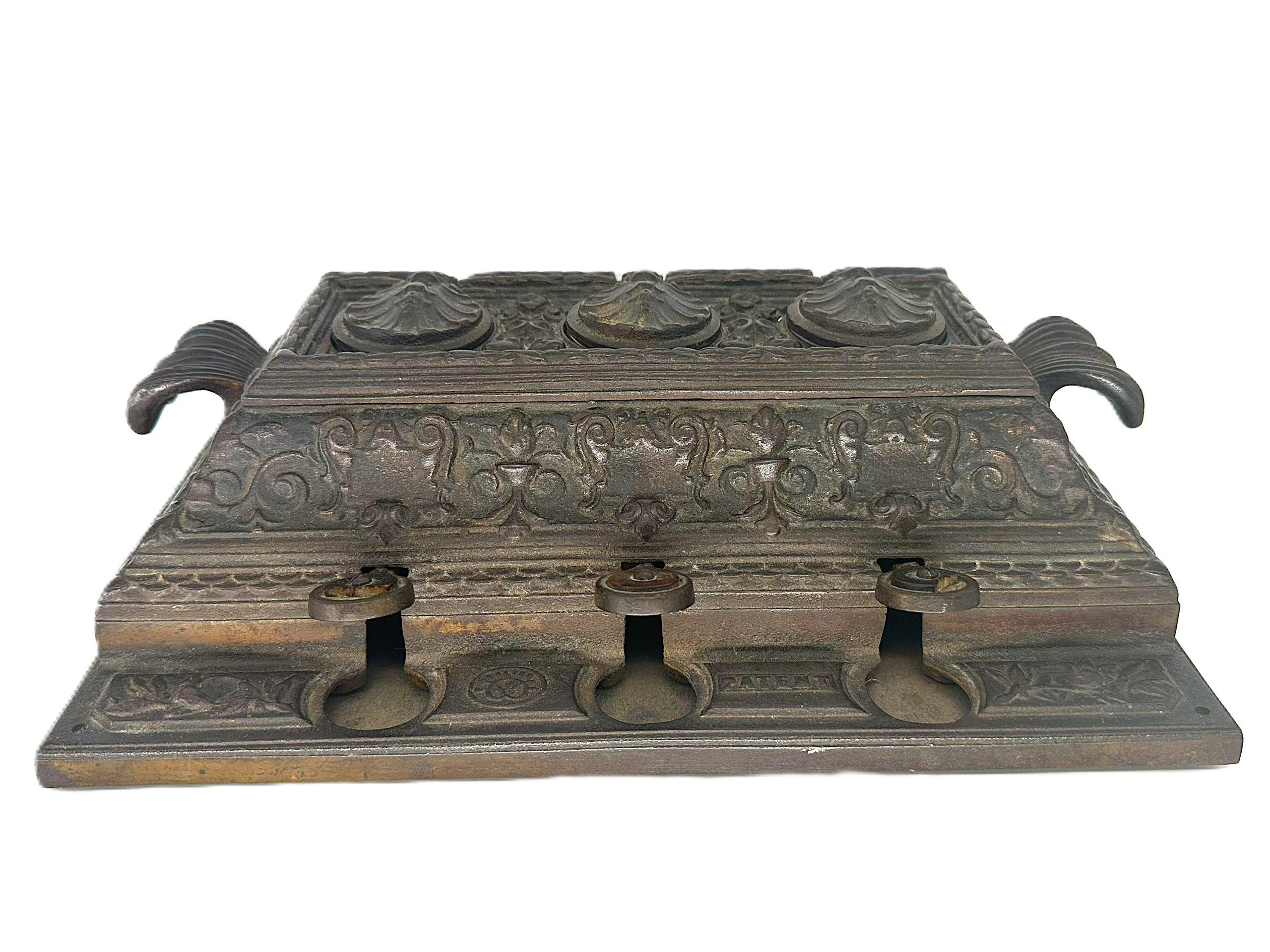
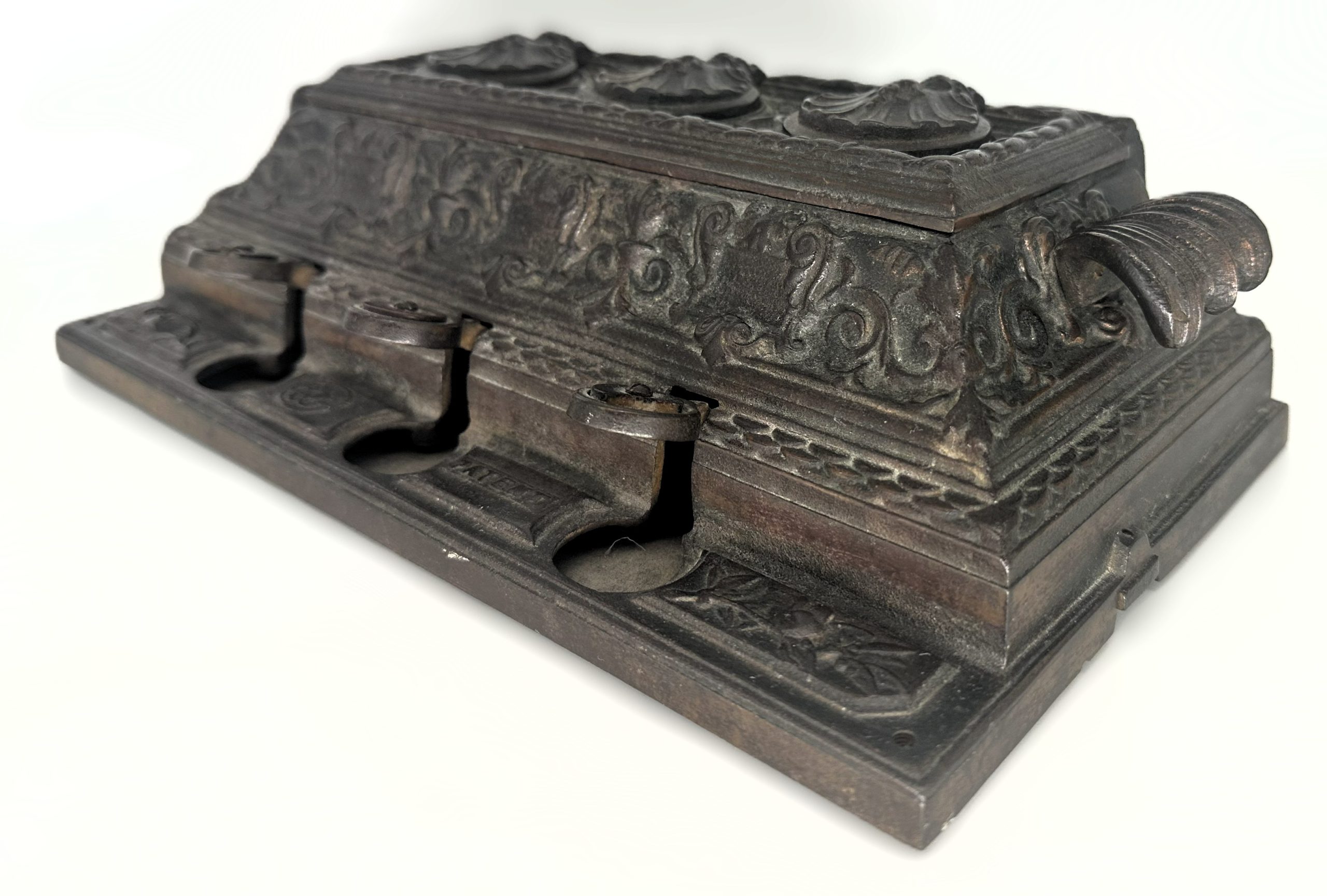
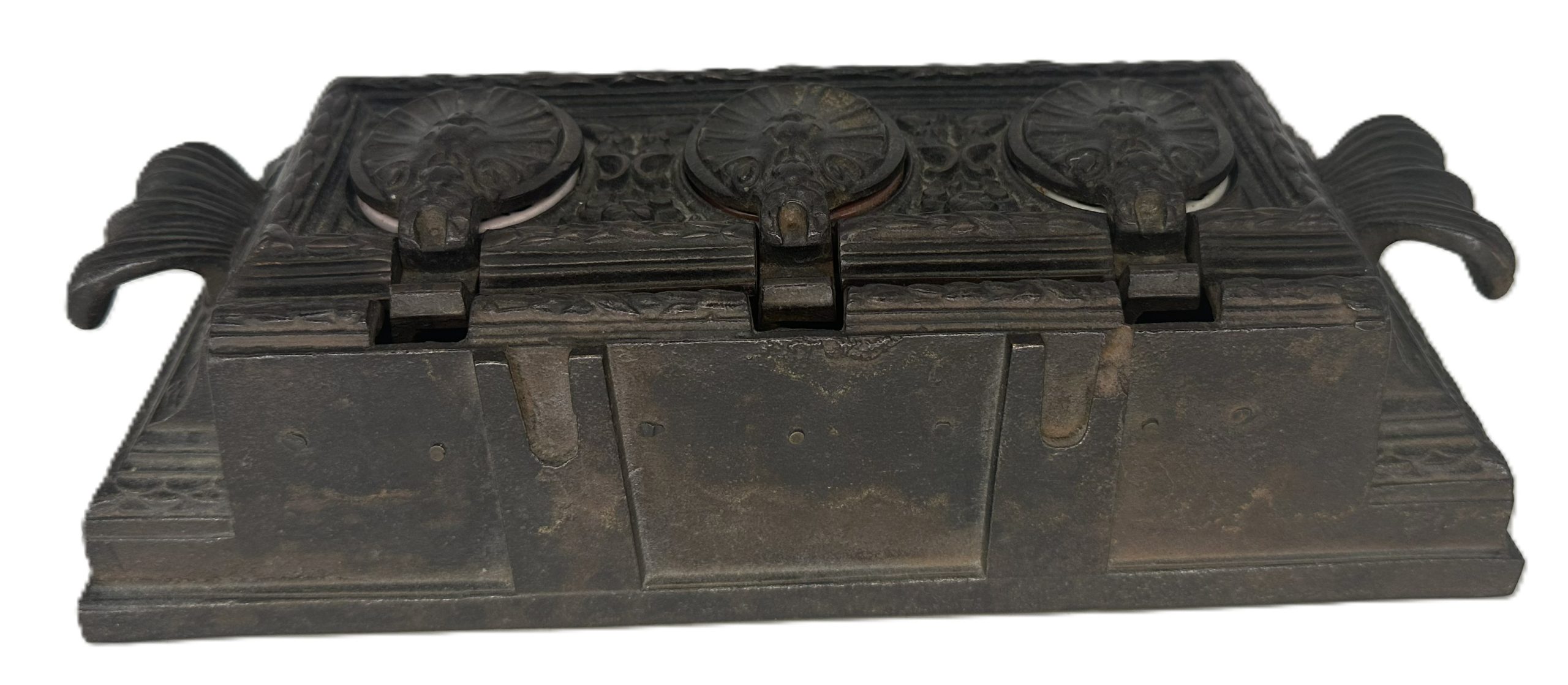
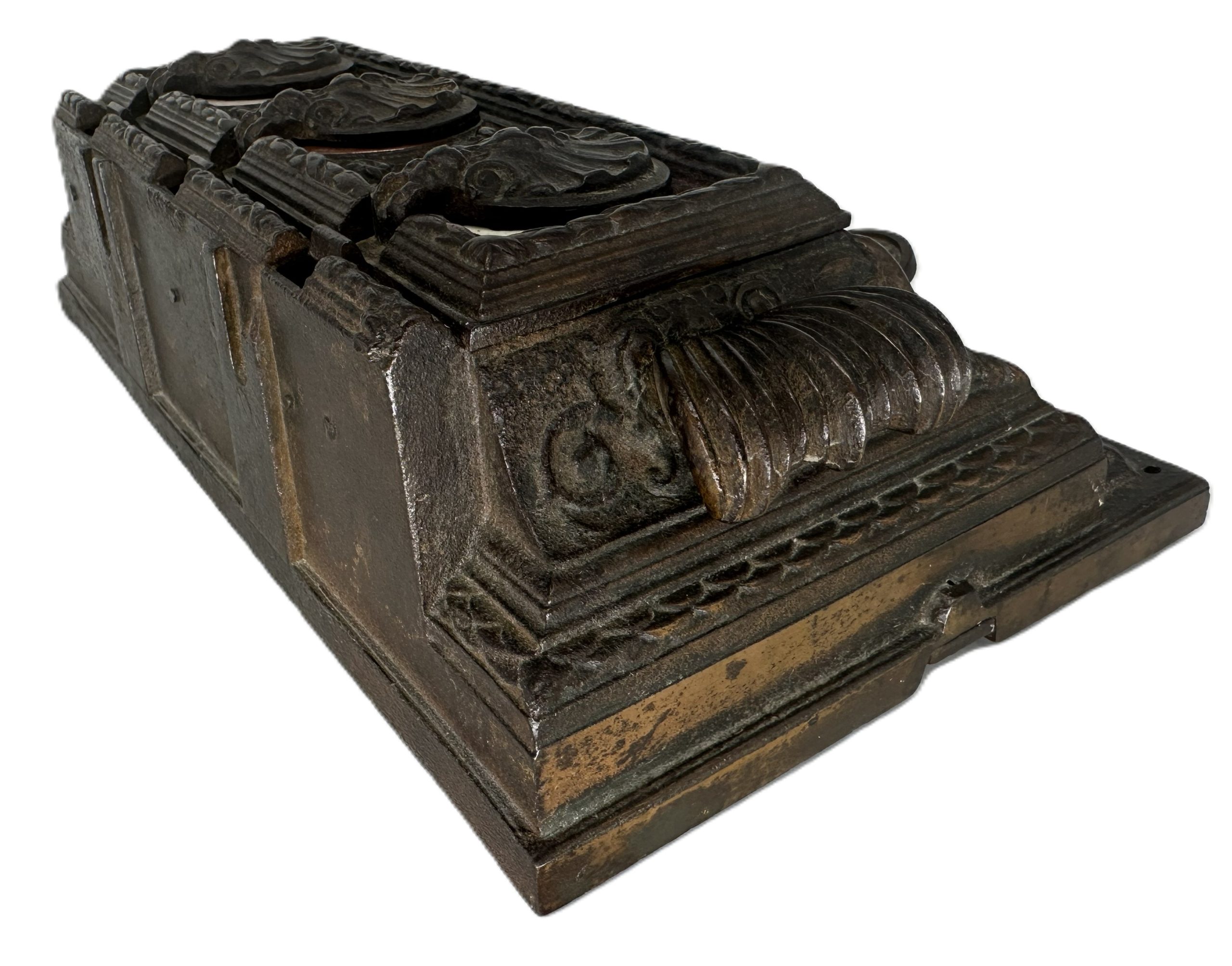
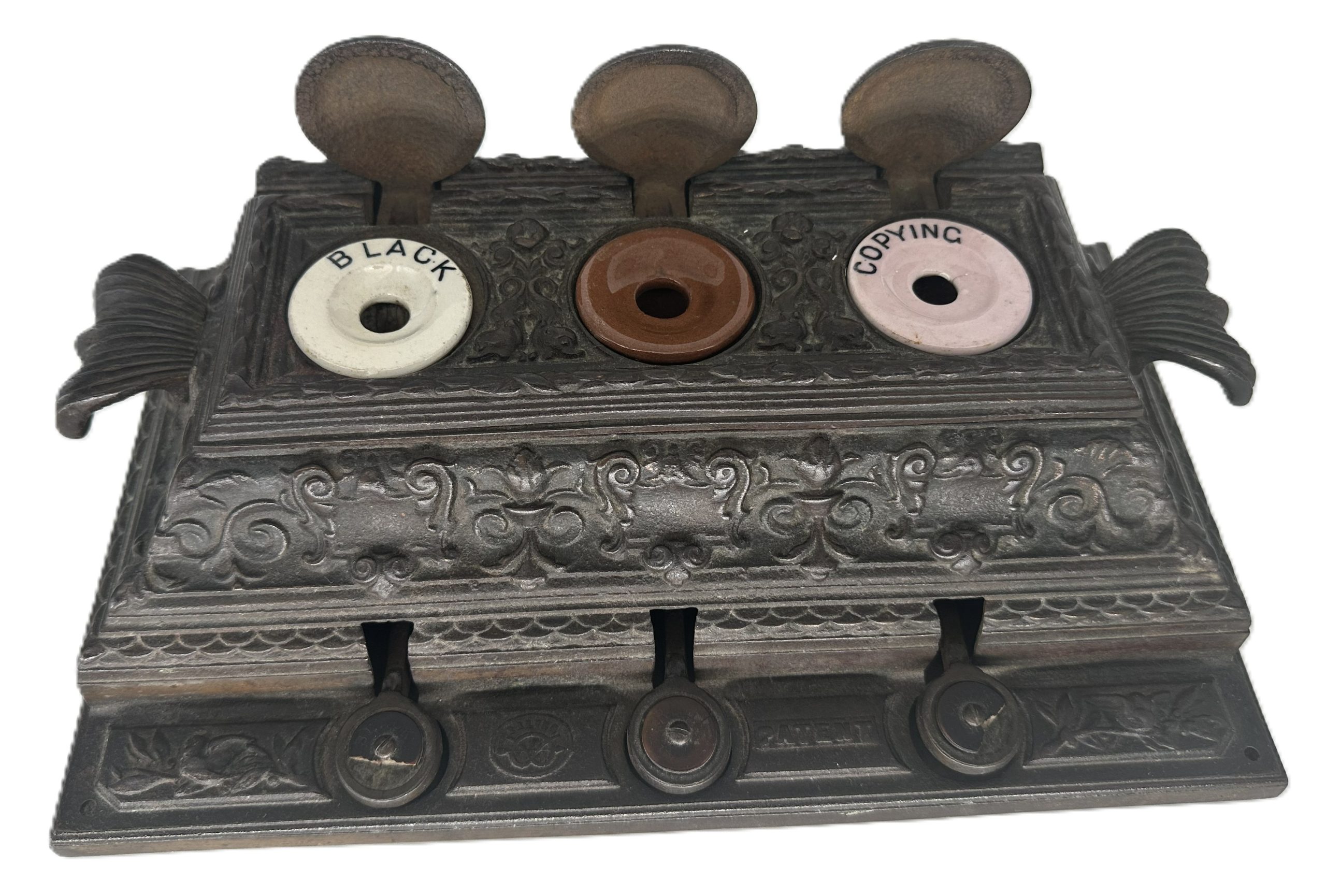
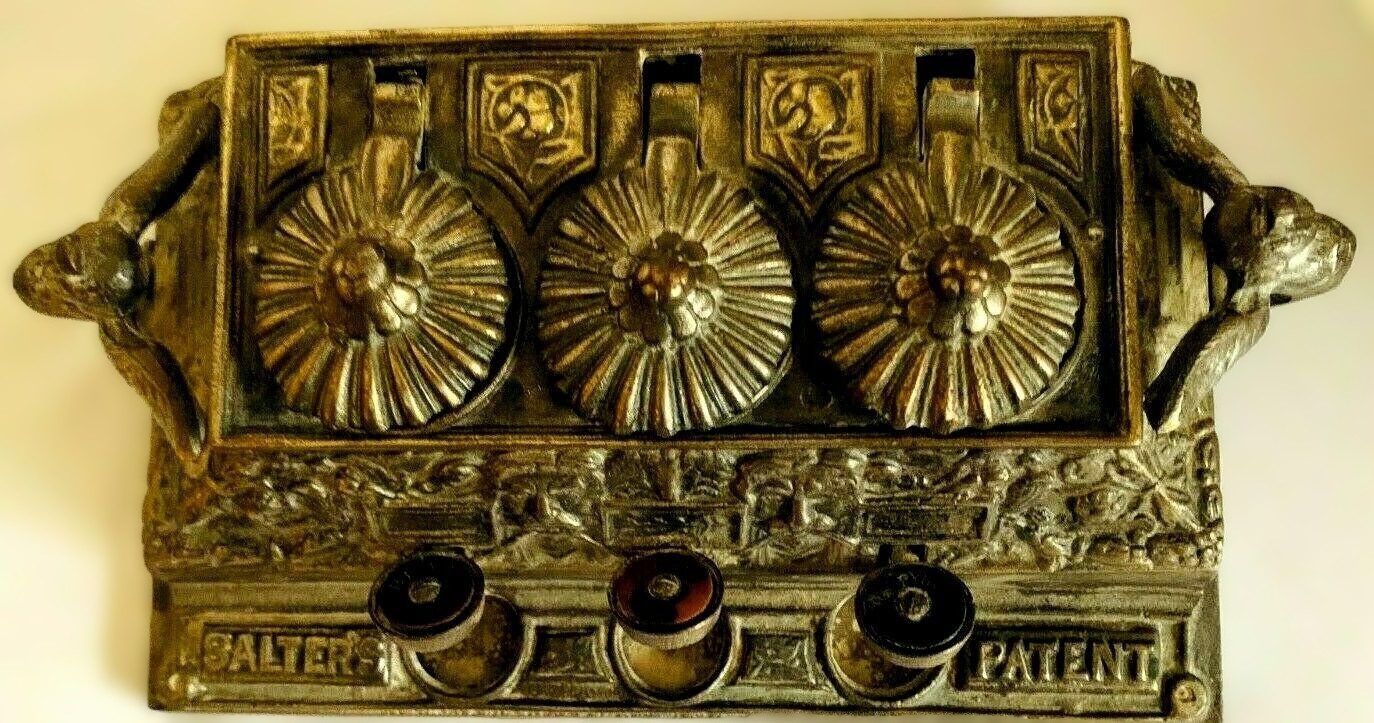
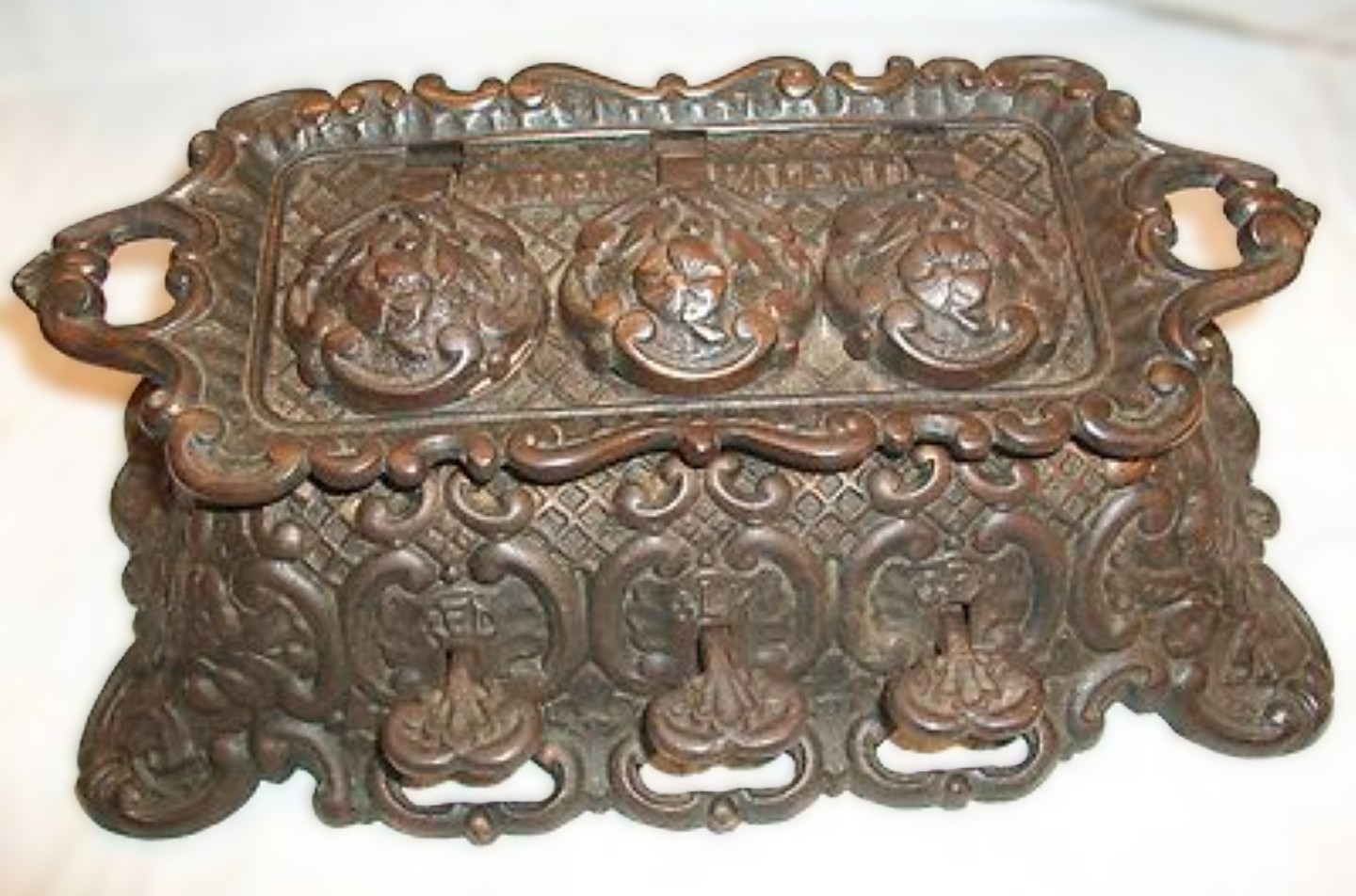
This Victorian cast-iron desk piece is an example of the Salter’s Patent Inkstand, manufactured in England during the late Victorian era (circa 1890s).
History of George Salter & Co.
- Company Origins: The firm was established in 1760 in Bilston, England, by Richard Salter, initially making pocket steelyards (spring scales). In 1825, Richard’s nephew, George Salter, took over the enterprise, establishing George Salter & Co. in West Bromwich, Staffordshire.
- Manufacturing Scope: While renowned worldwide for precision spring balances, weighing equipment, and spring-loaded mechanical devices, Salter expanded during the late 19th century into specialized desk appliances, sad irons, and office machinery—most notably producing Britain’s early typewriters, including the British Empire and the Salter No. 5 and No. 6.
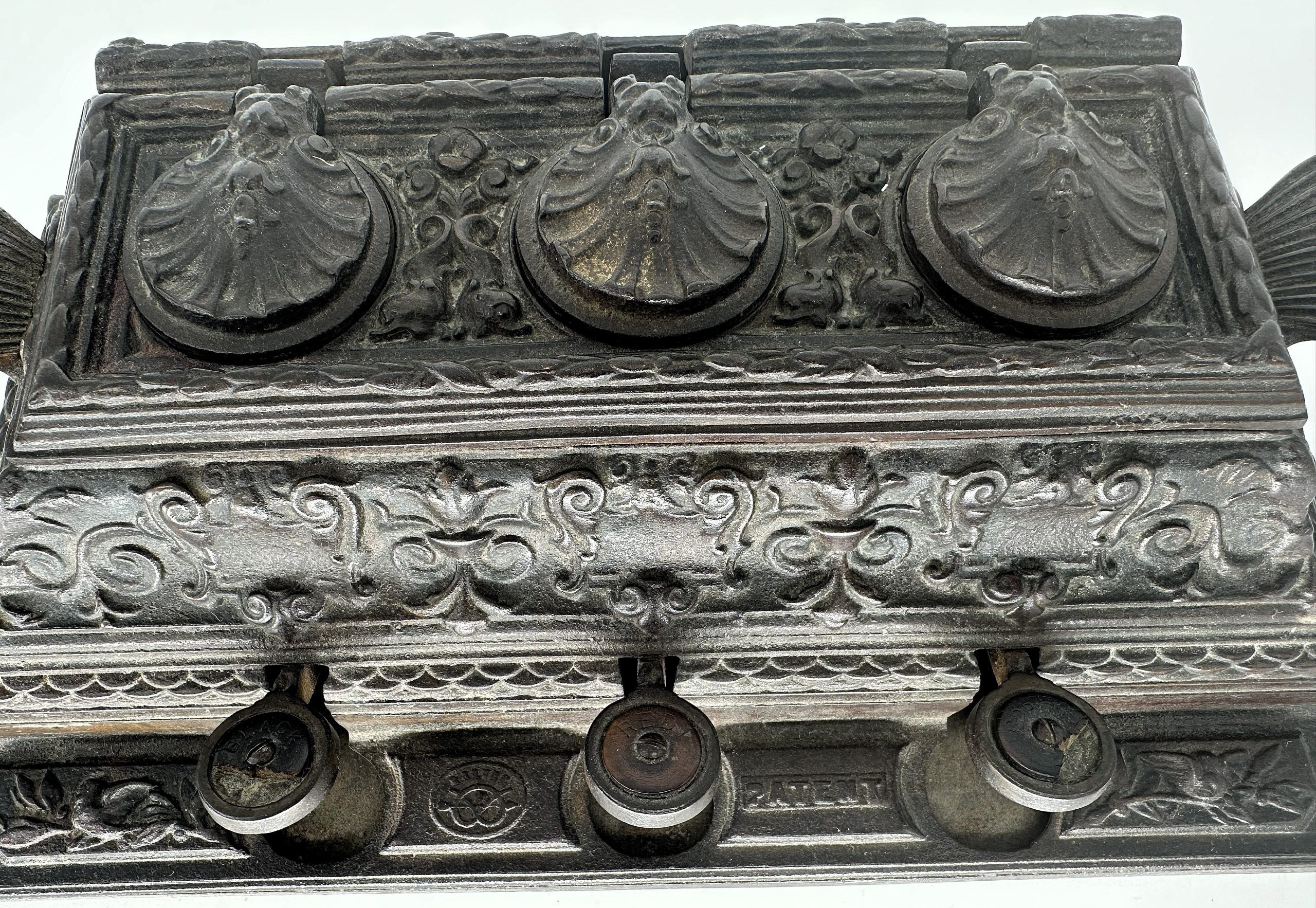
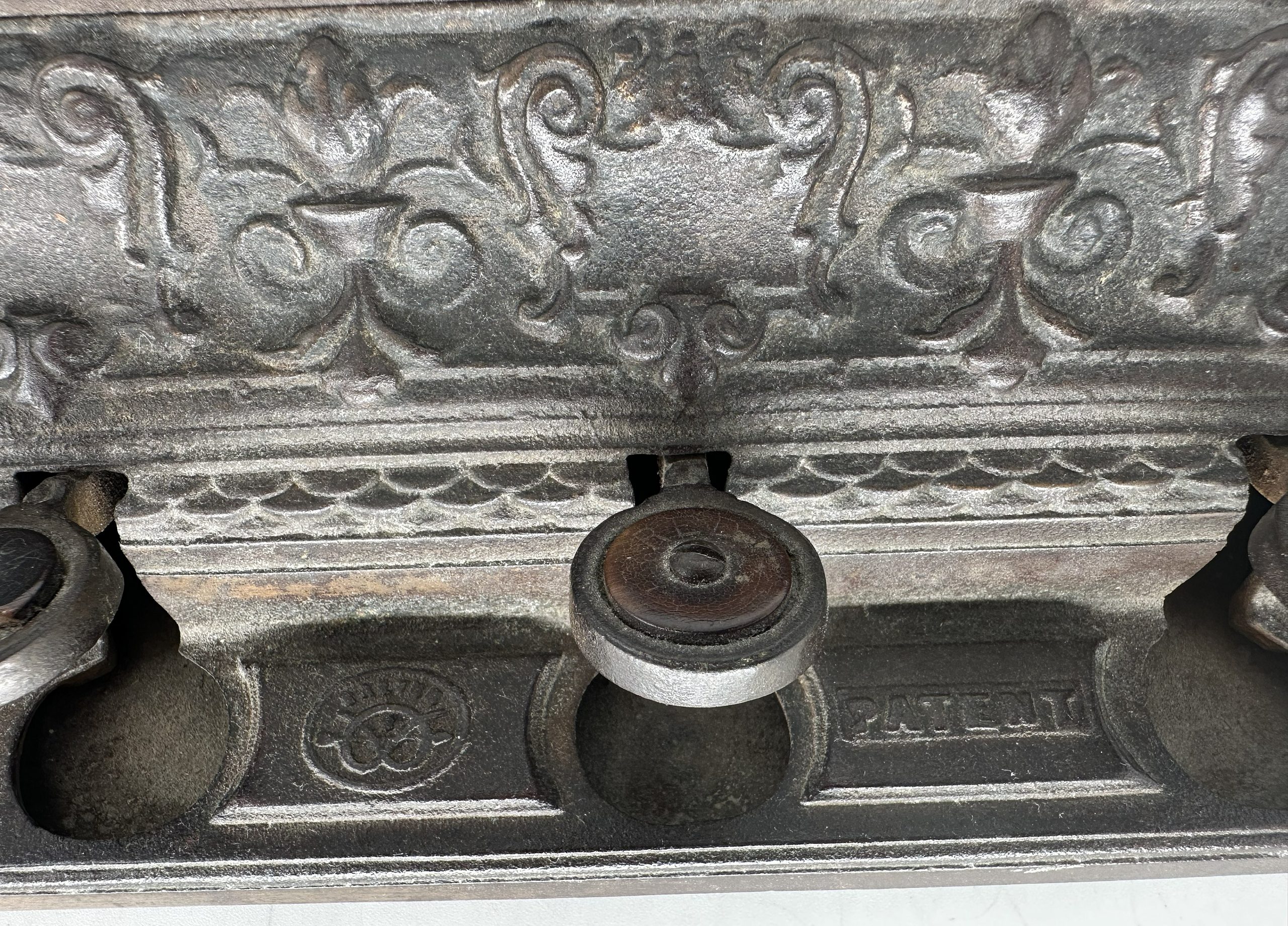
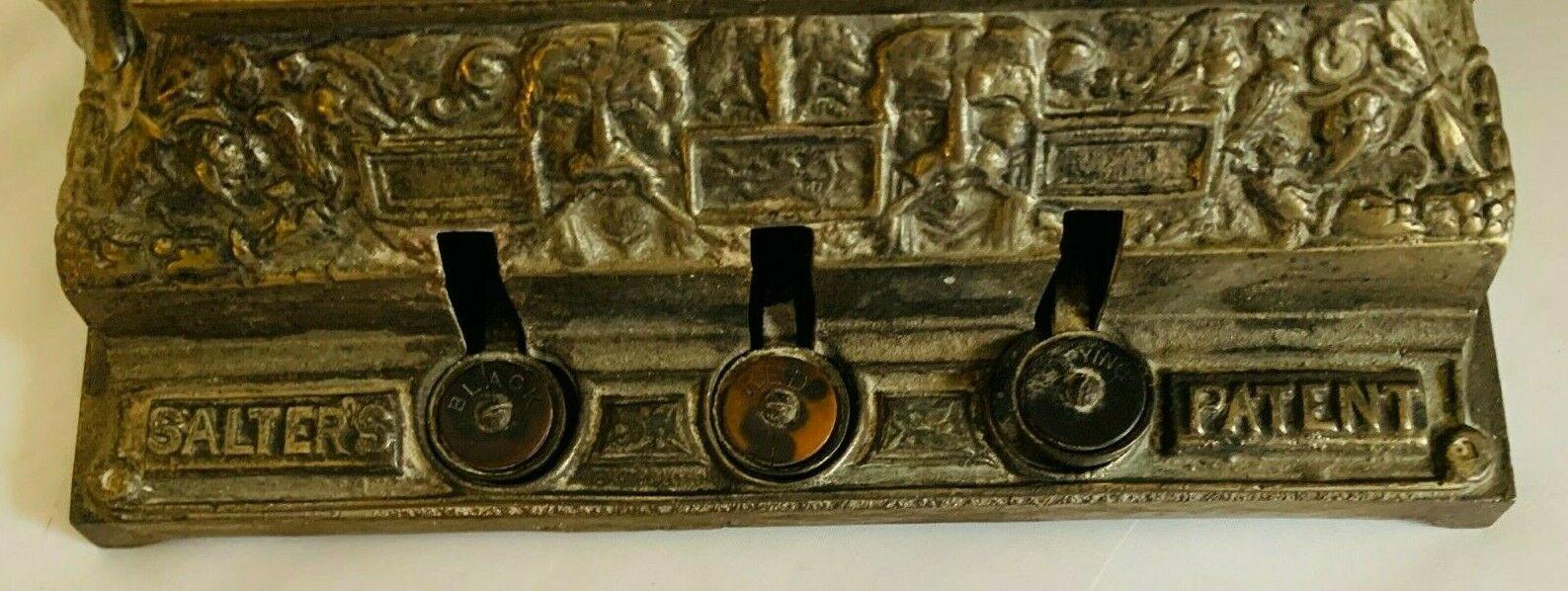
- Patentee & Maker Connection: George Salter & Co. acted as both the manufacturer and the patent holder/assignee for these mechanical items. Because British patent protection for stationary office wares was held directly under the firm’s brand name, products of this design bear the raised factory stamp “SALTER’S PATENT” directly on the cast-iron front apron.
Mechanical & Design Details
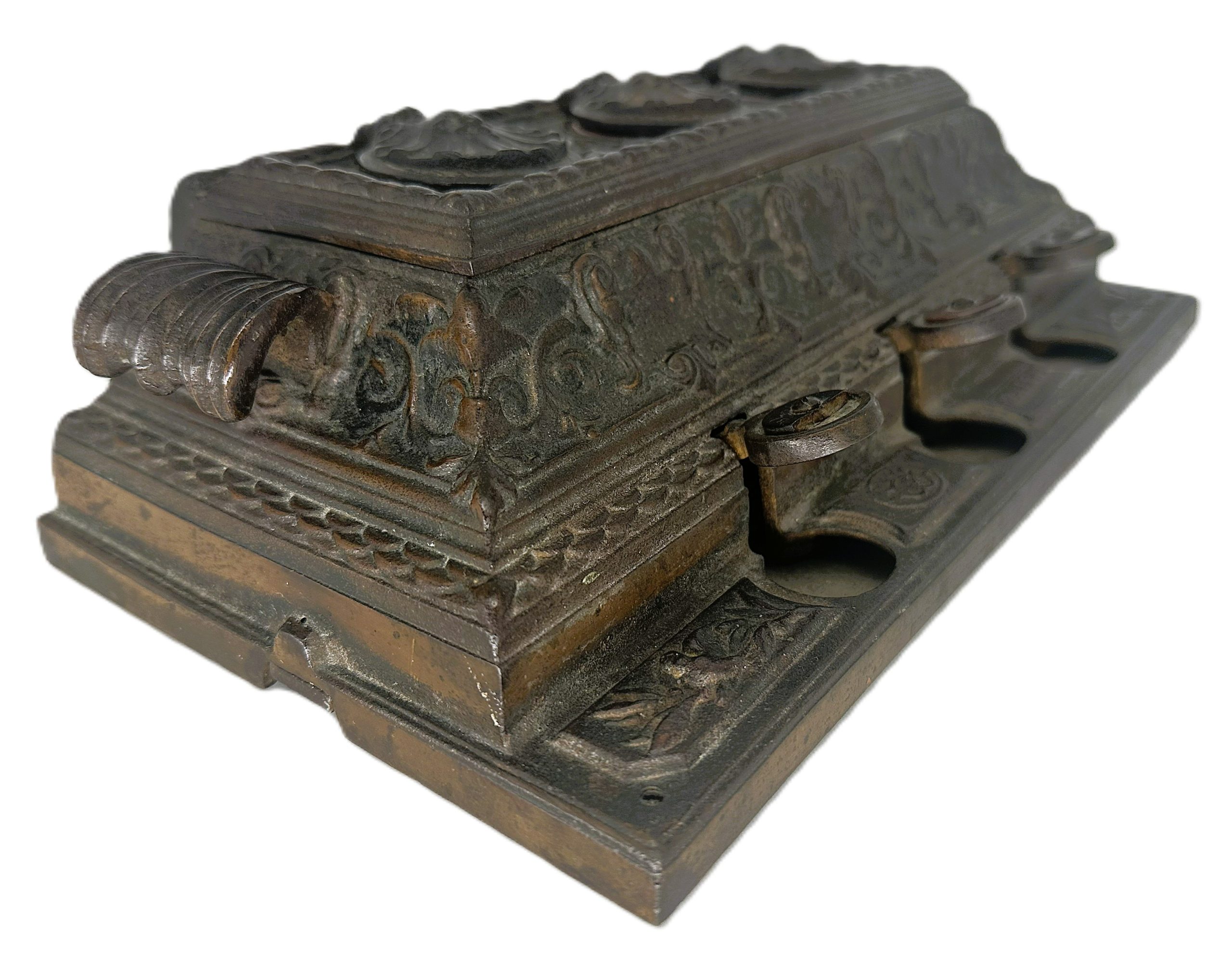
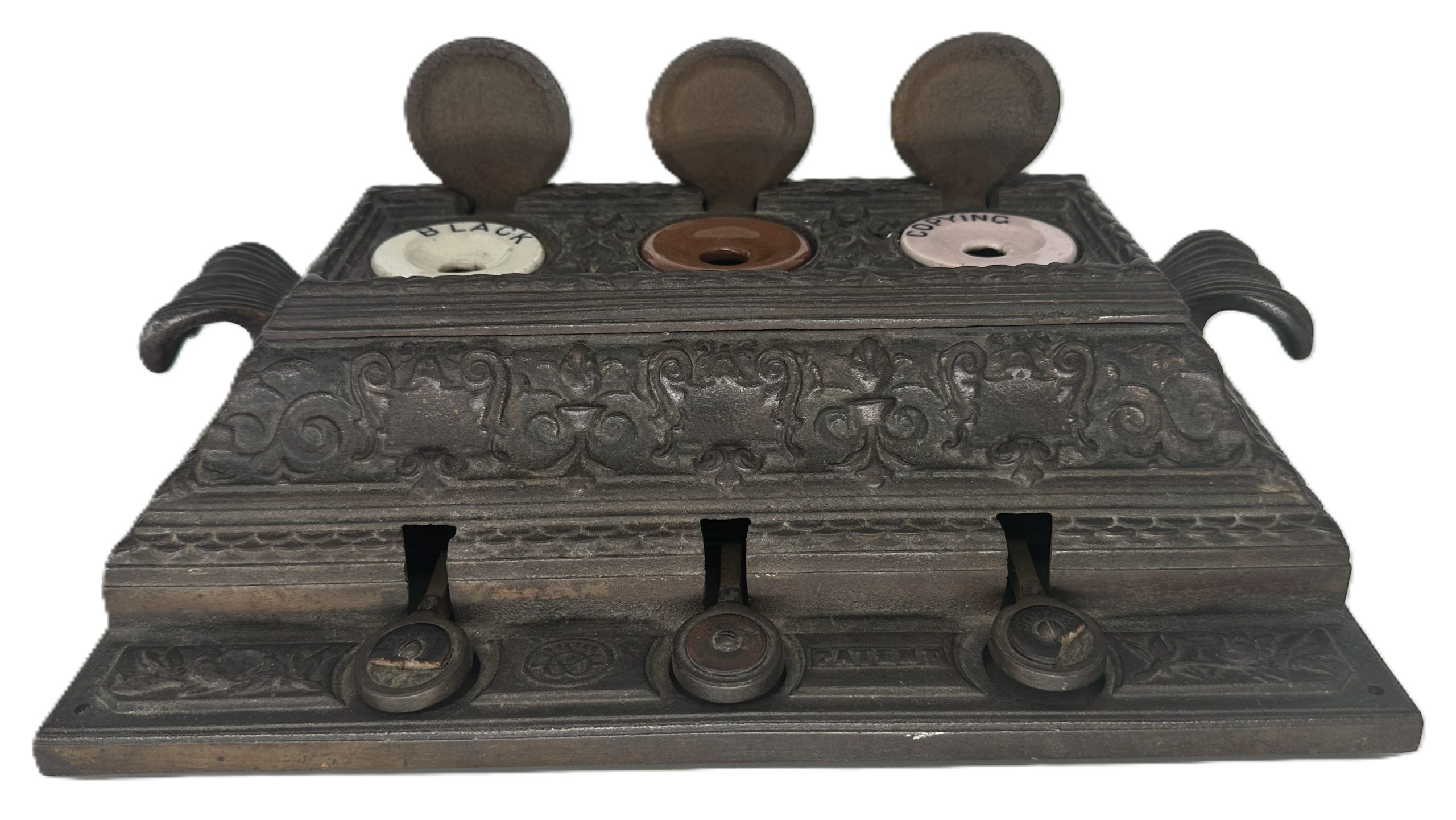
- Typewriter-Key Actuation: The primary innovation of this inkstand is its mechanical spring-lever system. Pressing one of the three front “keys” (resembling early typewriter keycaps) depresses an internal lever that pivots open the corresponding heavy cast-iron lid via a rear hinge mechanism, exposing the ceramic or porcelain ink pot. Releasing the key allows the lid to drop back down to seal the well.
- Three-Ink Configuration: The three wells provided quick access to the standard inks used in 19th-century commercial, legal, and accounting offices:
- Black (“Blk”): For standard correspondence and record-keeping.
- Red (“Red”): For ledger ruling, auditing, or highlighting.
- Copying Ink (“Cpy”): A heavy, glycerin-rich iron gall ink designed for transferring text onto thin tissue paper using a damp letter-copying press.
- Porcelain Inserts: The original inserts feature round porcelain tops with central dipping wells. The ceramic rings are color-coded and labeled around the rim (e.g., white for Black, brown for Red, pink/lilac for Copying).
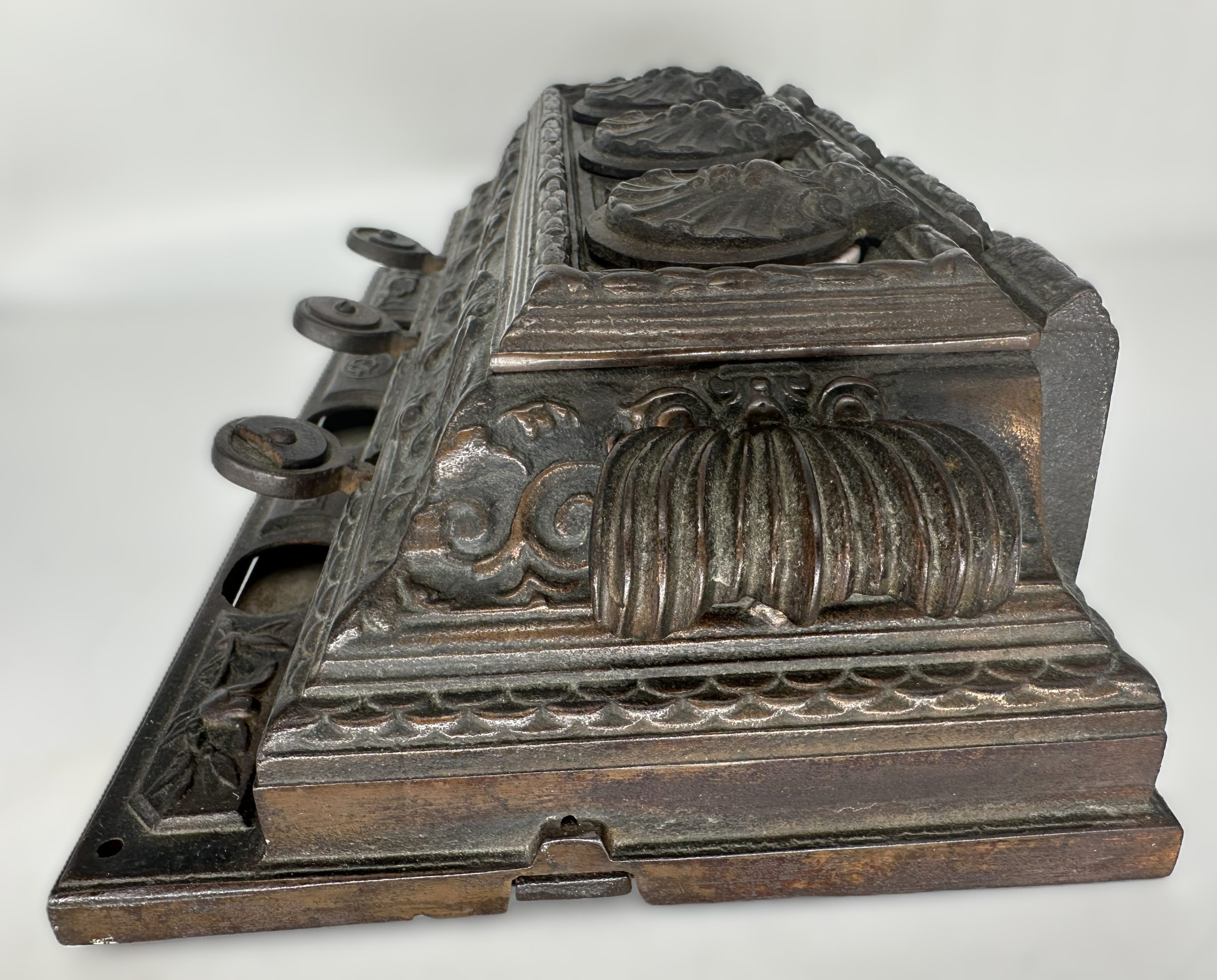
- Cast-Iron Aesthetics: The body is heavily cast in Victorian Revival taste, complete with scrolling foliate cartouches, shell-form lid handles, side scroll handles, and a scalloped base plate.
- Measurements: 11 ⅝” x 6 ½” x 4” high
A detailed timeline for the George Salter Co. can be found here: George Salter and Co – Graces Guide
Second Example Pictured:
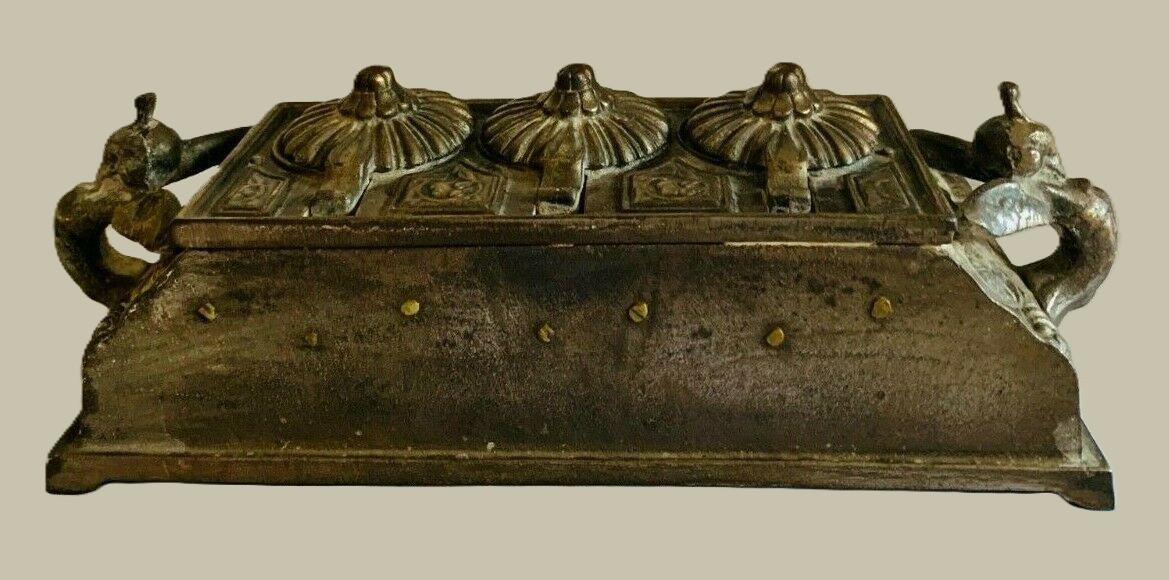
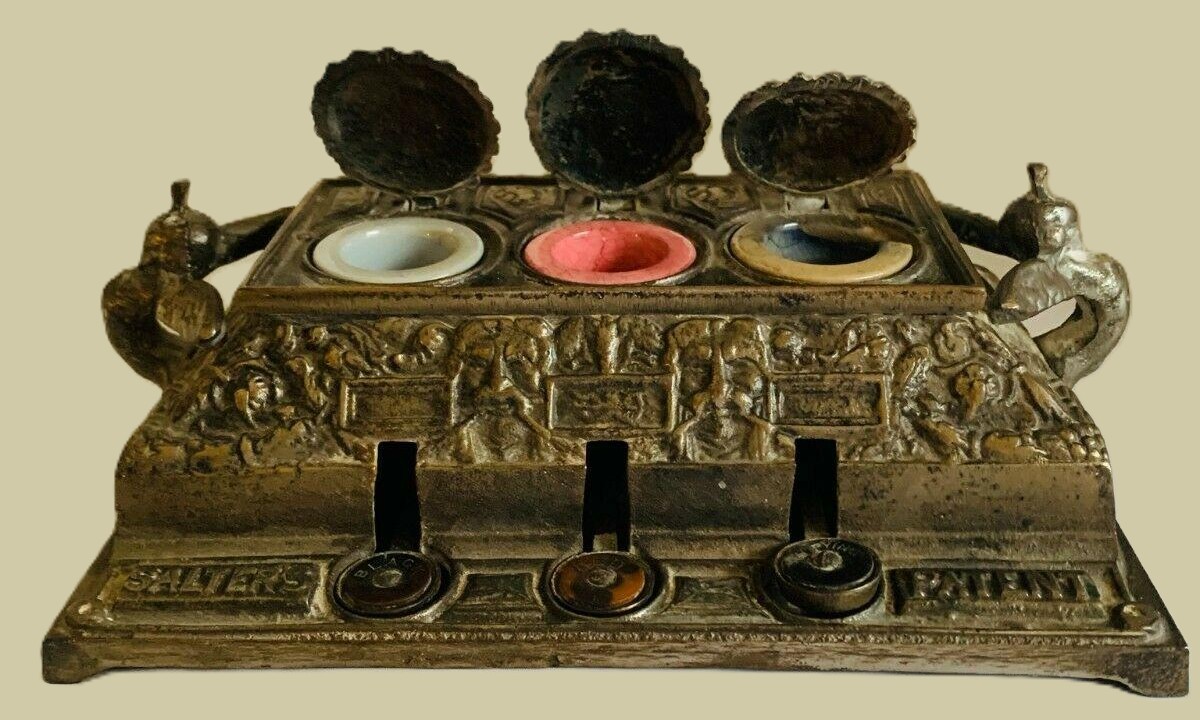
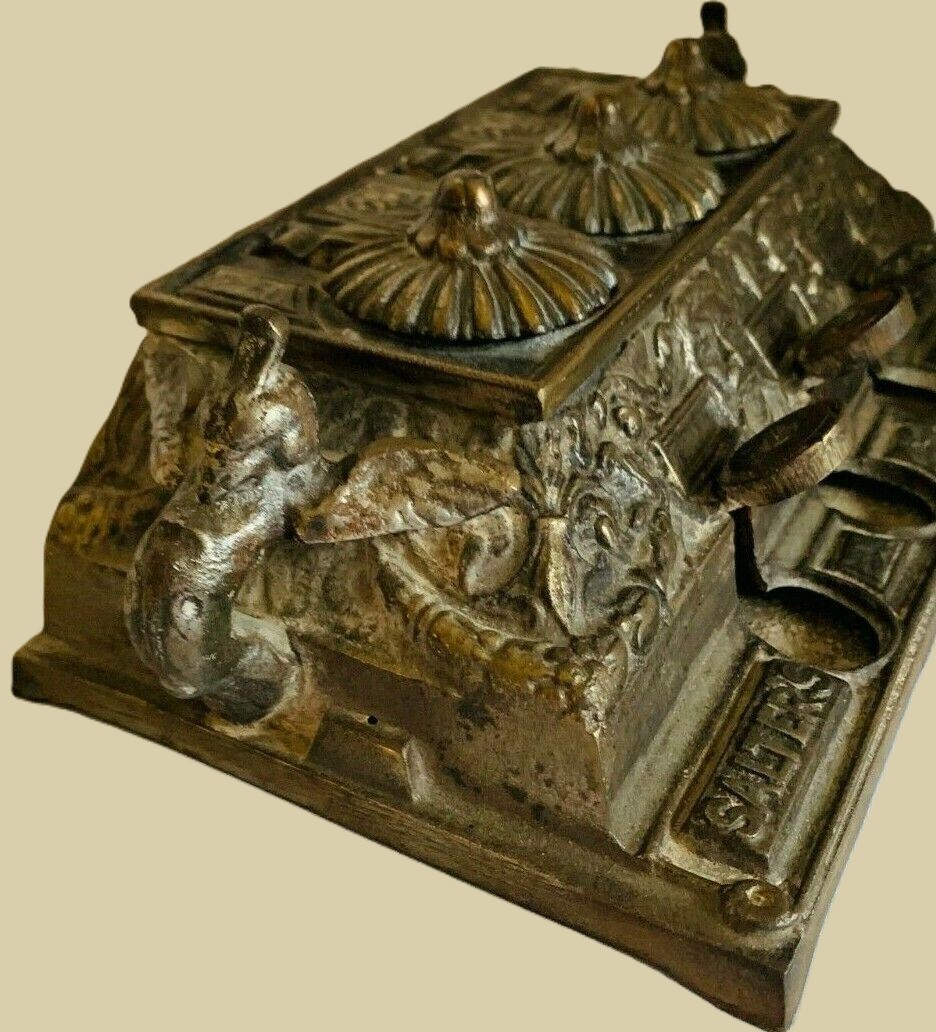
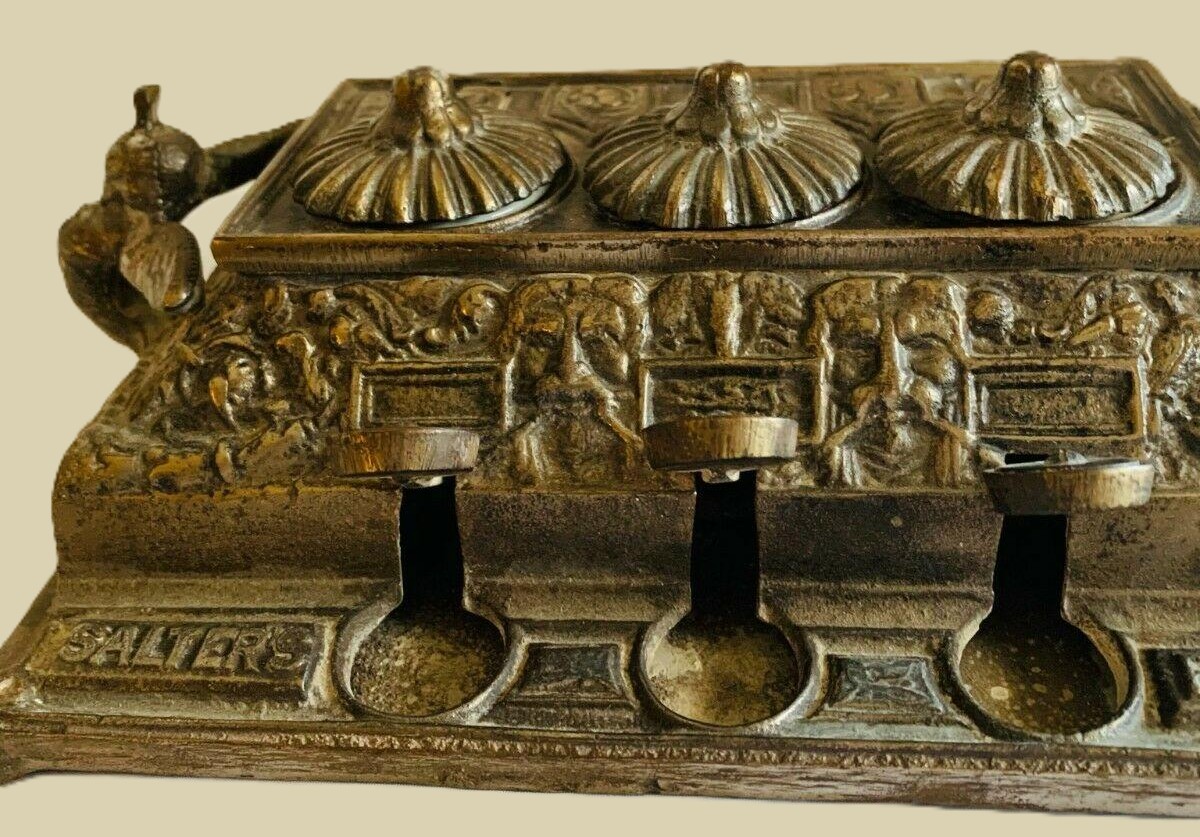
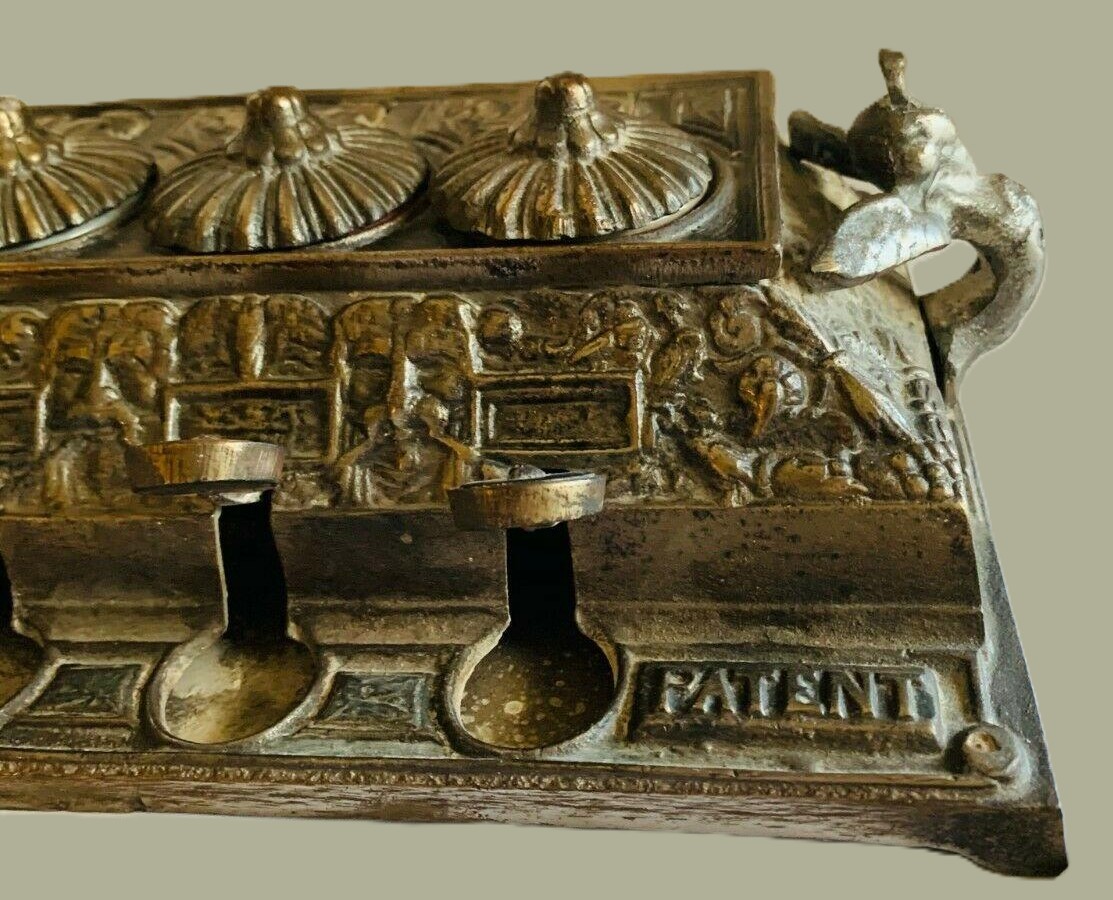
This smaller high version of the Salter’s Patent inkstand shares the exact same mechanical internal design as the larger model, but it shifts from a traditional Victorian Revival aesthetic toward a dynamic Renaissance/Rococo Revival composition.
Visual Description of the Second Example
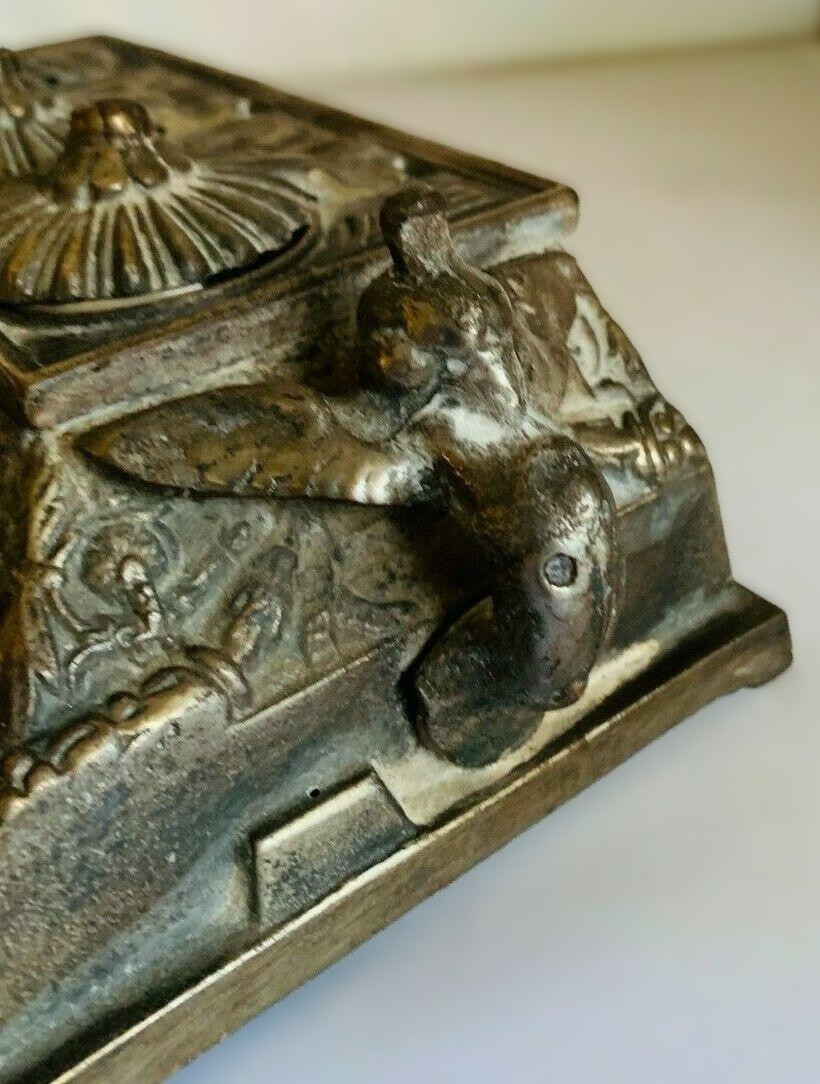
- Figural Side Handles: Instead of standard scroll or shell handles, the side grips on this example are cast as fully three-dimensional, winged winged putti / cherubs. They curve outwards with outstretched wings to create functional, sculpted handles.
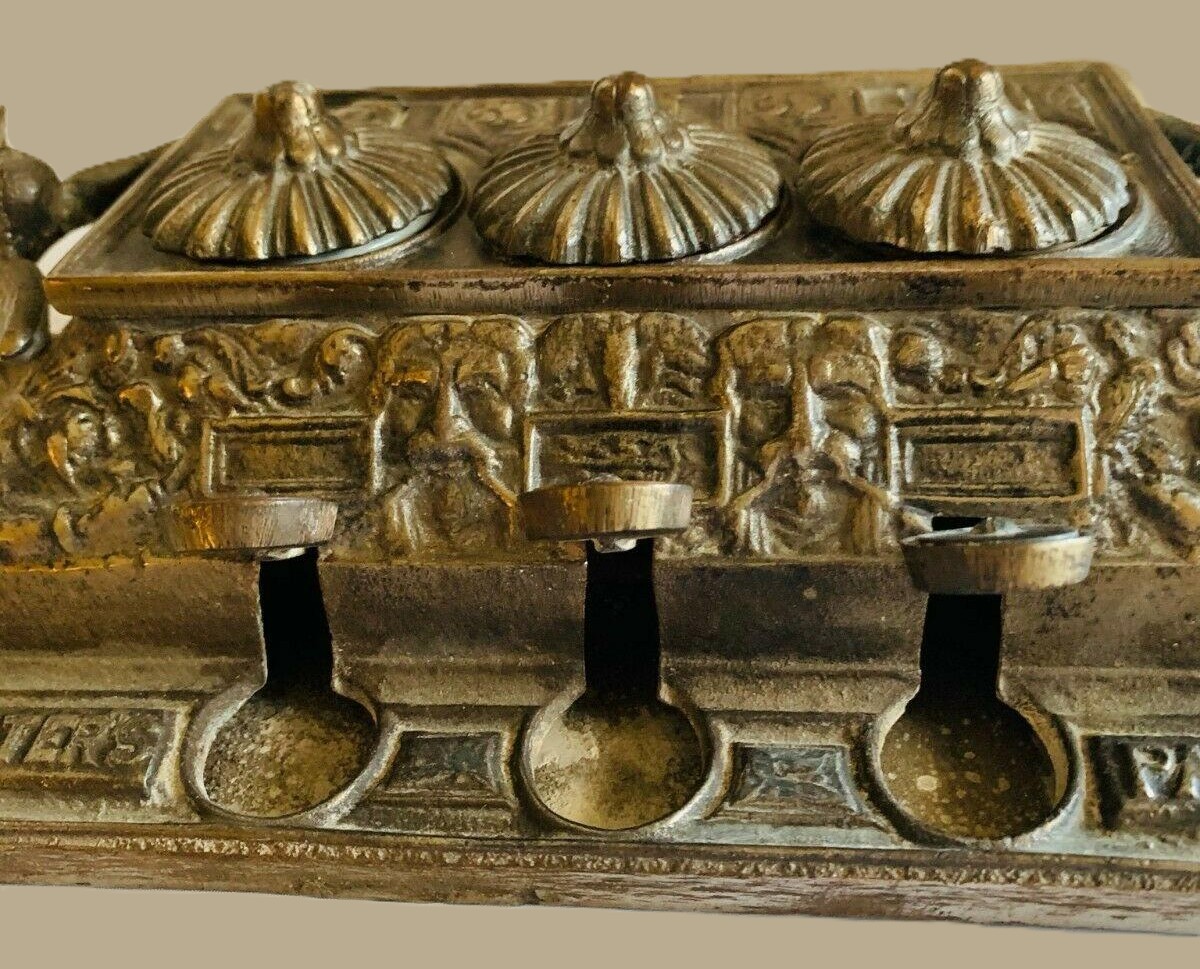
- Front Apron Relief & Masks: The sloped front panel above the mechanism slots features a detailed relief freeze depicting classical figures and grotesque/syrinx style bearded masks (faces) directly integrated into the cast pattern.
- Fluted/Gadrooned Dome Lids: The three hinged iron lids feature a prominent, raised radial gadrooning/fluting pattern terminating in a central finial or button knob.
- Re-Patinating/Gilt Finish: This piece exhibits a lighter, highlighted bronze or brass-toned wash over the heavy cast iron, bringing out the high-relief details of the faces, wings, and decorative cartouches.
- Porcelain Inserts & Keys: It retains three colored porcelain inserts (white for “Black”, red/pink for “Red”, and cream/yellowish for “Copying”) and three original typewriter-style depressible keys. The front lower bar is cast in prominent relief with “SALTER’S” on the left and “PATENT” on the right.
Compare and Contrast: Large vs. Small Example
| Feature | First Example (Larger) | Second Example (Smaller) |
| Dimensions | high | high |
| Decorative Style | Victorian Foliate Revival (scrolls, acanthus, lattice) | Renaissance/Rococo Revival (figural cherubs & masks) |
| Side Handles | Shell/fan-shaped flared cast grips | Sculpted winged cherubs / putti forming arched loops |
| Lid Design | Flat scalloped shell motif with low-profile hinge | High-domed, fluted/gadrooned lids with central finials |
| Front Relief Motif | Scrollwork and floral scrolls | Human/classical bearded masks and narrative figures |
| Finish / Patina | Dark, uniform Japanned/ebonized iron finish | Warm bronzed/gilt-toned highlight finish |
| Mechanism & Layout | 3 keys, 3 hinged lids, internal levers, porcelain pots | Identical 3-key mechanical spring-lever construction |
Mechanical Continuity
Despite the overall size reduction and distinct casting patterns, George Salter & Co. used identical internal engineering for both models. The footprint was condensed by narrowing the outer decorative border and fitting smaller ceramic pots, allowing Salter to offer a compact desk option alongside the larger executive model while maintaining the exact same spring-lever operation.
Third Example:
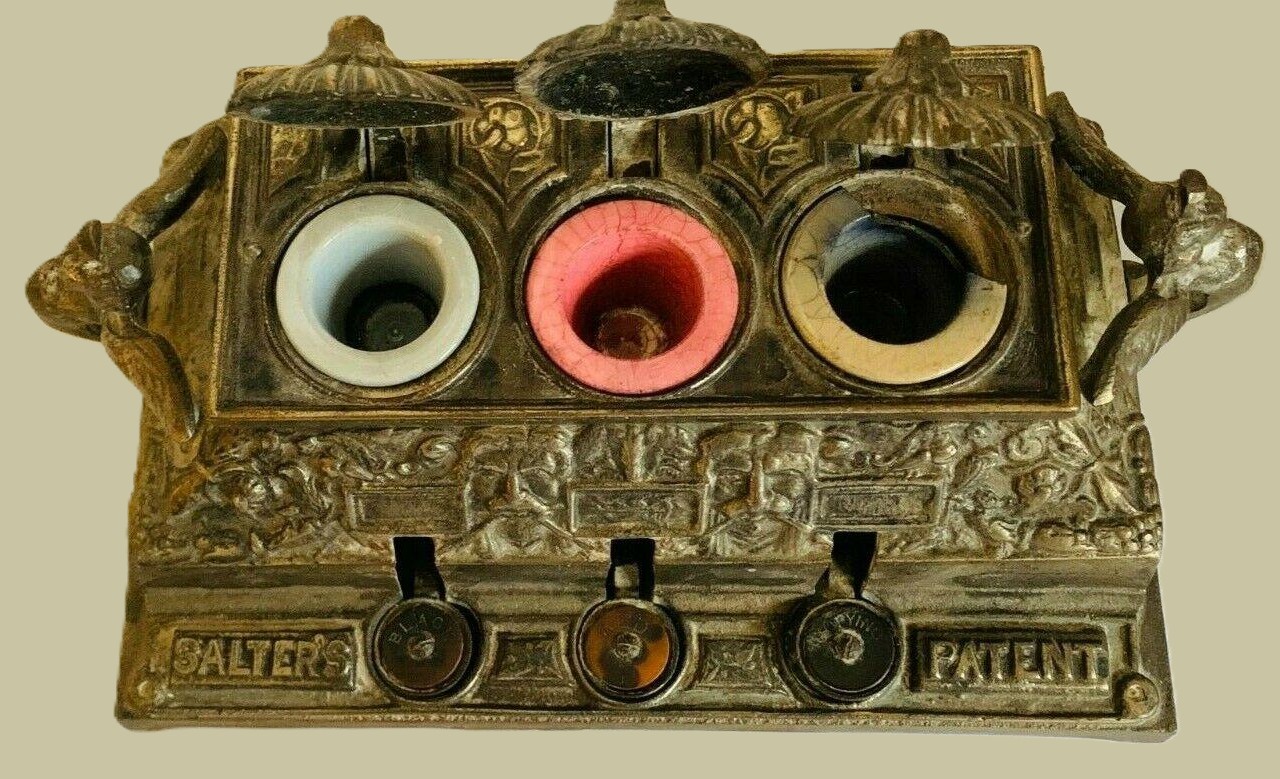
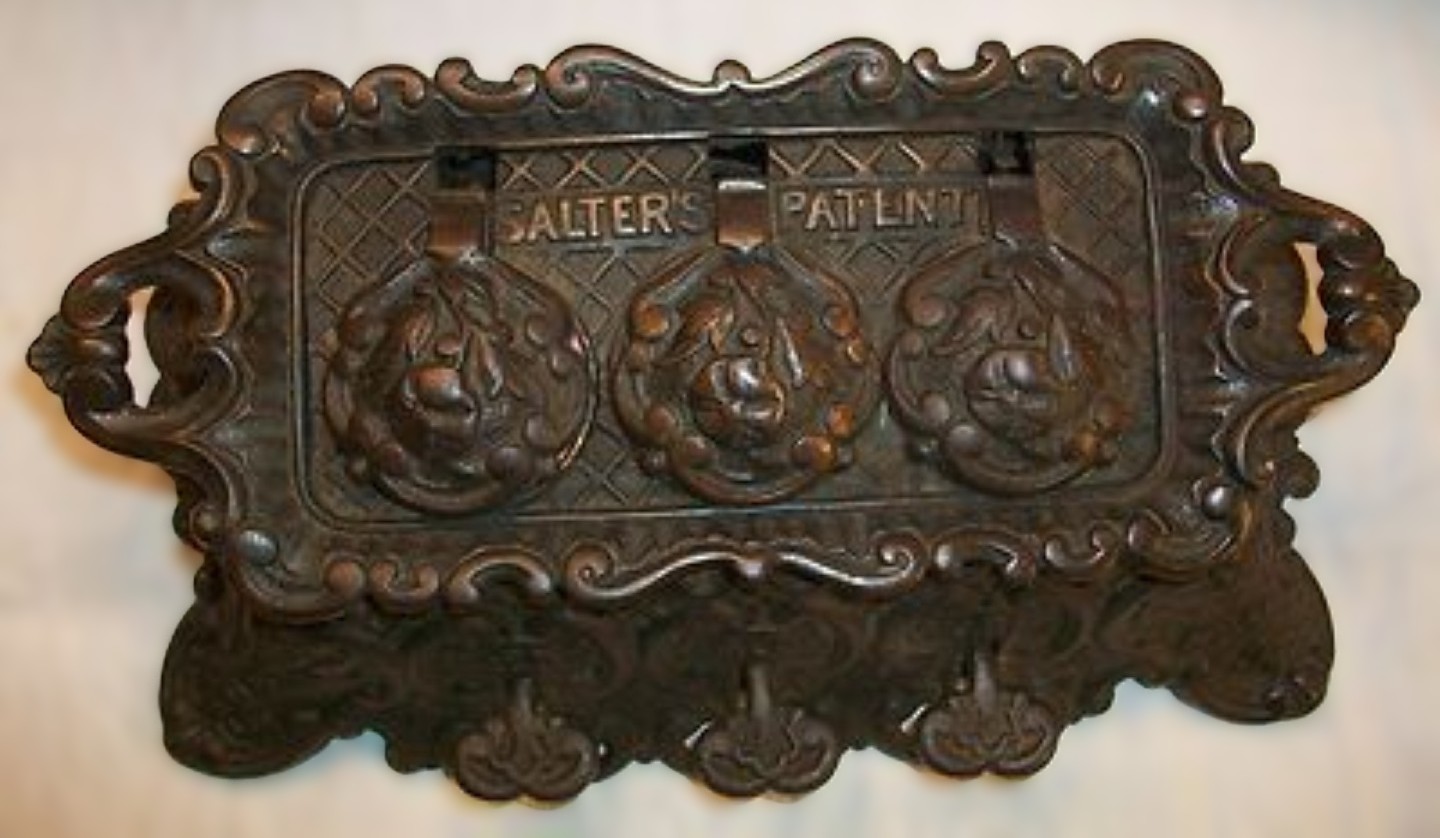
This third example () represents another distinct aesthetic variant in George Salter & Co.’s production line of mechanical spring-lever desk sets.
Description of the Third Example
- Overall Style & Pattern: This model features a rich Rococo / Baroque Revival framework dominated by openwork C-scrolls, lattice/cross-hatch engine-turned ground textures, and a pierced scalloped rim.
- Lid Detail & Marking: Unlike the first two examples where “SALTER’S PATENT” was cast into the front lower apron, this model displays “SALTER’S” and “PATENT” prominently raised on the upper platform behind the lids, set against a cross-hatched lattice background. The three hinged lids feature cast floral garlands surrounding a central fruit/flower medallion.
- Integral Handles & Front Keys: The side handles are fully integrated into the scrolling, lobed outer border rather than being applied figural putti or separate shell moldings. The typewriter-style keycaps at the front feature raised cast lettering for “RED”, “BLK”, and “CPY” directly on the metal caps.
Manufacturing Timeline & Sequence
All three models date to the late Victorian era, circa 1890–1900, coinciding with George Salter & Co.’s expansion into typewriter and office machinery production in West Bromwich. Based on design evolution, decorative complexity, and key labeling:
- Oldest (First Example – ): Circa early-to-mid 1890s. The heavy, formal Victorian scrollwork, dark Japanned iron finish, flat shell-motif lids, and classic side grips reflect Salter’s initial commercial office desk set production.
- Intermediate (Third Example – ): Circa mid 1890s. The placement of “SALTER’S PATENT” shifted to the top bedplate behind the lids, and the front keycaps were cast with permanent raised lettering rather than relying solely on porcelain inserts.
- Most Recent (Second Example – ): Circa late 1890s to early 1900s. The compact footprint, intricate classical masks, domed fluted lids, and fully sculpted winged putti side handles show a move toward high-decorative domestic desk sets and lighter metallic highlighting.
Patent Details & Commonality
- Single Master Patent: All three variations were manufactured under the same core British Patent, granted to George Salter & Co. in the early 1890s.
- Mechanism Claim: The patent protected the specific internal mechanical linkage—a spring-loaded rocker arm connected to a depressible front key lever that raises a rear-hinged heavy lid when pushed and automatically spring-closes it upon release to prevent ink evaporation.
- Patent Numbers: In 19th-century Great Britain, office wares received UK Letters Patent numbers rather than US utility patent numbers. Late Victorian UK patents were filed chronologically per year (e.g., UK Patent No. 12,345 of 1892 or 1893).
Catalog Descriptions & Comparable Examples
- Historical Trade Context: Period stationery trade journals (such as the British & Colonial Printer & Stationer and The Stationer, Printer, and Fancy Trades Register c. 1892–1898) listed Salter’s invention under listings such as:
“Salter’s Patent Mechanical Inkstand – Cast Iron or Bronzed Finish. Fitted with three porcelain wells for Black, Red, and Copying Inks. Each lid opened independently by typewriter key action.”
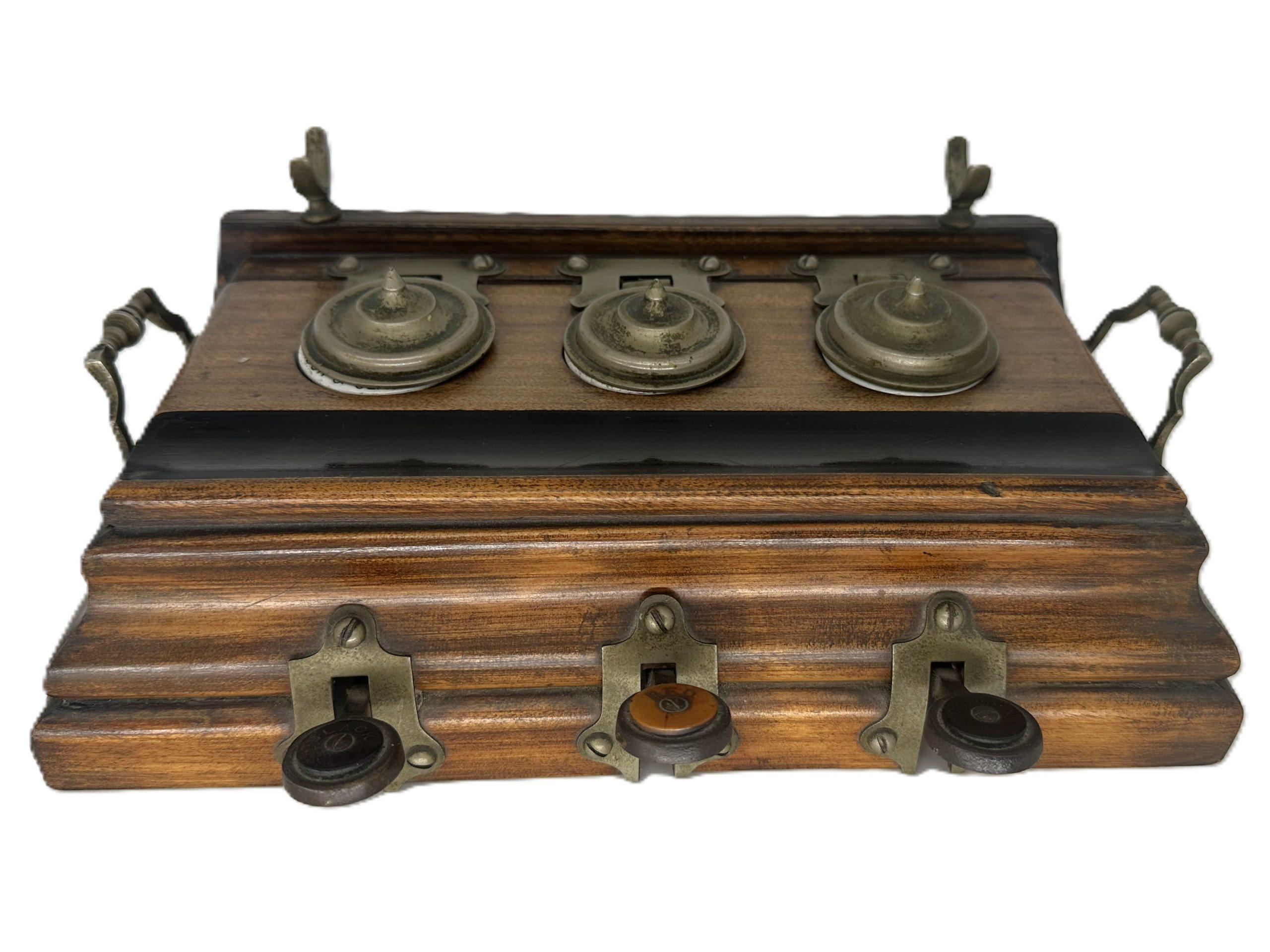
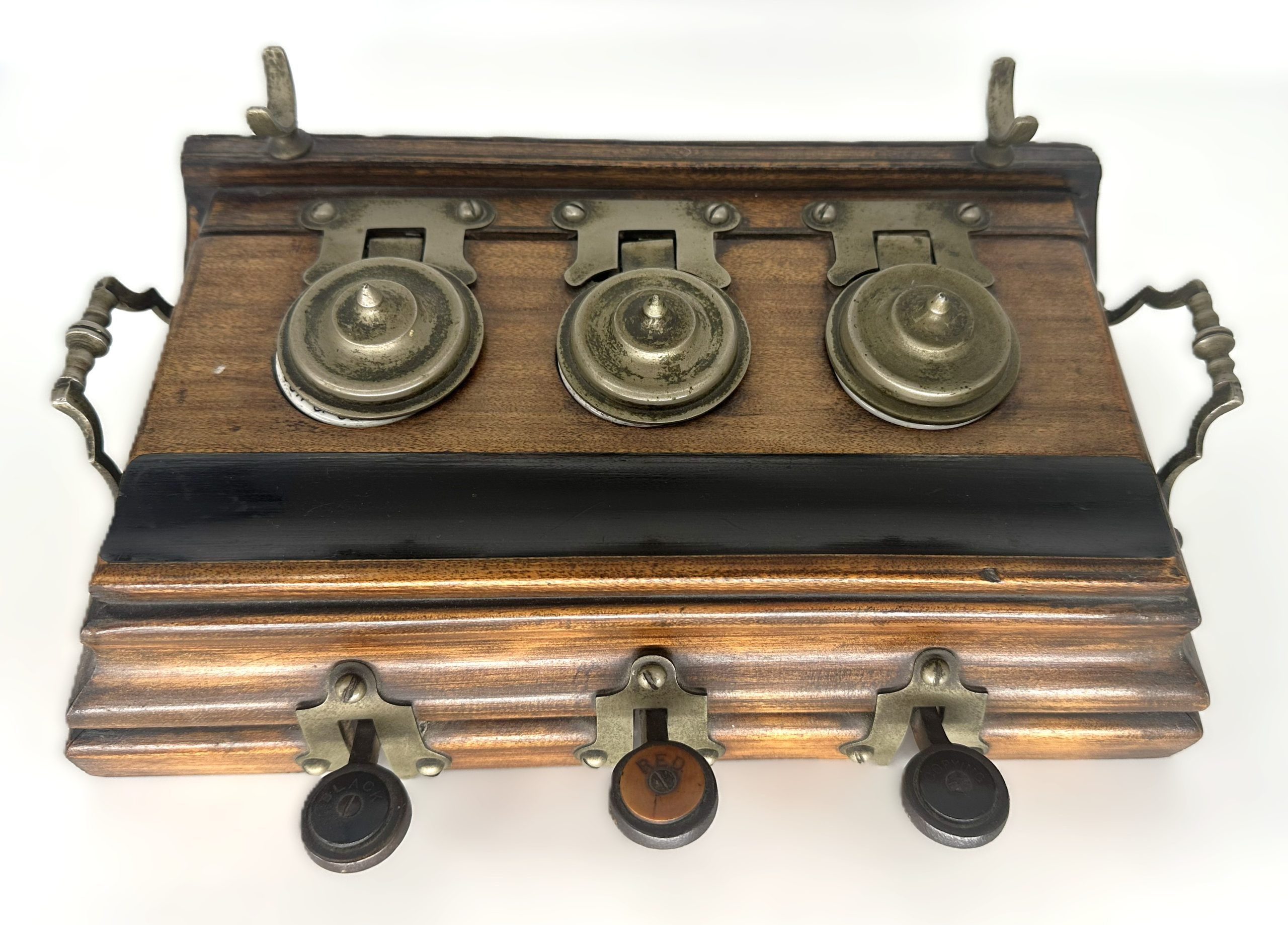
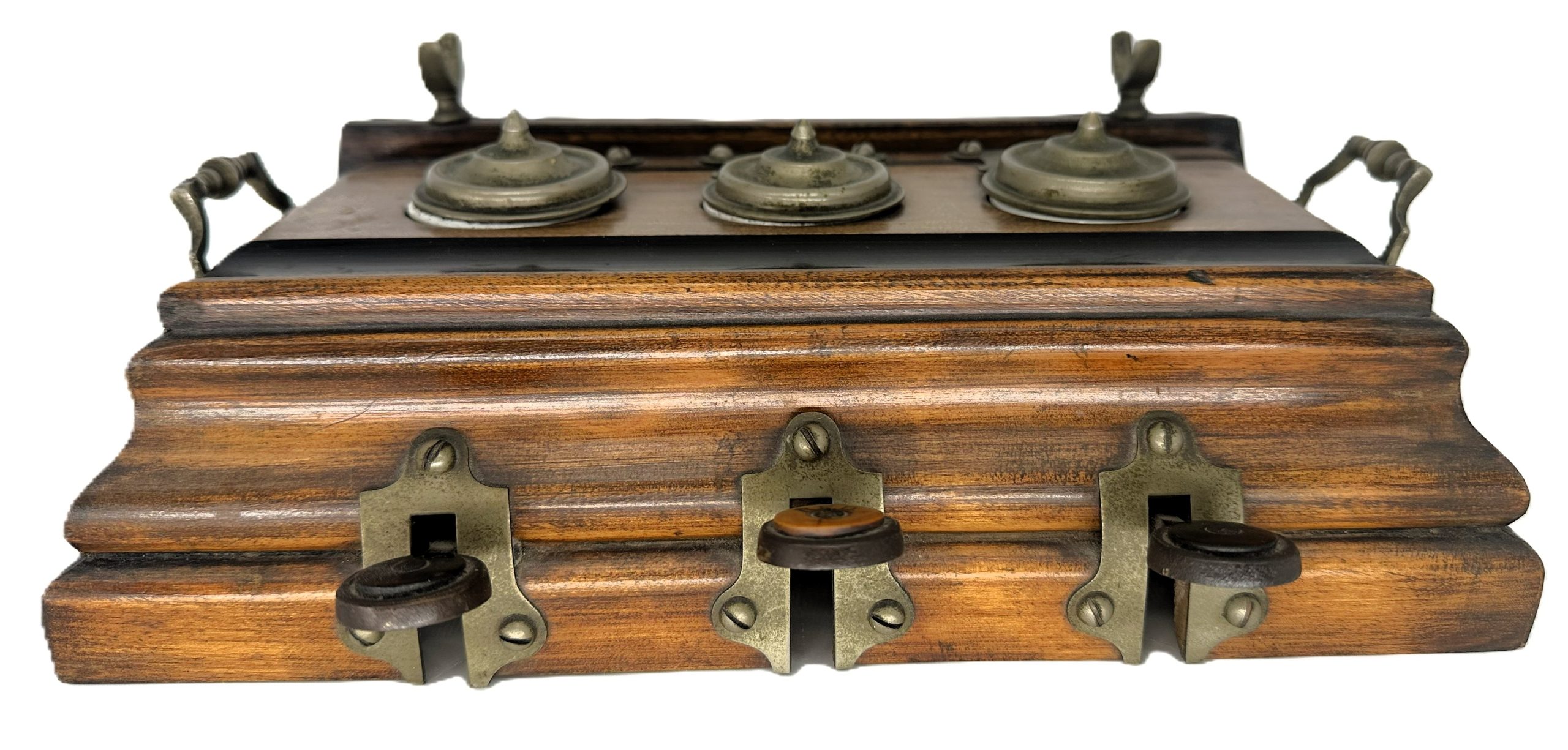
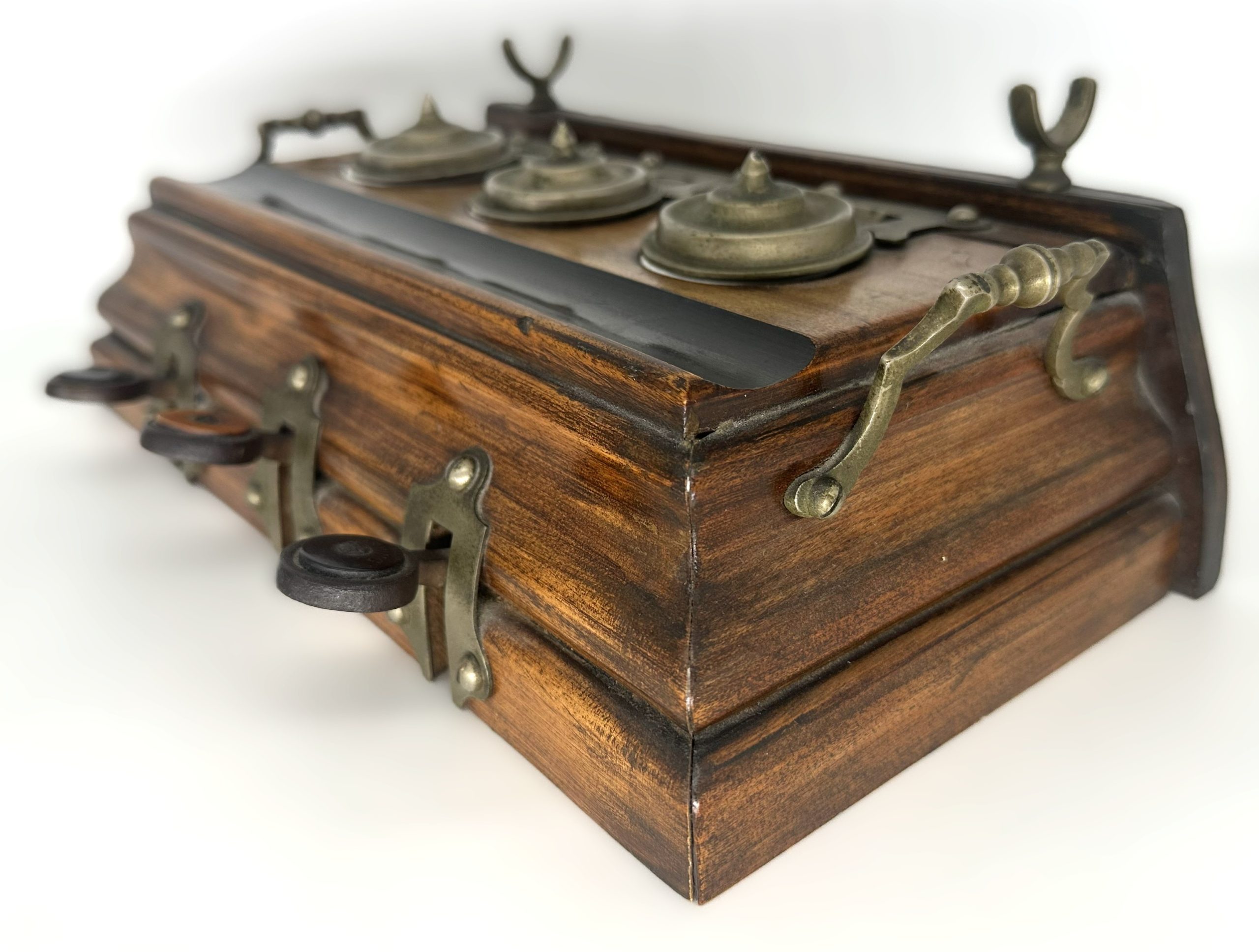
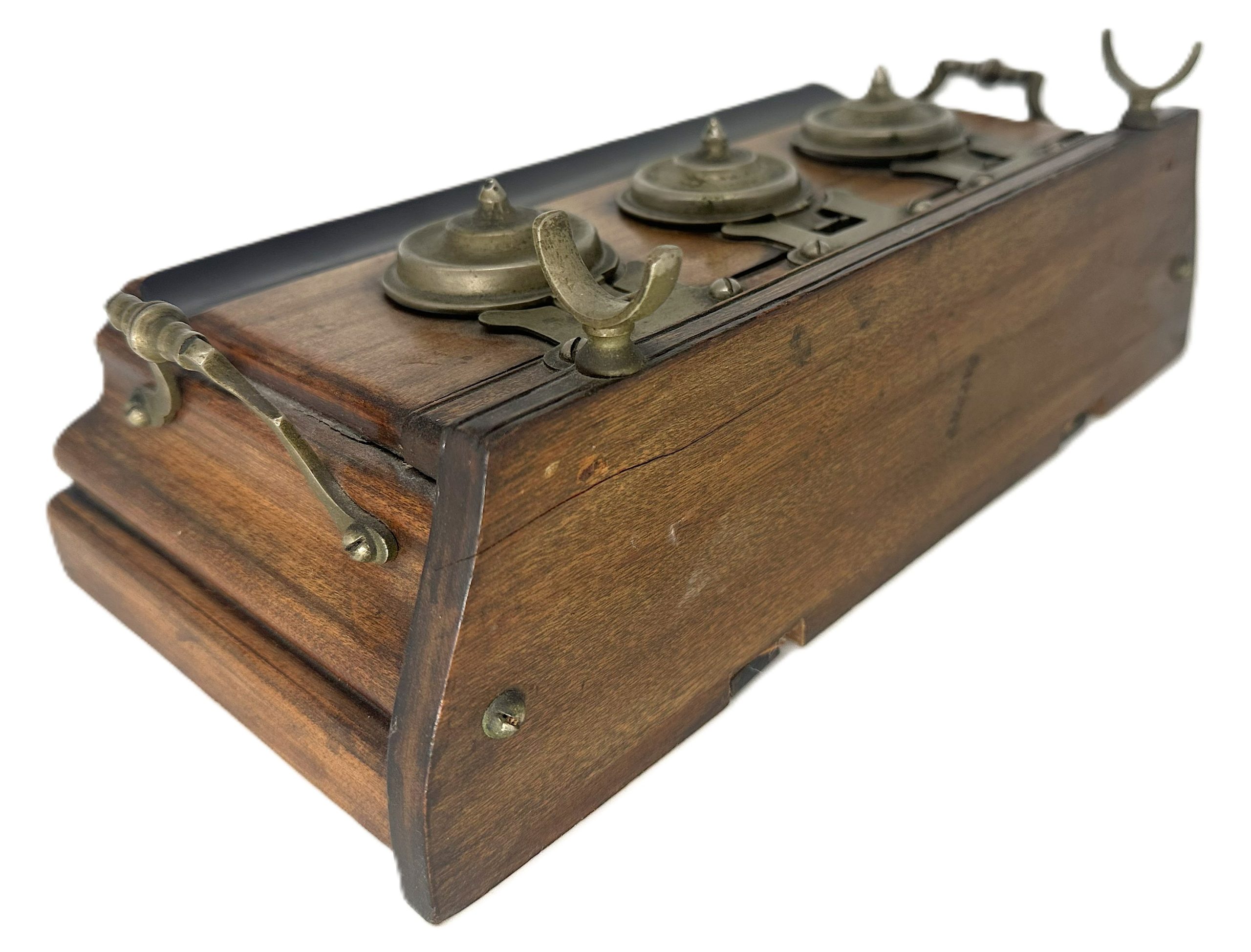
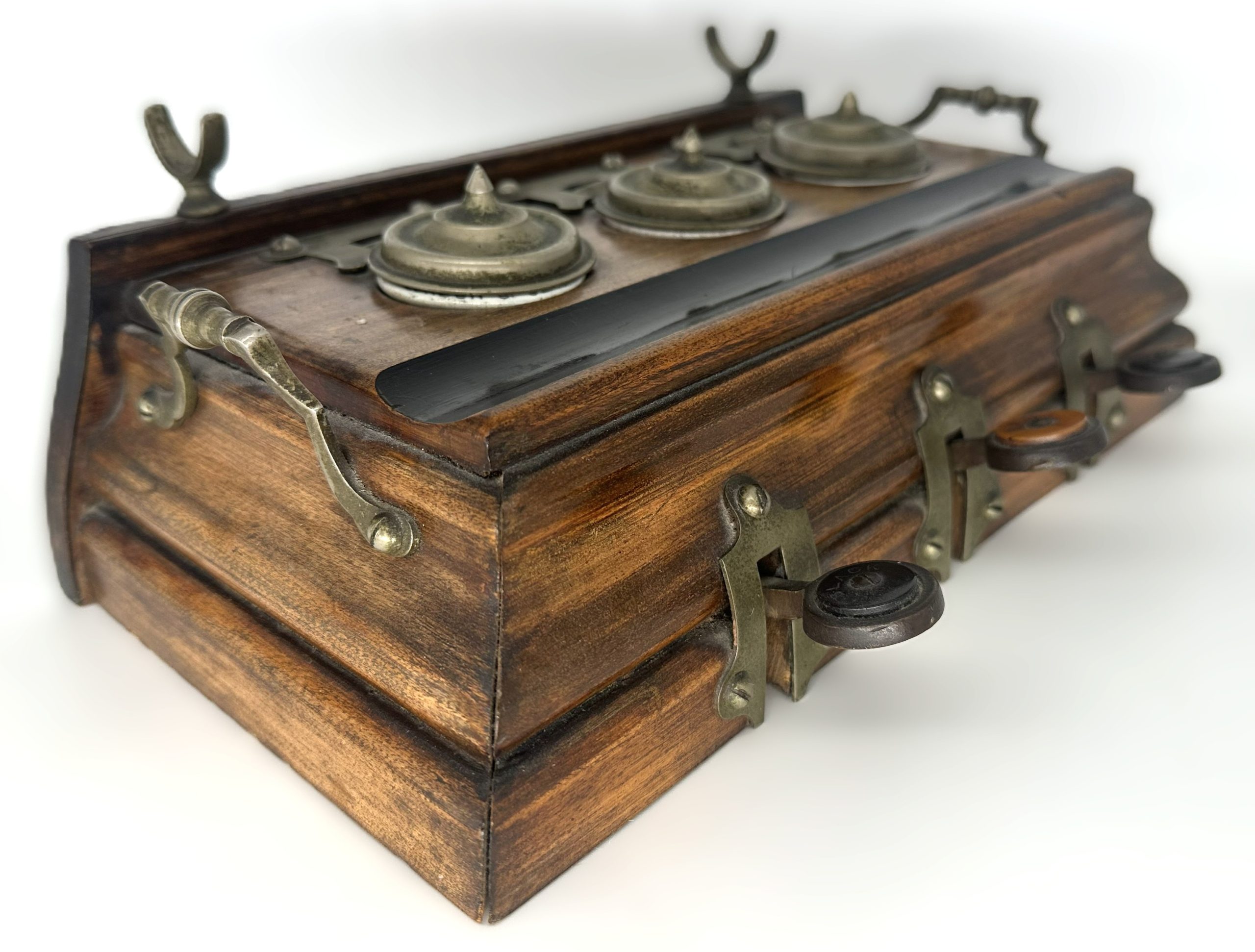
A Fourth Example: Wooden Mechanical Inkstand
Description
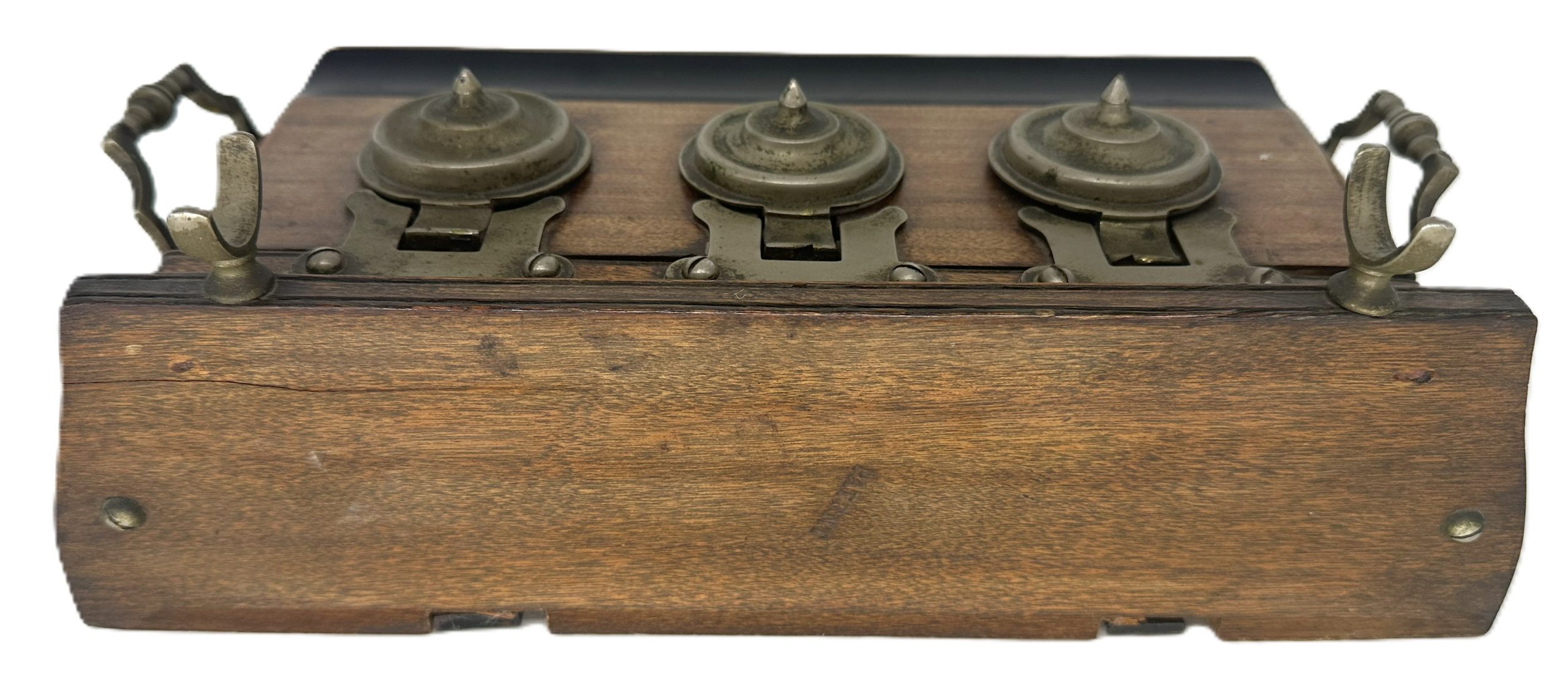
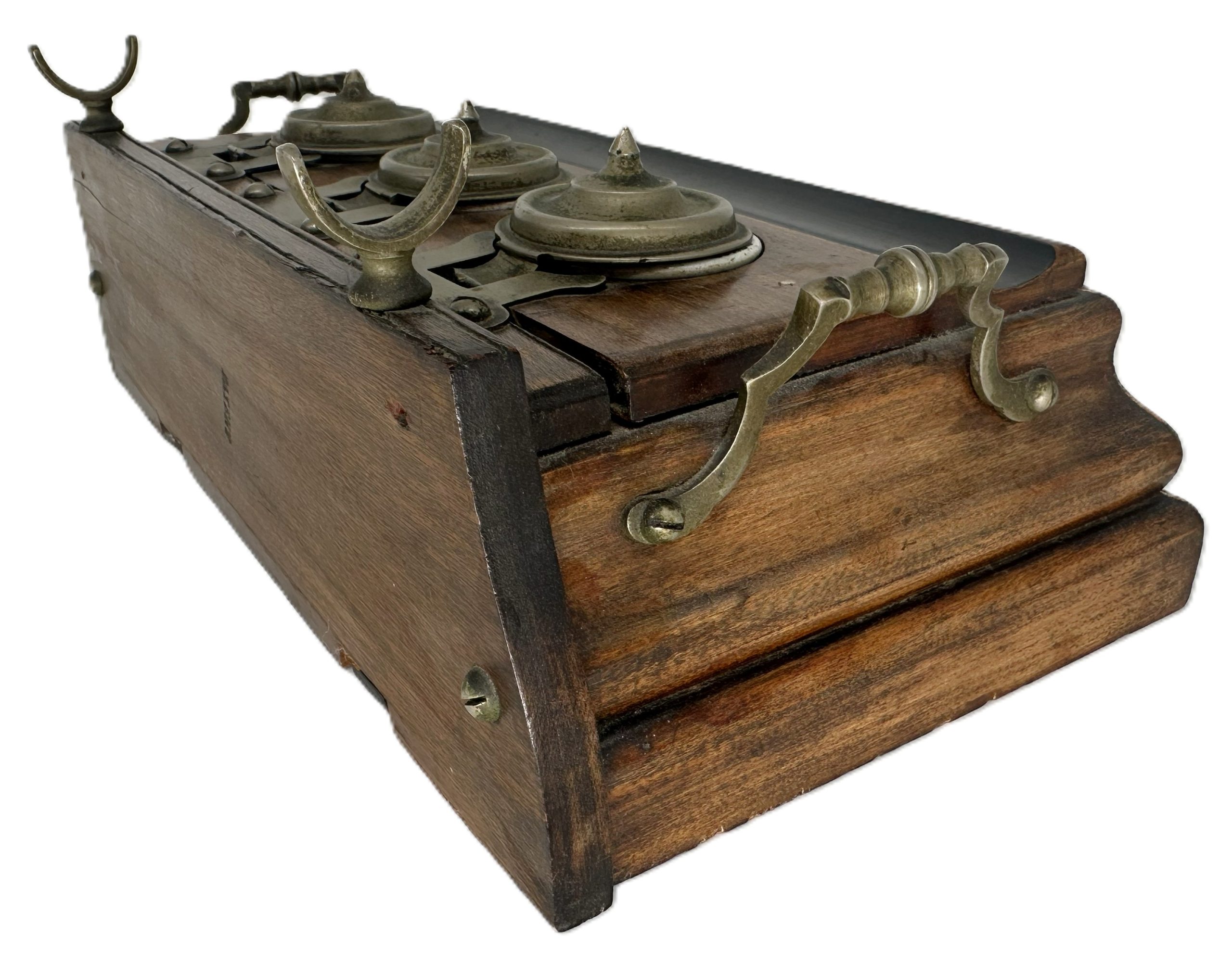
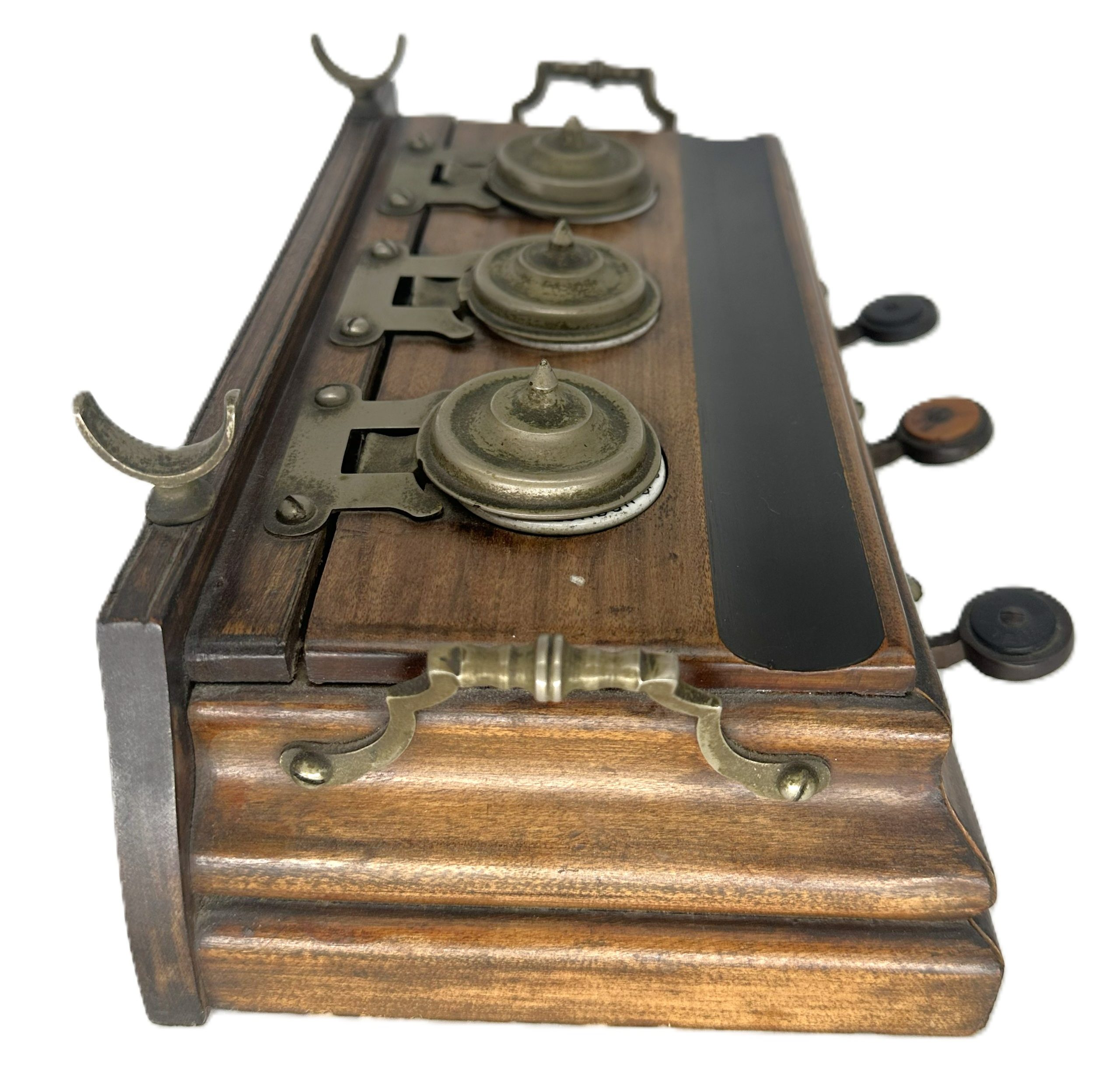
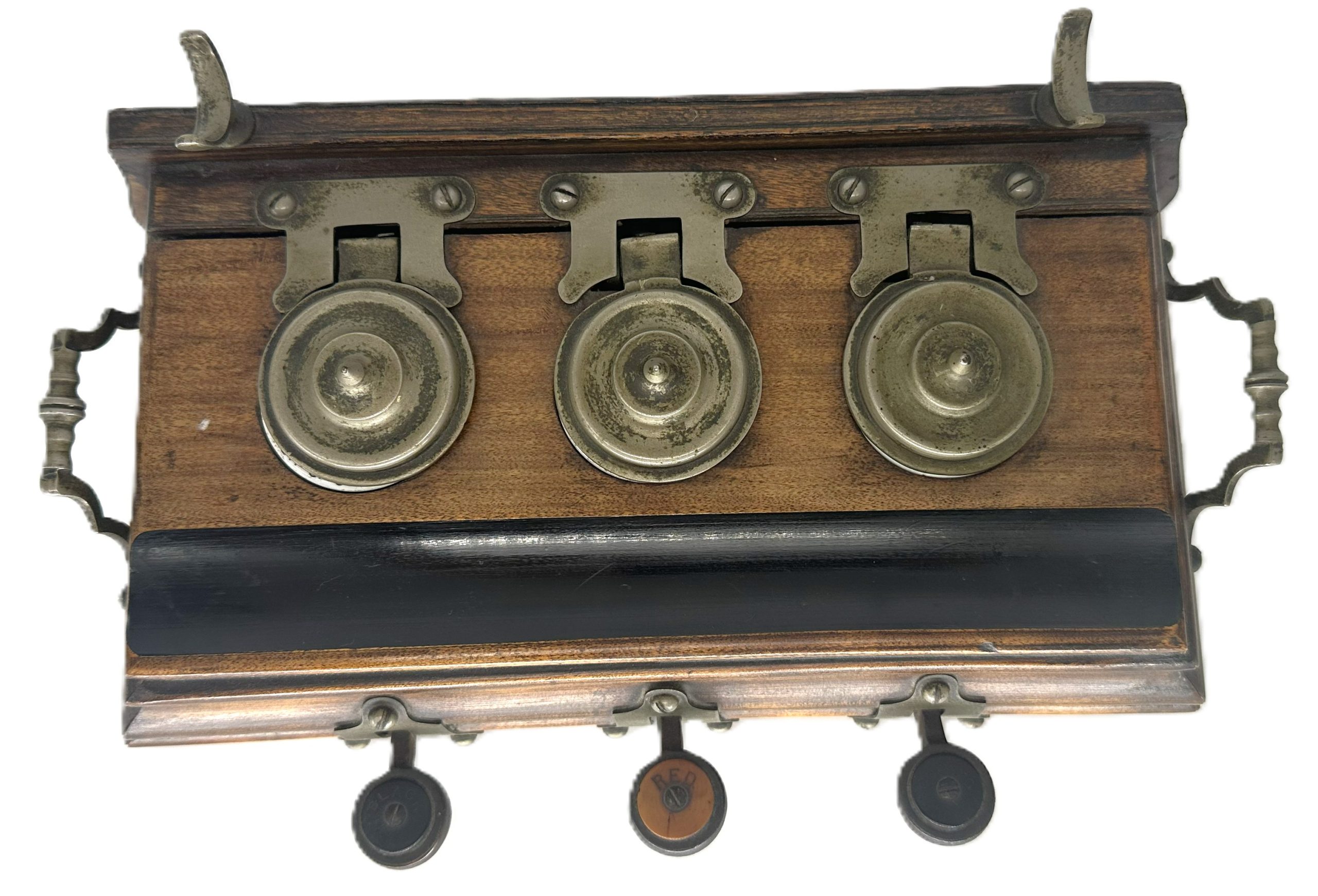
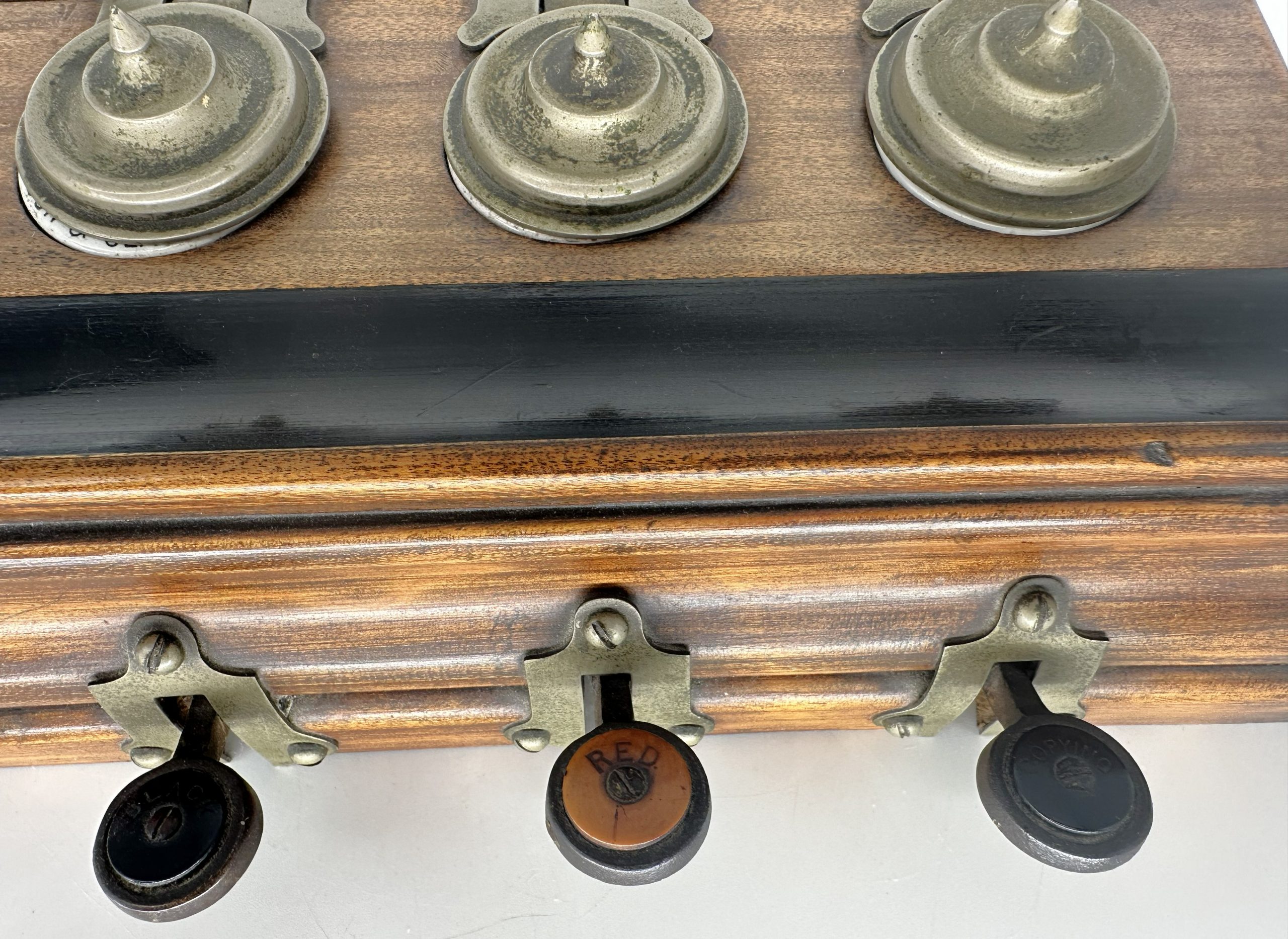
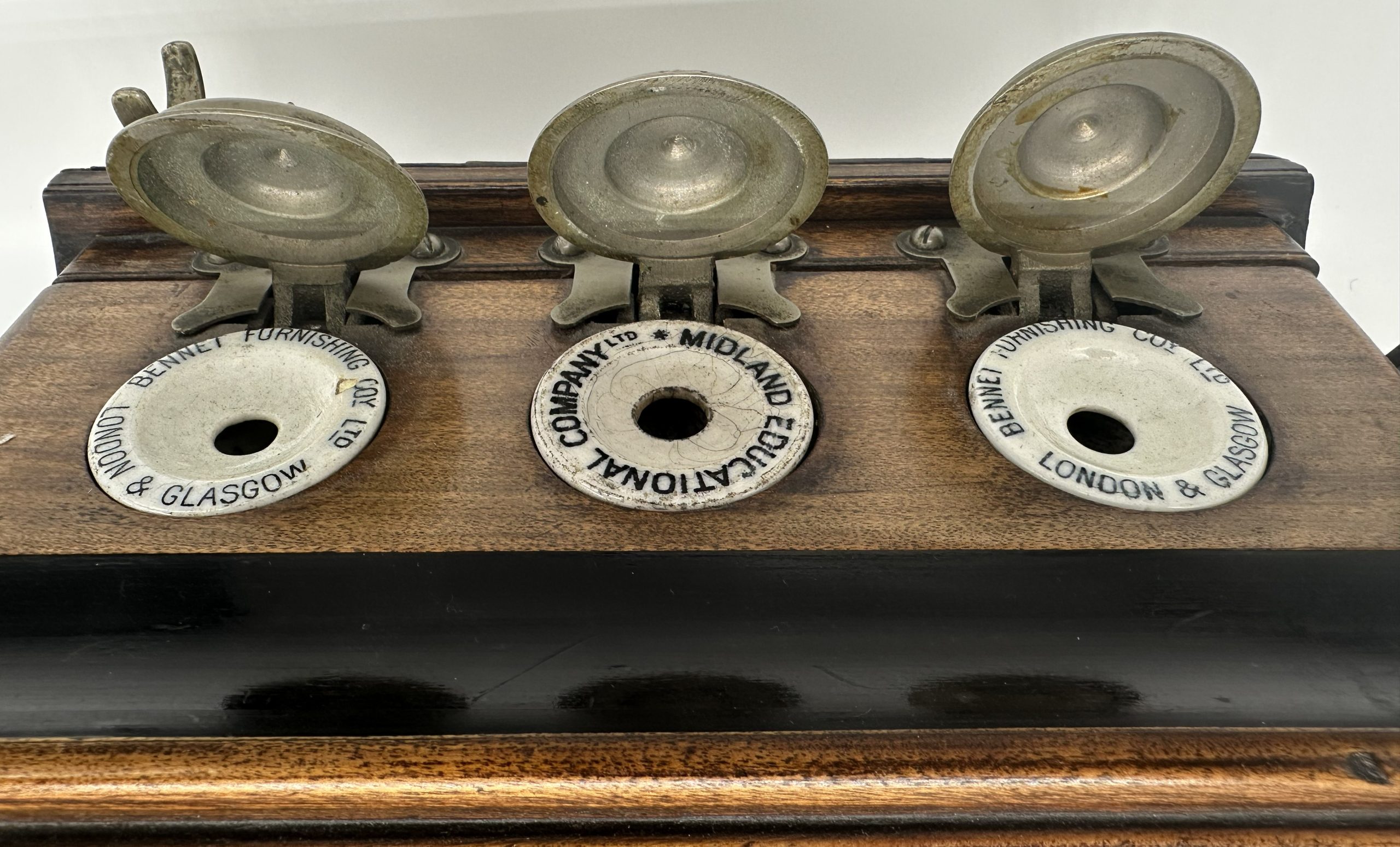
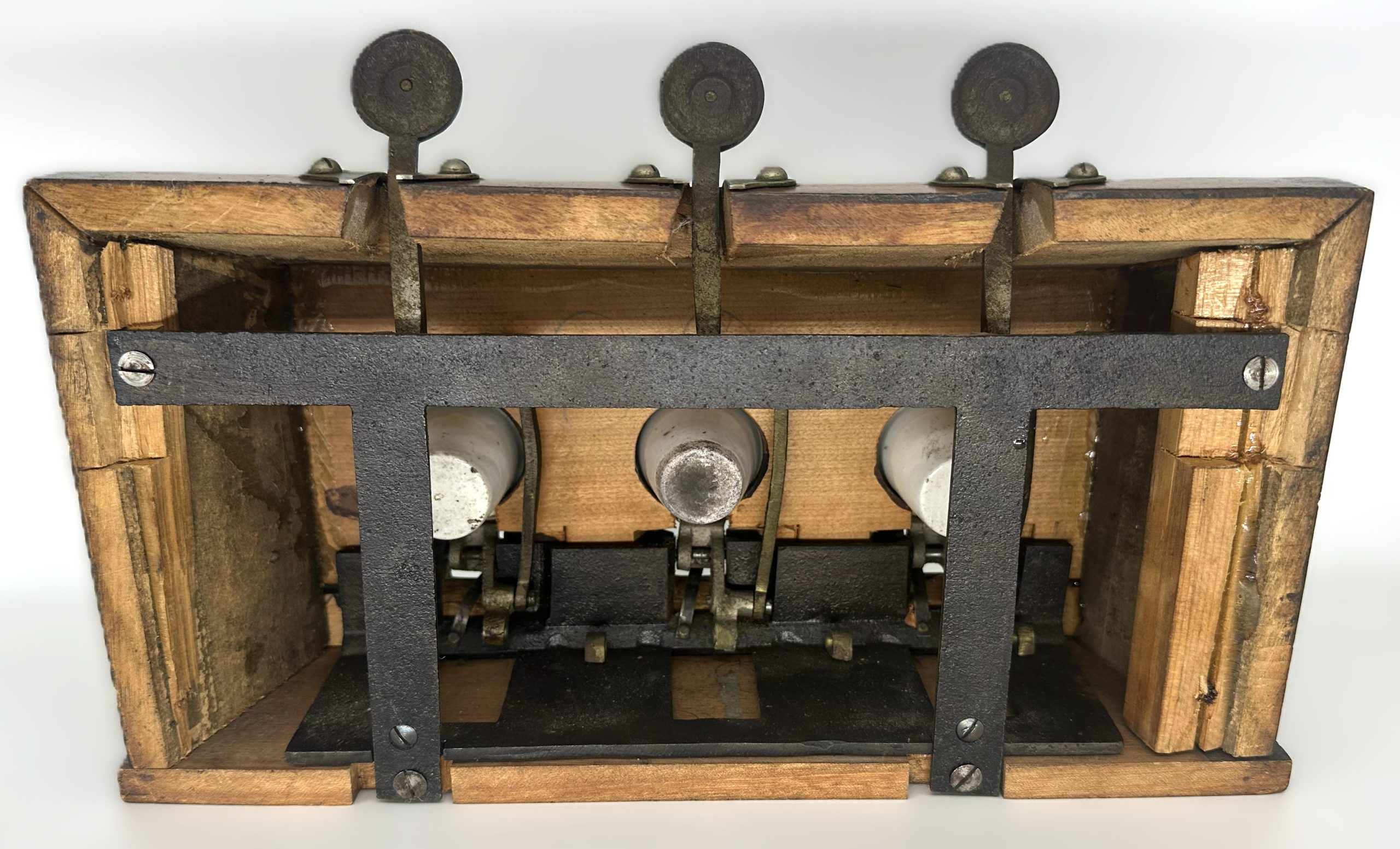
This example is a wooden-bodied variation featuring the same three-key mechanical spring-lever system seen in the cast-iron models.
- Body & Carving: The main housing is crafted from hardwood with stepped, molded tiered edging and a sloped front apron. A long, carved groove runs horizontally along the upper step to serve as a pen trough.
- Hardware & Mounts: It incorporates brass fittings, including:
- Two brass side drop-handles attached with ornamental escutcheons.
- Two upright brass pen rests mounted along the rear ridge.
- Brass escutcheon plates secured by screws over the front key slots and rear hinges.
- Domed brass lids with pointed finials.
- Internal Mechanism: The underside reveals a cast-iron mounting frame fitted into the wooden cavity. This iron frame houses the internal rocker arms, springs, and pivot points that connect the typewriter-style keys to the hinged lids above.
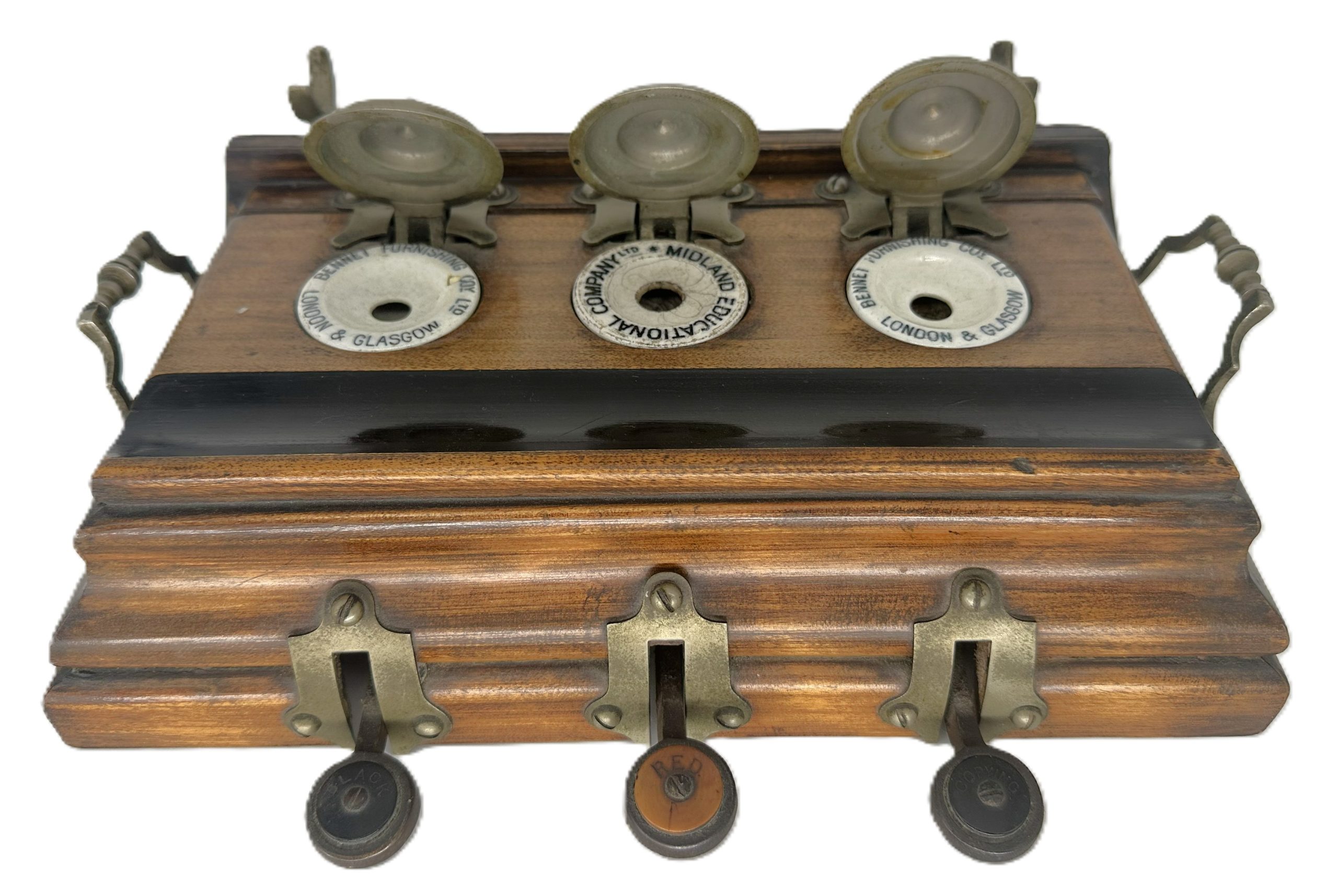
- Porcelain Retailer Inscriptions: When opened, the ceramic inserts show retailer markings printed on the porcelain rims:
- Left & Right Inserts: “BENNET FURNISHING CO LTD / LONDON & GLASGOW”.
- Center Insert: “MIDLAND EDUCATIONAL COMPANY LTD”.
Was it made by George Salter & Co.?
Yes, the internal mechanical movement was manufactured by George Salter & Co.
Although the exterior wooden case lacks the cast factory mark found on the iron models, the cast-iron internal framework, rocker linkage, brass key assemblies, and spring actions are identical to Salter’s patent design. Salter produced both fully cast-iron inkstands and supplied their patented internal mechanisms to commercial cabinetmakers, joiners, and office supply houses—such as the Midland Educational Company and Bennet Furnishing Co.—who cased the mechanisms in polished hardwoods for high-end office trade.
Production Date & Chronology (Earlier vs. Later)
- Estimated Date: Circa 1895–1905.
- Relative Timeline: This wooden edition represents a later, premium commercial iteration rather than an early prototype.
- Why it is Later:
- Retailer Stamps: The Bennet Furnishing Co. operated under “Ltd” status during the late Victorian and Edwardian periods, aligning with late 1890s/1900s production.
- Refined Construction: The combination of a cast-iron mechanical chassis fitted into a finished wooden case was a secondary development after the initial success of the all-cast-iron production models.
Type of Wood Used
The cabinet is constructed from Walnut (specifically English or European Walnut, Juglans regia), finished with a satin varnish. The tight, straight grain pattern, warm amber-brown tones, and dark growth rings visible on the mitered sides and rear panel are characteristic of late-Victorian walnut office cabinetry.
Estimated value: $250
Content disclaimer. The information posted is the owner’s best knowledge and may not have been vetted by the SOIC. We welcome comments, corrections, and additions, working to make our website information comprehensive and accurate.
Join the Society of Inkwell Collectors (SOIC) – it’s free!
Founded in 1981 as a non-profit organization,
we are documenting inkwells (and accessories).
We’re here to help and inform!