

Inkipedia
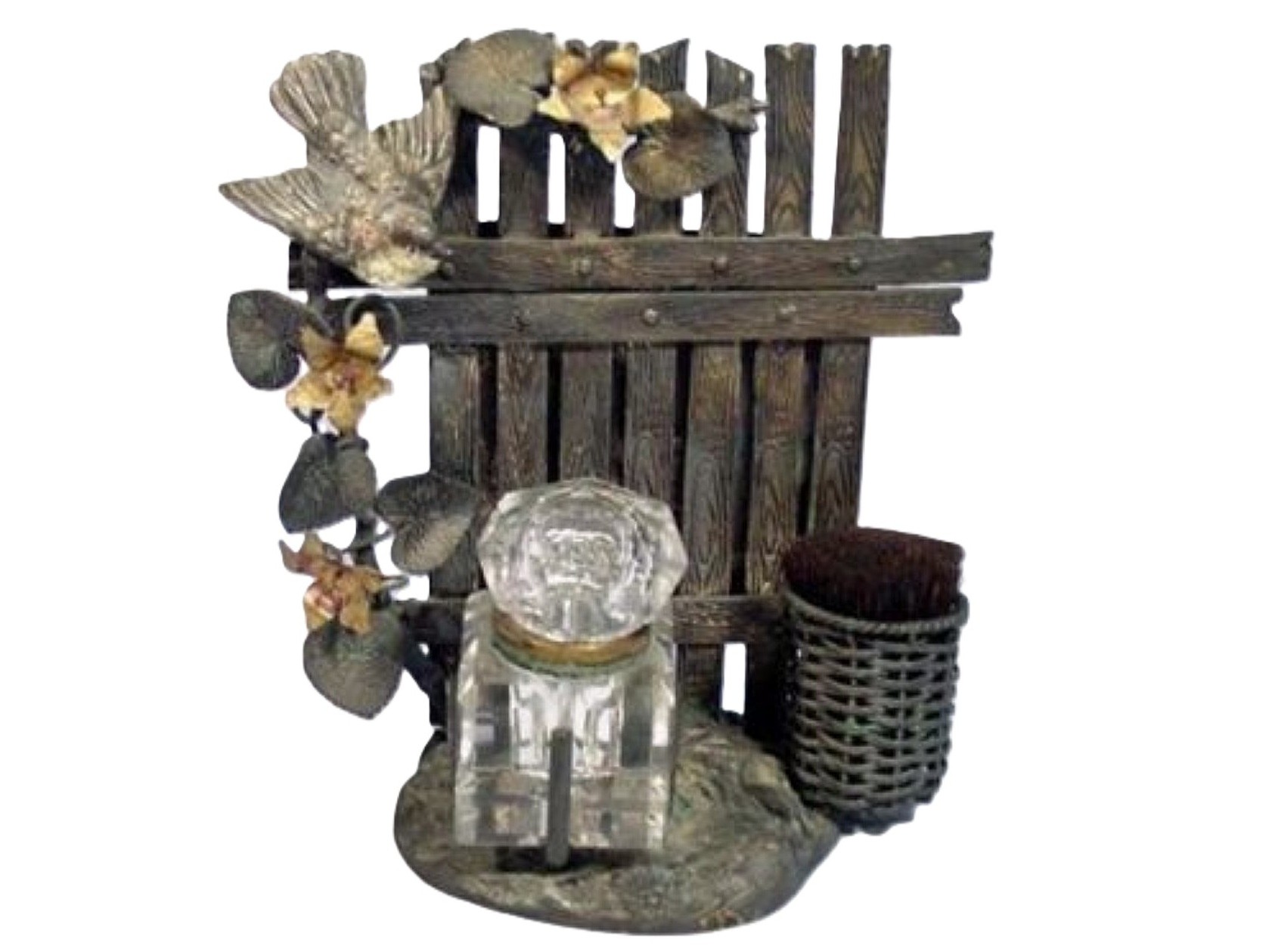
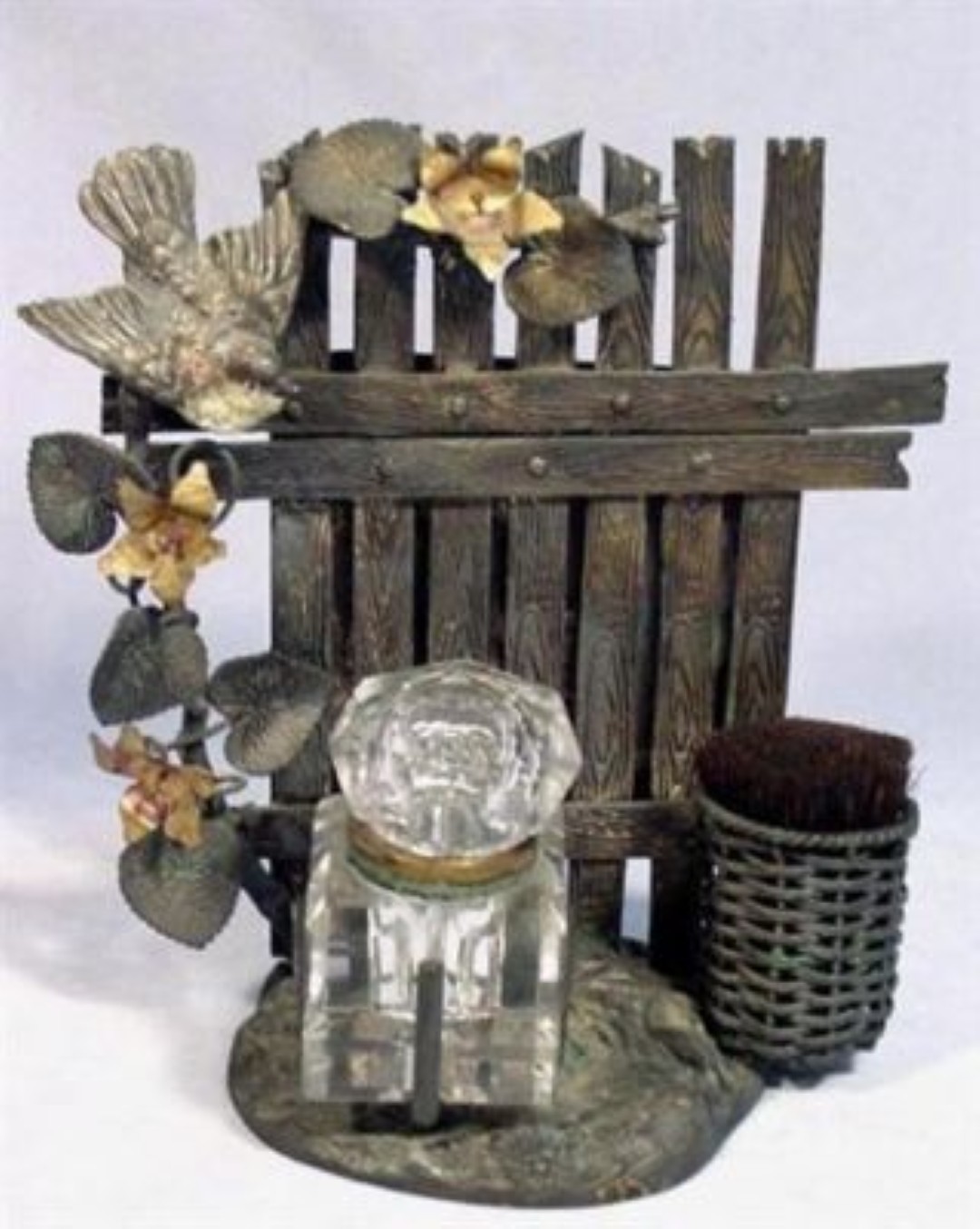
Rustic Scene with a Fence – Austrian Bronze
| Categories | Figural - Inanimate |
| Material | Bronze |
| Markings | Unmarked |
| Manufacturer | Undetermined |
| Origin | Austria |
| Date or Era | circa 1900 |
| Measuring | 5” x 3 ¼” x 6” high |
This whimsical, rustic scene is characteristic of the famous Viennese workshops that excelled in these naturalistic, multi-textured desk novelties.
Description
Austrian Cold-Painted Bronze and Cut-Glass Desk Inkstand
- Central Motif: A detailed, rustic desk stand modeled as an old wooden picket fence with a realistically cast faux-wood grain finish.
- Left & Upper Elements: A finely cast bronze bird is perched on a twisting vine that creeps up and over the fence. The vine features broad, green-patinated leaves and delicate, individually molded flowers with a gilded finish.
- Right Element: To the right sits an integrated, intricately cast woven basket that holds a pen wipe.
- The Inkwell: Positioned prominently in the center foreground is a heavy, square cut-glass inkwell featuring a multifaceted, hinged glass cap and brass collar fitting.
- Reverse Features: The back of the picket fence structure is equipped with two integrated bronze hooks designed to horizontally rest a dip pen.
- Base & Markings: The entire scene is anchored to a rocky, organic-form bronze base. The piece is unmarked.
Approximate Date of Manufacture
This inkstand was most likely manufactured between 1890 and 1910.
- The Vienna Bronze Golden Age: The production of highly detailed, whimsical, Cold-Painted Viennese bronzes (often featuring animals, rustic items, and clever combinations of utilitarian desk tools) peaked between the late 1880s and the outbreak of WWI.
- The Naturalistic / Art Nouveau Influence: The asymmetrical, winding vine with gilded flowers climbing an everyday object like a picket fence reflects the naturalistic, organic themes popularized by the Art Nouveau movement at the turn of the century.
- Utilitarian Elements: The presence of a dedicated bristle pen wipe basket and rear dip pen hooks strictly dates the functional design to a period before fountain pens completely dominated the market (pre-1920s). Heavy cut-glass wells with hinged collars were standard for high-end European writing sets of the 1890–1910 window.
Estimated value: $225
Content disclaimer. The information posted is the owner’s best knowledge and may not have been vetted by the SOIC. We welcome comments, corrections, and additions, working to make our website information comprehensive and accurate.
Join the Society of Inkwell Collectors (SOIC) – it’s free!
Founded in 1981 as a non-profit organization,
we are documenting inkwells (and accessories).
We’re here to help and inform!