

Royal Copenhagen Blue Fluted Full Lace Pattern
| Categories | Ceramics/Porcelain "Named" Makers |
| Material | Porcelain |
| Markings | See Narrative |
| Manufacturer | Royal Copenhagen |
| Origin | Denmark |
| Date or Era | circa 1895 |
| Measuring | Example #1: 6 ½” long / Example #2: 9 ¾” long |
History of Royal Copenhagen
Royal Copenhagen—officially known as the Royal Porcelain Factory (Den Kongelige Porcelænsfabrik)—has a rich heritage dating back to the late 18th century.
- Foundation and Royal Patronage (1775): The factory was founded in Copenhagen, Denmark, in 1775 under the special protection and patronage of Dowager Queen Juliane Marie. Its iconic and enduring symbol—the three blue waves—was chosen to represent Denmark’s three major waterways: the Sound (Øresund) and the Great and Little Belts.
- The Blue Fluted Pattern (Musselmalet): From its inception, the factory’s signature pattern was Blue Fluted (Musselmalet), characterized by delicate hand-painted cobalt blue floral motifs over fluted porcelain surfaces. Over generations, this pattern evolved into distinct styles: Plain, Half Lace, and Full Lace.
- Privatization and Artistic Renaissance (Late 19th Century): For its first century, the factory operated under royal and state control, but it was privatized in 1868 when it was acquired by merchant and industrialist G. Falck. A major turning point occurred in 1885 under the artistic direction of Arnold Krog, who revolutionized the factory’s output by reviving underglaze painting techniques, blending traditional Danish blue-and-white aesthetics with sophisticated Japanese-influenced styles and naturalism.
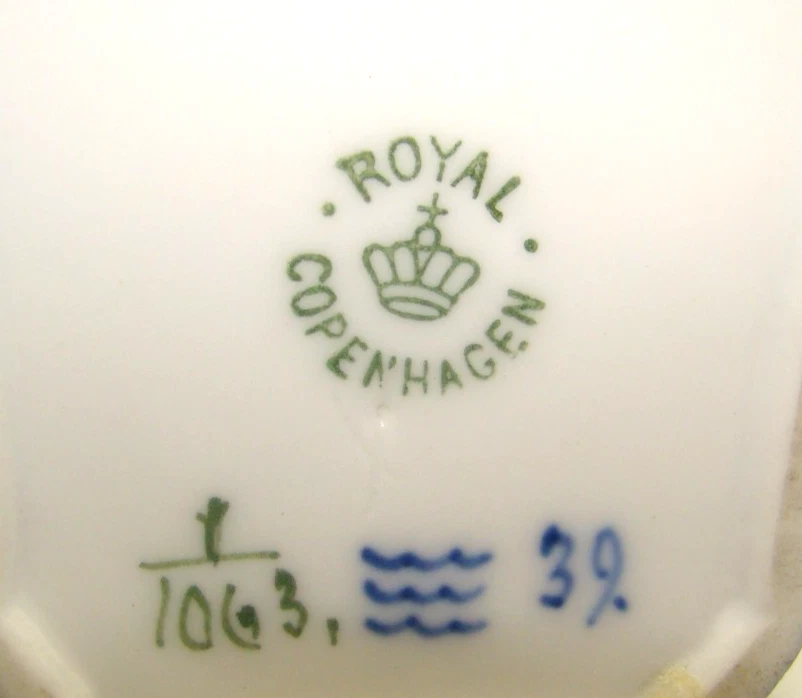
- Dating and Factory Marks (1889–1922 Period): The pieces feature the green underglaze factory mark consisting of a royal crown enclosed within a circular band bearing the text “ROYAL COPENHAGEN”, accompanied by the traditional three blue waves. This specific printed green text-circle mark was utilized between 1889 and approximately 1922. These pieces date to around 1894–1897.
Detailed Description of the Inkstands
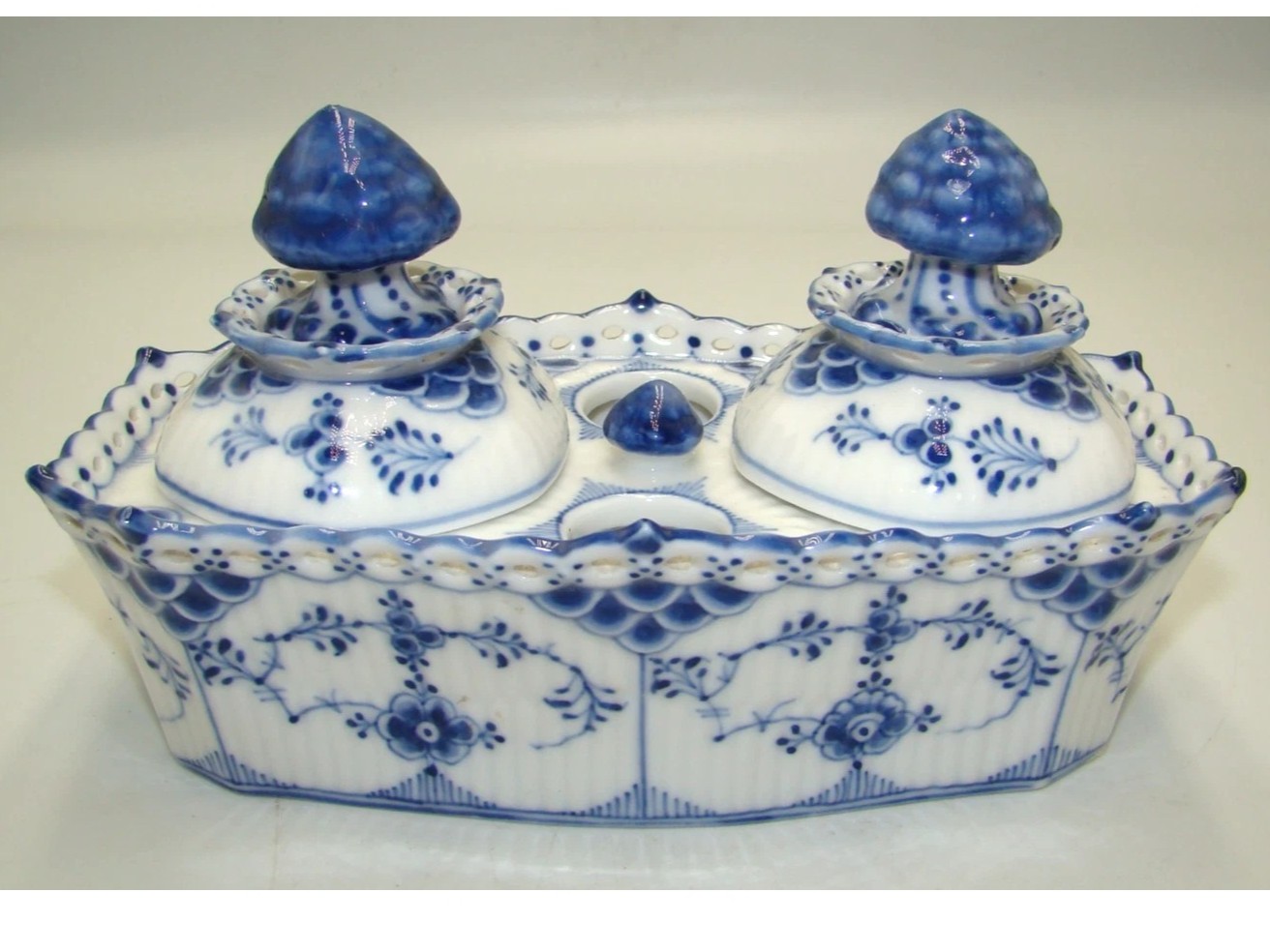
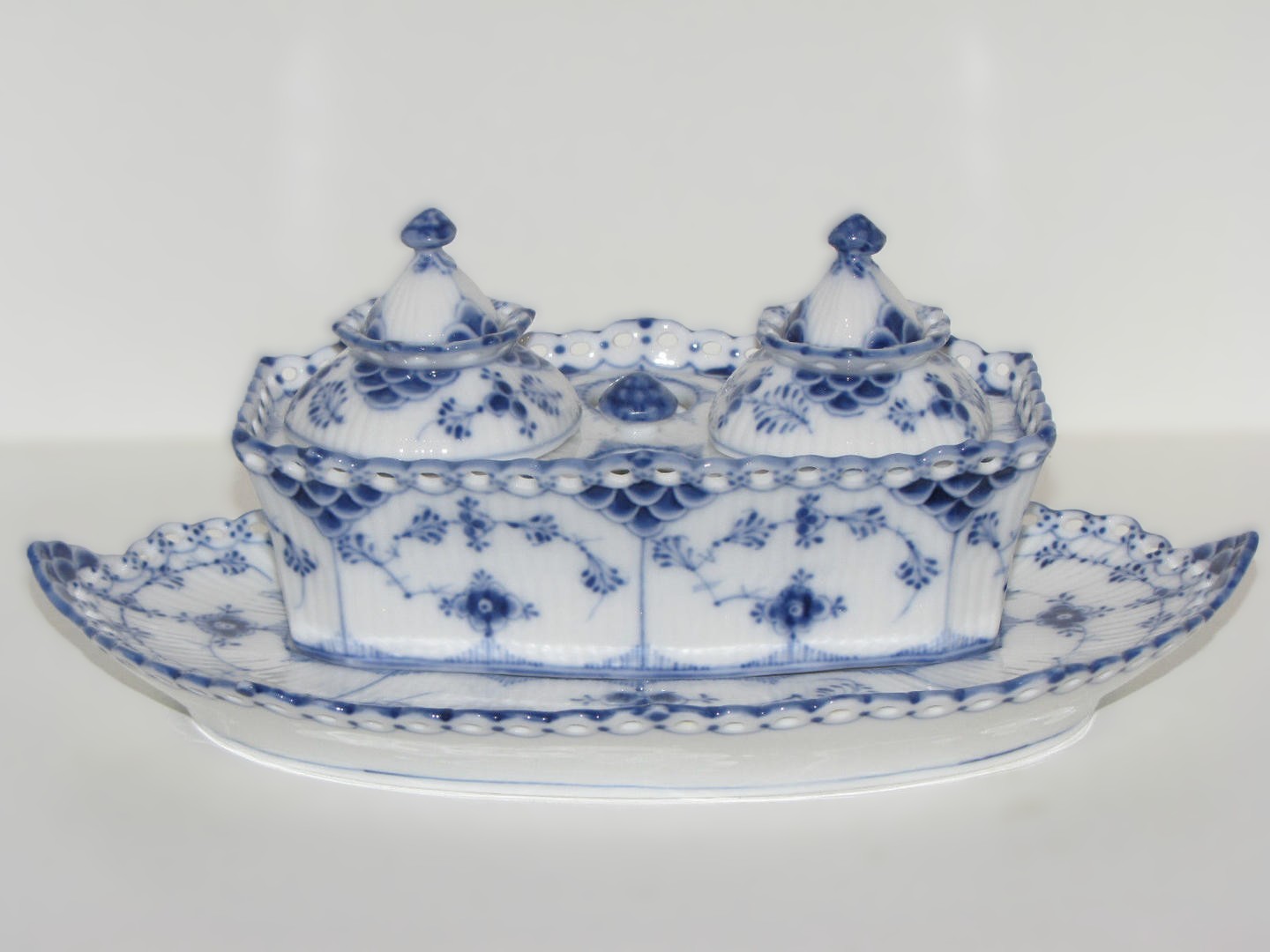
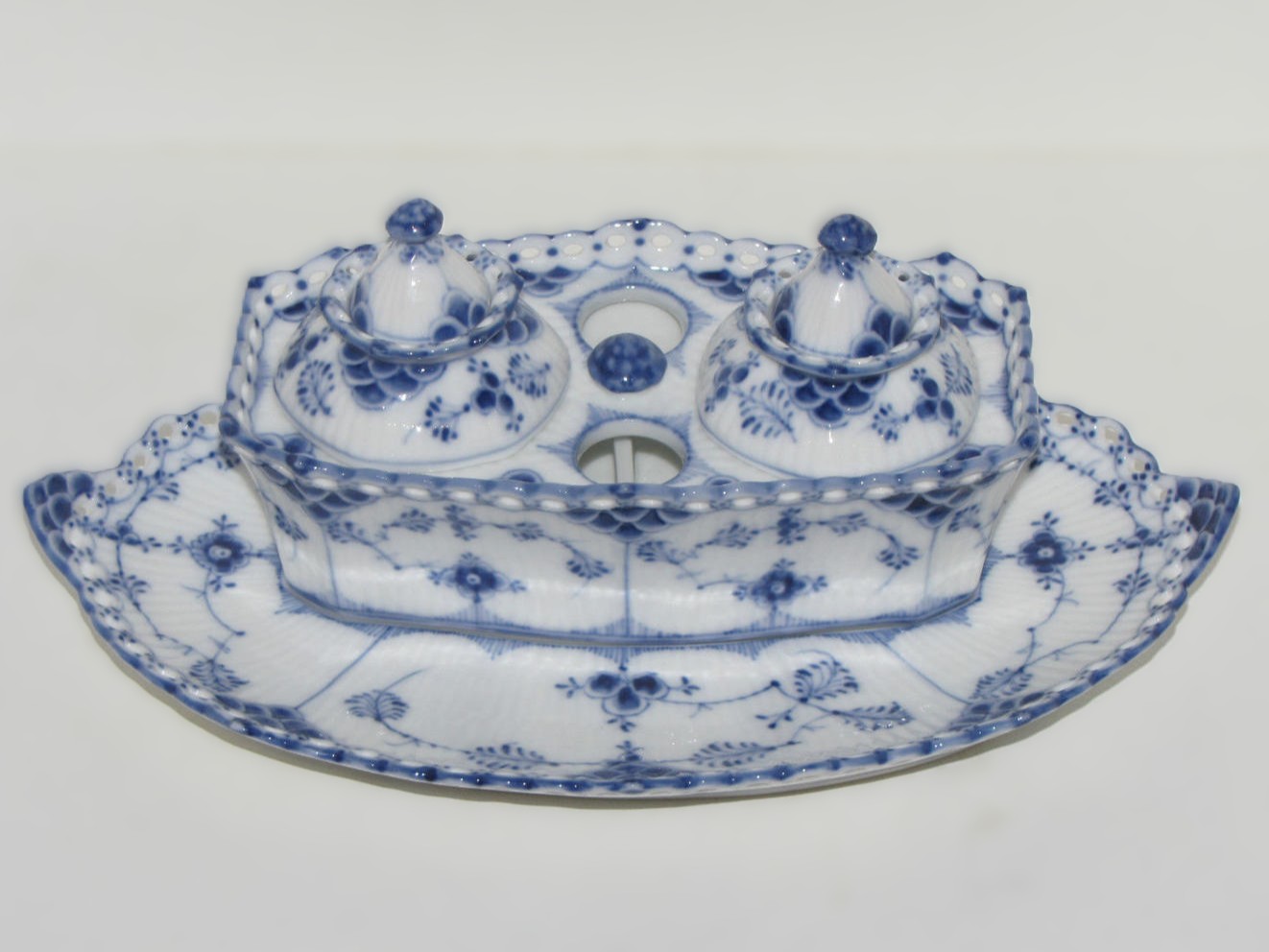
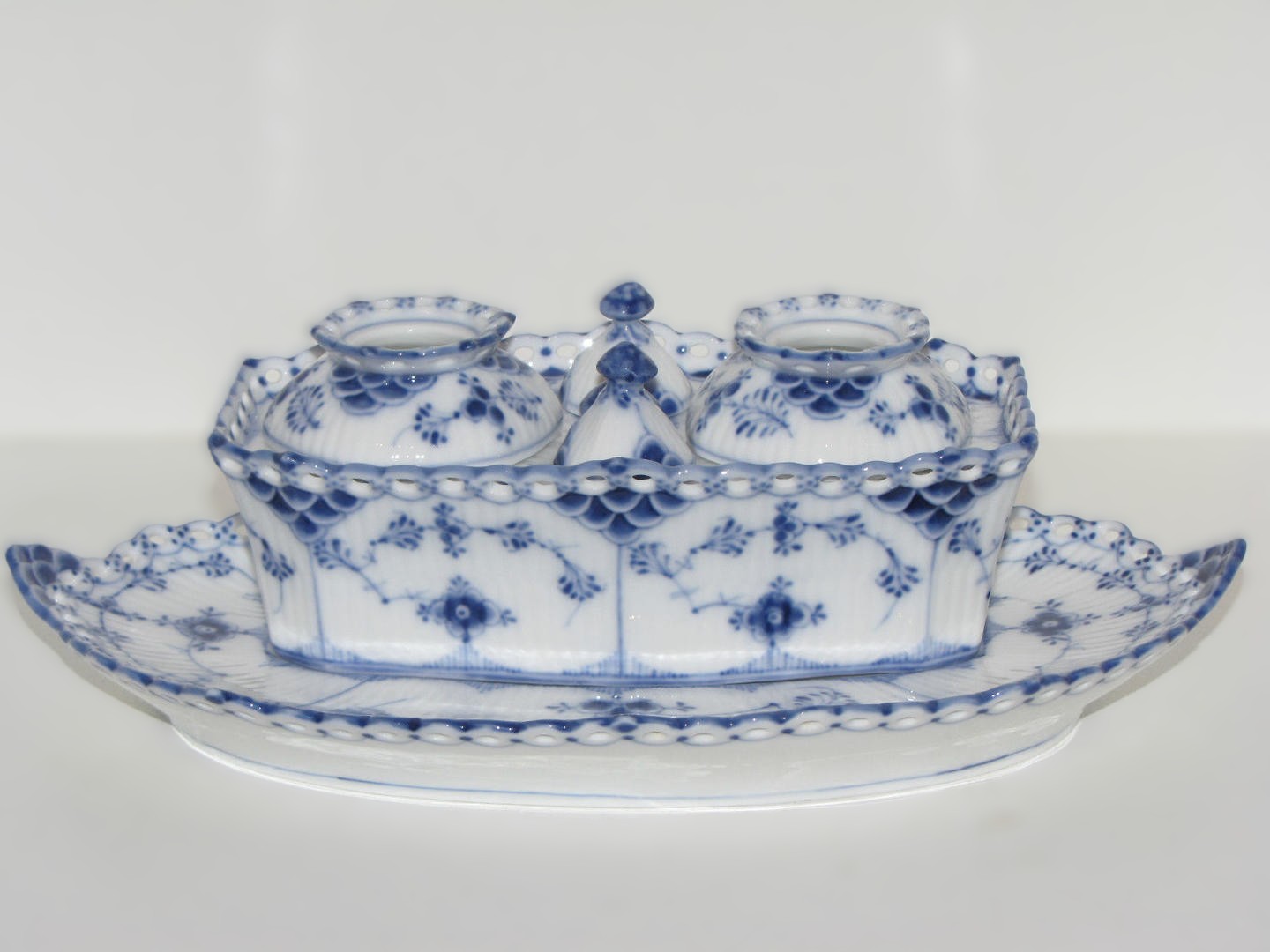
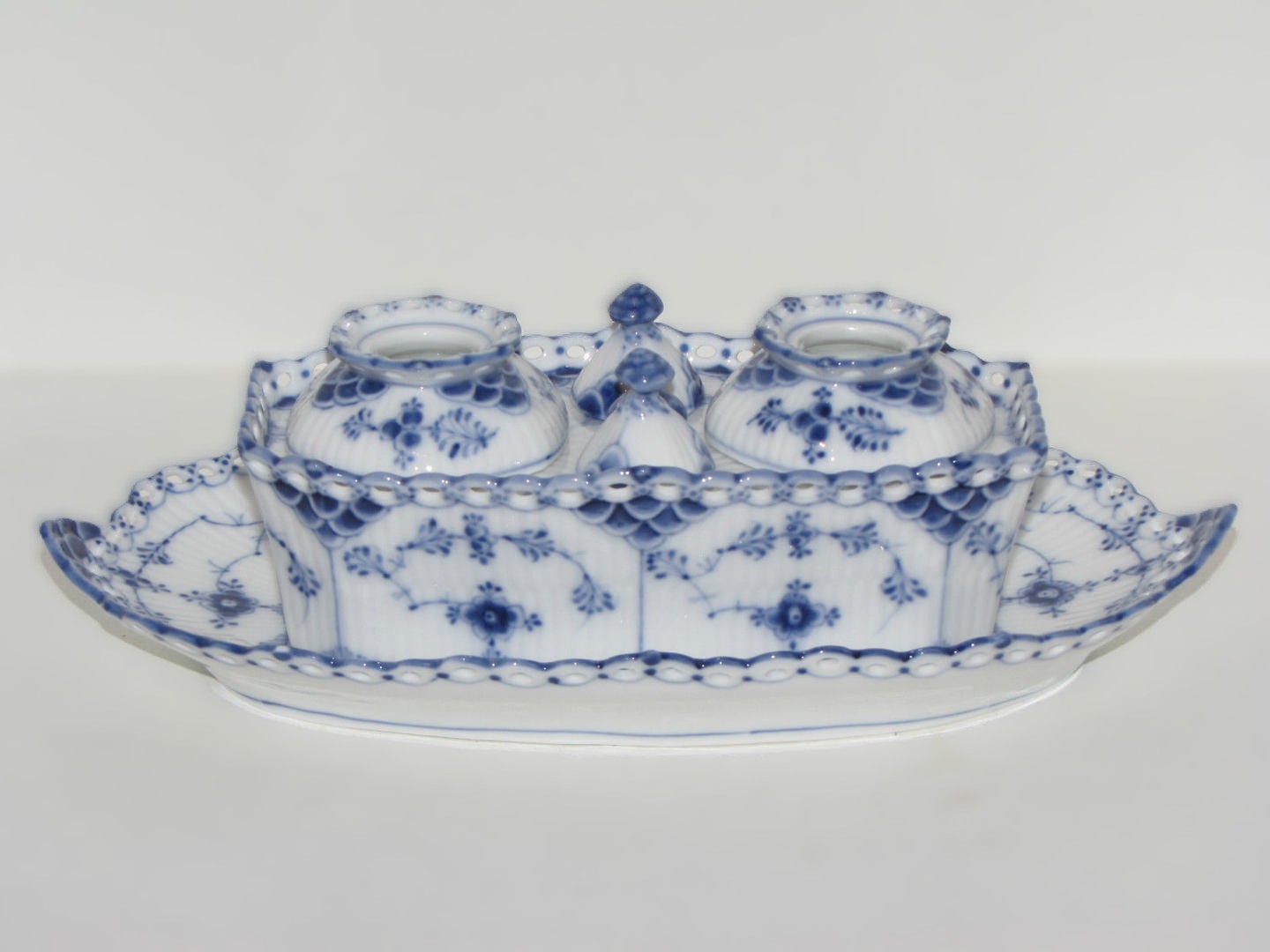
The two pieces represent shape No. 1063 executed in Royal Copenhagen’s iconic Blue Fluted Full Lace (Voll Spitze) pattern.
- Architectural Form & Structure
- The Inkwell Body: Both inkstands share a rectangular body with softly rounded, canted corners and paneled vertical sides that rest on an oval or conforming footprint. The vertical walls feature fine vertical fluting terminating in stylized arched architrave details at the base.
- The Pierced Gallery (“Lace” Rim): The upper perimeter is framed by an elaborate, openwork pierced gallery border characteristic of the Full Lace style. This delicate fretwork or “lace” pattern consists of symmetrical rows of tiny circular perforations framed by scalloped, beaded rims.
- Wells and Inserts: The top platform accommodates two lidded inkwells positioned on either end. Between the inkwells lie central apertures built into the porcelain body—designed to hold writing pens—centered with a small domed stub/finial.
- Lids and Finials
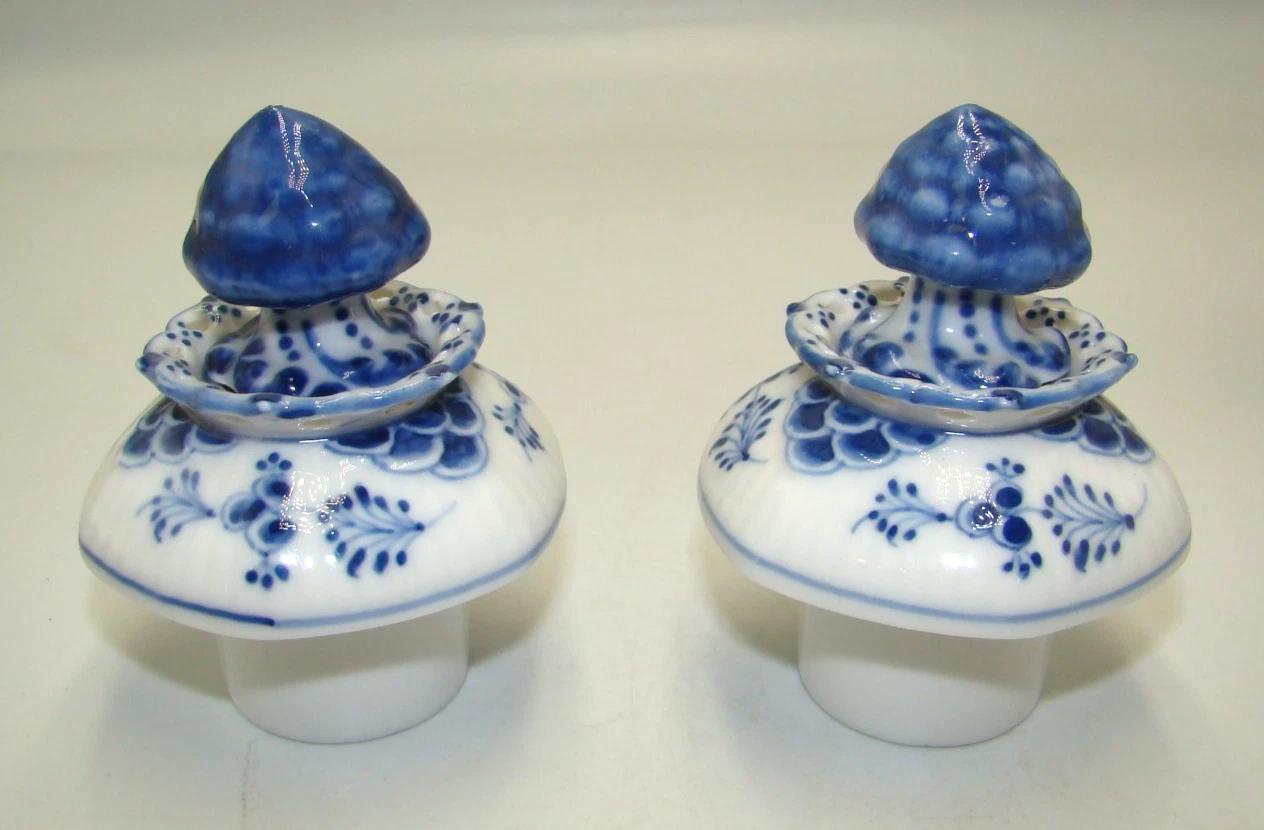
- Domed Covers: Each inkwell is sealed by a matching domed lid that follows the fluted contours of the body. The rim of each lid mirrors the openwork lace border of the main body.
- Mushroom/Cone Finials: Each lid is topped by a distinctive, organically shaped finial resembling a stylized bulb, bud, or mushroom cap, heavily textured with cobalt blue dotting and stippling.
- Hand-Painted Decoration & Palette
- Cobalt Blue Motif: Executed entirely in rich cobalt blue underglaze on a brilliant white porcelain body, the design showcases the quintessential Blue Fluted floral sprays (inspired by traditional chrysanthemum and aster motifs).
- Scalloped Detailing: The corners and structural ribs are accented with stylized fish-scale (fishscale) patterns in graduating shades of deep blue, transitioning into delicate, trailing floral garlands (blåblomst / lace trails) across the paneled sides.
- The Two Variations
- First Example (Standalone Inkstand): This piece stands as a self-contained double inkwell unit with its integrated base, measuring roughly 16.5 x 9 cm.
- Second Example (Tray-Mounted Set): This deluxe iteration features the exact same No. 1063 double inkstand resting securely upon a matching large, petal-edged oval undertray (writing set plateau). The tray features a conforming pierced lace rim and matching radial fluting with painted floral sprays radiating outward, providing an extended resting space for blotting paper, spare nibs, or pens.
- Base Markings
- The green printed Royal Copenhagen circular crown mark used between 1889 and 1922.
- The model/shape number 1063 inscribed in green.
- The iconic three blue waves painted underglaze.
- Painter and sorter numerals (such as the blue decorator/sorter number 39 and green sorting/work marks).
Example #1 sold for $440 in September 2026
Example #2 sold for $1300 in February 2015
Content disclaimer. The information posted is the owner’s best knowledge and may not have been vetted by the SOIC. We welcome comments, corrections, and additions, working to make our website information comprehensive and accurate.
Join the Society of Inkwell Collectors (SOIC) – it’s free!
Founded in 1981 as a non-profit organization,
we are documenting inkwells (and accessories).
We’re here to help and inform!